2609.38590v1 · First listed 2026-10-01
Chandra X-ray Spectral Evidence of the Dual AGN Nature of the Gravitational lens MG B2016+112 at z=3.273 with 175 pc separation
Separate Chandra spectra of the two lensed X-ray emitters in MG B2016+112 support the authors’ dual-AGN interpretation: the inner-caustic component is intrinsically absorbed, disfavoring its alternative identification as a highly magnified jet feature. [1][3][4]
Evidence
The target is the radio-loud, gravitationally lensed system MG B2016+112 at z=3.273, whose two inferred nuclei have a 175 pc projected separation. A new 175 ks Chandra observation (165 ks live time in the merged image) spatially separates the lensed X-ray source 1 from source 2, allowing individual spectra rather than a blended measurement. The authors fit a power law with Galactic absorption plus an absorber at the source redshift. For source 1 they report a 3σ lower bound N_H >4×10^22 cm^-2; the displayed best fit has Γ=2.54±0.21 and N_H=7.2×10^23 cm^-2. They interpret this strong local absorption as evidence for an obscured AGN, rather than jet emission from source 2. [1][4]
Earlier work
Earlier multi-epoch VLBI lens modelling favored two AGN but permitted a single source-2 AGN with a jet feature magnified by μ≈350 across the inner caustic. Archival Chandra data had established two distinct X-ray emitters but lacked enough counts for separate spectra. Thus the concrete advance over the earlier X-ray work is spectral, not merely positional: source 1 now has a measured intrinsic-absorption constraint. In comparison, supplied work on LID-1166 reports two JWST/NIRSpec-resolved broad-Hα nuclei and ALMA [C II] components at z≈4.5, but at a much wider ≈1.5 kpc projected separation. [3][11]
What changes
The key discriminant is that absorption local to source 1 cannot, under the authors’ geometry, be reprocessing by source 2’s torus 175 pc away in projection; they therefore infer two separate AGN. This conclusion exploits lensing both for flux amplification and effective source-plane spatial resolution. Figure 1 tests whether the X-ray centroids and extraction regions distinguish the lensed components. Figure 3 tests the absorbed-power-law description after folding it through the Chandra response. Figure 4 tests the absorption result against the Γ–N_H degeneracy by showing marginalized 1–3σ contours. [4][7][9]
Limits and open questions
The 175 pc value is projected, not a three-dimensional separation. The supplied excerpts do not provide source counts, fit statistic, lens-model uncertainty, or a numerical confidence interval on source 2’s fitted column, limiting independent assessment of spectral robustness. The absorption interpretation relies on the usual association of AGN X-ray obscuration with material close to its SMBH; it does not directly image a torus. The authors address a potential low-energy ACIS-S calibration concern by citing time-dependent calibration and consistency with the 2000 observation, but detailed calibration tests are not supplied here. [4][5]
The primary-paper evidence includes selected discussion excerpts and figure captions, plus the abstract; methods, count statistics, fit statistics, and tables were not supplied in extractable form. The related-paper comparison is abstract-only.
Key figures
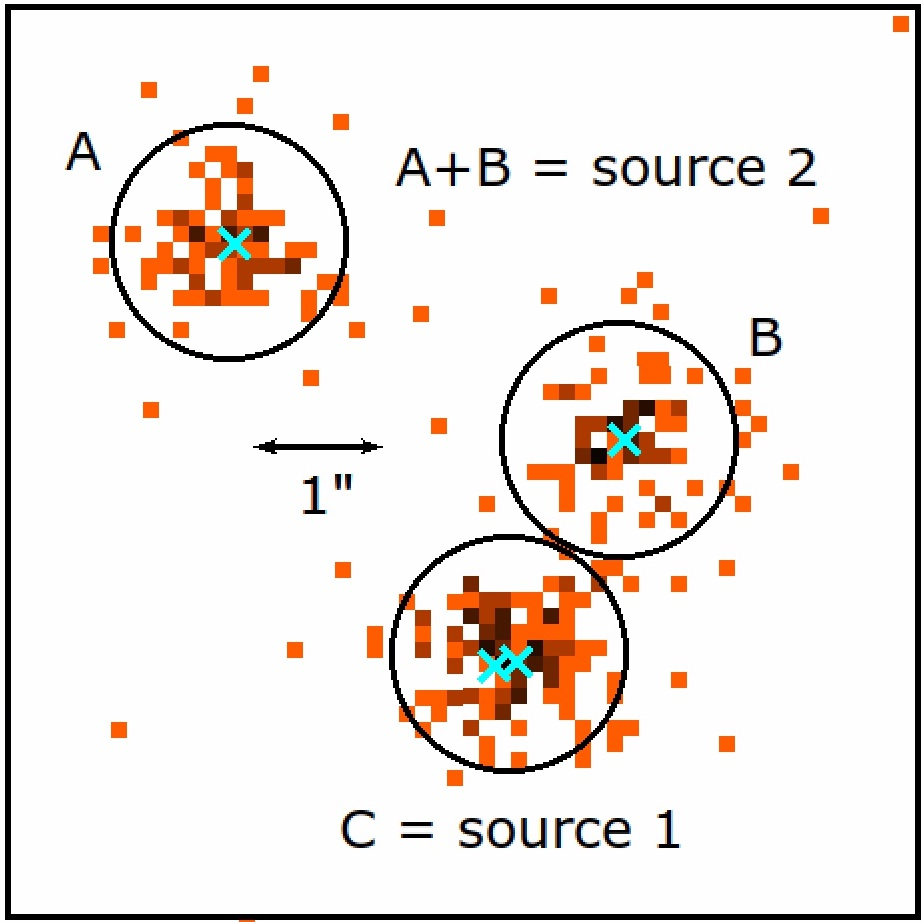
Tests source separation in the Chandra image: 0.90-arcsec apertures, the simulated 80%-encircled-count radius, are placed on the lensed images and compared with VLBI-component positions.
Original caption
Figure 1: The image plane merged data of the 165 ks live time observation of MG B2016+112. The box shows a 7 ′′ × \times 7 ′′ region around the lensed images. The circles around each image have an 0 . ′′ \farcs 90 radius, approximately the 80% encircled counts radius over the 0.5 – 7 keV band, as determined by an SAOTrace [ 23 ] plus Marx [ 14 ] simulation of the individual measured image spectra (A–C) over this band. The ACIS-S3 0.5 – 7 keV data is binned into 1/4 CCD pixels, 0 . ′′ \farcs 123 on a side, where orange (black) pixels show 1 (6) counts per bin. White space has zero counts. Background is approximately 0.0025 counts per 1/4 pixel bin. The cyan crosses show where the Chandra aspect solution gives the ICRS coordinates of the VLBI components [ 48 , cf.] . These offsets from the X-ray centroids are consistent with the absolute celestial location accuracy of Chandra .
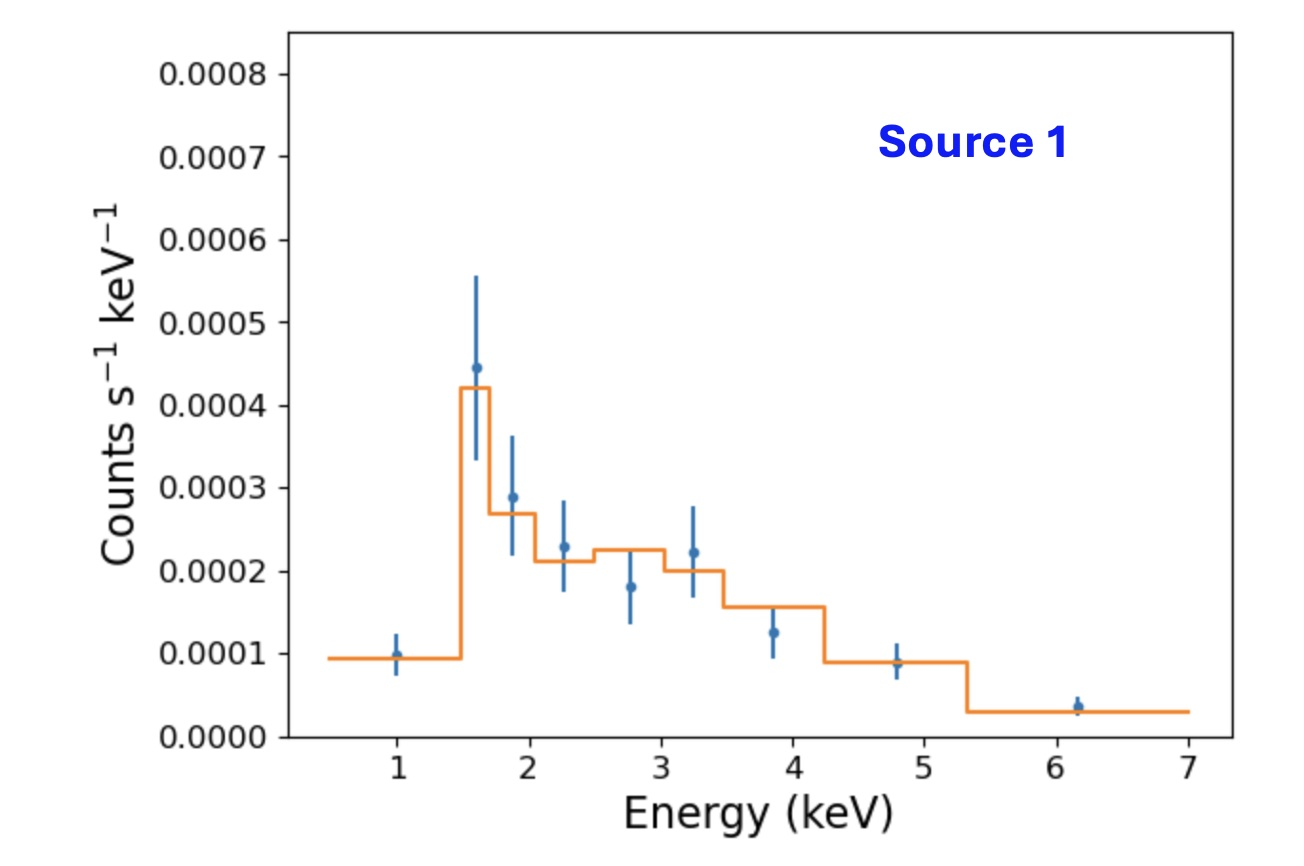
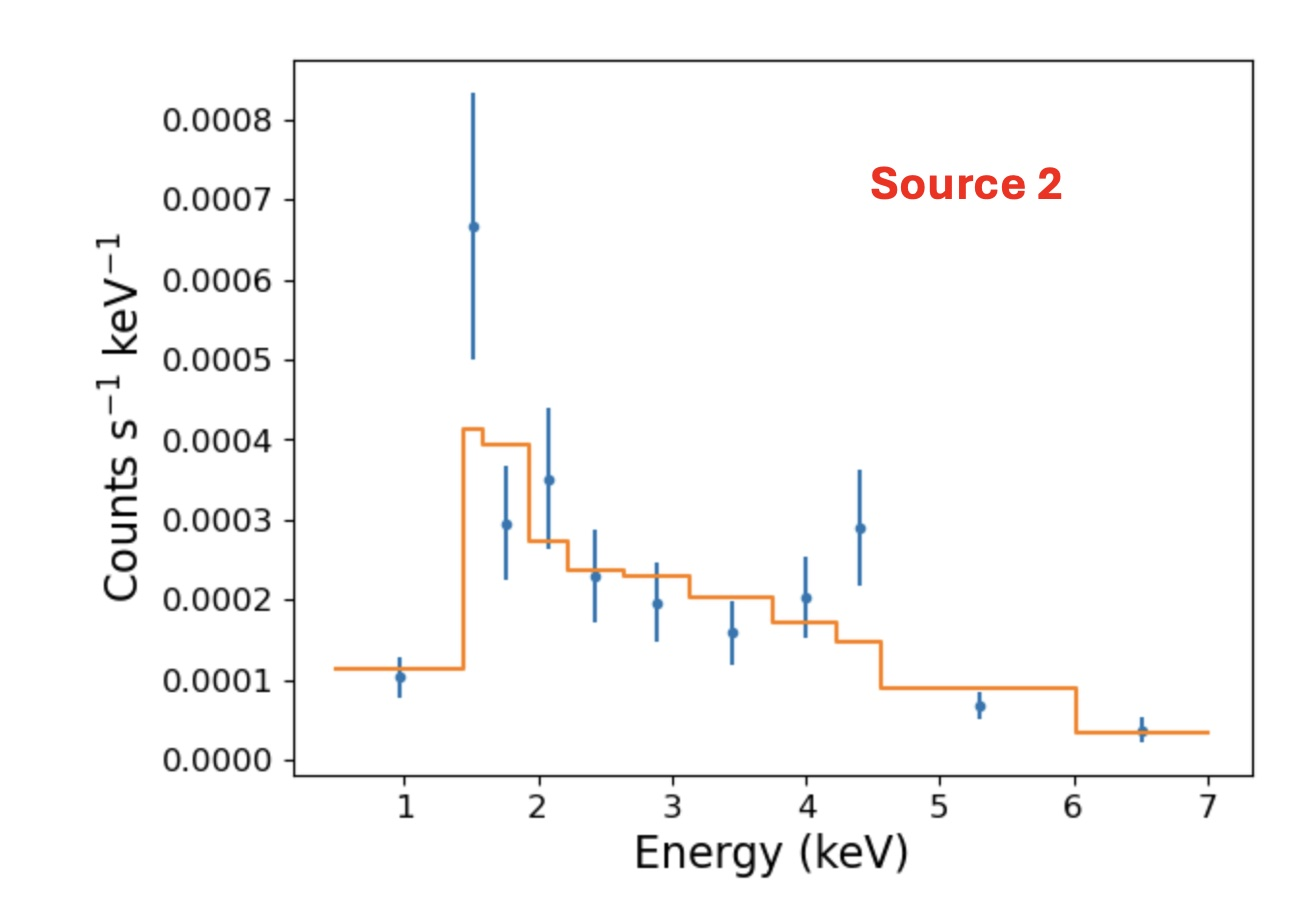
Tests the spectral model by comparing response-folded, intrinsically absorbed power laws with each source spectrum; it reports Γ=2.54±0.21 for source 1 and Γ=1.46±0.18 for source 2.
Original caption
Figure 3: The orange histograms show the models of a power-law with absorption in our galaxy, modified by intrinsic absorption local to the source at the redshift 3.273, folded through the expected mirror and detector response. The x-axis shows the observed energy. For the purpose of display only, the data have been binned into groups of 16 counts per energy channel. The error bars are 1 σ \sigma derived from the square root of the number of counts. The orange histogram shows the predicted counts per keV in each bin for the best fit photon power law index Γ \Gamma and intrinsic absorption n H , and gives the width in energy for each point. Left panel: source 1 with Γ = 2.54 ± 0.21 \Gamma=2.54\pm 0.21 and n H =72 × \times 10 22 H-atom cm -2 . Right panel: source 2 with Γ = 1.46 ± 0.18 \Gamma=1.46\pm 0.18 and n H =19 × \times 10 22 H-atom cm -2 .
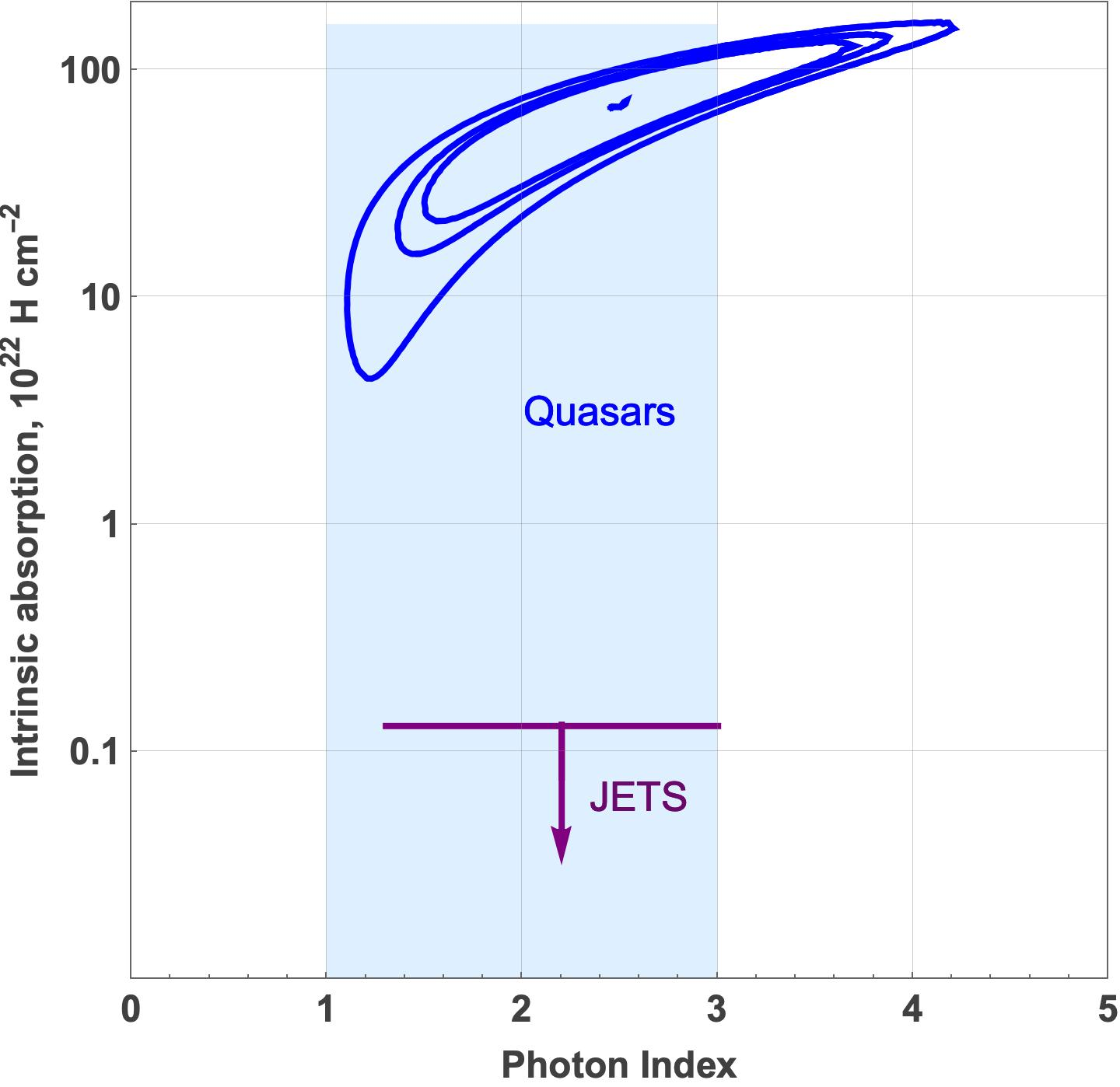
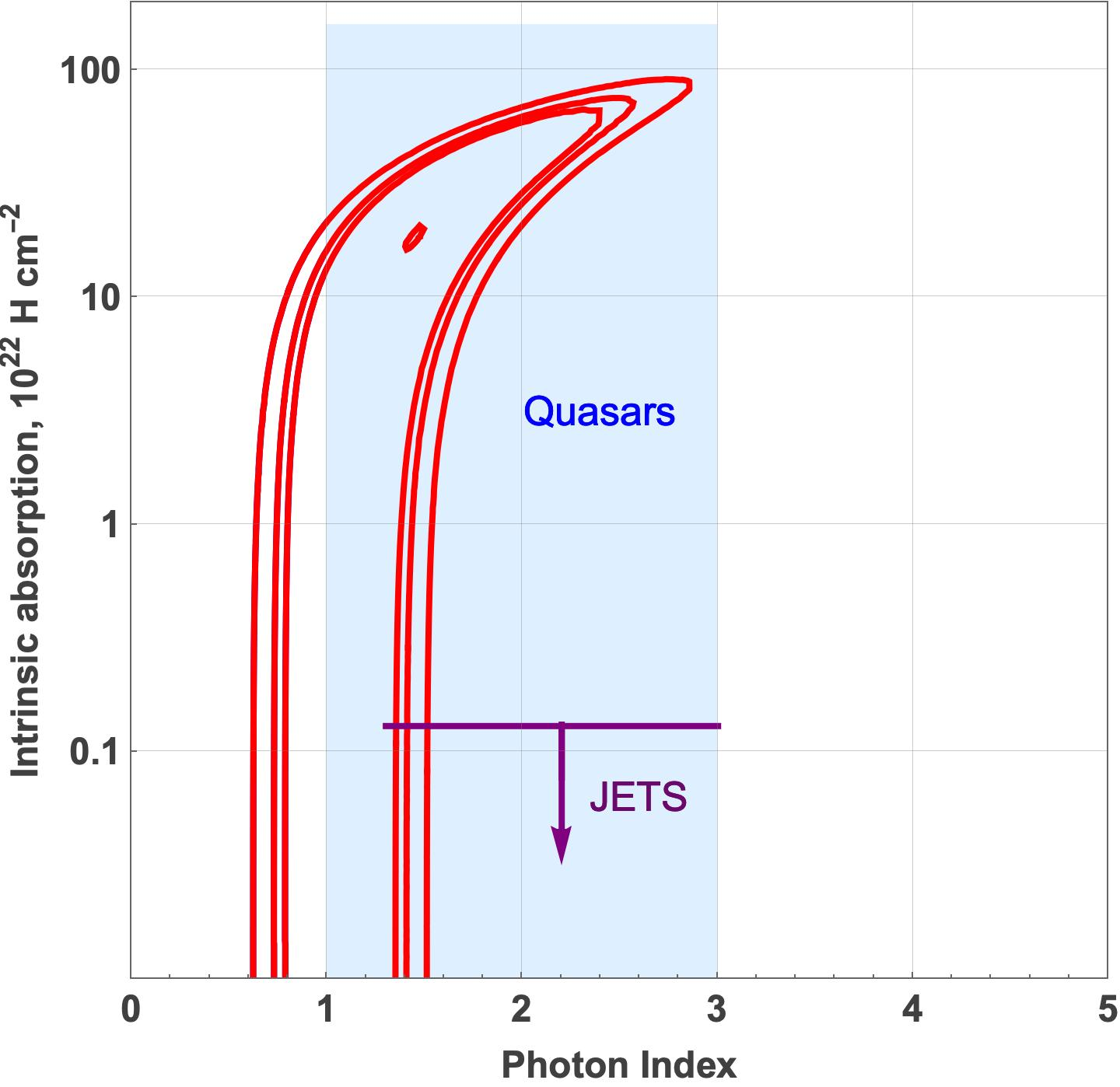
Tests whether absorption remains favored when correlated with photon index, through marginalized 1σ, 2σ, and 3σ Γ–N_H contours for each source.
Original caption
Figure 4: The left panel shows source 1 and the right panel source 2. The contour plots show allowed combinations of the correlated parameters of intrinsic absorption and photon power law index. The contours from innermost to outermost delineate regions of 1, 2, and 3 σ \sigma probability that the data could arise from such a pair of parameters, when marginalized over the uninteresting parameters of photon index and the normalization. The central dots show the best parameters from the spectra in figure 3 . The shaded blue region is indicative of the location of most quasars. The purple down-arrow indicates the allowed region for jets, with the bar at the n H =1.3 × 10 21 \times 10^{21} galactic column density that would allow no excess over the galactic column in this direction.
Related research
Previous digest
Using a new 175 ks Chandra ACIS campaign, the authors separately model the X-ray spectra of the two source-plane emitters in the strongly lensed radio source MG B2016+112 at z=3.273. The highly magnified source inside the lens caustic shows strong intrinsic absorption, N_H > 4 × 10^22 cm^-2 at 3σ, identifying it as an obscured AGN rather than a magnified jet knot; together with the previously established type II AGN outside the caustic, this confirms a dual AGN separated by just 175 pc. MG B2016+112 is therefore the tightest confirmed high-redshift AGN pair to date, demonstrating how extreme lensing magnification can expose the compact SMBH-pair phase relevant to merger evolution and gravitational-wave precursors.
Sources and evidence (19)
- 2609.38590v1: Chandra X-ray Spectral Evidence of the Dual AGN Nature of the Gravitational lens MG B2016+112 at z=3.273 with 175 pc separation
We use a new 175 ks Chandra X-ray observation of the z=3.273 radio-loud gravitational lens system MG B2016+112 to present definitive X-ray spectral evidence that it contains a dual active galactic nucleus (AGN). With a projected separation of 175 parsecs, this is the tightest separation confirmed AGN pair at high redshift. Prior multi-epoch very long baseline interferometry (VLBI) and archival Chandra data had revealed two distinct emitters, but could not rule out a single AGN with a complex, highly magnified jet. Our new Chandra observations allow a separate spectral analysis of each source. We find strong intrinsic absorption (N_H > 4 x 10^22 cm^-2, 3 sigma confidence) at the source redshift for the highly magnified source inside the caustic. This identifies it as an obscured AGN. In addition to the previously known type II AGN outside the caustic, this confirms a compact dual AGN system in MG B2016+112. On-going and future surveys using facilities such as Euclid, SKA, and the Rubin and Roman observatories will uncover more such systems, probing SMBH evolution and gravitational wave precursors.
- 2609.38590v1: Chandra X-ray Spectral Evidence of the Dual AGN Nature of the Gravitational lens MG B2016+112 at z=3.273 with 175 pc separation
Determining the fraction of dual AGN and their circumnuclear environments is critical for estimating galaxy merger rates in the early universe, and also for assessing the time scales for SMBH pairs to coalesce and emit gravitational waves. De Rosa et al. [15] and Bogdanović et al. [3] review techniques for identifying dual and binary SMBH. Estimates of dual AGN found in a single galaxy subsequent to a merger are uncertain, with a range of at least 1% [ 52 ] to 20 – 30% [ 37 ] .
- 2609.38590v1: Chandra X-ray Spectral Evidence of the Dual AGN Nature of the Gravitational lens MG B2016+112 at z=3.273 with 175 pc separation
The goal of this observation was to determine whether source 1 is an AGN. Source 2 was known to be an AGN due to the observation of broadened emission lines [ 55 ] and known to host a jet [ 48 ] . Multi-epoch VLBI lens modeling by [ 48 ] had preferred a dual AGN interpretation for sources 1 & 2, but could not rule out that source 1 was a jet (emitted from source 2), being highly magnified ( μ ∼ 350 \mu\sim 350 ) when crossing the inner caustic. The work of Schwartz et al. [45] confirmed the existence of two distinct X-ray sources, but the archival Chandra observations did not have sufficient counts to measure the individual X-ray spectra of each source. These results motivated the new Chandra observations we have presented, specifically to measure intrinsic X-ray absorption in source 1.
- 2609.38590v1: Chandra X-ray Spectral Evidence of the Dual AGN Nature of the Gravitational lens MG B2016+112 at z=3.273 with 175 pc separation
We measure a large intrinsic X-ray absorption of source 1, with a 3 σ \sigma lower limit N H > 4 × 10 22 N_{H}>4\times 10^{22} H-atoms cm -2 , which unambiguously identifies source 1 as an obscured AGN. Absorption in AGN is generally attributed to a dusty torus, at distances less than 10 pc from the SMBH [ 10 , 30 , e.g.] . The measured absorption cannot arise from reprocessing in the torus of source 2 (that is, at a distance of at least 175 pc in projection). Therefore, both X-ray emission regions identified by [ 45 ] originate from two separate AGN.
- 2609.38590v1: Chandra X-ray Spectral Evidence of the Dual AGN Nature of the Gravitational lens MG B2016+112 at z=3.273 with 175 pc separation
The ACIS-S response below 2 keV can be precluded as a source of potential bias in measuring the absorption. The ACIS-S response is increasingly reduced at energies below 2 keV, where intrinsic absorption effects are most pronounced. However, this is accounted for in the time-dependent calibration data base maintained by the Chandra X-ray Center [ 20 ] , and evident in the orange histograms of Figure 3 which show the predicted response to the given source models. Figures 6.4 and 6.8 of the relevant Chandra Proposer’s Guide 3 3 3 https://cxc.harvard.edu/proposer/POG/arch_pdfs/POG_cyc27.pdf show the ACIS-S3 response extending below 1 keV, and the good statistics from observation of the galaxy cluster Abell 1795 that are used to calibrate the response. We note that for recent ACIS observations of high redshift quasars both large intrinsic absorptions > > 10 22 cm -2 are measured [ 4 , e.g.] as well as measured limits less than 10 22 cm -2 [ 33 , e.g.] to column densities. Finally, we note that the present measurement of absorption is consistent with the one on 12 April, 2000 [ 8 , 45 ] when the ACIS filter was essentially uncontaminated.
- 2609.38590v1: Chandra X-ray Spectral Evidence of the Dual AGN Nature of the Gravitational lens MG B2016+112 at z=3.273 with 175 pc separation
With the confirmation of source 1 as an AGN, we have confirmed the dual AGN nature of MG B2016+112, making this the closest separation AGN pair known at high redshift. All massive galaxies are expected to harbor a central SMBH. When these galaxies merge, their SMBHs may experience a dual AGN phase. Dynamical friction may reduce the distance between the two SMBHs, to the extent that the two systems may eventually form a gravitationally bound pair and merge [ 27 , 28 ] . The galaxy merging process is expected to provide gas supply, possibly triggering AGN activity in both SMBH [ 6 , 35 ] .
- 2609.38590v1: Chandra X-ray Spectral Evidence of the Dual AGN Nature of the Gravitational lens MG B2016+112 at z=3.273 with 175 pc separation
Although cosmological simulations predict such systems [ 50 , 43 , 52 , 9 ] , direct observational evidence has remained elusive. Until now, dual AGNs with sub-kiloparsec separations had been observed only at low redshift, leaving scarce direct evidence for such systems at or beyond the peak of galaxy evolution [ 13 , 16 , 12 , 11 , 49 ] . The system MG B2016+112 presented here, with a projected separation of only 175 pc, is the first of its kind and provides a unique probe of hierarchical galaxy evolution. Its detection was enabled by strong gravitational lensing, which both magnified the source flux and spatially magnified the system. Without this combined flux and spatial magnification, the source would have been too faint and its two components too compact to resolve. Lensing therefore provided the sensitivity and effective source-plane resolution required to identify the two AGNs and measure their 175 pc projected separation at z = 3.237 z=3.237 .
- 2609.38590v1: Chandra X-ray Spectral Evidence of the Dual AGN Nature of the Gravitational lens MG B2016+112 at z=3.273 with 175 pc separation
Searches for dual AGN are currently of great interest, enhanced by the intial data releases from Euclid and SKA , and the commissioning of the Rubin and Roman observatories. These facilities allow detections of pairs of radio and optical sources at separations below a kpc. Ulivi et al. [51] applied machine learning methods to Euclid data to reveal quasar candidates that could be either dual AGN or lensed AGN. D’Amato et al. [18] make the case for the SKAO identifying pairs with projected separations of only several hundred pc at large redshift. One can then use high resolution X-ray imaging and spectroscopy to provide critical diagnostics for confirming AGN pair candidates as either dual or lensed systems. In parallel, gravitationally lensed AGN pairs at high redshift may be directly revealed via X-ray astrometry.
- 2609.38590v1: Chandra X-ray Spectral Evidence of the Dual AGN Nature of the Gravitational lens MG B2016+112 at z=3.273 with 175 pc separation
Figure 4: The left panel shows source 1 and the right panel source 2. The contour plots show allowed combinations of the correlated parameters of intrinsic absorption and photon power law index. The contours from innermost to outermost delineate regions of 1, 2, and 3 σ \sigma probability that the data could arise from such a pair of parameters, when marginalized over the uninteresting parameters of photon index and the normalization. The central dots show the best parameters from the spectra in figure 3 . The shaded blue region is indicative of the location of most quasars. The purple down-arrow indicates the allowed region for jets, with the bar at the n H =1.3 × 10 21 \times 10^{21} galactic column density that would allow no excess over the galactic column in this direction.
- 2609.38590v1: Chandra X-ray Spectral Evidence of the Dual AGN Nature of the Gravitational lens MG B2016+112 at z=3.273 with 175 pc separation
This work has been supported by NASA contract NAS8-03060 to SAO, NASA/ADAP grant 80NSSC24K0617, and grant GO4-25053X from the CXC. This research made use of the NASA Astrophysics Data System, now the SciX Digital Library, funded by NASA under Cooperative Agreement 80NSSC21M00561. We thank D. Burke for assistance with sherpa . We thank Giulia Migliori, Cristiana Spingola, and Mauro Dadina for calling our attention to the XMM observation.
- 2607.19491v1: Rapid growth in a dual AGN during a gas-rich merger at z~4.5
The late stages of galaxy mergers - when two supermassive black holes (SMBHs) reach kiloparsec-scale separations - represent a critical phase for understanding SMBH growth, galaxy co-evolution, and the progenitors of low-frequency gravitational waves. Yet confirmed close-separation (<3 kpc) dual active galactic nuclei (AGNs) remain confined to the local Universe, despite predictions that such systems should be common in the merger-rich early Universe. Here we report the discovery of LID-1166, a dual AGN with a projected separation of ~1.5 kpc at z~4.5, representing the first such system known beyond the local Universe. Spatially resolved JWST/NIRSpec integral-field spectroscopy reveals two spatially and kinematically distinct narrow-line emission components with a line-of-sight velocity offset of ~ -164 km/s. Both components additionally exhibit broad Ha emission, including a compact off-nuclei broad Ha component associated with the companion source, confirming two actively accreting SMBHs. Independent ALMA [CII] 158 um observations reveal corresponding spatially and kinematically distinct cold gas components associated with the same nuclei, demonstrating that the system is a gas-rich merger. While undergoing super-Eddington accretion during a late-stage merger, the SMBHs already lie on the local black hole-host mass relation for massive elliptical galaxies within the uncertainties, suggesting that rapid, obscured growth may help establish this relation early in cosmic history. LID-1166 reveals a previously hidden phase of SMBH growth and points to a missing population of heavily obscured, merger-driven dual AGNs at high redshift.
- 2504.10573v1: High-$z$ radio Quasars in RACS I: Selection, identification, and multi-wavelength properties
Radio-bright, jetted quasars at $z>5$ serve as unique laboratories for studying supermassive black hole activity in the early Universe. In this work, we present a sample of high-$z$ jetted quasars selected from the combination of the radio Rapid ASKAP Continuum Survey (RACS) with deep wide-area optical/near-infrared surveys. From this cross-match we selected 45 new high-$z$ radio quasar candidates with S$_{888MHz}>1$ mJy and mag$z<21.3$ over an area of 16000deg$^2$. Using spectroscopic observations, we confirmed the high-$z$ nature of 24 new quasars, 13 at $4.5<z<5$ and 11 at $z>5$. If we also consider similar, in terms of radio/optical fluxes and sky position, quasars at $z>5$ already reported in the literature, the overall $z>5$ RACS sample is composed by 33 powerful quasars, expected to be ~90% complete at mag$z<21.3$ and S$_{888MHz}>1$ mJy. Having rest-frame radio luminosities in the range $νL_{1.4GHz}=10^{41.5}-10^{44.4}$ erg s$^{-1}$, this sample contains the most extreme radio quasars currently known in the early Universe. We also present all X-ray and radio data currently available for the sample, including new, dedicated {\it Chandra}, uGMRT, MeerKAT and ATCA observations for a sub-set of the sources. from the modelling of their radio emission, either with a single power law or a broken power law, we found that these systems have a wide variety of spectral shapes with most quasars (22) having a flat radio emission (i.e., $-0.5<α_{r}<0.5$). At the same time, the majority of the sources with X-ray coverage present a high-energy luminosity larger than the one expected from the X-ray corona only. Both the radio and X-ray properties of the high-$z$ RACS sample suggest that many of these sources have relativistic jets oriented close to our line of sight. (i.e., blazars) and can therefore be used to perform statistical studies on the entire jetted population at high redshift.
- 2607.00093v1: Search for Quasar Pairs with ${\it Gaia}$ Astrometric Data. III. Discovery of 9 dual and projected quasars
We report the low-resolution long-slit spectroscopic observations and confirmations of 11 quasar pair candidates, which are selected from the MGQPC catalog presented in the first paper of our series work (hereafter, Paper-I) and the early version of this catalog. The spectroscopic follow-up was carried out with 5 spectrographs equipped on 3 telescopes, and the major discoveries include 6 dual quasars and 3 projected quasars. One of the dual quasars has a high redshift of $\sim$ 3.1. The LQ hypothesis of 3 dual quasars cannot be completely ruled out. We investigated the reason why previous spectroscopic surveys missed several new quasars. We discussed a projected quasar with a wide-separation lensing configuration, as well as two quasar-star projections that mimic the configuration of lensed quasars. The photometric redshifts for the 11 observed candidates were extracted from the second paper of our series work (hereafter, Paper-II) to illustrate their positive role in mitigating contamination from projected quasars and quasar-star projections. We also reviewed and discussed the confirmation strategies for dual and lensed quasar candidates, and outlined future confirmation strategies for them in the context of the era dominated by large-scale spectroscopic and imaging surveys.
- 2609.22449v1: LoTSS of dual AGN: enhanced detectability and prospects for a systematic search
Context: Dual active galactic nuclei (DAGN) - systems of two accreting supermassive black holes at kpc-scale separations - trace galaxy mergers and are the progenitors of gravitational-wave sources targeted by pulsar timing arrays and the upcoming Laser Interferometer Space Antenna. However, their radio properties remain poorly constrained, particularly at high redshift. Aims: We demonstrate the detectability of high-redshift DAGN at 144 MHz through sub-arcsec imaging of the LOFAR Two-metre Sky Survey (LoTSS) and characterize their low-frequency radio properties. Methods: We cross-matched 92 spectroscopically confirmed DAGN (z > 0.3, projected separation r_p < 30 kpc) with the LoTSS DR2 catalog and reprocessed international LOFAR telescope (ILT) data for three systems (0.59 < z < 2.39), achieving ~0.3 arcsec resolution at 144 MHz. Multi-frequency analysis and brightness-temperature diagnostics were used to investigate the radio emission. Results: We obtained high-quality ILT images for all three systems. In one source at z = 1.49, both AGN are detected at >5 sigma, making it one of the highest-redshift and faintest radio-detected DAGN. Brightness temperatures confirm AGN-powered emission even in sub-mJy sources. In the other two systems only one AGN is detected; for one, the new data constrain the low-frequency spectrum of a compact steep-spectrum source, indicating that its morphology is driven by jet-ISM interaction rather than the companion galaxy. For the 92 objects sample, the LoTSS detection rate is ~24%, significantly higher than for matched single AGN (~9-10%), suggesting an enhanced detectability of DAGN in the LoTSS. Conclusions: Low-frequency sub-arcsec radio observations provide an efficient, dust-unbiased method to detect and characterize DAGN. This pilot study establishes a benchmark for the forthcoming all-sky ~0.3 arcsec iLoTSS survey and future SKA observations.
- 2508.09749v1: A dual AGN at z = 5.4 associated with a Lyman-alpha Nebula in the Center of a Cosmic Filament
Predictions from current theories and simulations suggest that dual AGN systems are exceedingly rare at high redshifts. The intense radiation and powerful outflows from AGNs regulate star formation, heat the interstellar medium, and drive massive gas outflows that shape the host galaxy and its surroundings. One manifestation of AGN feedback is the creation of extended Ly$α$ nebulae. However, identifying these systems at high-$z$ is challenging. Here, we report a remarkable dual AGN candidate at $z \sim 5.4$ using JWST NIRCam and NIRSpec, with a separation of $\sim1.7$ arcseconds ($\sim10.4$ pkpc). This is one of the highest spectroscopically confirmed redshift dual AGNs discovered. Photometric SED fitting shows excellent agreement with AGN templates, strongly suggesting a rare dual AGN system. BPT diagrams and high ionisation lines further support the presence of AGNs. VLT/MUSE observations reveal strong extended Ly$α$ emission, extending to $>22$ kpc, making it one of the most extended Ly$α$ nebulae at $z \sim 6$. This provides observational evidence of anisotropic AGN-driven photoionization or shocks. The high Ly$α$ escape fraction also indicates an AGN outflow. This dual AGN candidate is also associated with a well-defined overdensity, potentially at the center of a $z \sim 5.4$ protocluster or filamentary structure node. Further analysis indicates the fraction of dual AGNs is significantly higher than theoretically expected at high redshifts. This discovery provides a new opportunity to study dual AGN interactions and their impact on the circumgalactic medium and cosmic structure evolution.
- 2607.17729v1: Two Peas in a Pod: The First Confirmed Dual Active Galactic Nucleus within a Green Pea Galaxy System
The growth of galaxies in the early Universe is thought to be dominated by compact, intensely star-forming systems, yet the corresponding growth of supermassive black holes (SMBHs) within such environments remains poorly constrained. Green Pea galaxies are nearby analogs of rapidly assembling galaxies in the early Universe owing to their compact morphologies, intense star formation, low metallicities, and extreme ionization conditions. Although galaxy interactions are thought to trigger episodes of rapid SMBH growth, direct observations of simultaneous accretion onto multiple SMBHs in compact, intensely star-forming galaxies are lacking. Here we report the discovery of the first confirmed dual active galactic nucleus (AGN) in a Green Pea system, SDSS J162209.41+352107.5. Chandra imaging resolves two luminous hard X-ray sources separated by 8.4 kpc in projection, demonstrating simultaneous accretion onto two SMBHs. Follow-up Keck spectroscopy confirms that the two optical nuclei share a common redshift and independently exhibit broad Balmer emission and high-ionization AGN emission lines. Unlike most known dual AGN, which are typically found in massive mergers, J162209.41+352107.5 is a compact low-mass system analogous to galaxies thought to dominate early phases of galaxy assembly. These findings demonstrate that efficient growth of multiple SMBHs can occur in such environments and establish Green Pea galaxies as nearby laboratories for investigating the interplay between galaxy interactions, star formation, and black-hole growth under conditions analogous to those prevalent in the young Universe.
- 2507.23774v1: Lord of LRDs: Insights into a "Little Red Dot" with a low-ionization spectrum at z = 0.1
The above results suggest J1025+1402 is extremely X-ray weak compared to typical AGN in the local Universe. In Figure 14 , we compare the bolometric-to-X-ray luminosity ratio of J1025+1402 with those of optically selected local AGN as well as high- z z broad-line AGN and LRDs selected by JWST . In this plot, all X-ray limits included represent 90% confidence limits. While J1025+1402 lies at the low-luminosity end, it has L bol / L 2 − 10 keV > 131 L_{\rm bol}/L_{\rm 2-10~keV}>131 as the 3 σ 3\sigma limit and L bol / L 2 − 10 keV > 336 L_{\rm bol}/L_{\rm 2-10~keV}>336 as the 90% confidence limit (assuming a standard bolometric conversion from H α \alpha from Stern & Laor, 2012 ), which is significantly higher compared to the local AGN, and even the current limits for JWST -selected Type 1 AGN and LRDs. For comparison, we plot two bright LRDs, the Rosetta Stone and the Monster, which have more stringent limits on L bol / L 2 − 10 keV L_{\rm bol}/L_{\rm 2-10~keV} but have 1 − 2 1-2 magnitudes higher nominal bolometric luminosities.
- 2507.23774v1: Lord of LRDs: Insights into a "Little Red Dot" with a low-ionization spectrum at z = 0.1
The extreme apparent X-ray weakness of J1025+1402 might potentially indicate similarly extreme levels of obscuration in this system. To investigate this further, we estimate the absorption columns that would be needed to result in the X-ray non-detections reported above, under the assumption that J1025+1402 should intrinsically be similar to other AGN. To do so, we use the information provided in Table 4 along with the λ Edd \lambda_{\rm{Edd}} -dependent 2–10 keV bolometric corrections ( κ 2 − 10 \kappa_{2-10} ) presented for type-1 AGN in Lusso et al. (2012) to predict what the intrinsic 2–10 keV luminosity ( L pred , int L_{\rm{pred,int}} ) of J1025+1402 should be (and in the case of the 10-30 keV band, subsequently determine the predicted intrinsic 10–30 keV luminosity assuming a Γ = 1.7 \Gamma=1.7 powerlaw continuum). We then determine what the observed luminosity ( L pred , obs L_{\rm{pred,obs}} ) should be for a range of different line-of-sight column densities at the redshift of J1025+1402, accounting for losses due to both photoelectric absorption and scattering using models for both included in xspec ( Arnaud 1996 ). These predicted luminosities are then compared to the corresponding limit on the luminosity provided by the X-ray data (which are also re-computed for each value of N H N_{\rm{H}} considered; we again consider 90% confidence limits here, as in Figure 14 ).
- 2603.24893v1: Revisiting the Claim for a Direct-Collapse Black Hole in UHZ1 at $z=10.05$
We reassess the direct collapse black hole (DCBH) interpretation of UHZ1 (UNCOVER-26185), a gravitationally lensed galaxy at $z_\mathrm{spec}=10.054$. That interpretation rests on a hard ($2-7$ keV) X-ray excess detected with Chandra, attributed to a Compton-thick AGN with an inferred $2-10$ keV luminosity of $L_\mathrm{X,int}\sim10^{46}~\mathrm{erg~s^{-1}}$ (Bogdan et al. 2024). The resulting extreme X-ray to rest-frame optical-IR ratio was taken as the hallmark signature of an "outsize black hole galaxy" at cosmic dawn. We analyse the full 2.2 Ms Chandra imaging dataset -- including 0.95 Ms of unpublished observations -- and present new JWST/MIRI photometry at $λ_\mathrm{obs}>5~μ\mathrm{m}$. Across the full range of plausible Chandra data reductions, the $2-7$ keV excess at the position of UHZ1 reaches a significance of only $2.3-2.9σ$; the originally reported $4.2-4.4σ$ detection is sensitive to the specific astrometric alignment adopted and is not robustly reproducible. Moreover, the hard X-ray signal does not grow with the additional exposure, contrary to expectations for a steady source, indicating that any excess is not persistent. UHZ1 is also undetected in all nine MIRI imaging bands. Fitting red/obscured AGN SED templates to the tightest MIRI upper limit, we constrain the bolometric luminosity of any buried AGN to $L_\mathrm{bol}<1.3\times10^{45}~\mathrm{erg~s^{-1}}$. These conclusions are further supported by independent JWST spectroscopy (Alvarez-Marquez et al. 2026), which reveals no AGN signatures in the rest-frame UV or optical. Taken together, the multiwavelength data paint a consistent picture of UHZ1 as a low-mass, metal-poor, star-forming galaxy in the early Universe, with no compelling evidence for a luminous obscured AGN, regardless of its proposed formation channel.
Abstract
We use a new 175 ks Chandra X-ray observation of the z=3.273 radio-loud gravitational lens system MG B2016+112 to present definitive X-ray spectral evidence that it contains a dual active galactic nucleus (AGN). With a projected separation of 175 parsecs, this is the tightest separation confirmed AGN pair at high redshift. Prior multi-epoch very long baseline interferometry (VLBI) and archival Chandra data had revealed two distinct emitters, but could not rule out a single AGN with a complex, highly magnified jet. Our new Chandra observations allow a separate spectral analysis of each source. We find strong intrinsic absorption (N_H > 4 x 10^22 cm^-2, 3 sigma confidence) at the source redshift for the highly magnified source inside the caustic. This identifies it as an obscured AGN. In addition to the previously known type II AGN outside the caustic, this confirms a compact dual AGN system in MG B2016+112. On-going and future surveys using facilities such as Euclid, SKA, and the Rubin and Roman observatories will uncover more such systems, probing SMBH evolution and gravitational wave precursors.
Discussion
Discussion access requires a security token. Register for the weekly digest.