2610.33297v1 · First listed 2026-10-27
Initial Conditions of Magnetized AGN Accretion Disks from Cloud Capture and Disruption
This analytic cloud-capture model predicts initially thick, toroidally magnetized, gravitationally stable disks, with growth weighted toward clouds near the black-hole mass. It offers a conditional hyper-Eddington fueling route for little red dots, not an observational identification. [1][5][6][7]
Evidence
The authors derive analytic initial-condition scalings for disks produced when magnetized, rapidly cooling ISM clouds are captured or disrupted. They divide the calculation by cloud-to-BH mass ratio: low-mass BHs in much larger clouds, comparable-mass encounters, and massive BHs disrupting smaller clouds. Across cloud-accretion regimes, they predict trans-Alfvénic turbulence, toroidal-field dominance, plasma beta much less than one, Q much greater than one, and H/R about 0.1–1 at circularization. Their cloud-spectrum weighting yields an accretion budget dominated by clouds with masses comparable to, or modestly exceeding, the BH mass; for Mcl below/above MBH, the stated outer-disk rate scales as Mcl^(3/4) and Mcl^(-1/4), respectively. These are model predictions, not disk-property measurements. [1][4][5][6][7][8]
Earlier work
Relative to classical Bondi-Hoyle and alpha-disk assumptions, the paper argues that magnetized cloud capture begins with qualitatively different disk conditions. A concrete supplied earlier comparison is the two-phase halo model, which also invokes sustained sub-cloud capture but embeds it in merger trees and a multi-channel seed-growth history; it reports LRD-like objects as a model outcome. In contrast, this paper isolates cloud capture and predicts its disk magnetization, thickness, and mass-ratio dependence. An alternative supplied LRD scenario attributes emission primarily to stellar tidal disruptions in runaway-collapsing clusters, rather than ISM-cloud capture. [1][23][20]
What changes
The central addition is a unified analytic treatment connecting cloud/BH mass ratio to both initial disk structure and population-weighted fueling: inefficient turbulent Bondi-Hoyle capture or hierarchical “leapfrog” sub-cloud growth for MBH much less than Mcl, vigorous near- or super-Eddington events for comparable masses, and weak late-time fueling from small clouds. The proposed LRD connection specifically requires dense cloud complexes and successful comparable-mass sub-cloud encounters; the cited per-crossing slow-encounter probability is model-dependent, about 1–15%. [1][2][4][9]
Limits and open questions
The supplied material supports analytic scalings and illustrative cloud-population integrations, not direct comparison to an observed LRD sample, fitted SEDs, or measured magnetic fields. Predictions depend on cloud mass spectra, surface densities, magnetic coherence, and whether feedback permits repeated leapfrog events. For small clouds, coherence is predicted to be shorter than the tidal scale and fields more vulnerable to losses; thus the strongest magnetic conclusions are less secure there. The Eddington-normalized rate is an outer-disk inflow quantity, so it need not equal emergent luminosity or BH growth after radiative losses and feedback. [2][9][1]
Paper text was available for selected conclusion and leapfrog passages; figure descriptions were supplied as captions. No observational data tables or full derivations were provided in the evidence.
Key figures
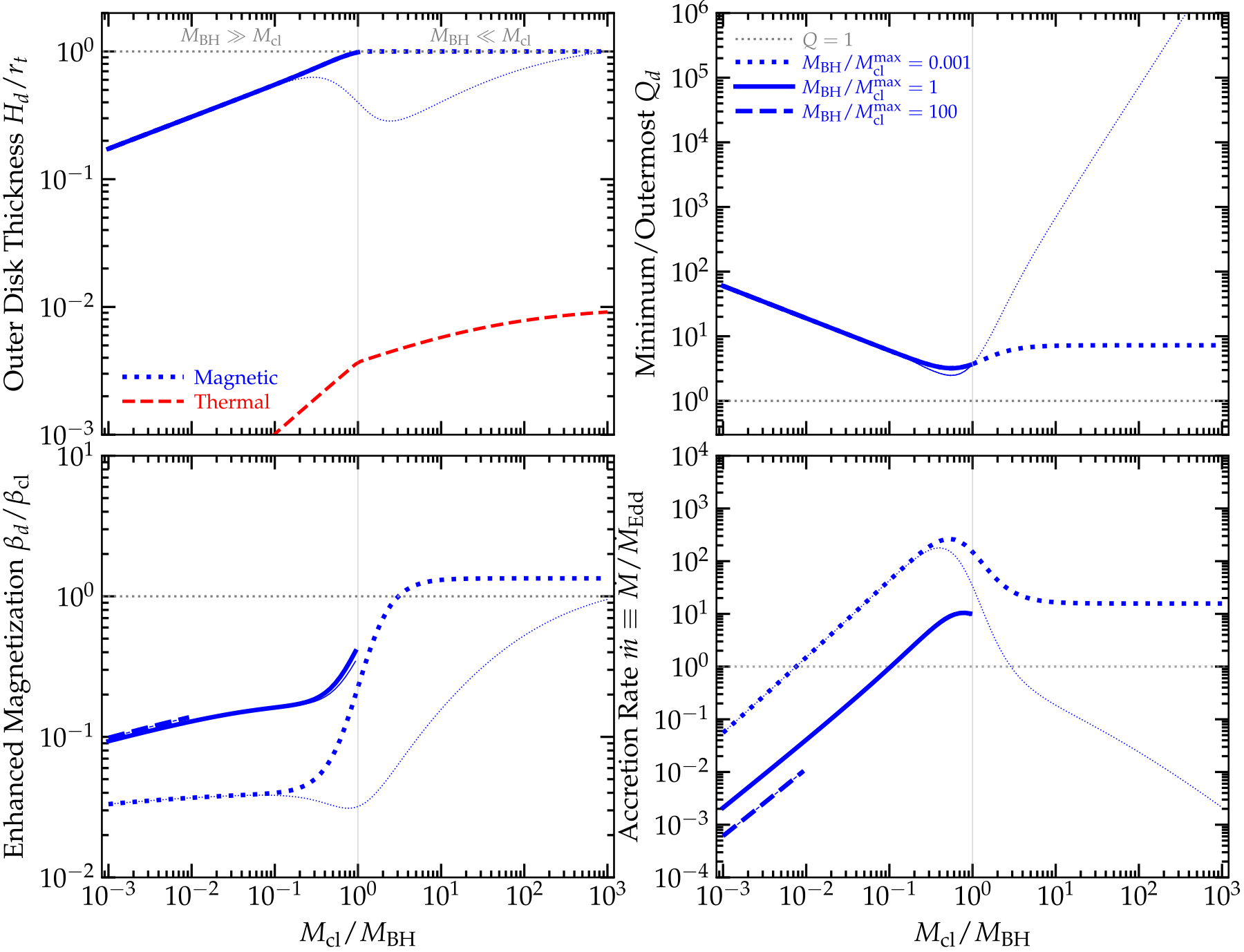
Tests how initial aspect ratio, magnetic versus thermal pressure, Toomre stability, and outer-disk Eddington ratio vary with cloud-to-BH mass ratio, including turbulent-Bondi and leapfrog prescriptions.
Original caption
Figure 1: Predicted initial disk properties at the circularization radius as a function of cloud-to-BH mass ratio M cl / M BH M_{\rm cl}/M_{\rm BH} , for fiducial parameters ( α cl , B = 0.3 \alpha_{\rm cl,\,B}=0.3 , ψ = 5 \psi=5 , Q 0 = 1 Q_{0}=1 , and different BH-to-ISM maximum cloud mass M cl max M_{\rm cl}^{\rm max} ratios labeled). Top left: Scale height/aspect ratio H d / r t H_{d}/r_{t} ( blue ). A crude estimate of the thermal value is compared ( red ). We also contrast the prediction (differing for M BH ≲ M cl M_{\rm BH}\lesssim M_{\rm cl} ) from the lower-accretion-rate, higher-duty-cycle “turbulent Bondi-Hoyle” mode ( thin ) vs. the “leap-frog” rapid-growth mode encountering sub-clouds of mass ∼ M BH \sim M_{\rm BH} ( thick ). Top right: Toomre Q d Q_{d} parameter at circularization (including magnetic support). The disk is always (initially) gravitationally stable ( Q d ≫ 1 Q_{d}\gg 1 ). Bottom left: Ratio of disk-to-progenitor cloud plasma β = P thermal / P mag ∼ c s 2 / v A 2 \beta=P_{\rm thermal}/P_{\rm mag}\sim c_{s}^{2}/v_{A}^{2} . In all regimes β d ≲ β cl ≪ 1 \beta_{d}\lesssim\beta_{\rm cl}\ll 1 – the disk at circularization is as-or-more magnetically dominated as the progenitor cloud. Bottom right: Eddington-normalized accretion rate m ˙ \dot{m} . High- m ˙ \dot{m} accretion is generic to broadly comparable-mass encounters (in the “leapfrog” mode, M cl ≫ M BH M_{\rm cl}\gg M_{\rm BH} but sub-cloud M cl sub ∼ M BH M_{\rm cl}^{\rm sub}\sim M_{\rm BH} ).
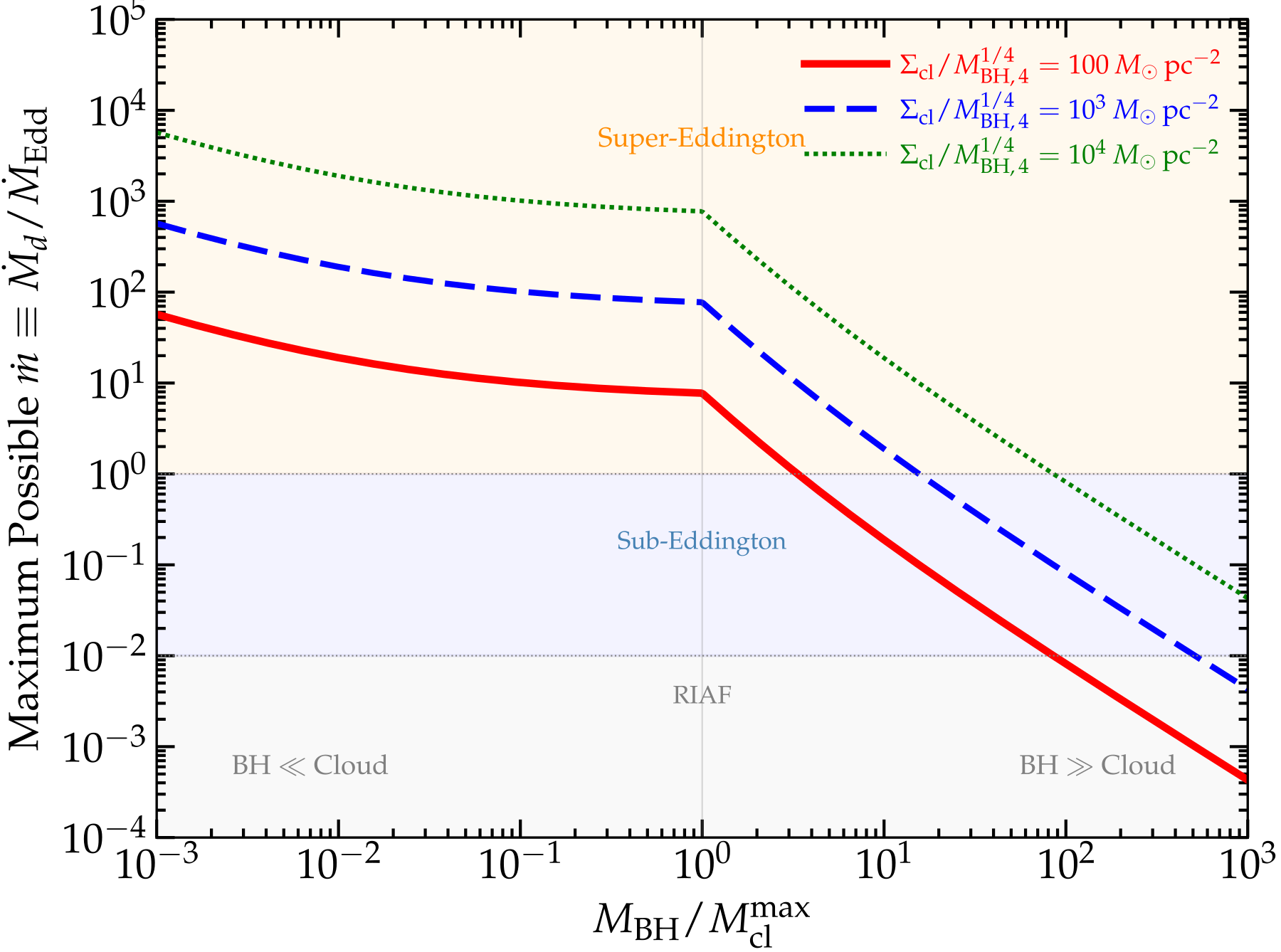
Tests the environmental condition for high outer-disk inflow by marginalizing over cloud encounters and varying maximum cloud mass and cloud surface density; dense, gas-rich cases produce the high predicted rates.
Original caption
Figure 2: Peak predicted Eddington-normalized accretion rate m ˙ \dot{m} (defined in terms of M ˙ d \dot{M}_{d} from the outer disk, marginalizing over encounters with all clouds of mass 0 < M cl < M cl max 0<M_{\rm cl}<M_{\rm cl}^{\rm max} and the leapfrog-vs.-turbulent Bondi mode), as a function of the BH-to-ISM maximum cloud mass M cl max M_{\rm cl}^{\rm max} ratio. We compare different cloud surface densities (assuming all clouds have the same Σ cl \Sigma_{\rm cl} ) normalized by BH mass Σ cl / M BH , 4 1 / 4 \Sigma_{\rm cl}/M_{\rm BH,\,4}^{1/4} ( M BH , 4 ≡ M BH / 10 4 M ⊙ M_{\rm BH,\,4}\equiv M_{\rm BH}/10^{4}\,M_{\odot} ). In the regime of massive BHs and quenched galaxies (small M cl max M_{\rm cl}^{\rm max} , Σ cl \Sigma_{\rm cl} ), m ˙ \dot{m} from cloud-capture is always low. Gas-rich, dense galaxies with high- M cl max M_{\rm cl}^{\rm max} and Σ cl \Sigma_{\rm cl} (e.g. high-redshift gas-rich massive galaxies, starburst nuclei) can produce supercritical m ˙ ≫ 1 \dot{m}\gg 1 accretion in the outer disk.
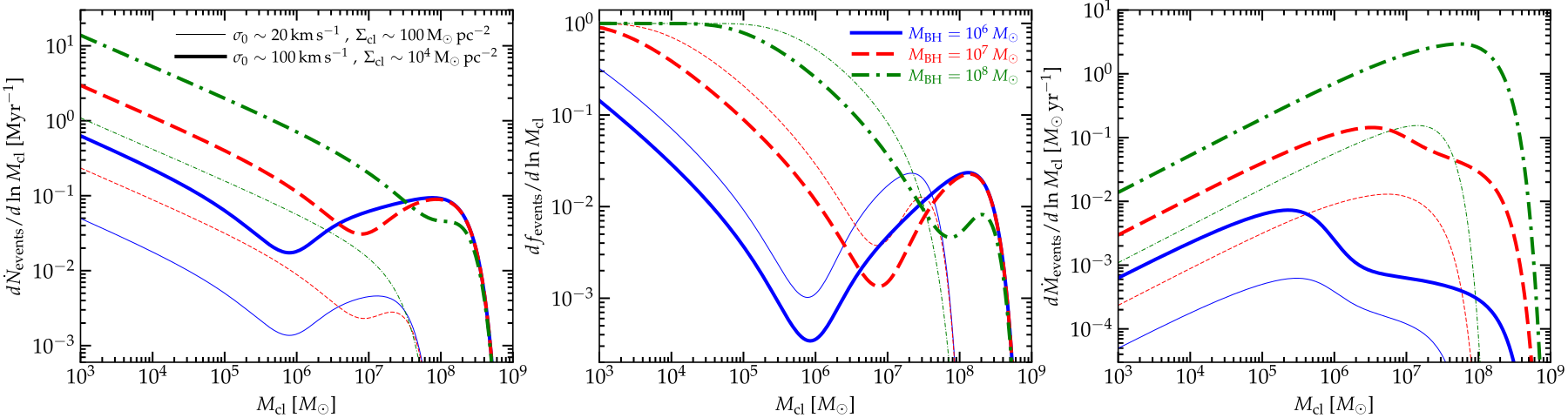
Tests which cloud masses control encounters, time-averaged accretion, and duty cycle for three BH masses under an assumed cloud mass function; the predicted accretion peak lies near Mcl approximately MBH.
Original caption
Figure 3: Cloud mass spectrum-weighted rates as a function of cloud mass M cl M_{\rm cl} , for three BH masses M BH = 10 6 M_{\rm BH}=10^{6} (blue), 10 7 10^{7} (red), and 10 8 M ⊙ 10^{8}\,M_{\odot} (green), assuming a cloud mass function with γ cl = 7 / 4 \gamma_{\rm cl}=7/4 , M 0 = 10 8 M ⊙ M_{0}=10^{8}\,M_{\odot} , Σ 0 = 100 M ⊙ pc − 2 \Sigma_{0}=100\,M_{\odot}\,{\rm pc^{-2}} . Left: Differential encounter rate d N ˙ / d ln M cl d\dot{N}/d\ln{M_{\rm cl}} . Center: Differential time-averaged mass accretion rate d M ˙ / d ln M cl d\dot{M}/d\ln{M_{\rm cl}} . Right: Differential duty cycle d f / d ln M cl df/d\ln{M_{\rm cl}} . In all cases, the transition between the M cl > M BH M_{\rm cl}>M_{\rm BH} and M cl < M BH M_{\rm cl}<M_{\rm BH} regimes is visible. The mass accretion rate is dominated by clouds of mass M cl ∼ M BH M_{\rm cl}\sim M_{\rm BH} , while the event rate is more broadly distributed.
Related research
Previous digest
Hopkins develops analytic scalings for AGN disks assembled when strongly magnetized, rapidly cooling ISM clouds are captured and circularized by black holes, spanning low-mass BHs encountering sub-clouds, comparable-mass BH-cloud encounters, and massive BHs tidally disrupting smaller clouds. Across all three regimes, the initial disk at the circularization radius is predicted to be toroidally magnetically dominated, thick with H/R of order 0.1–1, gravitationally stable, and supported by supersonic, trans-Alfvénic turbulence rather than the conditions assumed in classical thin-disk, Bondi-Hoyle, or stellar-TDE treatments. The cloud mass spectrum makes time-averaged growth primarily sensitive to clouds comparable in mass to the BH, providing a unified fueling picture in which dense early systems can drive leapfrog, hyper-Eddington growth relevant to little red dots, while massive quenched galaxies are limited to weak cloud-capture accretion.
Sources and evidence (25)
- 2610.33297v1: Initial Conditions of Magnetized AGN Accretion Disks from Cloud Capture and Disruption
Accretion onto supermassive black holes (BHs) from the ISM can occur via capture of cold gas 'clouds' (GMCs, clumps, or overdense structures). Unlike material in stellar tidal disruptions or X-ray binaries, or classical Bondi accretion, ISM clouds are strongly magnetized (plasma $β\equiv P_{\rm thermal}/P_{\rm magnetic} \ll 1$), with supersonic turbulence, and cool rapidly. We derive analytic scalings for the initial conditions of accretion disks formed by capture/disruption of such clouds, in three regimes: (1) low-mass BHs ($M_{\rm BH} \ll M_{\rm cl}$), where turbulent Bondi-Hoyle or hierarchical 'leapfrog' growth via sub-cloud encounters dominates; (2) comparable-mass encounters ($M_{\rm BH} \sim M_{\rm cl}$); and (3) massive BHs tidally disrupting small clouds ($M_{\rm BH} \gg M_{\rm cl}$). In each, the resulting disk is predicted to be initially toroidally-magnetically-dominated ($|B_φ| \gg |B_{z}|$, $β\ll 1$), geometrically thick ($H/R \sim 0.1-1$), and gravitationally stable ($Q \gtrsim 1$), with super-sonic, trans-Alfvenic turbulence. These conditions differ qualitatively from those assumed in classical accretion/$α$ disk theory, 'chaotic cold accretion', stellar tidal disruption, or Bondi-Hoyle accretion. At least initially, the toroidal field should be sustained by flux-freezing on timescales shorter than Parker or turbulent resistive losses. We examine how cloud mass spectra drive accretion rate distributions, duty cycles, and fueling rates, with integrated BH growth dominated by clouds of mass comparable to the BH. Given known cosmological evolution, we suggest a scenario linking (a) inefficient growth and wandering BHs in dwarf galaxies, (b) hyper-Eddington growth in little red dots, (c) peak quasar activity in massive gas-rich systems at cosmic noon, and (d) lower-luminosity AGN in gas-poor galaxies at late times.
- 2610.33297v1: Initial Conditions of Magnetized AGN Accretion Disks from Cloud Capture and Disruption
The probability of such a “slow” encounter is a weak function of most parameters, of order ∼ 1 − 15 % \sim 1-15\% per cloud crossing, depending on the ratio Σ cl / Σ sub \Sigma_{\rm cl}/\Sigma_{\rm sub} and the mass function slope. The resulting growth is therefore hierarchical: the BH encounters one sub-cloud of comparable mass, grows by 𝒪 ( 1 ) \mathcal{O}(1) , then encounters the next, and so on. One cannot assume that successive “leaps” are independent, because both observations and theory predict very strong auto-correlation of both density and velocity fluctuations in turbulent clouds ( Hopkins, 2013b ; Hopkins, 2013a ) . This is inevitable in any self-gravitating or scale-free cascade. Simulations show this hierarchical growth in the context of star cluster fragmentation/mergers and seed BH growth ( Shi et al., 2021 ; Shi et al., 2024b ; Shi et al., 2024a ; Rodriguez et al., 2023 ) , where the measured probability P 10 P_{10} for > 10 >10 such events (a factor ∼ 10 3 − 4 \sim 10^{3-4} in total growth) is nearly identical to P 2 P_{2} for > 2 >2 , provided (1) massive enough sub-clouds continue to exist and (2) BH growth is not ultimately limited by BH feedback (which depends on the feedback efficacy and sets the BH- σ \sigma relation; Hopkins et al. 2016 ; Hopkins et al. 2022 ; Shi et al. 2024a ) or stellar feedback (which sets the threshold surface density/column for accretion; Grudić et al. 2018b ; Grudić et al. 2019b ; Shi et al. 2023 ).
- 2610.33297v1: Initial Conditions of Magnetized AGN Accretion Disks from Cloud Capture and Disruption
We have derived simple analytic scalings for the “initial conditions” of accretion disks formed by tidal capture and disruption of ISM clouds by black holes. The key conclusions are:
- 2610.33297v1: Initial Conditions of Magnetized AGN Accretion Disks from Cloud Capture and Disruption
Cloud accretion can fuel BHs across all mass scales. From stellar-mass seeds to the most massive SMBHs, the cloud accretion process operates in qualitatively different but well-defined regimes. For low-mass BHs ( M BH ≪ M cl M_{\rm BH}\ll M_{\rm cl} ), the dominant modes are turbulent Bondi-Hoyle capture (which is generally inefficient) and hierarchical “leapfrog” growth via sub-cloud encounters (which can be hyper-Eddington). For comparable-mass and high-mass BHs, individual cloud encounters produce vigorous accretion at or above the Eddington rate.
- 2610.33297v1: Initial Conditions of Magnetized AGN Accretion Disks from Cloud Capture and Disruption
Clouds of mass M cl ∼ M BH M_{\rm cl}\sim M_{\rm BH} dominate the accretion budget. The time-averaged accretion rate, encounter rate, and duty cycle are all dominated by clouds of mass comparable to or modestly larger than the BH. This arises from the strong dependence of the capture radius and captured mass on M cl / M BH M_{\rm cl}/M_{\rm BH} , combined with the cloud mass function.
- 2610.33297v1: Initial Conditions of Magnetized AGN Accretion Disks from Cloud Capture and Disruption
The outer disk forms with β ≪ 1 \beta\ll 1 , toroidally-magnetically dominated. In all regimes where ISM clouds with β cl ≪ 1 \beta_{\rm cl}\ll 1 are accreted, the resulting disk at the circularization radius has | B ϕ | ≳ | B z | , | B R | |B_{\phi}|\gtrsim|B_{z}|,\,|B_{R}| (the toroidal field is amplified by azimuthal stretching and vertical compression under flux-freezing), with β d ≲ β cl ≪ 1 \beta_{d}\lesssim\beta_{\rm cl}\ll 1 . The turbulence is trans-Alfvénic and the thermal pressure is small. The disk is gravitationally stable with Q ≫ 1 Q\gg 1 .
- 2610.33297v1: Initial Conditions of Magnetized AGN Accretion Disks from Cloud Capture and Disruption
The initial disk is geometrically thick, H / R ∼ 0.1 − 1 H/R\sim 0.1-1 . For the accretion events that matter (i.e. that produce significant accretion relative to the BH mass), the initial disk at the circularization radius is geometrically thick, with H / R H/R set by the Alfvén speed rather than the thermal sound speed. This is always much thicker than a thermal or Q ∼ 1 Q\sim 1 disk. For increasingly small clouds ( M cl ≪ M BH M_{\rm cl}\ll M_{\rm BH} ), H / R H/R decreases as ( M BH / M cl ) − 1 / 6 (M_{\rm BH}/M_{\rm cl})^{-1/6} , but this simultaneously corresponds to m ˙ ≪ 1 \dot{m}\ll 1 and the transition to radiatively-inefficient accretion, which transitions back to quasi-spherical accretion for different physical reasons.
- 2610.33297v1: Initial Conditions of Magnetized AGN Accretion Disks from Cloud Capture and Disruption
Accretion rate scalings. For clouds with M cl ≲ M BH M_{\rm cl}\lesssim M_{\rm BH} , M ˙ d ∝ M cl 3 / 4 \dot{M}_{d}\propto M_{\rm cl}^{3/4} ; for M cl ≳ M BH M_{\rm cl}\gtrsim M_{\rm BH} , M ˙ d ∝ M cl − 1 / 4 \dot{M}_{d}\propto M_{\rm cl}^{-1/4} (weakly declining). In all cases, M ˙ \dot{M} scales as Σ cl 3 / 4 \Sigma_{\rm cl}^{3/4} , resembling a Shu-like isothermal collapse scaling ( Shu, 1977 ) rather than Bondi-like or α \alpha -disk scalings.
- 2610.33297v1: Initial Conditions of Magnetized AGN Accretion Disks from Cloud Capture and Disruption
Magnetic coherence is maintained for M cl ≳ M BH M_{\rm cl}\gtrsim M_{\rm BH} . When M cl ≳ M BH M_{\rm cl}\gtrsim M_{\rm BH} , the field coherence length is λ coh ∼ R cl ∼ r t \lambda_{\rm coh}\sim R_{\rm cl}\sim r_{t} , ensuring that turbulent dissipation and Parker instability losses are slower than the advective/accretion timescale. For M cl ≪ M BH M_{\rm cl}\ll M_{\rm BH} , λ coh ∼ R cl ≪ r t \lambda_{\rm coh}\sim R_{\rm cl}\ll r_{t} , and the field becomes more vulnerable.
- 2610.33297v1: Initial Conditions of Magnetized AGN Accretion Disks from Cloud Capture and Disruption
These intermediate expressions follow from the general scalings in § 2 and § 3 . The key scalings for the resulting disk are:
- 2509.09770v1: Early Stages of Dusty Tori: The First Infrared Spectra from a Highly Multiscale Quasar Simulation
Early (pre-outflow) stages of the dust torus appear as a buried, Compton-thick AGN, with optical/UV emission only escaping along a few ( ∼ \sim 5%) sightlines. The resulting spectra have a hot dust component that peaks around 3-4 μ m \mu\mathrm{m} . Significant IR reprocessing suppresses silicate emission features due to dust self-absorption. The local dusty ISM reservoir reprocesses this emission further, causing the emission to appear colder and producing silicate absorption lines.
- 2509.09770v1: Early Stages of Dusty Tori: The First Infrared Spectra from a Highly Multiscale Quasar Simulation
Since part of the accretion disk is resolved in the inner regions of FIF, we suspect electron scattering from the outer accretion disk structure may begin to influence our results. We incorporate this in our simulation as a population of free electrons tracing that in FIF and interacting with the radiation field via Thomson/Compton scattering. The SKIRT implementation for these processes is discussed in Vander Meulen et al. [120] .
- 2510.21709v1: From nuclear star clusters to Little Red Dots: black hole growth, mergers, and tidal disruptions
In the densest systems, an IMBH seed would rapidly grow through TDEs, EMRIs, and gas accretion. Simulations we carried out for NSCs with a central density of 10 8 pc − 3 10^{8}\,\rm pc^{-3} resulted in the rapid growth of a 10 3 M ⊙ 10^{3}\,M_{\odot} IMBH seed into the SMBH regime (final mass ≃ 2 × 10 7 M ⊙ \simeq 2\times 10^{7}\,M_{\odot} ) within a few × 10 Myr \times 10\,\rm Myr , giving rise to the z ∼ 5 z\sim 5 population of LRDs. Again, a significant fraction of the SMBH’s mass ( ∼ 80 % \sim 80\% ) is assembled through TDEs and captured EMRIs. Note that this fraction is dependent on the gas mass reservoir, which is taken in this example to be 10 7 M ⊙ 10^{7}\,M_{\odot} and supplied in ten inflow episodes over a 100 Myr 100\,\rm Myr period. Moreover, there is a residual population of stellar-mass BHs around the SMBH, leading to subsequent high-energy phenomena such as BH mergers and EMRIs.
- 2510.21709v1: From nuclear star clusters to Little Red Dots: black hole growth, mergers, and tidal disruptions
Based on the results by [ 36 ] , we assume that the M BH M_{\rm BH} - σ ⋆ \sigma_{\star} relation holds up to redshift z ∼ 9 z\sim 9 , where σ ⋆ \sigma_{\star} is the stellar velocity dispersion of the bulge. We use the relation from [ 24 ] . Up to an unknown fudge factor, we determine the break radius of the stellar density profile by the influence radius of the central SMBH, R 1 = G M BH / σ ⋆ 2 R_{1}=GM_{\rm BH}/\sigma_{\star}^{2} . This is motivated by observations of low-redshift cored galaxies [see [ 65 ] , pg. 20]. Furthermore, based on standard initial mass function assumptions, the total mass in stellar-mass BHs is roughly a fraction of ≈ 10 % \approx 10\% the stellar mass, and assuming energy equipartition among stars and BHs, we estimate R 2 = M 2 R 1 / M 1 ≈ 0.1 R 1 R_{2}=M_{2}R_{1}/M_{1}\approx 0.1R_{1} [ 10 ] . Notice that if equipartition is not achieved, then BHs would undergo Spitzer instability, compactify even further, and have a smaller value for R 2 R_{2} than what we estimate here, leading to an increase in captured EMRI rates.
- 2508.00774v1: A Novel Formation Channel for Supermassive Black Hole Binaries in the Early Universe via Primordial Black Holes
At z = 1100 z=1100 , when baryons and photons start to decouple, we include an additional uniform baryon matter field with the same resolution as PDM in the initial condition set up, resulting in a total number of N = 2 × 256 3 N=2\times 256^{3} particles with a mass of ∼ 100 ( 18 ) M ⊙ \sim 100(18)~M_{\odot} for PDM (gas) particles. With this setting, we both approximate the initial structure of PDM around the PBH, and let the gas collapse onto this PBH-seeded halo. In running these simulations, the softening length of PDM and gas is set to ϵ PDM = ϵ gas ∼ 0.01 L / N PDM 1 / 3 ≃ 0.01 h − 1 kpc \epsilon_{\rm PDM}=\epsilon_{\rm gas}\sim 0.01\,L/N_{\rm PDM}^{1/3}\simeq 0.01~h^{-1}\rm kpc , and the initial chemical abundances are assigned to the values predicted for the intergalactic medium (IGM) at z = 1100 z=1100 , as summarized in [ 36 ] .
- 2508.00774v1: A Novel Formation Channel for Supermassive Black Hole Binaries in the Early Universe via Primordial Black Holes
In addition, we also consider the relative streaming motion between gas and PDM particles by assigning a universal velocity offset. In our earlier work [ 135 ] , we found that streaming can enhance, rather than delay, galaxy formation—contrary to the conclusion generally reached within the standard Λ \Lambda CDM framework [ 106 , 105 , e.g.,] . This enhancement arises from a displacement in the center of mass (away from the PBH) caused by the relative motion between baryons and dark matter, leading to star formation in the dense gas structures that form in the wake of the PBH. These wake-driven overdensities promote gravitational collapse and thus play a catalytic role in early star formation. To systematically explore the impact of streaming velocity on black hole formation, we implement a velocity offset parameterized as a multiple of the root-mean-square streaming velocity σ b χ = 30 km \sigma_{\rm b\chi}=30~\rm km\, s -1 . Specifically, we consider four cases with velocity offsets of 0.4, 0.8, 1.2, and 1.6 σ b χ \sigma_{\rm b\chi} , corresponding to simulation runs labeled as PBH_LW_wstr_fd005 , PBH_LW_str_fd005 , PBH_LW_mstr_fd005 and PBH_LW_sstr_fd005 , respectively.
- 2608.23498v1: The Road to Normalcy: Environment-Driven Evolutionary Pathways for Primordial Black Holes
Based on the initial conditions and numerical setup described above, we now present the simulation results and discuss their physical implications. To highlight the environmental dependence of PBH-seeded evolution, we organize this section around four connected aspects. We first examine how the large-scale environment drives distinct BH–host evolutionary pathways in Section III.1 . Building on these trends, we identify the main evolutionary phases and possible transitions toward normal galaxy–AGN configurations in Section III.2 . We then connect these regimes to stellar growth and metal enrichment in Section III.3 before translating the resulting evolutionary stages into observable signatures for current and future surveys in Section III.4 .
- 2608.23498v1: The Road to Normalcy: Environment-Driven Evolutionary Pathways for Primordial Black Holes
The results of Section III.1 show that the cosmological environment regulates the gas supply and co-evolution of PBH-hosting systems. We now examine how the initial PBH mass and its placement within the assembling overdense region modify this evolution. Here, “normalcy” is defined in an evolutionary, trend-driven sense. It does not require exact agreement with the local BH–galaxy scaling relations. Instead, it refers to a progressive reduction in the relative dominance of the initial seed, such that stellar and halo growth outpace BH growth and drive both M ∙ / M ⋆ M_{\bullet}/M_{\star} and M ∙ / M h , PBH M_{\bullet}/M_{\rm h,PBH} toward the ranges occupied by more conventional high-redshift galaxy–AGN systems.
- 2501.03309v1: Little Red Dots are Tidal Disruption Events in Runaway-Collapsing Clusters
This model fails to directly address the red colors of LRDs. The red part of the SED is likely at least somewhat dominated by stellar light, as evidenced by a common feature of a Balmer break [ 30 ] (although see Inayoshi & Maiolino [18] ). LRDs do not characteristically show evidence of warm or hot dust (though see Barro et al. [5] ), and therefore a standard AGN model (consisting of a torus) cannot apply. Another common thorn in the side of LRD scientists is the number densities of these objects. If LRDs are assumed to be dominated by AGN, their number densities are not far from those of all galaxies in the universe, implying a near 100% AGN occupation fraction at z ∼ 7 z\sim 7 for the brightest galaxies ( L bol > 10 45 L_{\rm bol}>10^{45} erg s -1 ). Conversely, if most or all of the light is dominated by star formation, LRDs on their own reach or exceed the predicted stellar mass functions for all galaxies at high redshift in Λ \Lambda CDM [ 7 , 1 ] .
- 2501.03309v1: Little Red Dots are Tidal Disruption Events in Runaway-Collapsing Clusters
The plethora of LRDs discovered by JWST has challenged models of black hole and galaxy evolution. In this paper I suggest that a primary origin for the emission from LRDs is due to tidal disruption events occurring during the process of forming the seeds of supermassive black holes. The predicted number density of dense stellar clusters undergoing a runaway collapse is about 10 4 10^{4} times higher than that of LRDs, implying a TDE rate of 10 − 4 10^{-4} per year. Other common attributes include a spectral rise in the UV/optical, broad H α \alpha , and X-ray weakness. The broad H α \alpha emission from TDEs is not correlated with black hole mass (unlike in AGN), providing an explanation for the proposed overmassive nature of these high redshift black holes relative to their host. The H α \alpha lines also show absorption features [ 25 ] , which could be due to tidal streams of disrupted stars. X-ray weakness is thought to be a sign of super-Eddington accretion, likely combined with a viewing angle effect, and is thought to occur in TDEs. In addition, when TDEs do show X-rays they are soft, which may be redshifted out of the Chandra detection range.
- 2605.21589v1: A Magnetized Black Hole Envelope Model for Little Red Dots
We present a theoretical model for LRDs, assuming that a black hole is embedded within a dense BHE behaving like a convective protostar near the Hayashi-limit. This framework incorporates free-falling spherical accretion at high rates exceeding the Eddington value. By considering magnetic field effects, we investigate the dynamical and spectral properties of this BHE-as-a-protostar model. The main findings are as follows:
- 2605.21589v1: A Magnetized Black Hole Envelope Model for Little Red Dots
If BHEs possess surface magnetic fields similar to the thermal equipartition field B eq B_{\rm eq} , they develop a magnetosphere across a wide range of black hole masses and accretion rates. In particular, for BHEs with M BH ≤ 10 7 M ⊙ M_{\rm BH}\leq 10^{7}~M_{\odot} , this magnetosphere remains uncollapsed even at very high accretion rates (see Section II.2 and Figure 4 ).
- 2509.03283v1: A two-phase model of galaxy formation: IV. Seeding and growing supermassive black holes in dark matter halos
We present a theoretical framework for seeding and growing supermassive black holes (SMBHs) in dark matter halos along their assembly histories. Seeds are bred out of Pop-III stars formed during the first collapse of pristine gas in mini-halos that have reached the $\rm H_2$-cooling limit, modulated by UV radiation from star formation and dynamical heating from fast halo assembly. Such breeding persists until the enrichment of the intergalactic medium (IGM) enables Pop-II stars to form. Post-seeding growth of black holes (BHs) is driven by distinct channels, starting with episodic super-Eddington accretion associated with nuclear bursts induced by global disturbances of galaxies, followed by sustained sub-Eddington accretion via capturing sub-clouds formed in self-gravitating gas clouds (SGCs) in halos of fast assembly, and ending with merger-dominated, quiescent growth. We implement the model in subhalo merger trees to build a coherent framework to follow SMBH-galaxy-halo co-evolution across the whole history and structural hierarchy. BH seeds are bred with a broad mass spectrum of $M_{\rm BH} = 10 - 10^5\,{\rm M}_\odot$ at $z \approx 20 - 30$ in mini-halos with masses of $10^5 - 10^8\,{\rm M}_\odot$. Nuclear bursts provide the key condition for seeds to grow into SMBHs. The $M_{\rm BH}$-$M_*$ relation is a multi-piece, redshift-dependent function shaped by the interplay among different growth channels. Our model predictions are broadly consistent with existing observations; especially, a population of BHs reminiscent of 'little red dots' (LRDs) discovered by JWST naturally results from the seeding and growing processes. Potential future tests of the model are discussed.
- 2610.28723v1: Poisson Clustering and Seed Effect of PBHs: Implications for Microlensing, Gravitational Waves, Little Red Dots and Ultra-Faint Dwarf Galaxies
Some of the discussion in this section appeared in our earlier review [ 6 ] but it has been updated to cover an extended PBH mass function and we correct some minor errors in our earlier analysis. Carr and Silk [24] have clarified the relationship between these two effects and we start by presenting their heuristic analysis before discussing the seed and Poisson effects in more detail. If the PBHs have a single mass m m , the initial fluctuation in the matter density on a scale M M is [ 24 ]
- 2610.28723v1: Poisson Clustering and Seed Effect of PBHs: Implications for Microlensing, Gravitational Waves, Little Red Dots and Ultra-Faint Dwarf Galaxies
Our analysis of the fate of PBH clusters and PBH binaries presented here is essentially independent of the cluster origin. One could try to apply our results to determine the size and mass of more compact clusters that would be predicted in scenarios with additional clustering from non-Gaussian fluctuations. However, it is difficult to predict the initial size and mass of clusters in the non-Gaussian case and numerical simulations are typically needed for an accurate treatment. Choi et al. [73] have recently used such simulations to study the influence of spatial correlations on clustering properties of PBHs with a non-Gaussian exponential tail. Their analysis includes the non-sphericities of the emerging clusters, as well as the PBH mass function. These effects arise because any PBH-producing primordial power spectrum implies, for a range of scales, an increased likelihood for the occurrence of peaks near black holes. The associated dynamics take a finite time, possibly several e-folds (cf. Ref. [ 105 ] ). Therefore, a Hubble patch at the formation of an apparent horizon contains numerous initial Hubble patches (connected to the time of horizon entry) and therefore numerous other peaks which will merge and yield increased black hole masses.
Abstract
Accretion onto supermassive black holes (BHs) from the ISM can occur via capture of cold gas 'clouds' (GMCs, clumps, or overdense structures). Unlike material in stellar tidal disruptions or X-ray binaries, or classical Bondi accretion, ISM clouds are strongly magnetized (plasma $β\equiv P_{\rm thermal}/P_{\rm magnetic} \ll 1$), with supersonic turbulence, and cool rapidly. We derive analytic scalings for the initial conditions of accretion disks formed by capture/disruption of such clouds, in three regimes: (1) low-mass BHs ($M_{\rm BH} \ll M_{\rm cl}$), where turbulent Bondi-Hoyle or hierarchical 'leapfrog' growth via sub-cloud encounters dominates; (2) comparable-mass encounters ($M_{\rm BH} \sim M_{\rm cl}$); and (3) massive BHs tidally disrupting small clouds ($M_{\rm BH} \gg M_{\rm cl}$). In each, the resulting disk is predicted to be initially toroidally-magnetically-dominated ($|B_φ| \gg |B_{z}|$, $β\ll 1$), geometrically thick ($H/R \sim 0.1-1$), and gravitationally stable ($Q \gtrsim 1$), with super-sonic, trans-Alfvenic turbulence. These conditions differ qualitatively from those assumed in classical accretion/$α$ disk theory, 'chaotic cold accretion', stellar tidal disruption, or Bondi-Hoyle accretion. At least initially, the toroidal field should be sustained by flux-freezing on timescales shorter than Parker or turbulent resistive losses. We examine how cloud mass spectra drive accretion rate distributions, duty cycles, and fueling rates, with integrated BH growth dominated by clouds of mass comparable to the BH. Given known cosmological evolution, we suggest a scenario linking (a) inefficient growth and wandering BHs in dwarf galaxies, (b) hyper-Eddington growth in little red dots, (c) peak quasar activity in massive gas-rich systems at cosmic noon, and (d) lower-luminosity AGN in gas-poor galaxies at late times.
Discussion
Discussion access requires a security token. Register for the weekly digest.