2611.03812v1 · First listed 2026-11-04
The STARfall pathway: forging intermediate-mass black holes through stellar collisions in dense star clusters
STARfall semi-analytically models collision-driven very massive stars in dense clusters, predicting 10^3–10^4 M⊙ IMBH seeds under favorable density and timescale conditions. Its Little Red Dot implication is conditional on unresolved systems being sufficiently compact stellar clusters. [1][9]
Evidence
The authors evolve a massive binary placed in a cluster core with STARfall, a semi-analytic calculation of binary–single interactions, mergers/collisions, stellar evolution, and host-cluster dynamical evolution including core collapse. They report collision chains within 3 Myr above central densities of 10^6 M⊙ pc⁻³, with collapsing very massive stars (VMSs) producing seeds up to 10^3–10^4 M⊙ despite winds. Their modeled cluster grid spans initial masses 10^6–10^8 M⊙ and half-mass radii below 1 pc; maximum VMS mass correlates with initial cluster mass and density. At intermediate initial core densities (~10^7–10^9 M⊙ pc⁻³), seed masses can exceed those in still denser models, which the authors attribute to the VMS formation time and subsequent evolution rather than density alone. 【paper:2611.03812v1:3760802ffb45:104】【metadata:2611.03812v1:abstract】【paper:2611.03812v1:3760802ffb45:105】【paper:2611.03812v1:3760802ffb45:110】 [6][1][2][10]
Earlier work
Against earlier direct N-body results cited by the authors, STARfall’s end-of-chain maximum stellar masses show “overall good agreement”; its claimed practical distinction is sampling a higher-density tail inaccessible to those N-body calculations. For the same nominal compact-cluster initial conditions used by Pacucci et al. (Mcl,0≈10^6 M⊙, Rhm,0≈0.1 pc), the authors say the results are consistent, although that earlier work emphasizes rapid mass segregation. This supplied material does not provide a numerical, like-for-like uncertainty comparison with either study. 【paper:2611.03812v1:3760802ffb45:106】【paper:2611.03812v1:3760802ffb45:109】 [7][9]
What changes
The paper connects this cluster calculation to Cosmic Gems Arc clusters, globular clusters, and LRD interpretations. Models resembling Cosmic Gems Arc clusters form ≥10^3 M⊙ VMSs in about 60% of cases. For putative LRD stellar clusters of 10^6–10^7 M⊙ and central densities 10^5–10^8 M⊙ pc⁻³, the reported seed interval is 10^3–10^4 M⊙; 10^8 M⊙ cases have lower median seed masses because core collapse is slower, and their >10^3 M⊙ probability is described as low and broad. Thus the result constrains a stellar-cluster interpretation of LRD structure, not an IMBH detection in any LRD. 【paper:2611.03812v1:3760802ffb45:107】【paper:2611.03812v1:3760802ffb45:109】 [3][9]
Limits and open questions
The calculation follows stars initially in the core and omits outer-cluster contributions. The authors label this conservative because primordial or dynamical mass segregation could deliver additional massive stars to the center, but that direction of change is an inference rather than simulated here. Cluster-size uncertainty is especially consequential: it can move Cosmic Gems Arc analogues in parameter space and shift predicted seeds toward or below the pair-instability-supernova mass gap. For LRDs, high density alone is insufficient in these models; unresolved internal structure and core-collapse timing dominate the inference. 【paper:2611.03812v1:3760802ffb45:102】【paper:2611.03812v1:3760802ffb45:107】【paper:2611.03812v1:3760802ffb45:109】 [4][3][9]
This note uses supplied abstract, conclusion, limitation, and figure-caption excerpts rather than a complete methods/results extraction. The excerpts support the reported parameter ranges and author-level comparisons, but not a reconstruction of STARfall’s collision cross-sections, sampling, or statistical error model.
Key figures
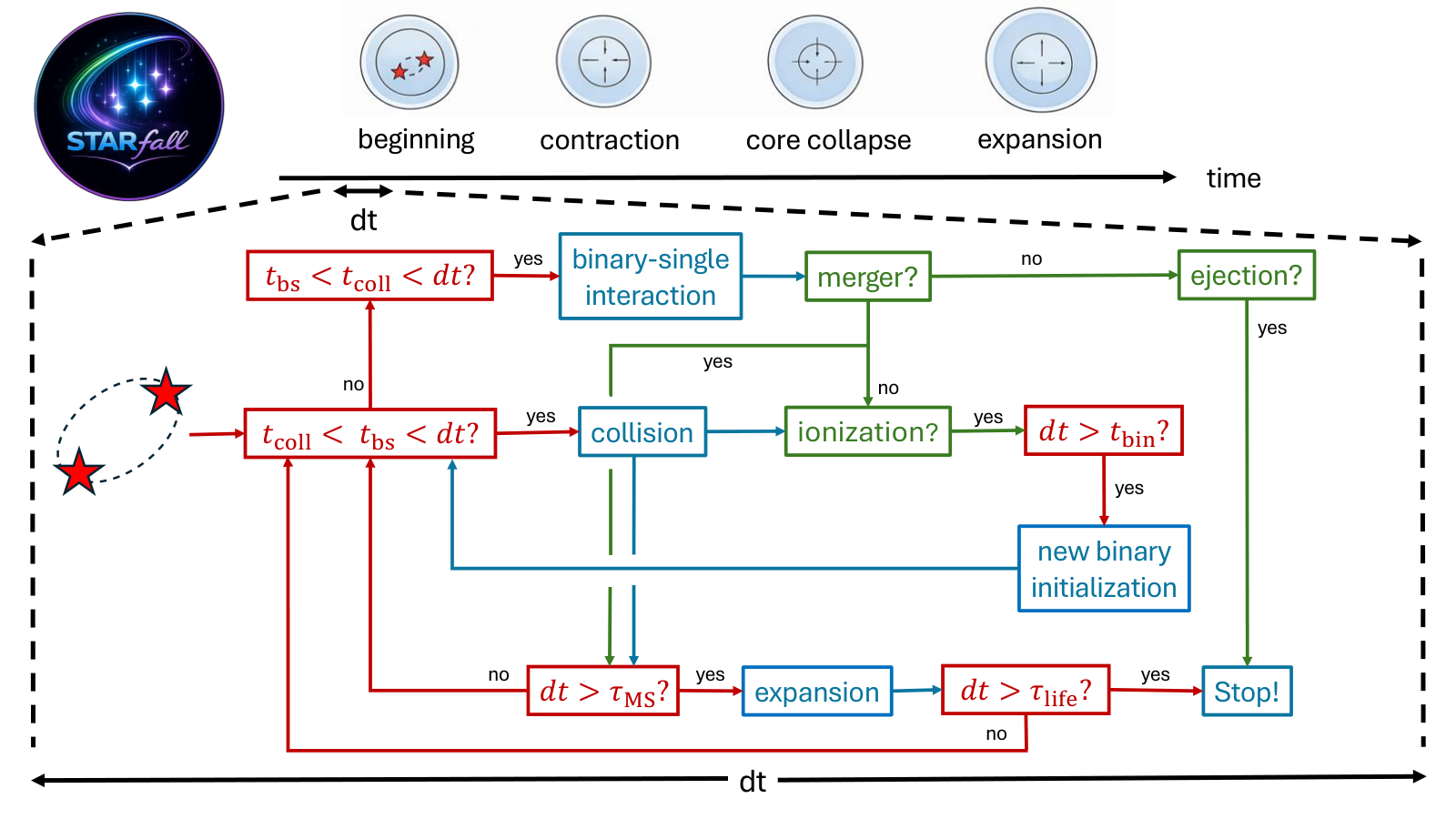
Tests the modeled decision sequence: collision versus binary–single interaction, binary re-formation after ionization, stellar expansion, and termination at primary collapse.
Original caption
Figure 1 : STARfall flowchart. The simulation time is advanced in logarithmic time-steps, d t dt . At each step, the collision timescale ( t coll t_{\rm coll} ) and the binary-single interaction timescale ( t bs t_{\rm bs} ) are computed as described in Sect. 2.3 . If t coll < t bs t_{\rm coll}<t_{\rm bs} , a collision occurs; otherwise, the system undergoes a binary-single interaction. If no interaction occurs during the current timestep, we proceed to the next one. If the binary is ionized after an interaction, the more massive star can experience repeated collisions or form a new binary over a timescale t bin ≡ t 3 b b t_{\rm bin}\equiv t_{\rm 3bb} (Eq. 13 ). After a time τ MS \tau_{\rm MS} (Eq. 4 ), the star expands. The simulation terminates when the primary star collapses, i.e., when t ≥ τ life t\geq\tau_{\rm life} (Eq. 6 ).
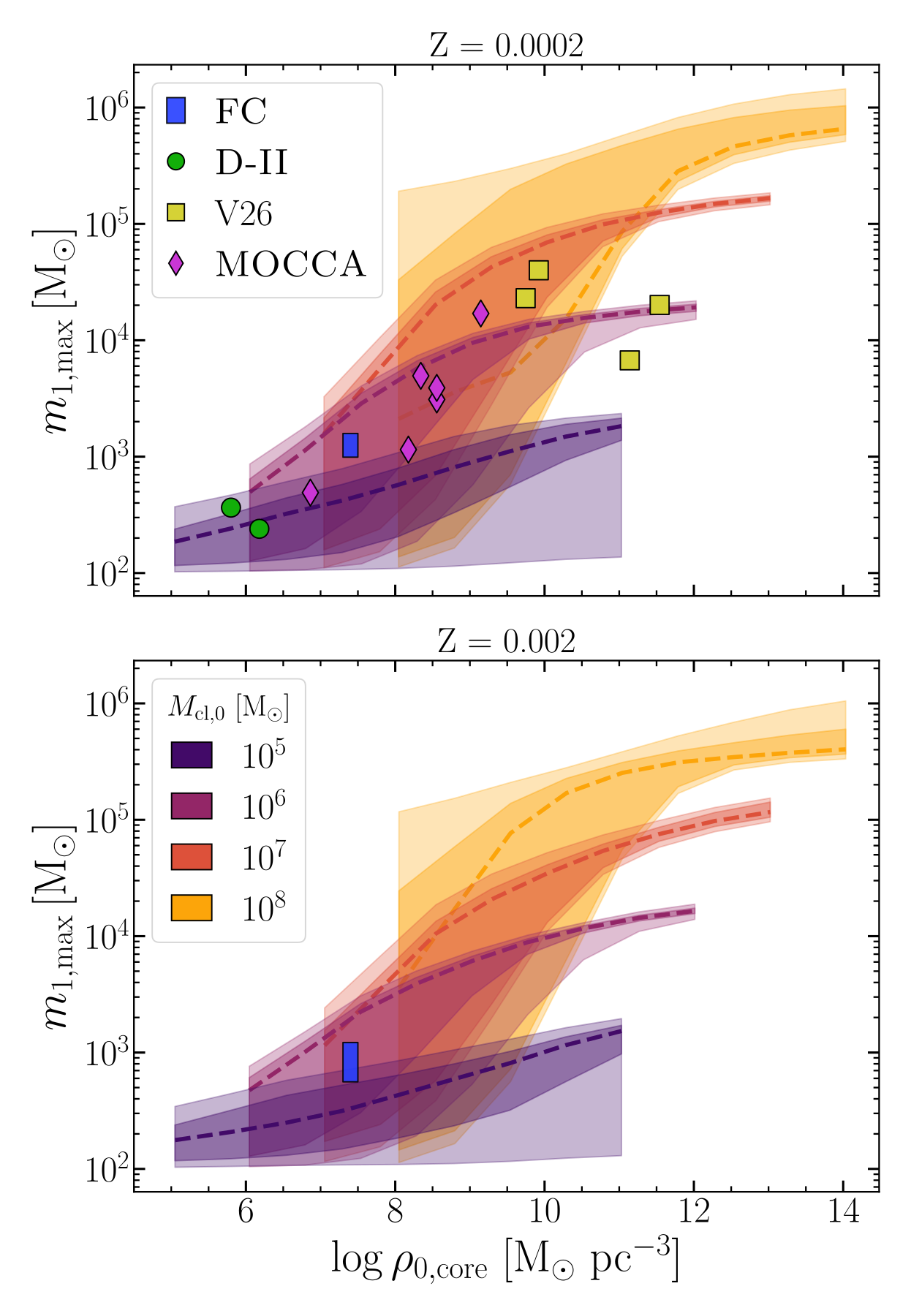
Tests how terminal VMS mass varies with initial central density, cluster mass, and metallicity; its 50% and 90% shaded ranges display modeled population spread and it overlays several external simulation results.
Original caption
Figure 3 : Median (dashed lines) mass at the end of the collision chain of VMSs as a function of the initial central density for Z = 0.0002 Z=0.0002 (upper panel) and Z = 0.002 Z=0.002 (lower panel). The colors encode the initial mass of the cluster, from M cl , 0 = 10 5 M ⊙ M_{\rm cl,0}=10^{5}\,{\rm M}_{\odot} (violet) to M cl , 0 = 10 8 M ⊙ M_{\rm cl,0}=10^{8}\,{\rm M}_{\odot} (yellow). The dark (light) shaded region encloses 50% (90%) of the entire population. The blue area indicates the range of stellar masses reported by Rantala et al. 2026 ( Frost-clusters ; FC ), the green dots mark those reported by Arca Sedda et al. 2023b ( Dragon-II ; D-II ), the yellow squares those by Vergara et al. 2026 ( Nbody6++GPU and MOCCA ; V26 ), while the purple diamonds those by Askar et al. in prep, Giersz et al. in prep ( MOCCA ).
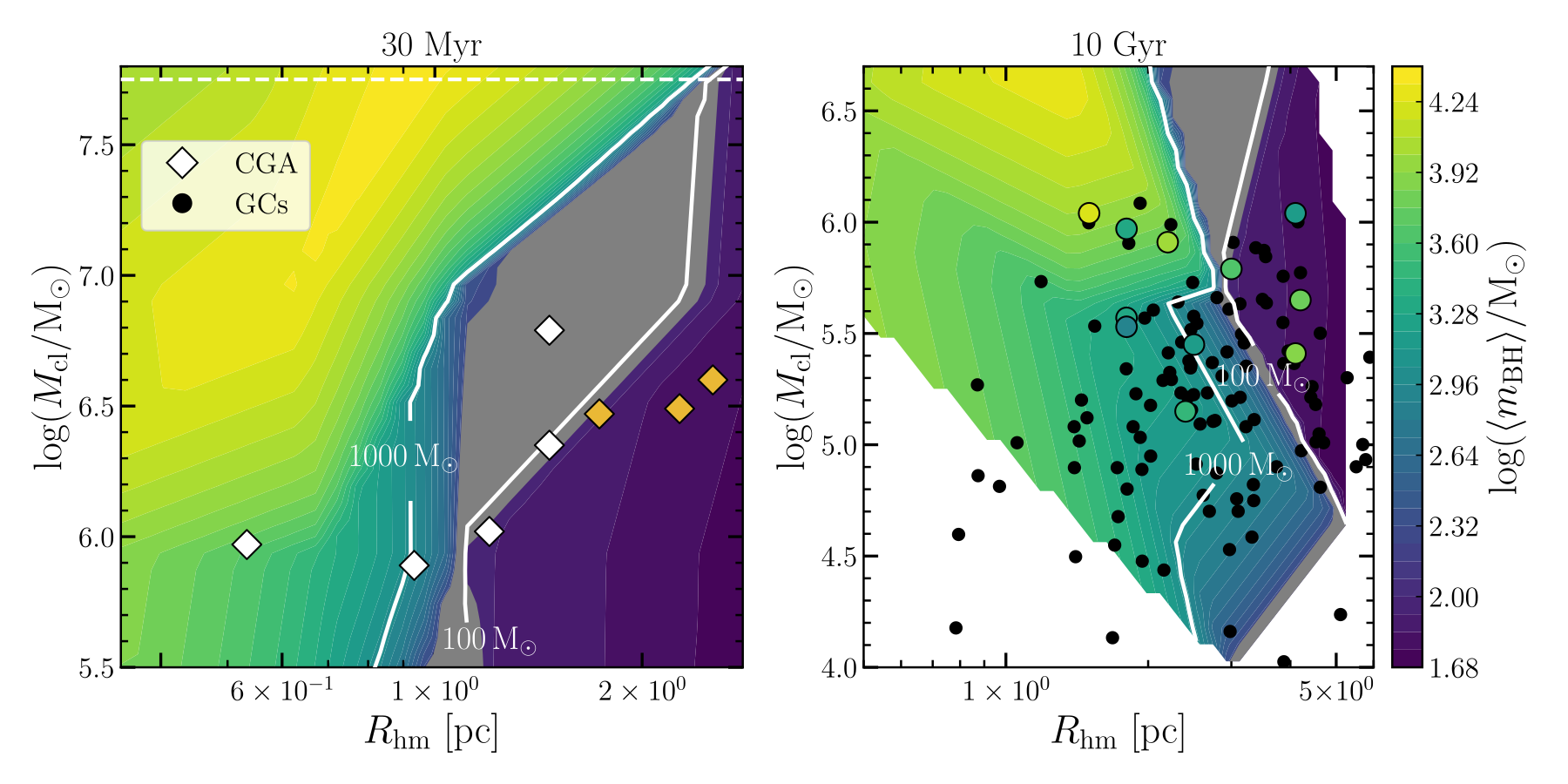
Tests the mapping from cluster mass and radius to mean IMBH-seed mass after 5 Myr, placing Cosmic Gems Arc cluster measurements and globular-cluster comparison points against the pair-instability gap.
Original caption
Figure 8 : Contour plot in the M cl − R hm M_{\rm cl}-R_{\rm hm} plane at 30 Myr (left panel) and 10 Gyr (right panel), showing the mean mass of IMBH seeds obtained from our simulations at Z = 0.0002 Z=0.0002 in 5 Myr. The white (orange) squares mark the masses and half-mass radii (of the counter-images) of the clusters in the Cosmic Gems Arc (CGA) reported by Messa et al. (2026) , while black dots indicate the globular clusters (GCs) from Harris et al. (2015) . Colored dots highlight those GCs for which an estimate of the IMBH mass is available ( Lützgendorf et al., 2013 ; Kızıltan et al., 2017 ) , with the color corresponding to the IMBH mass as indicated by the colorbar. The dashed white line represents the total mass of the Cosmic Gems Arc ( Bradley et al., 2025 ) . The grey region highlights the PISN mass gap.
Related research
Previous digest
Simonato et al. introduce STARfall, a semi-analytic framework that follows massive binaries, binary-single encounters, stellar collisions, winds, and host-cluster evolution to test when runaway stellar mergers assemble very massive stars. They find that clusters with central densities above roughly 10^6 Msun pc^-3 can enter a catastrophic "starastrophe" within 3 Myr, building very massive stars that collapse into IMBH seeds of about 10^3-10^4 Msun despite strong wind mass loss. The key requirements are both high central density and a short core-collapse time, placing compact Cosmic Gems Arc clusters and some Milky Way globular clusters in favorable territory; inferred Little Red Dot core densities could also permit seeds in the same mass range, although their longer collapse times make the pathway less immediate. This supplies a cluster-dynamical route to the intermediate-mass seeds relevant for early black-hole growth.
Sources and evidence (26)
- 2611.03812v1: The STARfall pathway: forging intermediate-mass black holes through stellar collisions in dense star clusters
Intermediate-mass black holes (IMBHs, $10^2 < m_{\rm BH}/\mathrm{M}_{\odot} < 10^5$) are elusive objects bridging the gap between stellar-mass and supermassive black holes, whose origin remains uncertain. They may form from the collapse of very massive stars (VMSs, $m_*\geq150\,\mathrm{M}_{\odot}$) assembled through repeated stellar collisions in compact and fast evolving star clusters. We investigate the formation of VMSs and IMBH seeds via repeated mergers and collisions as a function of cluster initial conditions, assessing the implications for globular clusters and dense high-redshift system. We develop STARfall, a semi-analytic tool that follows the evolution of a massive stellar binary via binary-single interactions, mergers, collisions, and stellar evolution, while consistently accounting for the host cluster evolution. Our results show that clusters with central densities above $10^6\,\mathrm{M}_{\odot}\,\mathrm{pc}^{-3}$ can undergo a catastrophic sequence of stellar collisions, or "starastrophe", within $3$ Myr. Through this process, VMSs rapidly grow in mass and collapse into IMBHs with masses of up to $10^3-10^4\,\mathrm{M}_{\odot}$, despite the effects of intense stellar winds. Applying our models to observed systems, we find that compact clusters in the Cosmic Gems Arc and Milky Way globular clusters could have hosted VMSs that collapsed into IMBHs in this mass range. Despite their longer core-collapse timescales, the inferred central densities of Little Red Dots may also support IMBH formation in the same mass interval. Our models show that VMS assembly requires two essential ingredients: short core-collapse times and large central densities. Compared to observed systems, our models suggest that clusters in the Cosmic Gems Arcs and several Galactic globular clusters could have nurtured VMSs that directly collapsed to IMBHs with masses $10^3-10^4\,\text{M}_{\odot}$.
- 2611.03812v1: The STARfall pathway: forging intermediate-mass black holes through stellar collisions in dense star clusters
We showed that in star clusters with masses in the range M cl , 0 = 10 6 − 10 8 M ⊙ M_{\rm cl,0}=10^{6}-10^{8}\,{\rm M}_{\odot} and half-mass radii R hm , 0 < 1 R_{\rm hm,0}<1 pc, stellar collisions are more likely to occur and can lead to the formation of VMSs with masses m ∗ ≳ 10 3 M ⊙ m_{*}\gtrsim 10^{3}\,{\rm M}_{\odot} (Figs. 2 , 4 ). The maximum VMS masses are strongly correlated with the initial mass and density of the host cluster (Fig. 3 ). In addition, the cluster structure, its dynamical evolution, and the relevant stellar evolutionary timescales play a key role in determining the probability of VMS formation. Even in clusters with core-collapse timescales longer than 5 Myr, the probability of forming a VMS in our model remains significant (between 15% and 50%), provided that the cluster is massive enough ( M cl ≳ 10 7 M ⊙ M_{\rm cl}\gtrsim 10^{7}\,{\rm M}_{\odot} ).
- 2611.03812v1: The STARfall pathway: forging intermediate-mass black holes through stellar collisions in dense star clusters
We also showed that cluster models with properties similar to those observed in the CGA ( Adamo et al., 2024 ; Bradley et al., 2025 ; Messa et al., 2026 ) can host VMSs with m ∗ ≥ 10 3 M ⊙ m_{*}\geq 10^{3}\,{\rm M}_{\odot} in ∼ 60 % \sim 60\% of the cases (Fig. 8 ), indicating that such environments are particularly favorable for the formation of both VMSs and IMBHs. However, uncertainties in the cluster sizes can significantly affect their position in parameter space, potentially shifting the predicted IMBH seed masses toward, or even below, the PISN mass gap.
- 2611.03812v1: The STARfall pathway: forging intermediate-mass black holes through stellar collisions in dense star clusters
Finally, we note that our results should be regarded as conservative. Our simulations focus on stars initially located in the cluster core and neglect contributions from the outer regions. However, strong mass segregation episodes and primordial mass segregation can funnel more massive stars toward the center ( Rantala et al., 2024 ) , potentially leading to a more massive VMS and increasing the number of BHs in the core, with implications for the subsequent growth of the central BH.
- 2611.03812v1: The STARfall pathway: forging intermediate-mass black holes through stellar collisions in dense star clusters
In this work, we investigated the formation of VMSs and IMBH seeds through runaway collisions and stellar mergers in dense stellar clusters.
- 2611.03812v1: The STARfall pathway: forging intermediate-mass black holes through stellar collisions in dense star clusters
We developed STARfall , a semi-analytic tool designed to follow the evolution of a massive stellar binary in the cluster core, accounting for binary-single interactions, stellar mergers, and collisions, as well as the dynamical evolution of the host cluster, with particular focus on core collapse (Sect. 2 ).
- 2611.03812v1: The STARfall pathway: forging intermediate-mass black holes through stellar collisions in dense star clusters
We compared the maximum stellar masses reached at the end of the collisional chains with results from N N -body simulations presented by Arca Sedda et al. 2023c ; Vergara et al. 2026 ; Rantala et al. 2026 ; Askar et al. in prep.; Giersz et al., in prep. (Fig. 3 ). We find overall good agreement, with STARfall also probing the high-density tail of the parameter space, which is not accessible to N N -body simulations.
- 2611.03812v1: The STARfall pathway: forging intermediate-mass black holes through stellar collisions in dense star clusters
Globular clusters (GCs) also represent favorable environments for forming VMSs with m ∗ ≥ 300 M ⊙ m_{*}\geq 300\,{\rm M}_{\odot} and IMBH seeds (Fig. 8 ; Lützgendorf et al. 2013 ; Harris et al. 2015 ; Kızıltan et al. 2017 ). In dense, low-mass GCs, where the population of massive stars has already been largely depleted (Fig. 7 ), alternative channels to BH-BH mergers may become dominant for subsequent mass growth of the IMBH. In particular, TDEs involving low-mass stars ( Stone et al., 2017 ; Rizzuto et al., 2023 ; Rantala et al., 2026 ) are expected to play a key role in driving further mass growth.
- 2611.03812v1: The STARfall pathway: forging intermediate-mass black holes through stellar collisions in dense star clusters
In contrast, although LRDs may have high stellar masses and densities ( Guia et al., 2024 ; Akins et al., 2025 ) , their structural properties, if interpreted as stellar clusters, do not always favor the onset of long stellar collision chains. For core densities between 10 5 10^{5} and 10 8 M ⊙ pc − 3 10^{8}\,{\rm M}_{\odot}\,\text{pc}^{-3} and cluster masses of 10 6 10^{6} – 10 7 M ⊙ 10^{7}\,{\rm M}_{\odot} , IMBHs with masses in the range 10 3 10^{3} – 10 4 M ⊙ 10^{4}\,{\rm M}_{\odot} can form. For more massive clusters ( M cl = 10 8 M ⊙ M_{\rm cl}=10^{8}\,{\rm M}_{\odot} ), the longer core-collapse timescale results in a lower median IMBH mass. Although the distribution is very broad, the probability of forming BHs with masses above 10 3 M ⊙ 10^{3}\,{\rm M}_{\odot} remains low (Sect. 4.1 ). This suggests that high density alone is not sufficient to trigger collision chains. Resolving their internal structure will play a key role in determining their dynamical evolution. However, Pacucci et al. (2025) suggest that, in these high density systems, mass segregation happens on very short timescales favoring the onset of runaway collisions and the formation of more massive VMSs. Nevertheless, when considering the same initial conditions ( M cl , 0 ∼ 10 6 M ⊙ M_{\rm cl,0}\sim 10^{6}\,{\rm M}_{\odot} , R hm , 0 ∼ 0.1 R_{\rm hm,0}\sim 0.1 pc), we find consistent results.
- 2611.03812v1: The STARfall pathway: forging intermediate-mass black holes through stellar collisions in dense star clusters
We further deepened the impact of metallicity and stellar wind mass loss on the mass of IMBH seeds (Figs. 5 , 6 ; but see also Appendix F ). We found that, although denser clusters tend to produce more massive VMSs, they do not necessarily produce the most massive BHs, with clusters at intermediate densities ( ρ 0 , core ∼ 10 7 − 10 9 M ⊙ pc − 3 \rho_{\rm 0,core}\sim 10^{7}-10^{9}\,{\rm M}_{\odot}\,{\rm pc}^{-3} ) producing IMBHs with masses higher than those produced in denser environments. This introduces a dependence on both the formation timescale of the VMS and its subsequent evolution (see also Fig. 2 ).
- 2509.02664v1: Little Red Dots Are Nurseries of Massive Black Holes
for f c = 0.8 f_{c}=0.8 , which is the empirical result found in [ 26 ] . The mass accretion rate onto the central VMS is estimated as ∼ 3 % \sim 3\% of the star formation rate in the stellar cluster. This result holds across a wide range of stellar densities and metallicities and is the outcome of mass segregation and binary-induced collisions in the evolution of a compact cluster.
- 2509.02664v1: Little Red Dots Are Nurseries of Massive Black Holes
To perform the calculation, we need to estimate the star formation rate and the metallicity of a typical LRD. Regarding the former, estimates for the LRDs vary widely. For example, [ 36 ] estimate values between ∼ 12 M ⊙ yr − 1 \sim 12\,\,{\rm M_{\odot}}\,\mathrm{yr}^{-1} and ∼ 49 M ⊙ yr − 1 \sim 49\,\,{\rm M_{\odot}}\,\mathrm{yr}^{-1} . [ 75 ] obtain values between ∼ 11 M ⊙ yr − 1 \sim 11\,\,{\rm M_{\odot}}\,\mathrm{yr}^{-1} and ∼ 30 M ⊙ yr − 1 \sim 30\,\,{\rm M_{\odot}}\,\mathrm{yr}^{-1} , although instantaneous values may reach ∼ 150 M ⊙ yr − 1 \sim 150\,\,{\rm M_{\odot}}\,\mathrm{yr}^{-1} . [ 43 ] infer values in an ultraluminous LRD at z = 4.47 z=4.47 that are significantly higher. Given such a range of estimates, we assume a conservative value of ∼ 30 M ⊙ yr − 1 \sim 30\,\,{\rm M_{\odot}}\,\mathrm{yr}^{-1} . Regarding the metallicity, estimates from [ 36 ] and [ 75 ] provide values between 6 % Z ⊙ 6\%\,\rm Z_{\odot} and 32 % Z ⊙ 32\%\,\rm Z_{\odot} , while [ 43 ] provides a value of 10 % Z ⊙ 10\%\,\rm Z_{\odot} . Hence, we reasonably assume a reference value of Z = 10 % Z ⊙ Z=10\%\,\rm Z_{\odot} . From the star formation rate, we calculate a constant accretion rate of M ˙ acc ∼ 1 M ⊙ yr − 1 \dot{M}_{\rm acc}\sim 1\,\,{\rm M_{\odot}}\,\mathrm{yr}^{-1} .
- 2603.26872v1: A cosmological framework for stellar collisions at high redshift in proto-globular clusters, nuclear star clusters, and Little Red Dots
We integrate this expression analytically and provide the full formulae in Appendix A . For black hole systems, the equilibrium condition results in the [ 7 ] stellar power law of ρ ∝ r − α \rho\propto r^{-\alpha} with α = 7 / 4 \alpha=7/4 [ 55 , 78 , e.g.,] . Given that we also consider self-gravitating stellar systems, and systems which may be out of equilibrium, we allow for a range of power law indices between 1-2. Figures are presented for α = 6 / 5 \alpha=6/5 , a more cored profile than the [ 7 ] profile, which will result in a more conservative estimate (as demonstrated by the lower left panel of Figure 3 ). We discuss the effect of varying α \alpha in the text.
- 2603.26872v1: A cosmological framework for stellar collisions at high redshift in proto-globular clusters, nuclear star clusters, and Little Red Dots
where v esc , ∗ v_{\rm esc,*} is the escape velocity from the surface of the stars, then the collision will result in significant mass loss–typically destroying the stars involved. Such collisions release material of the inner layers of the stars into the local region.
- 2604.22924v1: Supermassive stars with embedded stellar black hole cores: dense assembling star clusters as faint multiple Little Red Dot systems
Astrophysical models in which a compact object such as a neutron star (NS) or a black hole (BH) is embedded within the gaseous layers of a star have for a long time been constructed out of theoretical curiosity and invoked to interpret various unexplained observational results (e.g. Clayton et al. 1975 ; Oncins et al. 2022 ; Bellinger et al. 2023 ) especially in the context of binary stellar evolution (e.g. Sparks and Stecher 1974 ; Paczynski 1976 ; MacLeod and Ramirez-Ruiz 2015 ; Cruz-Osorio and Rezzolla 2020 ) and supermassive black hole (SMBH) seed formation. Such more or less exotic astrophysical objects include red giant stars with NS cores (Thorne-Żytkow objects, Thorne and Zytkow 1977 ; Cannon et al. 1992 ; Hutilukejiang et al. 2018 ; Farmer et al. 2023 ; Everson et al. 2024 ; Nathaniel et al. 2025 ; Williams et al. 2025 ) or quasi-stars (QSs; Begelman et al. 2008 ; Volonteri and Begelman 2010 ; Ball et al. 2011 ; Schleicher et al. 2013 ; Coughlin and Begelman 2024 ) in hydrostatic equilibrium with their central BH cores. Quasi-stars have been considered as relatively short-lived black hole gas envelope phases of the low metallicity direct collapse gas cloud scenario channel (DCBH; Bromm and Loeb 2003 ; Begelman et al. 2006 ; Dijkstra et al. 2008 ; Begelman 2010 ; Agarwal et al. 2012 ; Latif et al. 2013 ; Habouzit et al. 2016 ; Regan et al. 2017 ; Wise et al. 2019 ; Chon et al. 2021 ; Jeon et al. 2025 ) for SMBH seed formation ( Rees, 1978 ; Volonteri et al., 2008 ; Natarajan, 2014 ; Inayoshi et al., 2020 ) . Recently, attention for such embedded BH scenarios has been reinvigorated by the discovery of a novel and enigmatic class of objects now known as little red dots (LRDs; Matthee et al. 2024 ) by the James Webb Space Telescope ( JWST ). LRDs are characterized, among other properties, by their abundance at z ≳ 4 z\gtrsim 4 ( Kokorev et al., 2024 ; Kocevski et al., 2025 ) , compact ( ≲ 100 \lesssim 100 pc) sizes (e.g. Labbe et al. 2025 ), and peculiar spectral energy distributions (SEDs; Barro et al. 2024 ; Harikane et al. 2023 ; Williams et al. 2024 ; Yue et al. 2024 ; D’Eugenio et al. 2026 ; Inayoshi et al. 2026 ) including broad emission lines, X-ray
- 2604.22924v1: Supermassive stars with embedded stellar black hole cores: dense assembling star clusters as faint multiple Little Red Dot systems
Observationally, the expected bolometric luminosity of a ∼ 10 4 M ⊙ \sim{10^{4}}\>\mathrm{M_{\odot}} SMS or QS is of the order of L QS ∼ 10 8 L ⊙ L_{\mathrm{QS}}\sim 10^{8}L_{\odot} – 10 9 L ⊙ 10^{9}L_{\odot} ( Santarelli et al., 2026 ; Roman-Garza et al., 2026b ) corresponding to log 10 ( L QS / erg s -1 ) ∼ 42.5 \log_{\mathrm{10}}(L_{\mathrm{QS}}/\textrm{erg\>s${}^{-1}$})\sim 42.5 – 43.5 43.5 . As such, the QS like SMSs in our simulations are less luminous than typical LRDs with log 10 ( L / erg s -1 ) ∼ 44 \log_{\mathrm{10}}(L/\textrm{erg\>s${}^{-1}$})\sim 44 ( L ∼ 3 × 10 10 L ⊙ L\sim 3\times 10^{10}L_{\odot} ) (e.g. Akins et al. 2025 ; Greene et al. 2026 ; Umeda et al. 2026 ). However, the inferred QS luminosities are consistent with luminosities of the potential emerging population of faint LRDs ( Yanagisawa et al., 2026 ) that can be detected in strongly magnified star forming galaxies at high redshift.
- 2601.06015v1: VENUS: Two Faint Little Red Dots Separated by $\sim70\,\mathrm{pc}$ Hidden in a Single Lensed Galaxy at $z\sim7$
Figures 3 , 4 , and 5 , show the SED-fitting results for each component. The photometric redshifts of the individual components are generally consistent at z ∼ 7.4 z\sim 7.4 . The BAGPIPES fits that include a blackbody component reproduce both the blue UV continuum and the red optical continuum observed in the LRD images. Without this component, the best-fit solutions require dusty star-forming galaxy templates to match the red optical continuum, which in turn leads to a significant underestimate of the UV flux. In contrast, the SFG components are well-explained by young star-forming galaxy models. We note that the fits to the SFG images with and without the blackbody component yield nearly identical best-fit SEDs, implying little contribution from the blackbody component. For the LRD images, the best-fit T BB T_{\mathrm{BB}} values are ∼ 4000 – 4500 K \sim 4000\text{--}4500\,\mathrm{K} , which are slightly lower than theoretical predictions of ∼ 5000 K \sim 5000\,\mathrm{K} from the black hole envelope models [ 45 , 40 ] but consistent with the JWST/PRISM spectroscopy demographic study of de Graaff et al. [20] .
- 2601.06015v1: VENUS: Two Faint Little Red Dots Separated by $\sim70\,\mathrm{pc}$ Hidden in a Single Lensed Galaxy at $z\sim7$
In this work, we present the detection of a very close pair of LRDs found in a strongly lensed galaxy and separated by ∼ 70 pc \sim 70\,\mathrm{pc} , which are embedded in the typical SFGs at z ∼ 7 z\sim 7 . The main findings in this work are summarized below:
- 2602.15929v1: Toward Black Hole Stars: supermassive black hole growth in nuclear clusters via stellar-object and gas accretion
The resulting SGWBs are shown in Fig. 3 (thick lines). The WD capture background peaks at deciHz and are observable with an SNR > 10 \rm SNR>10 when compared with the corresponding LGWA PLS [ 1 ] and LISA PLS [ 47 ] for T obs = 4 yr T_{\rm obs}=4\,\rm yr . For comparison, we also show the background from massive black-hole mergers under two seeding scenarios [ 9 ] . While the BH and NS backgrounds have SNR < 10 \rm SNR<10 within four years, there are still thousands of captures within z < 6 z<6 with LISA. Finally, the SGWB from inspirals is undetectable.
- 2602.15929v1: Toward Black Hole Stars: supermassive black hole growth in nuclear clusters via stellar-object and gas accretion
We modeled stellar feeding onto SMBHs in NSCs, including TDEs and compact-object captures. Stellar plunges contribute only a sizable fraction to SMBH mass growth; however, gas accretion still dominates at all redshifts.
- 2608.27596v1: Formation of black hole stars via star--black hole collisions
Whether the sBH can be captured also depends critically on the impact parameter b b . Taking a representative sBH with M ∙ = 10 M ⊙ M_{\bullet}=10\,M_{\odot} , we conduct a grid search over b b and v ∞ v_{\infty} to map the retention threshold. The results are displayed in the right panel of Figure 2 , where the red dashed line represents the retention boundary, which is well-fitted with v ∞ / v 0 = − 0.352 ( b / R ⋆ ) 2 − 0.572 ( b / R ⋆ ) + 1.35 v_{\infty}/v_{0}=-0.352(b/R_{\star})^{2}-0.572(b/R_{\star})+1.35 , and the solid red line marks the geometric collision boundary. At low v ∞ v_{\infty} , the critical impact parameter for retention is comparable to the geometric collision threshold. However, as v ∞ v_{\infty} increases, the critical retention impact parameter deviates rapidly. Ultimately, when v ∞ ∼ 1.4 v 0 v_{\infty}\sim 1.4\,v_{0} , only head-on ( b = 0 b=0 ) collisions can marginally retained the sBH inside the star. However, for most sBHs retained in the star, the stopping time is still ∼ 10 \sim 10 – 100 h 100\,\rm h .
- 2608.27596v1: Formation of black hole stars via star--black hole collisions
The results in Section 3 indicate that energy dissipation during the sBH’s orbital decay can lead to changes in the massive main-sequence star’s interior. However, this 1-D MESA model does not fully capture the rapid 3-D dynamical response of the stellar envelope. In this section, we perform a suite of hydrodynamical simulations of star–sBH collisions, using the Lagrangian code GIZMO [ 21 ] . The simulations solve the standard hydrodynamical equations 1 1 1 Specifically: (1) ∂ t ρ + ∇ ⋅ ( ρ 𝒗 ) = 0 \partial_{t}\rho+\nabla\cdot(\rho\bm{v})=0 ; (2) ∂ t ( ρ 𝒗 ) + ∇ ⋅ ( ρ 𝒗 𝒗 + p 𝐈 ) = ρ 𝒈 \partial_{t}(\rho\bm{v})+\nabla\cdot(\rho\bm{v}\bm{v}+p\mathbf{I})=\rho\bm{g} ; (3) ∂ t ( ρ e + ρ v 2 / 2 ) + ∇ ⋅ [ ( ρ e + ρ v 2 / 2 + p ) 𝒗 ] = ρ 𝒈 ⋅ 𝒗 \partial_{t}\left(\rho e+\rho v^{2}/2\right)+\nabla\cdot\left[\left(\rho e+\rho v^{2}/2+p\right)\bm{v}\right]=\rho\bm{g}\cdot\bm{v} ; (4) p = ( γ − 1 ) ρ e p=(\gamma-1)\rho e . with the code’s Meshless Finite-Mass (MFM) mode, and self-gravity is solved with tree-gravity [ 20 ] .
- 2509.20452v1: A GLIMPSE of Intermediate Mass Black holes in the epoch of reionization: Witnessing the Descendants of Direct Collapse?
One source has a modest M BH / M ∗ ∼ 0.1 % M_{\rm BH}/M_{*}\sim 0.1\% . This value is considerably lower and aligns more closely with the relation observed in the local universe [ 65 , ∼ 0.5 % \sim 0.5\% ; ] . This result corroborates recent discoveries of low-luminosity AGNs in massive galaxies that also follow the local trend [ 69 ] . Four sources (ID 11026, ID 46938, ID 12248, and ID 39803) have a significantly higher BH-to-stellar mass ratio of M BH / M ∗ ≥ 2 % M_{\rm BH}/M_{*}\geq 2\% , which are consistent with faint AGNs identified in previous studies [ 47 , 80 , e.g., ] .
- 2509.20452v1: A GLIMPSE of Intermediate Mass Black holes in the epoch of reionization: Witnessing the Descendants of Direct Collapse?
Figure B.2: Fitting results. Similar to that shown in Figure B.1 .
- 2606.27427v1: SEEDZ: Rapid Galaxy Assembly as a Pathway to Supermassive Stars, Dense Stellar Environments and Massive Black Hole Seeds
Stars with masses in the type II (11 - 20 M ⊙ ) supernovae (SNe) or the hypernova (20 - 40 M ⊙ ) mass bands will experience an explosion and undergo some degree of mass loss. The explosion energy and resulting black hole remnant mass are calculated from the stellar mass as taken from Nomoto et al. (2006) , and the explosion is modelled with an isotropic injection of thermal energy into the surrounding 10 pc. The particle is then converted into a black hole particle.
- 2606.27427v1: SEEDZ: Rapid Galaxy Assembly as a Pathway to Supermassive Stars, Dense Stellar Environments and Massive Black Hole Seeds
Here we have presented a new cosmological simulation using the SEEDZ framework, with enhanced resolution compared to the original suite. The simulation was performed with the hydrodynamics code Arepo2 and probes scales of ∼ \sim 0.5 physical pc. On top of the base code, the SEEDZ framework includes subgrid models for PopIII star formation, supernovae explosions, metal enrichment, PopII star formation, black hole formation, and heavy seed black hole formation. Heavy seeds form in regions where the mass inflow into 10 pc regions surrounding a gravitationally unstable sub-pc sized cell exceeds 1 M ⊙ yr -1 . By splitting our catalogue of early galaxies into two groups – those that form heavy seeds and those that do not – we investigate the conditions necessary for high inflow environments to occur and by extension the conditions necessary for SMS and/or dense stellar cluster formation. We make the following conclusions:
Abstract
Intermediate-mass black holes (IMBHs, $10^2 < m_{\rm BH}/\mathrm{M}_{\odot} < 10^5$) are elusive objects bridging the gap between stellar-mass and supermassive black holes, whose origin remains uncertain. They may form from the collapse of very massive stars (VMSs, $m_*\geq150\,\mathrm{M}_{\odot}$) assembled through repeated stellar collisions in compact and fast evolving star clusters. We investigate the formation of VMSs and IMBH seeds via repeated mergers and collisions as a function of cluster initial conditions, assessing the implications for globular clusters and dense high-redshift system. We develop STARfall, a semi-analytic tool that follows the evolution of a massive stellar binary via binary-single interactions, mergers, collisions, and stellar evolution, while consistently accounting for the host cluster evolution. Our results show that clusters with central densities above $10^6\,\mathrm{M}_{\odot}\,\mathrm{pc}^{-3}$ can undergo a catastrophic sequence of stellar collisions, or "starastrophe", within $3$ Myr. Through this process, VMSs rapidly grow in mass and collapse into IMBHs with masses of up to $10^3-10^4\,\mathrm{M}_{\odot}$, despite the effects of intense stellar winds. Applying our models to observed systems, we find that compact clusters in the Cosmic Gems Arc and Milky Way globular clusters could have hosted VMSs that collapsed into IMBHs in this mass range. Despite their longer core-collapse timescales, the inferred central densities of Little Red Dots may also support IMBH formation in the same mass interval. Our models show that VMS assembly requires two essential ingredients: short core-collapse times and large central densities. Compared to observed systems, our models suggest that clusters in the Cosmic Gems Arcs and several Galactic globular clusters could have nurtured VMSs that directly collapsed to IMBHs with masses $10^3-10^4\,\text{M}_{\odot}$.
Discussion
Discussion access requires a security token. Register for the weekly digest.