2610.20697v1 · First listed 2026-10-16
A Vision for Little Red Dots in the Low-Redshift Universe with ALMA2040
Forecasts for one z=0.1007 LRD suggest ALMA2040 could constrain its CO-traced gas reservoir, but a dynamical black-hole test requires optimistic CO brightness and long exposure; a 10^6-M⊙ black hole remains inaccessible. [1][9]
Evidence
The study uses the nearby LRD J1025+1402 (“The Egg”; z=0.1007) as a single-object benchmark rather than presenting new CO data. It forecasts CO(2–1) at 209.45 GHz for an assumed molecular mass of 10^9 M⊙, 100 km s⁻¹ linewidth, and unresolved emission. This mass implies fmol=0.5 under the adopted stellar mass and remains below a stated dynamical-mass upper bound. For 10 h, the projected ALMA2040 noise is 54.5 μJy beam⁻¹ per 10 km s⁻¹ channel, or 5.45×10⁻4 Jy km s⁻¹ integrated over the assumed line. The authors identify αCO as the dominant uncertainty: The Egg’s narrow-line metallicity is 12+log(O/H)=7.55±0.03, making a Milky-Way conversion likely inappropriate. [2][3][4]
Earlier work
The proposal is motivated by recently identified low-z LRDs, which make low-J CO accessible, whereas high-z LRD gas reservoirs and BH-to-stellar mass ratios remain uncertain. A concrete observational comparison comes from the DESI z<0.45 sample: most sources have Hα/Hβ≳7 and unusually strong He I equivalent widths, resembling high-z LRDs; their broader parent broad-line-AGN sample clusters near Hα/Hβ≈3.1. This supports, but does not prove, that local selections trace analogous spectral conditions. [1][18]
What changes
The paper translates local-LRD accessibility into quantitative ALMA2040 experiments: first a CO detection/gas-depletion-time constraint, then a resolved dynamical test. At 209 GHz, a 14.6-mas (27-pc) beam would place about 3.7 beams across an assumed 100-pc gas effective radius. In an optimistic 50-h, αCO≈70 simulation, forward modelling of a spectral cube could distinguish a 10^7-M⊙ BH from no BH through steeper central velocities/high-velocity structure, thereby testing an illustrative BH-to-stellar mass ratio of 0.01. [7][9][10]
Limits and open questions
All principal outcomes depend on assumed gas mass, αCO, CO size/profile, inclination, stellar mass profile, and beam smearing. The 10^7-M⊙ case has a 17-pc sphere of influence—still formally unresolved by the 27-pc beam—and the model’s ≈18 km s⁻¹ central-speed contrast does not itself ensure detectability. With fiducial low-metallicity conversion factors, a 10-h resolved measurement is only 1–3σ and has sub-unity central-channel S/N. Even the favorable 50-h case is conditional on CO being brighter or more compact than assumed; a 10^6-M⊙ BH cannot be separated from the null model. Dust continuum is not an unambiguous cross-check because gas-to-dust ratio and non-dust emission are uncertain. [6][8][9]
The target paper is supported by selected HTML passages plus its abstract and Figure 2 caption; the supplied extraction omits the numerical entries of Table 1 and target-paper discussion of Figure 1, so this note does not report their unextracted details.
Key figures
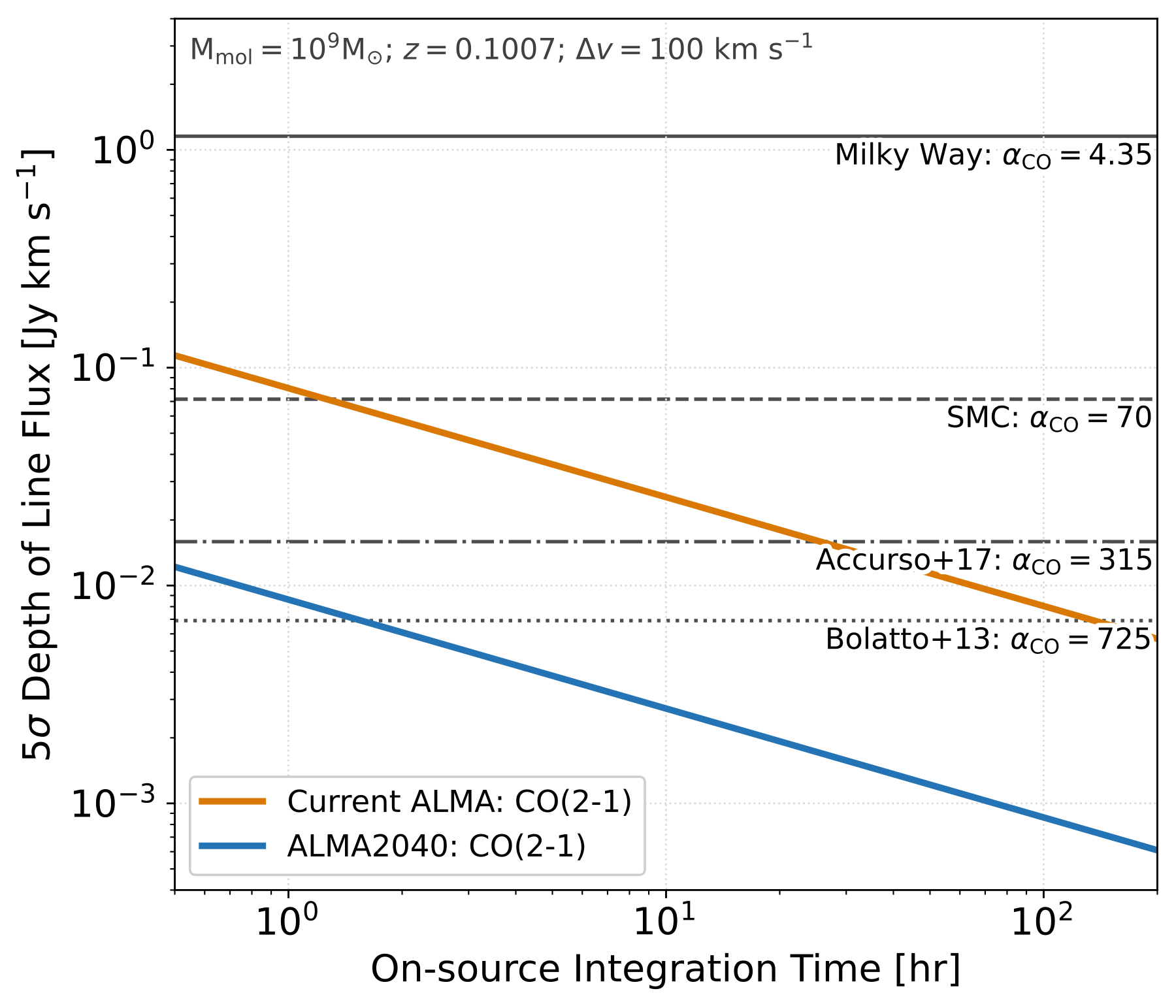
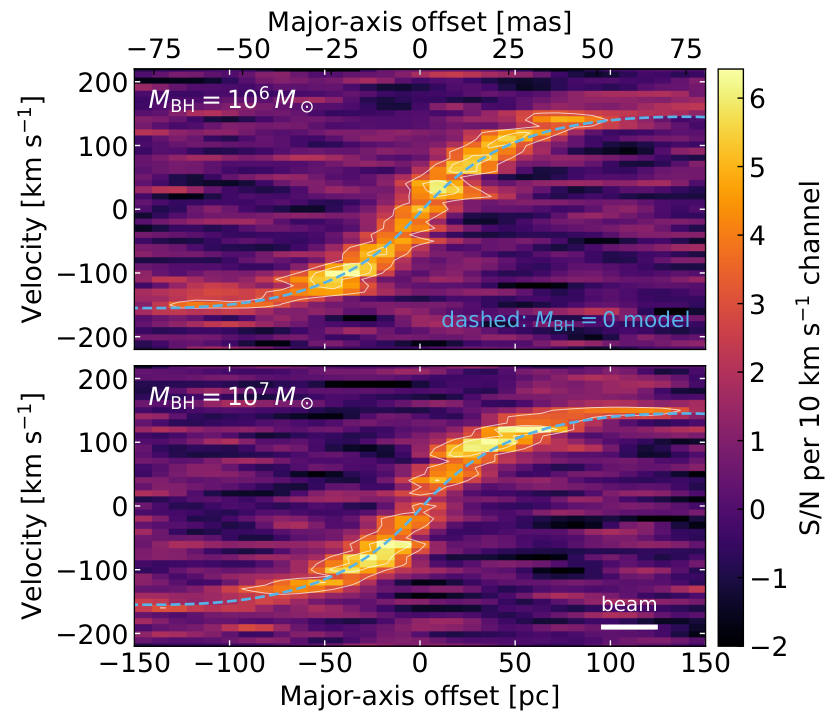
Left panel tests how the 5σ CO(2–1) detection threshold at The Egg’s redshift changes from current ALMA to ALMA2040 as αCO changes for a fixed 10^9-M⊙ gas assumption. Right panel tests whether simulated resolved kinematics can discriminate BH masses: under αCO=70 and 50 h, only the 10^7-M⊙ model shows diagnostic central high-velocity structure relative to no BH; 10^6 M⊙ does not.
Original caption
Figure 2: Left : 5 σ 5\sigma CO(2–1) line detection limit at the redshift of The Egg with current ALMA (orange) and ALMA2040 (blue), assuming a line width of 100 km s -1 . For a molecular gas mass of M mol = 10 9 M ⊙ M_{\mathrm{mol}}=10^{9}\,\mathrm{M}_{\odot} , the expected line fluxes for various α CO \alpha_{\mathrm{CO}} are shown as horizontal lines. Right : Simulated position–velocity diagrams of The Egg as observed with ALMA2040, assuming α CO = 70 M ⊙ ( K km s − 1 pc 2 ) − 1 \alpha_{\mathrm{CO}}=70\,\mathrm{M}_{\odot}\,(\mathrm{K\,km\,s^{-1}\,pc^{2}})^{-1} and a 50-hour on-source integration (see the main text for the other assumptions of the gas and stellar profiles). Contours denote the 3 σ 3\sigma and 5 σ 5\sigma levels per 10 km s -1 channel. Under such idealized assumptions, the M BH = 10 6 M ⊙ M_{\mathrm{BH}}=10^{6}\,\mathrm{M}_{\odot} scenario cannot be differentiated from the null ( M BH = 0 M_{\mathrm{BH}}=0 ) model, while the M BH = 10 7 M ⊙ M_{\mathrm{BH}}=10^{7}\,\mathrm{M}_{\odot} scenario will exhibit high-velocity wings at r < 50 r<50 pc, hinting at the presence of an overly massive BH ( M BH / M ⋆ = 0.01 M_{\mathrm{BH}}/M_{\star}=0.01 ).
Related research
Previous digest
This ALMA2040 white paper uses the z=0.1007 local little red dot J1025+1402, “The Egg,” to assess how next-generation ALMA capabilities could turn nearby LRDs into laboratories for molecular-gas and black-hole measurements. For an assumed 10^9 M⊙ molecular reservoir, CO(2–1) is likely beyond current ALMA if the low metallicity implies a very large CO-to-H2 conversion factor, whereas ALMA2040 should robustly constrain the gas reservoir and could resolve the emission on 27 pc scales. In an optimistic CO-bright case, 50-hour mock position–velocity observations show that a 10^7 M⊙ black hole could produce distinguishable central high-velocity structure, opening a route to gas depletion times, CO excitation, and eventually dynamical BH constraints in local LRDs.
Sources and evidence (24)
- 2610.20697v1: A Vision for Little Red Dots in the Low-Redshift Universe with ALMA2040
The discovery of Little Red Dots (LRDs) at high redshifts with JWST has revealed a previously unknown phase of black-hole growth. However, their black-hole (BH) masses, BH-to-stellar mass ratios, cold-gas reservoirs, and depletion times remain uncertain. The recent discovery of low-redshift LRDs at $z\simeq0.1 - 0.9$ creates a decisive opportunity to access their low-$J$ CO lines for measuring molecular gas reservoirs, and the nearest systems can in principle be spatially resolved. We use J1025+1402 ("The Egg") at $z=0.1007$, the best-studied local LRD, as a benchmark to explore the scientific opportunities with ALMA2040. Assuming a molecular gas mass of $10^9\,M_\odot$, the CO(2-1) detectability strongly depends on the assumed CO-to-H$_2$ conversion ($α_{\rm CO}$). With a large $α_{\rm CO} \simeq 315 - 725\,M_\odot\,({\rm K\,km\,s}^{-1}\,{\rm pc}^2)^{-1}$ at a low gas-phase metallicity, the CO line would remain very challenging for the current ALMA to detect, while ALMA2040 will likely deliver a robust CO detection and thus a gas-reservoir constraint for The Egg. Furthermore, with the best angular resolution at its CO(2-1) frequency (14.6 mas, or 27 pc), ALMA2040 may spatially resolve the CO emission from The Egg. Assuming an optimistic, SMC-like $α_{\rm CO}$ with a 50-hour deep integration, we produce mock position-velocity diagrams that may distinguish a $10^7\,M_\odot$ black hole from the no-BH model through its steeper central velocity structure. We conclude that ALMA2040 has the potential to directly measure the gas masses, depletion times, and excitation of local LRDs, while the CO-bright subset may ultimately yield dynamical constraints on the mass of their central black holes.
- 2610.20697v1: A Vision for Little Red Dots in the Low-Redshift Universe with ALMA2040
We test the capability of ALMA2040 in studying LRDs at low redshifts with “The Egg” as a benchmark. We assume a flat Λ \Lambda CDM cosmology with H 0 = 70 H_{0}=70 km s -1 Mpc -1 and Ω m = 0.3 \Omega_{\rm m}=0.3 . At z = 0.1007 z=0.1007 , the CO(2–1) emission from “The Egg” is observed at 209.45 GHz and the luminosity distance is 463.7 Mpc. For the sensitivity calculation, we assume a total molecular mass M mol = 10 9 M ⊙ M_{\mathrm{mol}}=10^{9}\,\mathrm{M}_{\odot} , a 100 km s -1 line width, and an unresolved source size for the detection experiment. This benchmark gives a molecular gas fraction f mol = M mol / ( M ⋆ + M mol ) f_{\rm mol}=M_{\mathrm{mol}}/(M_{\star}+M_{\mathrm{mol}}) of 0.5 and a total baryonic mass below the conservative dynamical mass upper limit.
- 2610.20697v1: A Vision for Little Red Dots in the Low-Redshift Universe with ALMA2040
In this calculation, the dominant astrophysical uncertainty is the CO-to-H 2 conversion factor. A Milky-Way value, α CO = 4.35 M ⊙ ( K km s − 1 pc 2 ) − 1 \alpha_{\mathrm{CO}}=4.35\,\mathrm{M}_{\odot}\,(\mathrm{K\,km\,s^{-1}\,pc^{2}})^{-1} with r 21 = 0.6 r_{21}=0.6 , predicts a bright S 21 Δ v = 1.15 S_{21}\Delta v=1.15 Jy km s -1 , which would be very easy for the current ALMA to detect. This is likely too optimistic because the gas-phase metallicity of The Egg is only 12 + log ( O / H ) = 7.55 ± 0.03 12+\log({\rm O/H})=7.55\pm 0.03 (i.e., 7 % 7\% solar metallicity), inferred from its narrow-line emission; Lin et al. 2026a , and α CO \alpha_{\mathrm{CO}} will sharply increase in low-metallicity environments ( Leroy et al. 2011 , e.g., α CO ≈ 70 M ⊙ ( K km s − 1 pc 2 ) − 1 \alpha_{\mathrm{CO}}\approx 70\,\mathrm{M}_{\odot}\,(\mathrm{K\,km\,s^{-1}\,pc^{2}})^{-1} for SMC at 12 + log ( O / H ) ≈ 8.0 12+\log({\rm O/H})\approx 8.0 ;) . We therefore also perform the sensitivity calculation using the metallicity-dependent prescription of Accurso et al. (2017) ,
- 2610.20697v1: A Vision for Little Red Dots in the Low-Redshift Universe with ALMA2040
Based on the expected ALMA2040 sensitivity table, we estimate an RMS noise of 54.5 μ \mu Jy beam -1 through one-hour on-source integration per 10 km s -1 channel at 209.4 GHz. With ten hours of integration over a 100 km s -1 line width, we derive an RMS noise for the integrated line flux of 5.45 × 10 − 4 5.45\times 10^{-4} Jy km s -1 . Table 1 compares this emission line sensitivity with that of current ALMA and presents the expected line signal-to-noise ratio (S/N).
- 2610.20697v1: A Vision for Little Red Dots in the Low-Redshift Universe with ALMA2040
Table 1: CO(2–1) detectability for The Egg assuming M mol = 10 9 M ⊙ M_{\mathrm{mol}}=10^{9}\,\mathrm{M}_{\odot} , a line width of 100 km s -1 , and a gas-phase metallicity of 12 + log ( O / H ) = 7.55 12+\log({\rm O/H})=7.55 . α CO \alpha_{\mathrm{CO}} is in units of M ⊙ ( K km s − 1 pc 2 ) − 1 \mathrm{M}_{\odot}\,(\mathrm{K\,km\,s^{-1}\,pc^{2}})^{-1} .
- 2610.20697v1: A Vision for Little Red Dots in the Low-Redshift Universe with ALMA2040
Assuming that the UV emission of The Egg predominantly arises from its host galaxy, we estimate an SFR ≃ 0.4 M ⊙ yr − 1 {\rm SFR}\simeq 0.4\,\mathrm{M}_{\odot}\,{\rm yr}^{-1} . The benchmark gas mass 10 9 M ⊙ 10^{9}\,\mathrm{M}_{\odot} then corresponds to a depletion timescale of approximately 2.5 Gyr, while the ALMA2040 detection limit corresponds to a depletion time limit of ∼ 0.4 − 1.0 \sim 0.4-1.0 Gyr. In principle, a dust continuum measurement could validate the CO-based gas mass, although the uncertain gas-to-dust ratio at ≃ 7 % \simeq 7\% solar metallicity and possible AGN, free–free, or synchrotron contamination make it very difficult to provide a unique gas-mass estimate ( Rémy-Ruyer et al. 2014 ; Scoville et al. 2016 ) .
- 2610.20697v1: A Vision for Little Red Dots in the Low-Redshift Universe with ALMA2040
ALMA2040 may enable a second, more challenging experiment: resolved gas dynamics. At The Egg’s redshift, one arcsecond corresponds to 1.86 kpc, and therefore an exponential gas disk with a circularized effective radius of r e = 100 r_{\rm e}=100 pc subtends 54 mas. The ALMA2040 extended reference configuration will offer a 14.6 mas synthesized beam size at 209 GHz (or 27 pc), placing approximately 3.7 beams across r e r_{\rm e} . For an illustrative model, we adopt M mol = 10 9 M ⊙ M_{\mathrm{mol}}=10^{9}\,\mathrm{M}_{\odot} for the exponential gas disk and a separate M ⋆ = 10 9 M ⊙ M_{\star}=10^{9}\,\mathrm{M}_{\odot} stellar component with R e , star = 500 R_{\rm e,star}=500 pc under a Hernquist profile. We assume an inclination i = 60 ∘ i=60^{\circ} , and intrinsic gas velocity dispersion σ gas = 20 \sigma_{\rm gas}=20 km s -1 . We note that the stellar size is motivated by the HST-resolved host galaxy size of J1047+0739 ( R e = 530 R_{\rm e}=530 pc; Lin et al. 2026a ) and is not a direct measurement of The Egg.
- 2610.20697v1: A Vision for Little Red Dots in the Low-Redshift Universe with ALMA2040
For a characteristic stellar dispersion of 50 km s -1 , the black-hole sphere of influence is only 1.7 pc for M BH = 10 6 M ⊙ M_{\mathrm{BH}}=10^{6}\,\mathrm{M}_{\odot} and 17 pc for M BH = 10 7 M ⊙ M_{\mathrm{BH}}=10^{7}\,\mathrm{M}_{\odot} . Neither is formally resolved by a 27 pc beam, but the larger black hole changes the projected circular speed at half a beam from about 56 to 74 km s -1 in this model. This ∼ 18 \sim 18 km s -1 contrast is a geometric prediction and does not by itself establish detectability after surface-brightness dilution and beam smearing. At 14.6 mas resolution, the adopted exponential disk spans roughly 100 effective synthesized beams, reducing the fiducial 13 − 29 σ 13-29\sigma unresolved detection to only 1 − 3 σ 1-3\sigma in a spatially matched, line-integrated high-resolution measurement. The estimated central-beam S/N in an individual 10 km s -1 channel is below unity. Therefore, under the fiducial low-metallicity conversion factors, a ten-hour observation will not provide a robust black-hole dynamical measurement.
- 2610.20697v1: A Vision for Little Red Dots in the Low-Redshift Universe with ALMA2040
However, if the CO emission is substantially brighter than our fiducial estimate, for example at the SMC-like α CO ≃ 70 M ⊙ ( K km s − 1 pc 2 ) − 1 \alpha_{\mathrm{CO}}\simeq 70\,\mathrm{M}_{\odot}\,(\mathrm{K\,km\,s^{-1}\,pc^{2}})^{-1} benchmark, a deeper 50-hour integration would raise the spatially matched high-resolution significance to ∼ 28 σ \sim 28\sigma , with an estimated central 10 km s -1 channel significance of ∼ 7 σ \sim 7\sigma . We simulate mock position–velocity diagrams under these assumptions in Figure 2 (right), where the M BH = 10 7 M ⊙ M_{\mathrm{BH}}=10^{7}\,\mathrm{M}_{\odot} case is distinguishable from the null model through the steeper central velocity structure. By forward modeling the full spectral cube, we may then constrain the dynamical mass and test for the presence of a M BH ∼ 10 7 M ⊙ M_{\mathrm{BH}}\sim 10^{7}\,\mathrm{M}_{\odot} black hole, although the result will remain sensitive to beam smearing, inclination, and the stellar and gas mass profiles. Such an optimistic scenario could arise if the extrapolated α CO \alpha_{\mathrm{CO}} is indeed too large, if the CO is substantially more compact than our assumption, or if another low-redshift LRD is intrinsically more suitable for resolved ALMA follow-up than The Egg. Again, an M BH ∼ 10 6 M ⊙ M_{\mathrm{BH}}\sim 10^{6}\,\mathrm{M}_{\odot} black hole will remain inaccessible at this spatial resolution.
- 2610.20697v1: A Vision for Little Red Dots in the Low-Redshift Universe with ALMA2040
Figure 2: Left : 5 σ 5\sigma CO(2–1) line detection limit at the redshift of The Egg with current ALMA (orange) and ALMA2040 (blue), assuming a line width of 100 km s -1 . For a molecular gas mass of M mol = 10 9 M ⊙ M_{\mathrm{mol}}=10^{9}\,\mathrm{M}_{\odot} , the expected line fluxes for various α CO \alpha_{\mathrm{CO}} are shown as horizontal lines. Right : Simulated position–velocity diagrams of The Egg as observed with ALMA2040, assuming α CO = 70 M ⊙ ( K km s − 1 pc 2 ) − 1 \alpha_{\mathrm{CO}}=70\,\mathrm{M}_{\odot}\,(\mathrm{K\,km\,s^{-1}\,pc^{2}})^{-1} and a 50-hour on-source integration (see the main text for the other assumptions of the gas and stellar profiles). Contours denote the 3 σ 3\sigma and 5 σ 5\sigma levels per 10 km s -1 channel. Under such idealized assumptions, the M BH = 10 6 M ⊙ M_{\mathrm{BH}}=10^{6}\,\mathrm{M}_{\odot} scenario cannot be differentiated from the null ( M BH = 0 M_{\mathrm{BH}}=0 ) model, while the M BH = 10 7 M ⊙ M_{\mathrm{BH}}=10^{7}\,\mathrm{M}_{\odot} scenario will exhibit high-velocity wings at r < 50 r<50 pc, hinting at the presence of an overly massive BH ( M BH / M ⋆ = 0.01 M_{\mathrm{BH}}/M_{\star}=0.01 ).
- 2608.27571v1: Dust and PAHs in late-stage galaxy evolution: Imprints of TP-AGB dust injection, grain growth and AGN feedback in high-z quiescent galaxies with JWST and ALMA
AGN feedback removes and heats the cold gas, suppressing the material available for grain re-accretion. At fixed sSFR, this accelerates the decline in f dust f_{\rm dust} by a factor of ∼ 2 \sim 2 – 3 3 relative to the AGN-off case, yielding f dust < 10 − 4 f_{\rm dust}<10^{-4} (> 1 dex below the dust MS) within ≲ 1 \lesssim 1 Gyr. Thus, AGN feedback can drive QGs into a dust-poor state primarily by preventing dust regrowth, without requiring direct grain destruction.
- 2608.27571v1: Dust and PAHs in late-stage galaxy evolution: Imprints of TP-AGB dust injection, grain growth and AGN feedback in high-z quiescent galaxies with JWST and ALMA
Grain processing remain active long after quenching: silicate grains dominate the large grain budget required for cold dust, while shattering of TP-AGB supplied large C grains replenishes the small-C reservoir for up to ∼ 2.5 \sim 2.5 Gyr. This produces diverse PAH fractions ( q PAH ∼ 0.3 q_{\rm PAH}\sim 0.3 – 3.5 % 3.5\% ) that can temporarily match those of metal-rich SFGs at z ∼ 1 z\!\sim\!1 despite the declining cold dust reservoir.
- 2609.09271v1: The Ashes of Supermassive Stars: Globular Cluster-like Aluminum Enhancement in Little Red Dots
To assess the possible impact of unresolved saturation in Mg ii , we repeat the inference after increasing the measured [ Mg / Fe ] {\rm[Mg/Fe]} abundance by 0.5 dex. The resulting posterior distributions in T c T_{\rm c} and Δ Y \Delta Y become substantially broader, but remain consistent with the fiducial solution within the correspondingly larger uncertainties. This demonstrates that the inference is not driven solely by the extreme Mg depletion: the strong Al enhancement relative to ordinary star-forming galaxies which we show in Extended Data Figure 2 provides an independent constraint and remains the principal driver of the hot hydrogen-burning interpretation.
- 2609.09271v1: The Ashes of Supermassive Stars: Globular Cluster-like Aluminum Enhancement in Little Red Dots
We fit the resulting spectrum with a curved power-law continuum attenuated by a damped Ly α \alpha absorption profile. The continuum is parameterized by a normalization A A , slope β \beta , and curvature γ \gamma , while the absorption is described by the full Lorentzian natural-broadening profile with N HI N_{\rm HI} as a free parameter. Allowing continuum curvature is important because otherwise intrinsic spectral curvature can be absorbed into the inferred damping opacity and bias N HI N_{\rm HI} high. We allow | γ | ≤ 24 |\gamma|\leq 24 and marginalize over both β \beta and γ \gamma when deriving the N HI N_{\rm HI} posterior.
- 2506.14896v1: Overmassive Black holes live in compact galaxies in the early Universe
A significant population of quasars have been found to exist within the first Gyr of cosmic time. Most of them have high black hole (BH) masses ($M_{\rm BH} \sim 10^{8-10} M_{\odot}$) with an elevated BH-to-stellar mass ratio compared to typical local galaxies, posing challenges to our understanding of the formation of supermassive BHs and their coevolution with host galaxies. Here, based on size measurements of [CII] 158$μ$m emission for a statistical sample of $z \sim 6$ quasars, we find that their host galaxies are systematically more compact (with half-light radius $R_{\rm e} \sim 1.6$ kpc) than typical star-forming galaxies at the same redshifts. Specifically, the sizes of the most compact quasar hosts, which also tend to contain less cold gas than their more extended counterparts, are comparable to that of massive quiescent galaxies at $z \sim 4-5$. These findings reveal an intimate connection between the formation of massive BHs and compactness of their host galaxies in the early universe. These compact quasar hosts are promising progenitors of the first population of quiescent galaxies.
- 2604.09177v1: The Cliff: A Metal-Poor Little Red Dot Hosting an Overmassive Black Hole at $z = 3.55$
The paper is organised as follows. In Section 2 we describe the spectroscopic data and data reduction used in this work. We present our analysis of the data in Section 3 , the results of which are then described in Section 4 . In Section 5 , we discuss and interpret our findings in the wider context of other observations and simulations. Finally, our key observations and findings are summarised in Section 6 . Throughout this work, unless stated otherwise, we assume a flat Λ \Lambda CDM cosmology with H 0 = 67.4 km s − 1 Mpc − 1 H_{0}=67.4\mathrm{km}\ \mathrm{s}^{-1}\ \mathrm{Mpc}^{-1} and Ω m = 0.315 \Omega_{\mathrm{m}}=0.315 ( Planck Collaboration et al., 2020 ) . At z = 3.548 z=3.548 , this means an on-sky separation of 1 ′′ 1^{\prime\prime} corresponds to 7.453 kpc. We additionally take solar metallicity to be defined by [ 12 + log ( O / H ) ] ⊙ = 8.69 [12+\log(\mathrm{O/H})]_{\odot}=8.69 ( Asplund et al., 2009 ) .
- 2604.09177v1: The Cliff: A Metal-Poor Little Red Dot Hosting an Overmassive Black Hole at $z = 3.55$
Figure 17 : Comparison of The Cliff to results from aesopica hydrodynamical simulations run down to z ∼ 3.5 z\sim 3.5 on the M BH − Z M_{\mathrm{BH}}-Z (left) and M BH / M ∗ − Z M_{\mathrm{BH}}/M_{\ast}-Z (right) diagrams. Further descriptions of the simulations are provided in Section 5.4 and Appendix E . Contours enclose 68%, 95%, and 99% of the simulations; simulations outside of the 99% contours are plotted as individual points. The large magenta and black circles illustrate the properties of The Cliff for our fiducial and scattering scenario BH masses, respectively.
- 2605.14233v1: A new sample of Little Red Dots at $z<0.45$ in DESI DR1: Broad Balmer lines, low ionization spectrum and no variability
As shown in Figure 4 , we find consistent results with the high-redshift LRDs, with most sources showing large ( ≳ 7 \gtrsim 7 ) H α \alpha /H β \beta ratios. Meanwhile, in the parent sample of broad-line AGN with weak [S ii ] and [N ii ], we find a clustering of points near H α \alpha /H β ≈ 3.1 \beta\approx 3.1 . Moreover, the LRDs stand out significantly in terms of their He i EW, similar to the high-redshift sources ( Matthee et al., 2026 ) . Both the low-redshift and high-redshift LRDs display an anti-correlation between the Balmer deecrement and the EW of the HeI line.
- 2605.14233v1: A new sample of Little Red Dots at $z<0.45$ in DESI DR1: Broad Balmer lines, low ionization spectrum and no variability
Like J1717+3807, we find evidence for weak and uncorrelated white noise variability, based on the intrinsic scatter σ int = 0.0 − 0.1 \sigma_{\rm int}=0.0-0.1 mag for most sources and small τ DRW \tau_{\rm DRW} for all. In particular for J1717+3807, J0716+5433, J0829+1312, this result holds for hundreds or thousands of observations. While J1502+0250 shows the most potential for significant variability, we are cautious to make such a conclusion given that most of its data points lie below the ZTF limiting magnitude. Moreover, the damping timescale τ DRW \tau_{\rm DRW} for J1502+0250 is much smaller than typical quasar variability (see also Fig. 8 ), indicative of white noise as also shown in the other DESI LRDs. ZTF r-band light curves of the DESI LRDs besides J1717+3807 can be seen in Figure 16 .
- 2607.19491v1: Rapid growth in a dual AGN during a gas-rich merger at z~4.5
The late stages of galaxy mergers - when two supermassive black holes (SMBHs) reach kiloparsec-scale separations - represent a critical phase for understanding SMBH growth, galaxy co-evolution, and the progenitors of low-frequency gravitational waves. Yet confirmed close-separation (<3 kpc) dual active galactic nuclei (AGNs) remain confined to the local Universe, despite predictions that such systems should be common in the merger-rich early Universe. Here we report the discovery of LID-1166, a dual AGN with a projected separation of ~1.5 kpc at z~4.5, representing the first such system known beyond the local Universe. Spatially resolved JWST/NIRSpec integral-field spectroscopy reveals two spatially and kinematically distinct narrow-line emission components with a line-of-sight velocity offset of ~ -164 km/s. Both components additionally exhibit broad Ha emission, including a compact off-nuclei broad Ha component associated with the companion source, confirming two actively accreting SMBHs. Independent ALMA [CII] 158 um observations reveal corresponding spatially and kinematically distinct cold gas components associated with the same nuclei, demonstrating that the system is a gas-rich merger. While undergoing super-Eddington accretion during a late-stage merger, the SMBHs already lie on the local black hole-host mass relation for massive elliptical galaxies within the uncertainties, suggesting that rapid, obscured growth may help establish this relation early in cosmic history. LID-1166 reveals a previously hidden phase of SMBH growth and points to a missing population of heavily obscured, merger-driven dual AGNs at high redshift.
- 2601.04955v1: Rapid emergence of overmassive black holes in the early Universe
Our results demonstrate that heavy-seed formation is a natural outcome of early structure formation in overdense regions, with profound implications for the observed abundance of early quasars and their gravitational-wave signatures. The overmassive BHs produced in these simulations represent plausible progenitors of the first quasars, bridging the gap between the birth of seed BHs and the luminous active nuclei observed by JWST.
- 2601.04955v1: Rapid emergence of overmassive black holes in the early Universe
The LW background is primarily contributed by Pop II stars, and its amplitude depends on assumptions regarding the IMF and the stellar models adopted. We note that uncertainties in the LW-intensity modeling have only a minor impact on our results, as we later test explicitly. A halo begins to form Pop III stars once its mass exceeds the critical threshold determined by the local LW intensity ( Kulkarni et al., 2021 ) . Under strong LW irradiation, star formation is delayed until the halo virial temperature reaches ∼ 8000 \sim 8000 K, at which point Ly α \alpha cooling triggers rapid collapse. Such halos typically experience high mass accretion rates and host more massive Pop III stars, extending to supermassive stars (SMSs) with M ∗ ∼ 10 5 M ⊙ M_{\ast}\sim 10^{5}~M_{\odot} , which subsequently collapse into heavy black-hole (BH) seeds. Indeed, Ishiyama and Hirano (2025) identified more than ∼ 10 4 \sim 10^{4} SMSs with the masses larger than 10 5 M ⊙ 10^{5}~M_{\odot} as heavy seed candidates in their simulation volume.
- 2601.18864v1: Inside the cocoon: a comprehensive explanation of the spectra of Little Red Dots
Accounting for electron-scattering broadening, we find the intrinsic width of the broad lines in our sample. Standard AGN scaling relations ( [ 65 ] ) imply SMBH masses log 10 ( M / M ⊙ ) = 5.0 − 7.0 \log_{10}(M/M_{\odot})=5.0{-}7.0 . By contrast, Sirocco does not rely on a luminosity–size scaling: the recombination luminosity and measured column density set the cocoon scale, while the unscattered broad-line width gives the Keplerian velocity at that scale. Matching the unscattered components in the sample to our models yields log 10 ( M / M ⊙ ) = 5.7 ± 0.8 \log_{10}(M/M_{\odot})=5.7\pm 0.8 (median with 1 σ \sigma percentiles). For our sample luminosities, this implies Eddington ratios of log 10 ( L / L e d d ) = − 0.2 − 0.9 + 1.2 \log_{10}(L/L_{edd})=-0.2_{-0.9}^{+1.2} , implying that most of our sample is accreting close to the Eddington limit. The mass of gas in the ionized cocoon is small: 1 − 100 1-100 M ⊙ (see Sect. B.3 ). Typical electron temperatures vary across the cocoon from about 4000 K to about 10 000 K. The hydrogen column densities range from about 10 24 10^{24} cm -2 to a few 10 25 10^{25} cm -2 . As mentioned above the dust content in the ionized cocoon is extremely low, essentially negligible. Velocities are ≲ 100 \lesssim 100 km s -1 in the inflow, up to 400 km s -1 in the outflow and these two components contain comparable mass-flows.
- 2601.18864v1: Inside the cocoon: a comprehensive explanation of the spectra of Little Red Dots
consistent with the reverberation-tracked photon delays in the Sirocco models. Multi-epoch JWST studies find LRDs are photometrically steady as a population ( [ 34 , 69 ] ), although individual lensed systems do vary: A2744-QSO1 shows broad-line equivalent-width changes at the ∼ 20 % \sim 20\% level over 2.4 yr rest-frame ( [ 70 ] ), and R2211-RX1 shows intrinsic colour and brightness variations on 10–100 yr timescales ( [ 71 ] ). A prediction of our model is that variability should appear on longer timescales only, and most strongly in the unscattered cores of the broad lines.
Abstract
The discovery of Little Red Dots (LRDs) at high redshifts with JWST has revealed a previously unknown phase of black-hole growth. However, their black-hole (BH) masses, BH-to-stellar mass ratios, cold-gas reservoirs, and depletion times remain uncertain. The recent discovery of low-redshift LRDs at $z\simeq0.1 - 0.9$ creates a decisive opportunity to access their low-$J$ CO lines for measuring molecular gas reservoirs, and the nearest systems can in principle be spatially resolved. We use J1025+1402 ("The Egg") at $z=0.1007$, the best-studied local LRD, as a benchmark to explore the scientific opportunities with ALMA2040. Assuming a molecular gas mass of $10^9\,M_\odot$, the CO(2-1) detectability strongly depends on the assumed CO-to-H$_2$ conversion ($α_{\rm CO}$). With a large $α_{\rm CO} \simeq 315 - 725\,M_\odot\,({\rm K\,km\,s}^{-1}\,{\rm pc}^2)^{-1}$ at a low gas-phase metallicity, the CO line would remain very challenging for the current ALMA to detect, while ALMA2040 will likely deliver a robust CO detection and thus a gas-reservoir constraint for The Egg. Furthermore, with the best angular resolution at its CO(2-1) frequency (14.6 mas, or 27 pc), ALMA2040 may spatially resolve the CO emission from The Egg. Assuming an optimistic, SMC-like $α_{\rm CO}$ with a 50-hour deep integration, we produce mock position-velocity diagrams that may distinguish a $10^7\,M_\odot$ black hole from the no-BH model through its steeper central velocity structure. We conclude that ALMA2040 has the potential to directly measure the gas masses, depletion times, and excitation of local LRDs, while the CO-bright subset may ultimately yield dynamical constraints on the mass of their central black holes.
Discussion
Discussion access requires a security token. Register for the weekly digest.