2610.27086v1 · First listed 2026-10-21
Dual and lensed AGN at sub-arcsecond separations uncovered by ERIS
AO-assisted ERIS/SPIFFIER spectroscopy of 34 Gaia Multi-Peak candidates resolves six sub-arcsecond dual AGN and seven lensed quasars, but foreground-star superpositions dominate the non-multiple outcomes and broad-line velocity offsets do not securely measure systemic pair velocities. [1][6]
Evidence
The authors observed 34 optically selected Gaia DR3 Multi-Peak (GMP) candidates with laser-guide-star AO ERIS/SPIFFIER integral-field spectroscopy at R≈5000–5600. Targets span z≈0.7–3.4 and 0.2–0.9 arcsec (≈1.7–7.8 kpc). Thirteen systems resolved into multiple AGN-like components: six are classified as dual AGN and seven as lensed quasars (four doubles, three quads). The duals lie at z=0.68–1.57, with 0.26–0.80 arcsec (2.2–6.7 kpc) separations and broad-line shifts of about 290–950 km s⁻¹. Eighteen targets (≈53%) are AGN–foreground-star superpositions. Candidate pre-screening fit long-slit spectra with pPXF quasar and stellar templates, ranking likely stellar contamination using Δχ²R>10% or ΔBIC>6 before IFU follow-up. [1][2][7]
Earlier work
The paper combines these ERIS results with prior GMP follow-up using Keck/OSIRIS and VLT/MUSE, yielding 20 dual AGN, one dual candidate, 18 double lenses, and seven quad lenses. This is a concrete extension beyond conventional galaxy-scale strong-lens samples, which the authors describe as largely having >1-arcsec image separations and sources up to z≈2; GMP reaches compact systems at redshifts up to about 3. A cautionary earlier-work comparison is J1608+2716: initially reported from Keck AO IFU data as a sub-arcsecond triple-quasar candidate, it was later shown with deep HST imaging to be one quasar lensed into four images. [3][5]
What changes
This ERIS program adds six confirmed duals and seven lenses, of which only one lens was previously known, within its 34-object follow-up. It also reports the compact quad J1453+0529 with Einstein radius 0.21±0.02 arcsec and identifies J0602−3852 at z=3.04 as its most distant system. Rather than establishing a population rate for all AGN, these yields characterize a GMP-selected, luminous and predominantly unobscured type-1-QSO-oriented sample. [1][9][7]
Limits and open questions
The reported Δv values derive from total Hα profiles dominated by broad-line-region emission. Broad-line kinematics, outflows, and blending can shift centroids, while unresolved narrow lines prevent unambiguous systemic redshifts; the authors therefore treat Δv as indicative broad-line shifts with potentially large uncertainties. Selection and scheduling also leave substantial stellar contamination: the fitted chance-alignment probability is ≈0.43 at the sample mean separation of ≈0.5 arcsec, versus the ≈30% fraction previously assumed. Thus classifications and separations do not by themselves demonstrate merger dynamics for every dual. [4][6]
Full-text excerpts support sample selection, classifications, contamination modeling, and velocity caveats. The supplied extraction does not include the complete per-object results table or the detailed dual/lens decision criteria, so this note does not reconstruct individual classifications beyond stated totals.
Key figures
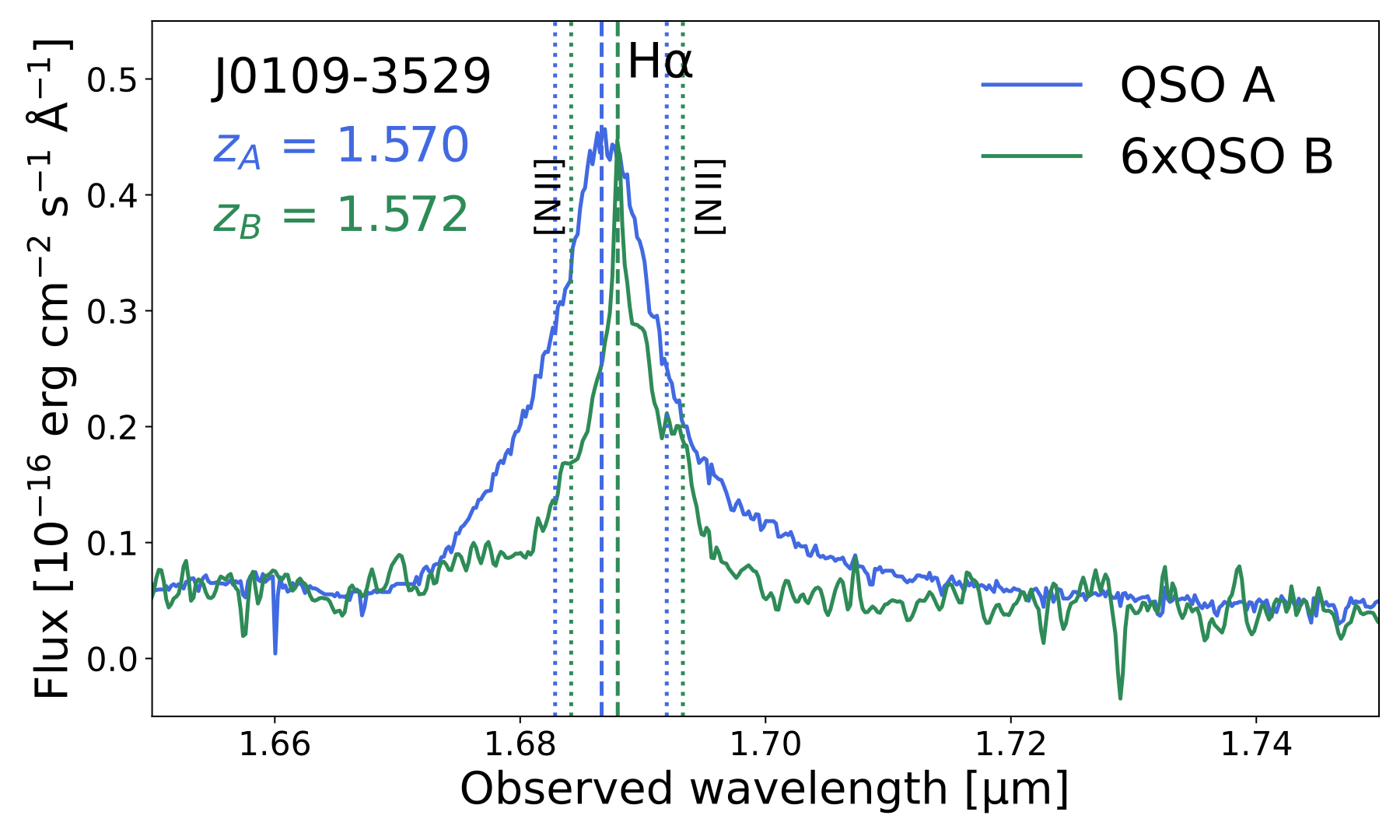
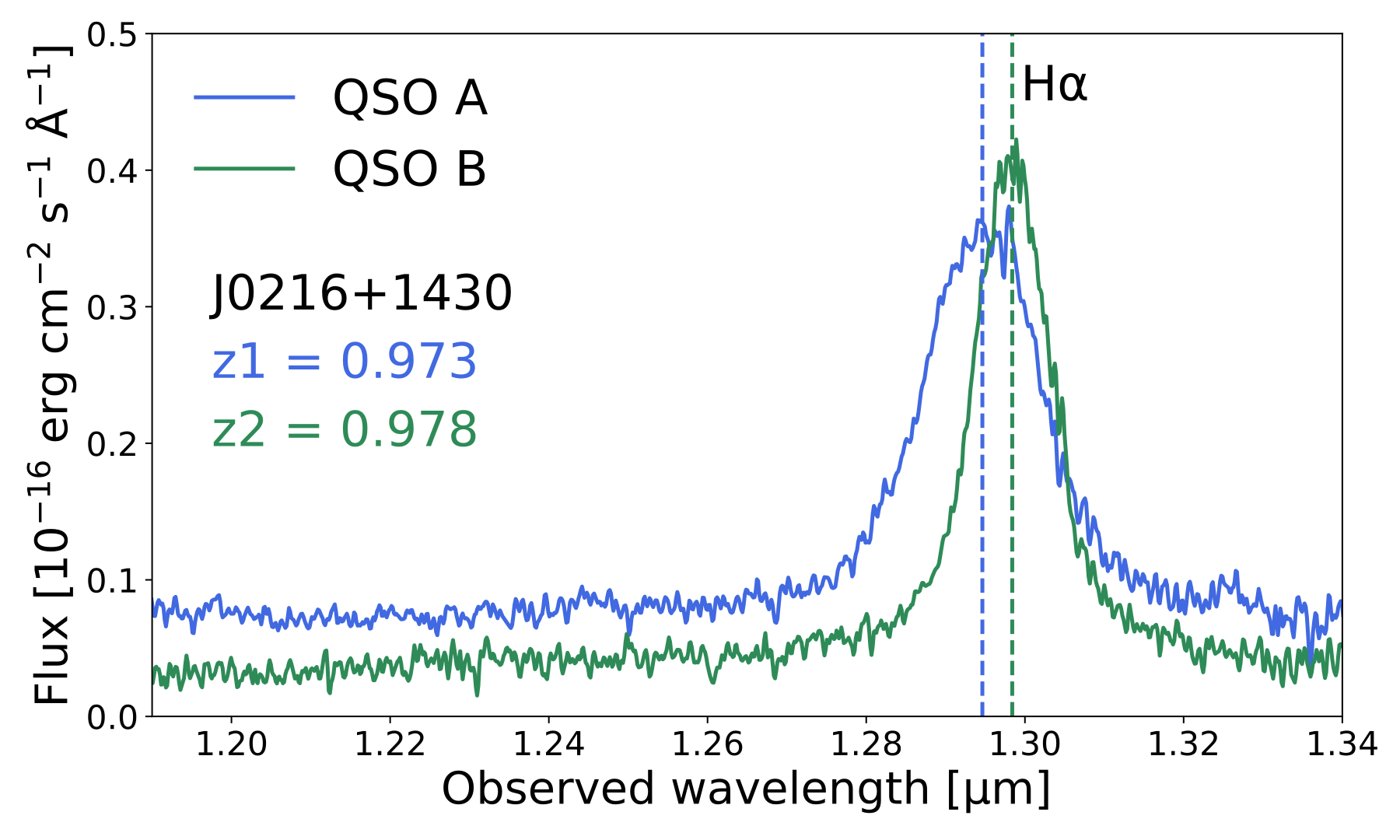
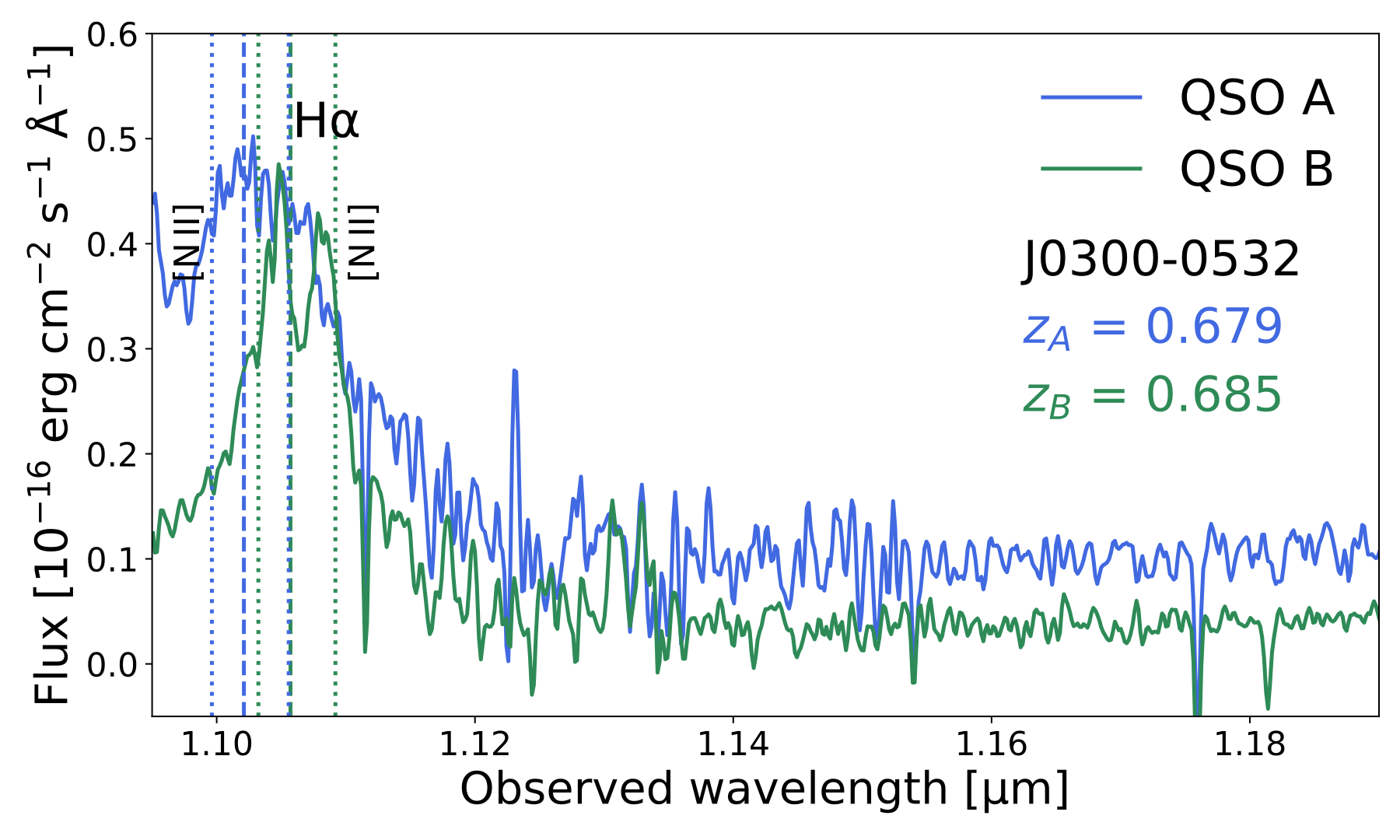
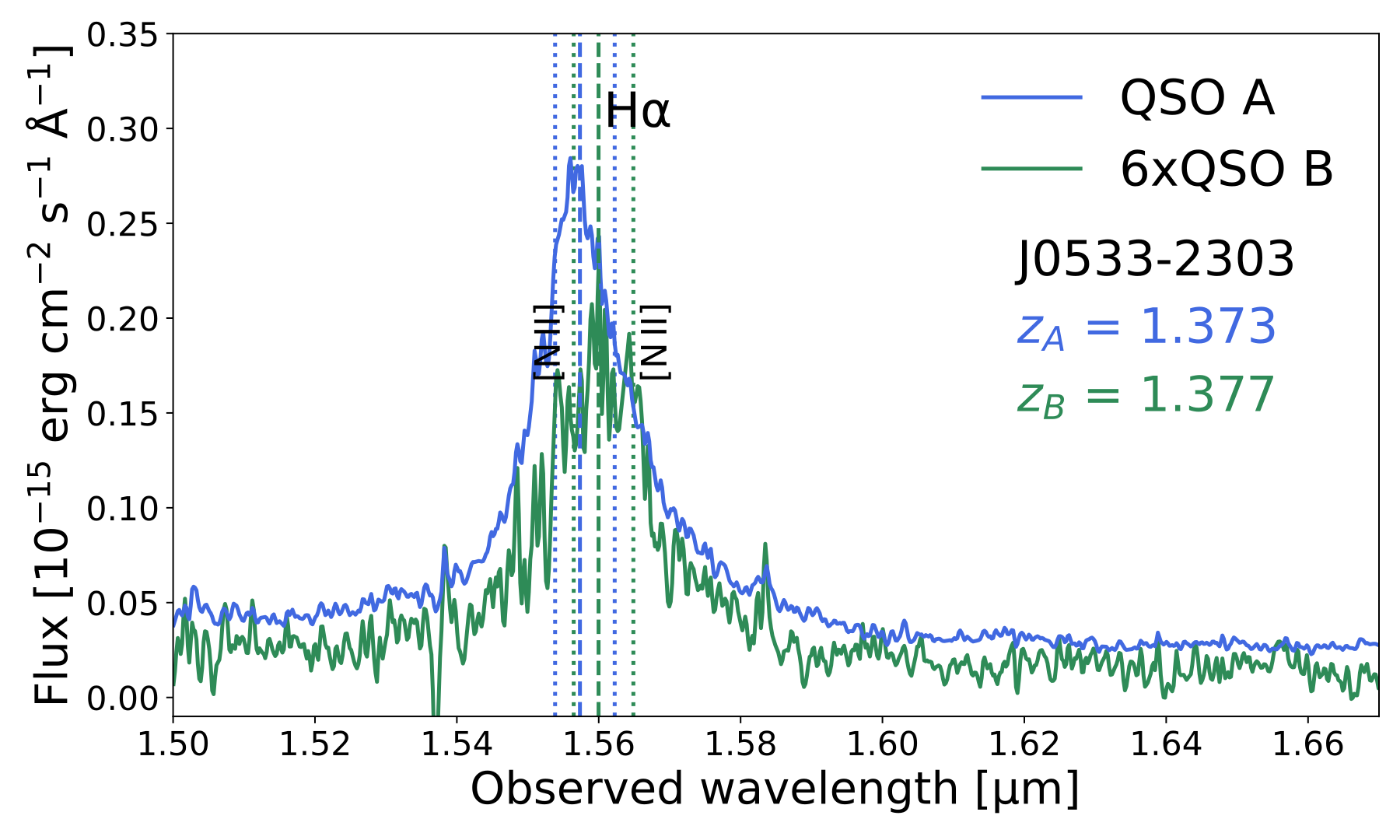
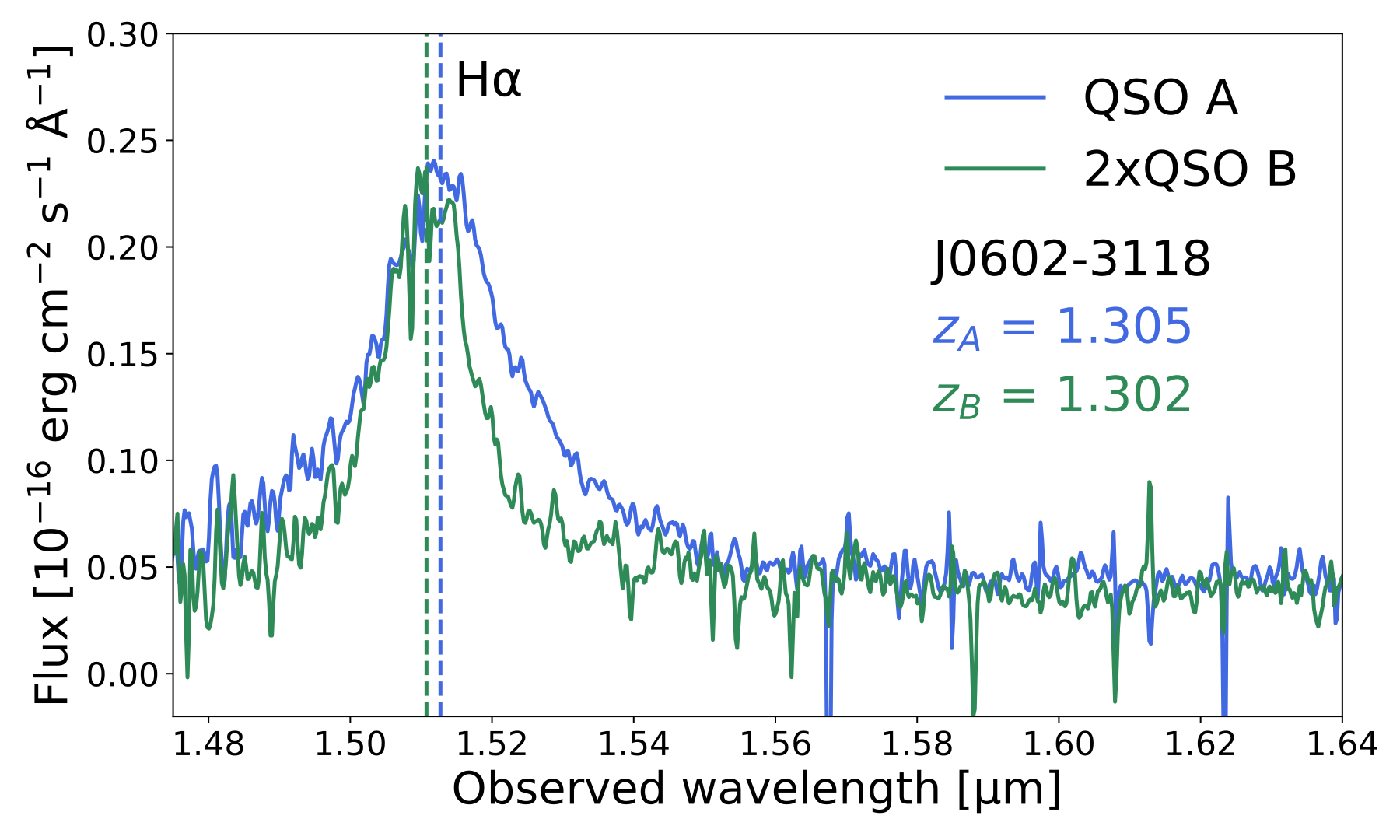
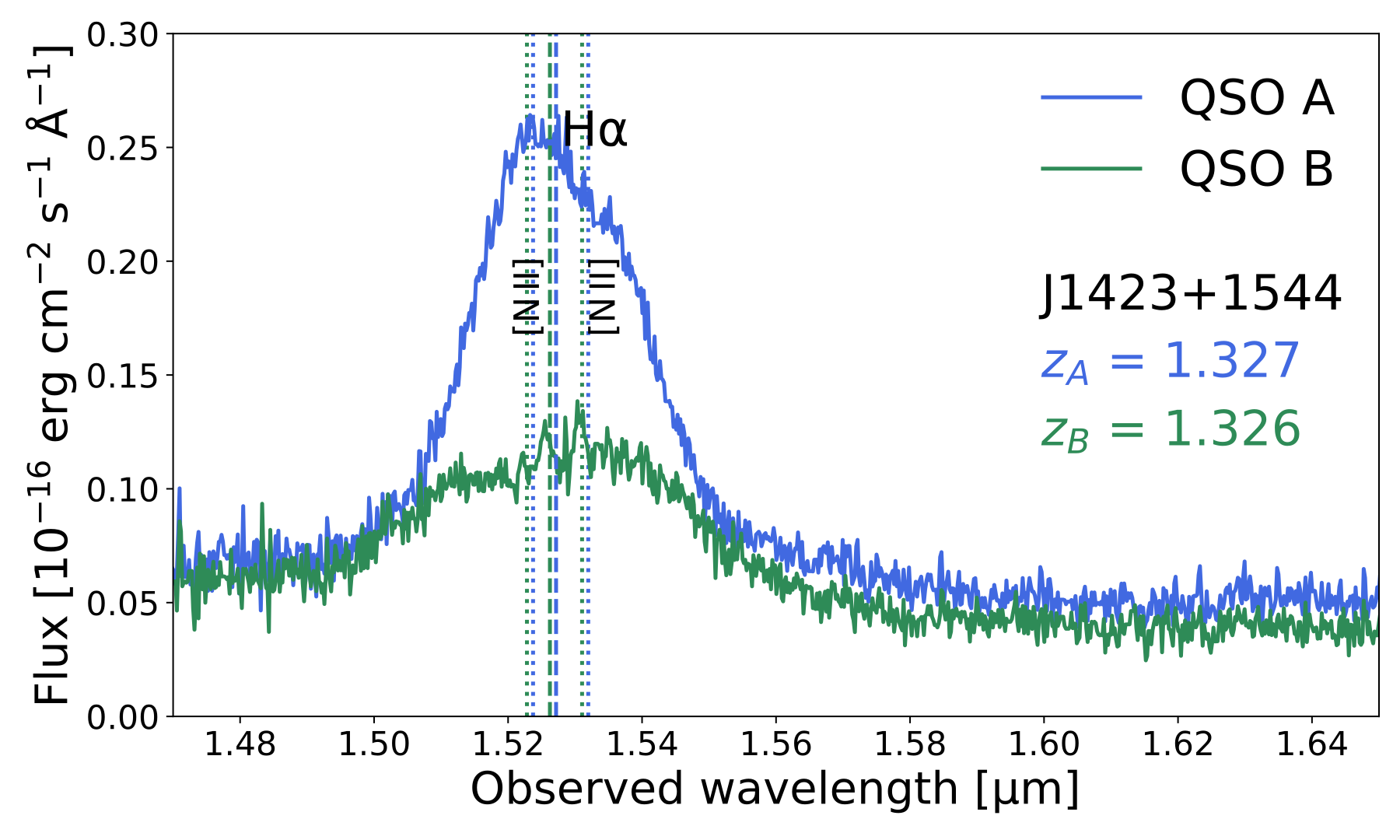
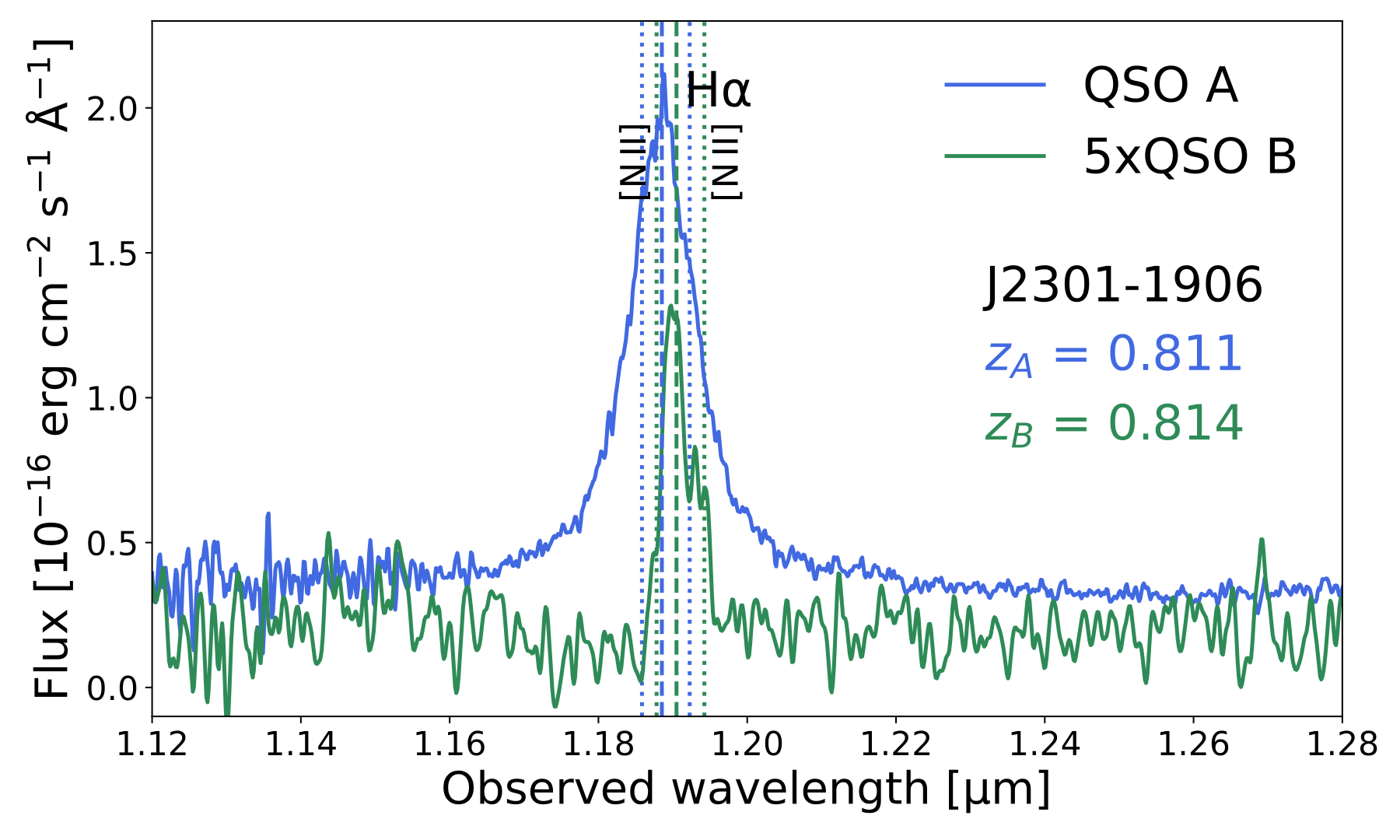
Tests component-level spectral classification: spectra are extracted with combined 2D-Moffat functions to limit cross-contamination, and expected emission-line positions are marked for the two components.
Original caption
Figure 3: Spectra of the dual AGN systems and J2301–1906 observed with ERIS (target name and redshift are reported in the panels). They have been extracted using a combination of 2D-Moffat functions in order to avoid contamination, as explained in the text. The spectra have the same color-coding of the labels of Figure 1 . Vertical dotted lines mark the position of the main expected emission lines.
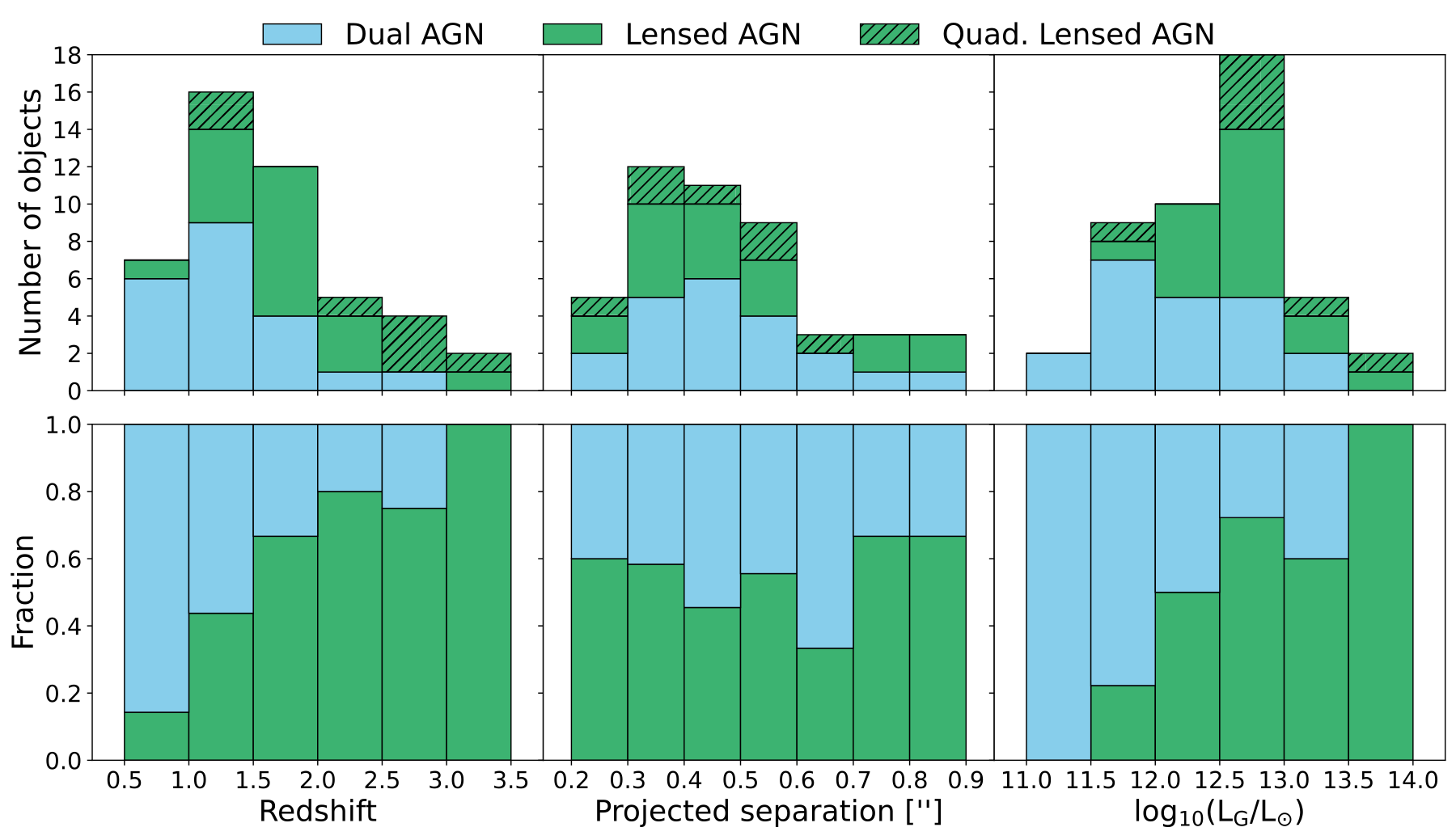
Tests how dual and lensed GMP classifications vary with redshift, separation, and total Gaia G-band luminosity in the combined follow-up sample; quad-lens scales use enclosing-circle radii or specified Einstein radii.
Original caption
Figure 5: Number distributions and fractions of dual and lensed AGN in the sample of GMP systems classified either as dual or lensed (double or quadruple) AGN. The sample includes the systems listed in Table 2 and the GMP systems classified as dual or lensed AGN in previous works ( Ciurlo et al., 2023 ; Mannucci et al., 2023 ; Scialpi et al., 2024 ; Scialpi et al., 2026a ) . Top panels: Number distributions of dual AGN and the dual AGN candidate J2301–1906 (blue) and lensed AGN (green) as a function of redshift, projected separation, and total Gaia G G -band luminosity. Quadruply imaged lensed systems are shown in green with black hatching. Bottom panels: Fractions of dual AGN (blue) and lensed AGN (green) in this sample as a function of the same quantities. For quadruply imaged lensed systems, the radius of the circle enclosing all four AGN images is used as a proxy for the projected separation. In the case of J1453+0529 and J1608+2716 the Einstein ring radius calculated by D’Amato et al. (2026b) and Li et al. (2023) is used.
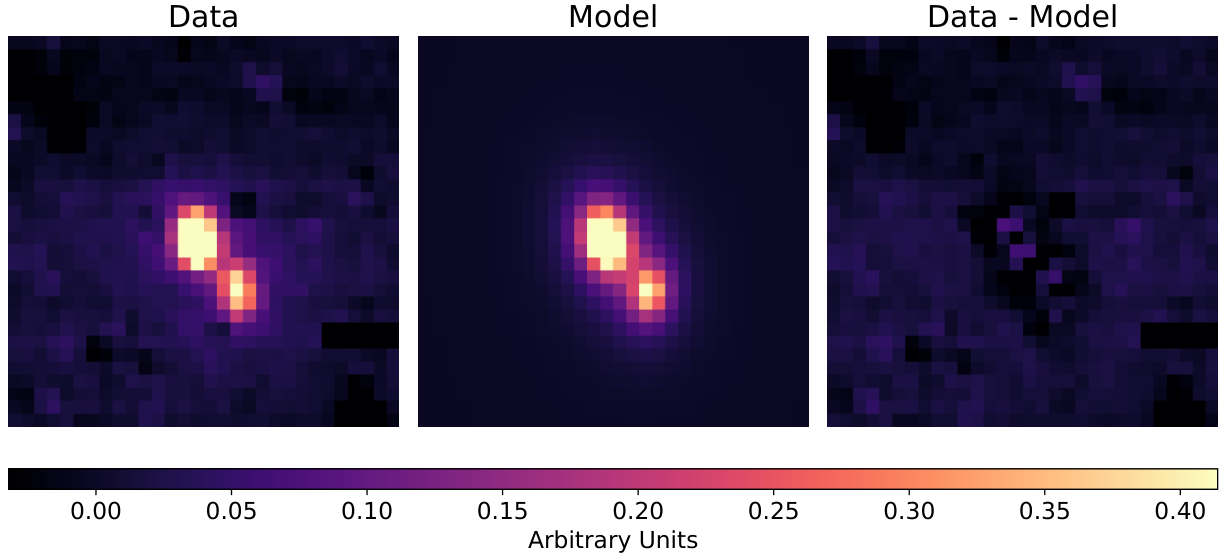
Tests spatial deblending with an example dual AGN: it compares the broadband data, a two-component 2D-Moffat model, and the residual map.
Original caption
Figure 8: Example of the 2D--Moffat decomposition for the dual AGN J0602–31118. From left to right: broad band image (data) of the system, double 2D--Moffat model and residual (data - model) map. The maps are normalized to the maximum of the data map.
Related research
Previous digest
This ERIS–SPIFFIER adaptive-optics integral-field survey follows up 34 Gaia Multi-Peak candidates, a selection that targets luminous unobscured AGN at sub-arcsecond separations, across 0.7 < z < 3.4. Spatially resolved imaging and component-separated near-infrared spectra identify 13 multiple AGN-like systems: six kpc-scale dual AGN at z = 0.68–1.57 with 290–950 km s⁻¹ velocity offsets, plus seven lensed quasars, six of them newly recognized. The high foreground-star superposition rate (18/34) underscores the need for spatially resolved spectroscopy, while the confirmed systems substantially expand the compact dual and lensed AGN census beyond z > 0.5.
Sources and evidence (25)
- 2610.27086v1: Dual and lensed AGN at sub-arcsecond separations uncovered by ERIS
We present the first results of the ongoing INAF GTO program focused on the search of sub–arcsecond dual AGN, carried out with the near-infrared integral-field unit SPIFFIER of the Enhanced Resolution Imager and Spectrograph (ERIS) at the ESO Very Large Telescope, operating in adaptive-optics mode with a laser guide star. We report integral field spectroscopy with the low–resolution gratings ( R ∼ 5000 − 5600 R\sim 5000-5600 ) of 34 multiple AGN candidates selected from the Gaia Data Release 3 source catalog via the Gaia Multi-Peak (GMP) method, which preferentially identifies luminous unobscured AGN at sub-arcsecond separations. The targets span the redshift range 0.7 ≲ z ≲ 3.4 0.7\lesssim z\lesssim 3.4 and exhibit projected angular separations between ∼ 0.2 ′′ {\sim}0.2^{\prime\prime} and ∼ 0.9 ′′ {\sim}0.9^{\prime\prime} , corresponding to physical separations of ∼ 1.7 {\sim}1.7 – 7.8 7.8 kpc. Of the 34 observed systems,13 ( ∼ 40 % {\sim}40\% ) are resolved into multiple AGN-like components; 18 ( ∼ 53 % {\sim}53\% ) are classified as AGN plus foreground star superpositions, one as a single AGN, and two as systems with an AGN primary and an unclassified secondary component. Among the multiple AGN systems, we confirm six dual AGN at projected separations of 0.26 ′′ 0.26^{\prime\prime} – 0.80 ′′ 0.80^{\prime\prime} ( 2.2 2.2 – 6.7 6.7 kpc), in the redshift range z = 0.68 z\penalty\ =\penalty\ 0.68 – 1.57 1.57 , and with velocity offsets in the range Δ v ∼ 290 \Delta v\sim 290 – 950 950 km s − 1 \rm km\penalty\ s^{-1} . We also identify seven gravitationally lensed quasars, only one of which was previously known, including four doubly imaged and three quadruply imaged systems. These results substantially enlarge the census of spectroscopically confirmed compact multiple AGN systems at z > 0.5 z>0.5 and demonstrate the efficiency of ERIS–SPIFFIER for the systematic characterization of sub-arcsecond dual and lensed AGN candidates.
- 2610.27086v1: Dual and lensed AGN at sub-arcsecond separations uncovered by ERIS
The resulting sample of ∼ \sim 700 spectra, for which the primary component was confirmed to be an AGN, was further inspected for possible stellar contamination through a spectral decomposition analysis ( Scialpi et al., 2026a ; Scialpi & Marconcini, in prep.). This step is necessary because long-slit spectroscopy alone cannot distinguish between AGN pairs and projected AGN+star systems, both of which may appear as multiple-peaked sources in Gaia light profile. Each spectrum was modeled with pPXF ( Cappellari and Emsellem, 2004 ) using a linear combination of quasar ( Temple et al., 2021 ) and stellar (G, K, M types, Yan et al. 2019 ) templates. The fit simultaneously accounts for the quasar redshift, dust attenuation, and relative template normalizations, while allowing for a velocity shift of the stellar component. Candidate AGN+star systems were identified by comparing the quality of the best-fitting quasar+star model with that of a pure quasar model. The presence of a stellar component was assessed by quantifying the improvement of the fit around prominent stellar absorption features relative to a pure quasar model. Sources satisfying the adopted contamination criteria ( Δ χ R 2 > 10 % \Delta\chi^{2}_{\rm R}>10\% or Δ BIC > 6 \Delta{\rm BIC}>6 ) were classified as likely AGN+star contaminants. We note that the spectral-decomposition analysis was primarily used to rank candidates according to their probability of stellar contamination. To optimize the use of the allocated observing time, some lower-priority candidates were observed when higher-priority targets were unavailable. Consequently, a fraction of AGN+star contaminants remains in the final IFU sample.
- 2610.27086v1: Dual and lensed AGN at sub-arcsecond separations uncovered by ERIS
Figure 5 shows the number distributions (top panels) and fractions (bottom panels) of dual AGN and the dual AGN candidate J2301–1906 (blue) and lensed AGN (green) relative to the total sample of GMP multiple AGN systems (i.e. dual+dual cand.+lensed) as a function of redshift, projected separation, and total Gaia G G -band luminosity. In the top panels we also distinguish between double lensed AGN (green) and quadruply lensed AGN (green with black hatching). When multiple components are present in the Gaia archive, the total luminosity is computed by converting the individual G G -band magnitudes into luminosities and summing their contributions. The sample comprises 20 dual AGN, the dual AGN candidate J2301–1906, 18 doubly imaged lensed AGN, and 7 quadruply imaged lensed AGN, all selected through the GMP method, combining the results obtained with VLT/ERIS in this work with those from Keck/OSIRIS ( Ciurlo et al., 2023 ; Mannucci et al., 2023 ) and VLT/MUSE ( Scialpi et al., 2024 ; Scialpi et al., 2026a ) . The quadruply imaged lensed systems are included by adopting the radius of the circle enclosing all four AGN images as a proxy for the image-separation scale. In the case of J1453+0529, we adopt the Einstein ring radius calculated by D’Amato et al. (2026b) . The GMP system J1608+2716, at z = 2.575 z=2.575 , was reported as a triple-quasar candidate with sub–arcsecond separations ( ∼ \sim 0.25 ″ 0.25\text{\,}\mathrm{\SIUnitSymbolArcsecond} ) based on Keck AO-assisted IFU spectroscopy ( Ciurlo et al., 2023 ) ; deep HST imaging subsequently revealed a fourth point-like component, indicating that J1608+2716 is a single quasar lensed into four images ( Li et al., 2023 ) . We therefore adopt r E = 0.42 ″ r_{\rm E}=$0.42\text{\,}\mathrm{\SIUnitSymbolArcsecond}$ ( Li et al., 2023 , ∼ 3.4 {\sim}3.4 kpc at z = 2.575 z=2.575 ;) as proxy for the separation in this system.
- 2610.27086v1: Dual and lensed AGN at sub-arcsecond separations uncovered by ERIS
The AGN+star contamination fraction varies across the different instruments and selection sub-samples: ∼ 40 % {\sim}40\% in the VLT/MUSE-based follow-up ( Scialpi et al., 2024 ; Scialpi et al., 2026a ) , and ∼ 50 % {\sim}50\% in the combined Keck/OSIRIS and VLT/ERIS samples ( Ciurlo et al., 2023 ; Mannucci et al., 2023 ) , including this work. At wider separations, the GMP selection becomes increasingly sensitive to chance projections between an AGN and a foreground star, since the contamination probability increases monotonically with r r (scaling as ∼ r 2 {\sim}r^{2} in the small- r r limit; Mannucci et al. 2022 ; Scialpi et al. 2026a ). To quantify this behavior across the full combined sample, we fit the empirical contamination model given by Eq. (3) of Scialpi et al. (2026a) to the binned AGN+star fraction as a function of projected separation, using all systems observed with VLT/MUSE, VLT/ERIS, and Keck/OSIRIS. This functional form describes the probability of a chance alignment between an AGN and a foreground star within a projected radius r r , where D D represents the mean distance to the nearest stellar contaminant. We obtain a best-fit value of D ∼ 0.60 ′′ D\sim 0.60^{\prime\prime} . At the mean separation of our sample ( r ¯ ≃ 0.5 ′′ \bar{r}\simeq 0.5^{\prime\prime} ), the resulting contamination probability is P ( r ¯ ) ≃ 0.43 P(\bar{r})\simeq 0.43 . This value is higher than the ∼ 30 % {\sim}30\% stellar-contamination fraction assumed by Mannucci et al. (2022) . A fraction of these contaminants is removed prior to IFU follow-up by the spectral-decomposition analysis ( Scialpi et al., 2024 ; Scialpi et al., 2026a , Scialpi & Marconcini, in prep.) , which was primarily used to rank candidates by their probability of stellar contamination. Nevertheless, observational constraints inherent to a GTO program, namely fixed observing nights and the consequent limited flexibility in target selection, meant that some lower-priority, higher-contamination candidates were still observed whenever higher-priority targets were unavailable. Consequently, a fraction of AGN+star contaminants remains in the final IFU sample. In addition, the faintest stellar contamin
- 2610.27086v1: Dual and lensed AGN at sub-arcsecond separations uncovered by ERIS
Compared with classical strong-lens searches, which have built statistical samples of galaxy-scale lenses mostly at image separations larger than ∼ 1 ′′ \sim 1^{\prime\prime} and source redshifts up to z ∼ 2 z\sim 2 ( Bolton et al., 2008 ; Faure et al., 2008 ; Inada et al., 2012 ; Shajib et al., 2021 , e.g.) , GMP-selected lensed systems extend the explored parameter space toward compact sub-arcsecond lensed quasars at higher redshifts up to z ∼ 3 z\sim 3 ( Ciurlo et al., 2023 ; Mannucci et al., 2023 ; Scialpi et al., 2024 ; Scialpi et al., 2026a , and this work) . Indeed, the GMP method targets Einstein radii smaller than the effective radius of the lens galaxy and therefore enables studies of its inner regions even at high redshift (e.g. D’Amato et al., 2026b , z QSO = 2.82 z_{\rm QSO}=2.82 , r E ∼ 1.71 r_{E}\sim 1.71 kpc) .
- 2610.27086v1: Dual and lensed AGN at sub-arcsecond separations uncovered by ERIS
The six dual AGN analyzed in this work exhibit line-of-sight velocity offsets spanning Δ v ∼ 290 \Delta v\sim 290 – 950 950 km s − 1 \rm km\penalty\ s^{-1} , as measured via template fitting, see Section 4.1 . These values are broadly consistent with those expected for physically associated galaxy pairs undergoing mergers. Using interacting galaxy pairs with recent close passages ( < 1 <1 Gyr) from the Illustris-TNG100 simulation ( Patton et al., 2024 ) , Pfeifle et al. (2025) found that most systems in the relevant projected-separation range exhibit line-of-sight velocity offsets of | Δ v | ≲ 600 |\Delta v|\lesssim 600 km s − 1 \rm km\penalty\ s^{-1} . Four of our six dual AGN fall within this range, while the other two systems lie above this threshold, J0300 − - 0532 ( Δ v ∼ 950 \Delta v\sim 950 km s − 1 \rm km\penalty\ s^{-1} ) and J0216 + + 1430 ( Δ v ∼ 800 \Delta v\sim 800 km s − 1 \rm km\penalty\ s^{-1} ). We caution, however, that all Δ v \Delta v measurements are derived from the total H α \rm H\alpha line profile, dominated by the BLR component, whose centroid can be shifted with respect to the systemic velocity by BLR kinematics, outflow components, or blended emission. Therefore, these velocity offsets should be interpreted as indicative broad-line shifts rather than precise systemic velocity differences. In the absence of spectrally resolved narrow emission lines, the systemic redshift of each component cannot be determined unambiguously and the quoted Δ v \Delta v values may be affected by large uncertainties.
- 2610.27086v1: Dual and lensed AGN at sub-arcsecond separations uncovered by ERIS
Among the 34 targets, 13 ( ∼ 40 % {\sim}40\% ) are resolved into two or more AGN or AGN-like components, 18 ( ∼ 53 % {\sim}53\% ) are identified as AGN+star superpositions, one ( ∼ 3 % {\sim}3\% ) is classified as a single AGN, and two as systems with an AGN primary and an unclassified secondary component. The fraction of single AGN systems is consistent with the false-positive rate predicted for GMP-selected sources ( Mannucci et al., 2022 ; Mannucci et al., 2023 ) . Of the 13 multiple AGN systems, we classify six as dual AGN, and seven as gravitationally lensed quasars, including four doubly imaged and three quadruply imaged systems. The dual AGN span the redshift range 0.68 ≤ z ≤ 1.57 0.68\leq z\leq 1.57 , projected separations of 0.26 ′′ 0.26^{\prime\prime} – 0.80 ′′ 0.80^{\prime\prime} ( 2.2 2.2 – 6.7 6.7 kpc), and broad-line velocity offsets of Δ v ∼ 290 \Delta v\sim 290 – 950 950 km s − 1 \rm km\penalty\ s^{-1} . Dust attenuation is generally modest, with E ( B − V ) ≲ 0.3 E(B-V)\lesssim 0.3 , indicating that GMP-selected dual AGN predominantly probe unobscured systems. The lensed sample includes J1453 + + 0529, currently the smallest-separation quadruply imaged quasar known ( r E = 0.21 ′′ ± 0.02 ′′ r_{\rm E}=0.21^{\prime\prime}\pm 0.02^{\prime\prime} ; D’Amato et al. 2026b ), and J0602 − - 3852, the most distant system in our sample ( z = 3.04 z=3.04 ). Combined with previous GMP follow-up campaigns ( Ciurlo et al., 2023 ; Mannucci et al., 2023 ; Scialpi et al., 2024 ; Scialpi et al., 2026a ) , these results further demonstrate that the GMP method efficiently identifies compact lensed quasars that occupy a region of parameter space largely unexplored by traditional lens searches, namely sub-arcsecond systems at z ≳ 2 z\gtrsim 2 .
- 2610.27086v1: Dual and lensed AGN at sub-arcsecond separations uncovered by ERIS
We present the first results of the ongoing INAF GTO program focused on the search of sub-arcsecond dual AGN, carried out with the near-infrared integral-field unit SPIFFIER of the Enhanced Resolution Imager and Spectrograph (ERIS) at the ESO Very Large Telescope, operating in adaptive-optics mode with a laser guide star. We report integral field spectroscopy with the low-resolution gratings (R ~ 5000 - 5600) of 34 multiple AGN candidates selected from the Gaia Data Release 3 source catalog via the Gaia Multi-Peak (GMP) method, which preferentially identifies luminous unobscured AGN at sub-arcsecond separations. The targets span the redshift range 0.7 < z < 3.4 and exhibit projected angular separations between ~0.2'' and ~0.9'', corresponding to physical separations of ~1.7-7.8 kpc. Of the 34 observed systems,13 (~40 %) are resolved into multiple AGN-like components; 18 (~53 %) are classified as AGN plus foreground star superpositions, one as a single AGN, and two as systems with an AGN primary and an unclassified secondary component. Among the multiple AGN systems, we confirm six dual AGN at projected separations of 0.26'' - 0.80'' (2.2 - 6.7 kpc), in the redshift range z = 0.68 - 1.57, and with velocity offsets in the range Δv ~ 290 - 950 km/s. We also identify seven gravitationally lensed quasars, only one of which was previously known, including four doubly imaged and three quadruply imaged systems. These results substantially enlarge the census of spectroscopically confirmed compact multiple AGN systems at z > 0.5 and demonstrate the efficiency of ERIS-SPIFFIER for the systematic characterization of sub-arcsecond dual and lensed AGN candidates.
- 2610.27086v1: Dual and lensed AGN at sub-arcsecond separations uncovered by ERIS
In this paper, we present the first results of the VLT/ERIS follow-up of the GMP-selected multiple AGN candidates. Table 1 summarizes the main properties of the full sample. We report the FMP parameter, as well as the G-band magnitudes of the primary ( G A G_{A} ) and secondary components ( G B G_{B} , when multiple components are present in the Gaia catalog), as listed in the Gaia archive. By definition, the primary component (A) is the brightest source in the Gaia G band, i.e. G A < G B G_{A}<G_{B} . The redshift of each system is derived from the long-slit spectra, as described in Section 2 . Because the selection is based on optically bright AGN, the targets are expected to be type 1 QSOs. The ERIS–SPIFFIER observations therefore allow us to classify the systems by comparing the emission-line properties of the different components (see Section 4 ) and, for confirmed dual AGN, to derive black-hole mass estimates from the broad-line emission. Scialpi et al. (2026b) will present the black-hole mass estimates for all the GMP dual AGN confirmed so far, i.e. including from this work; Mannucci et al. (2023) ; Ciurlo et al. (2023) ; Scialpi et al. (2024) ; Scialpi et al. (2026a) . In Table 1 , we also report the classification of each system as: (i) AGN+AGN, corresponding to the 13 systems resolved into multiple AGN-like components, either dual AGN or gravitationally lensed systems; (ii) AGN+star, corresponding to 18 systems that are chance alignments between an AGN and a foreground star; (iii) AGN, for the system in which only a single AGN component is detected (see Section F ); and (iv) AGN+Unclass., for the systems in which the secondary remains unclassified (see Section 4.2 ).
- 2610.27086v1: Dual and lensed AGN at sub-arcsecond separations uncovered by ERIS
Table 2: Results of the analysis of systems classified as dual AGN, double lensed and quadruply lensed AGN. 2 2 2 Notes. The position angle (PA) is the angle measured clockwise from North toward East, calculated from the primary component A to the secondary B. The separation corresponds to the distance between the two components in case of a double system (lensed or dual AGN), to the radius of the circle enclosing all the four AGN images for J0459–0413 and J0602–3852, and to the Einstein ring radius in the case of J1463+0529 ( D’Amato et al., 2026b ) . (∗) : Jap3, Hap3 or Kap3 magnitudes from the fifth data release (DR5) of the VISTA Hemisphere survey ( McMahon et al., 2013 , VHS;) . The 2MASS ( Skrutskie et al., 2006 ) H magnitude was adopted for J0533–2303 since the Hap3 magnitude from VHS DR5 was not available. (∗∗) : J, H or K magnitudes derived from the available ones, see Appendix A . For J0602–3852, we report the results from the observation taken in K _ \_ low band, see Section 4.3 for details on the J _ \_ low data. J1335+0527 is classified as double lensed AGN thanks to VLT/MUSE NFM data, see Sections D and 4.3 . J0300–0532 was first observed and classified using HST /STIS data (Tozzi et al. in prep.).
- 2607.00093v1: Search for Quasar Pairs with ${\it Gaia}$ Astrometric Data. III. Discovery of 9 dual and projected quasars
This work reported the spectroscopic follow-up of 11 QP candidates and the discovery of 6 DQs and 3 PQs. One of the DQs has a high redshift of ∼ \sim 3.1. These candidates were selected from the MGQPC catalog proposed in the Paper-I and the early version of this catalog that was not published in Paper-I . Low-resolution long-slit spectroscopic observations were carried out employing 5 spectrographs equipped on 3 telescopes (OMR/XLT216, BFOSC/XLT216, YFOSC/LJ240, DBSP/P200, and NGPS/P200). The observed spectra were reduced using a Python module PySpecRedux , which was developed by us and is dedicated to low-resolution long-slit spectra. In addition, public spectra from SDSS DR17, DESI DR1, and LAMOST DR13 were also adopted as auxiliary data to improve the confirmation of the observed candidates. Two QSP systems were securely ruled out by our NGPS observations. By calculating | Δ v r | \lvert\Delta v_{r}\rvert between the two member quasars in each pair, 3 PQs were distinguished using a simple cut of | Δ v r | \lvert\Delta v_{r}\rvert ⩽ \leqslant 2000 km/s. The remaining 6 pairs with identical member redshifts were all confirmed as DQs through examination of the member quasar spectra, spectral flux ratios, and imaging data. The LQ hypothesis of 3 of the 6 DQs cannot be completely ruled out.
- 2607.00093v1: Search for Quasar Pairs with ${\it Gaia}$ Astrometric Data. III. Discovery of 9 dual and projected quasars
We discuss 3 main topics aimed at optimizing the QP confirmation strategy and guiding future spectroscopic follow-up and identification efforts. The 3 topics include analyzing the color features of the observed targets, using photometric redshift estimation to improve the selection of QP candidates, and future confirmation strategies that could provide decisive observational evidence.
- 2607.19491v1: Rapid growth in a dual AGN during a gas-rich merger at z~4.5
solating nuclear emission lines even when the underlying host galaxies are invisible. Our results suggest that close-separation (< 3 kpc) dual AGNs may have been missed in previous surveys owing to heavy obscuration, thereby biasing current census estimates. Systematic IFU studies with JWST, complemented by adaptive-optics (AO)-assisted near-infrared IFU spectroscopy from the ground (i.e., Gemini/GNIRS, Gemini/GIRMOS, Keck/OSIRIS, VLT/ERIS) and future 30-m class telescopes, will be essential for revealing this missing population and establishing the true role of mergers in driving rapid SMBH growth across cosmic time.
- 2607.19491v1: Rapid growth in a dual AGN during a gas-rich merger at z~4.5
M.V., G.H., F.C., A.G., A.F., S.O. helped with the interpretation of the results and provided comments on the analysis. All authors contributed to the discussion of the presented results and the preparation of the manuscript.
- 2510.09820v1: Resolving stellar populations, star formation, and ISM conditions with JWST in a large spiral galaxy at z $\sim$ 2
In Fig. 15 , we show the resulting maps of observed (i.e. not dust-corrected) H α \alpha and Pa β \beta flux, along with the nebular A V , neb A_{V,{\rm neb}} map, as obtained from pixel-per-pixel Pa β \beta /H α \alpha line ratios, according to a Calzetti et al. (2000) dust attenuation law ( R V R_{V} = 4.05). Unfortunately, due to faintness of the Pa β \beta line emission compared to the continuum, this approximate procedure allows us to recover only Pa β \beta line flux in part of the most actively star-forming regions (i.e., clumps and spiral arms). Apparently Pa β \beta is also detected in the bulge, as opposed to the NIRCam WFSS Pa β \beta map (shown in Fig. 5 ). For this reason, we caution on the reliability of the Pa β \beta detection in the inner central regions. The right-hand panel of Fig. 15 displays the resulting A V , neb A_{V,{\rm neb}} map inferred from Pa β \beta /H α \alpha line ratios, after masking pixels with (non-physical) negative A V , neb A_{V,{\rm neb}} values. Given the sparse nature of the resulting A V , neb A_{V,{\rm neb}} map, we estimate the average A V , neb A_{V,{\rm neb}} value, after masking pixels within our 0.25 ′′ -diameter bulge aperture (being them subject to the large uncertain on the Pa β \beta line flux), and adopt this value as indicative of the global dust attenuation of the galaxy, assuming an uncertainty of 30% (i.e. A V , neb A_{V,{\rm neb}} = 2.0 ± \pm 0.6).
- 2510.09820v1: Resolving stellar populations, star formation, and ISM conditions with JWST in a large spiral galaxy at z $\sim$ 2
Figure 16: Expected observed H α \alpha flux (left), as recovered from the SFR10 and A V , star A_{V,{\rm star}} maps resulting from our spatially resolved SED fitting (see Fig. 4 ), and the real observed H α \alpha flux from VLT/ERIS observations (right). Grey contours trace NIRCam F444W emission at 5%, 10%, 35%, 50% of the emission peak. Both maps have the same colorscale and a 0.025 ′′ pixelscale.
- 2609.22449v1: LoTSS of dual AGN: enhanced detectability and prospects for a systematic search
where A int A_{\mathrm{int}} is the integration area in beam units, and σ cal \sigma_{\mathrm{cal}} is the calibration error conservatively assumed to be 20% for the 144 MHz images and 10% for the GHz-range archival images when they are used ( Perley and Butler, 2013 ; Sweijen et al., 2022 ) . J0930+4614 and J1120+6711 are well fitted by a single Gaussian component, while for the extended irregular emission of J1643+3156 we found that a 6-Gaussian components fitting provided the best results (the total flux density is 1 σ \sigma in agreement with that measured manually within the 5 σ 5\sigma contours). The major ( θ maj \theta_{\rm maj} ) and minor ( θ min \theta_{\rm min} ) axes are calculated as the deconvolved full-width-half-maximum (FWHM) of the Gaussian fit for J0930+4614 and J1120+6711, while for J1643+3156 complex extended emission we manually measured a size of ∼ 1.9 ′′ × 2.3 ′′ \sim 1.9^{\prime\prime}\times 2.3^{\prime\prime} within its 5 σ 5\sigma contours. In Table 2 we report flux densities in column 1, and θ maj \theta_{\rm maj} and θ min \theta_{\rm min} in columns 4 and 5, respectively.
- 2609.22449v1: LoTSS of dual AGN: enhanced detectability and prospects for a systematic search
Results. We successfully produced high-quality ILT images for the three DAGN in the pilot sample. In one source at z = 1.49 z=1.49 , we detect both AGN components at > 5 σ >5\sigma , making it one of the highest- z z and faintest DAGN detected at radio frequencies. Brightness temperature measurements confirm that ILT 144 MHz observations can efficiently distinguish AGN-powered emission from star formation even in sub-mJy sources. In the other two sources we detect only one AGN. In one of them, the new ILT imaging constrains the low-frequency radio spectrum of the compact steep spectrum source, indicating that its complex morphology is shaped by jet-ISM interaction rather than by the companion galaxy. In addition, for the full 92 DAGN sample, we found a detection rate of ∼ \sim 24% in both LoTSS DR2 and DR3, significantly larger than that of single AGN matched in selection ( ∼ \sim 9–10%), suggesting an enhanced detectability of DAGN in the LoTSS.
- 2609.29072v1: High-z galaxies with the JWST and the ELT: Toward Ever-finer Detail
). As a result, in the low − - magnification regime ( μ ≲ 10 \mu\lesssim 10 ), statistical errors can be reduced to only a few percent, while at large magnifications, close to critical lines, systematic errors dominates.
- 2609.29072v1: High-z galaxies with the JWST and the ELT: Toward Ever-finer Detail
s et al., 2026 , e.g.,) . For more complete reviews of JWST results see also ( Adamo et al., 2025 ; Matthee, 2025 ) .
- 2511.06085v1: A JWST/NIRSpec Integral Field Unit Survey of Luminous Quasars at z ~ 5-6 (Q-IFU): Rest-frame Optical Nuclear Properties and Extended Nebulae
In Liu et al. [39] , we introduced a JWST cycle 2 NIRSpec/integral field unit (IFU) survey program #3428 (; PI W. Liu), which observed 27 luminous quasars at z ∼ \sim 5–6. In that paper, we presented novel results on the detection of more frequent extreme galaxy-scale outflows in the z ∼ \sim 5–6 quasars from the survey program than in the lower-z quasars. In this work, we report other key rest-frame optical spectral properties of these z ∼ \sim 5–6 quasars and their host galaxies/companion galaxies from the same program. This paper is organized as follows. In Section II , we describe the sample selection, observations and data reduction. In Section III , the spectral fitting and analysis are presented. The discussion on the quasar nuclear spectral properties and extended line emission is presented in IV and V , respectively. Finally, our main conclusions are summarized in Section VI . Throughout the paper, we assume a Λ \Lambda CDM cosmology with H 0 = H_{0}= 70 km s -1 Mpc -1 , Ω m \Omega_{\rm m} = 0.3, and Ω Λ = 0.7 \Omega_{\rm\Lambda}=0.7 . An arcsecond corresponds to 5.71–6.45 kpc at the redshifts of our objects.
- 2511.06085v1: A JWST/NIRSpec Integral Field Unit Survey of Luminous Quasars at z ~ 5-6 (Q-IFU): Rest-frame Optical Nuclear Properties and Extended Nebulae
We determine the systemic redshifts of our objects through the peak of the narrow [O iii ] component or the overall H β \beta component when no narrow [O iii ] emission line is detected. Our mean and median redshifts ∼ \sim 390 and ∼ \sim 40 km s -1 larger than the rest-frame UV emission line-based redshifts (including C IV , C III ] and/or Si IV ] ) in the literature, respectively, despite the large scatter.
- 2506.20634v1: The VLA Frontier Fields Survey: A 6GHz High-resolution Radio Survey of Abell 2744
We present a 6GHz radio continuum image of the galaxy cluster Abell 2744 ($z = 0.307$) obtained with the Karl G. Jansky Very Large Array (VLA) as part of the VLA Frontier Fields program, whose goal is to explore the radio continuum emission from high-redshift galaxies that are magnified by foreground, massive galaxy clusters. With an rms noise of $\approx 1 μ$Jy beam$^{-1}$, at the phase center, and sub-arcsec angular resolution ($θ_{1/2}=0.82$ arcsec), this is the deepest and most detailed radio image of Abell 2744 ever obtained. A total of 93 sources are detected with a peak signal-to-noise ratio $\geq5$, of which 46 have optical/near-infrared (IR) counterparts with available redshift, magnification ($μ$), and stellar mass (${M}_*$) estimates. The radio sources are distributed over a redshift from 0.15 to 3.55, with a median redshift value of $z = 0.93$, and a median stellar mass of ${M}_{*}= 2.3 \times 10^{10}\,\rm{M}_{\odot}$. A comparison between the radio-based star formation rates (SFRs) and those derived from ultraviolet-to-near IR data reveals that the radio SFRs are, on average, an order of magnitude higher than the ultraviolet-to-near IR SFRs. We look for radio counterparts of the so-called "Little Red Dots (LRDs)'' galaxies at $z\approx6$ in Abell 2744, but find no significant detections. After stacking, we derive a 3$σ$ upper limit to the 6GHz radio luminosity of LRDs of $4.1\times 10^{39}\,\rm erg\,s^{-1}$. Finally, we present a sample of 22 moderately/strongly lensed galaxies ($μ\gtrsim 2$) in the VLA Frontier Fields survey, which is adequate to zoom into star formation processes of main sequence galaxies at $z\approx 1-2$.
- 2601.06255v1: GA-NIFS: high prevalence of dusty and metal-enriched outflows in massive and luminous star-forming galaxies at $z\sim3-9$
We have identified outflows in 13 out of 15 star-forming systems. In terms of the individual galaxies/regions explored, we find outflows in 14 out of 40 of them, which translates into an outflow incidence of 35%. We ascribe this high prevalence of ionized outflows, which is larger than in previous works at similar redshifts, mainly due to the higher stellar masses (log 10 (M ⋆ /M ⊙ ) > 8.5 >8.5 ) and SFRs (log 10 ( S F R H α SFR_{\rm H\alpha} /M ⊙ yr -1 ) = [ − 0.3 , 2.5 ] [-0.3,2.5] ) of our galaxies, and the advantages provided by our deep IFS data to identify galactic outflows.
- 2601.06255v1: GA-NIFS: high prevalence of dusty and metal-enriched outflows in massive and luminous star-forming galaxies at $z\sim3-9$
The outflowing gas presents, on average, ∼ 0.59 \sim 0.59 mag higher dust attenuation and ∼ 0.13 \sim 0.13 dex higher oxygen abundances than the host galaxies, indicating that outflows entrain significant amounts of dust and metals. However, the velocities are not large enough ( v out v_{\rm out} / v esc < 1 v_{\rm esc}<1 ) for the outflowing gas to escape the host galaxies and reach the CGM, so instead they probably redistribute the gas throughout the galaxies.
Abstract
We present the first results of the ongoing INAF GTO program focused on the search of sub-arcsecond dual AGN, carried out with the near-infrared integral-field unit SPIFFIER of the Enhanced Resolution Imager and Spectrograph (ERIS) at the ESO Very Large Telescope, operating in adaptive-optics mode with a laser guide star. We report integral field spectroscopy with the low-resolution gratings (R ~ 5000 - 5600) of 34 multiple AGN candidates selected from the Gaia Data Release 3 source catalog via the Gaia Multi-Peak (GMP) method, which preferentially identifies luminous unobscured AGN at sub-arcsecond separations. The targets span the redshift range 0.7 < z < 3.4 and exhibit projected angular separations between ~0.2'' and ~0.9'', corresponding to physical separations of ~1.7-7.8 kpc. Of the 34 observed systems,13 (~40 %) are resolved into multiple AGN-like components; 18 (~53 %) are classified as AGN plus foreground star superpositions, one as a single AGN, and two as systems with an AGN primary and an unclassified secondary component. Among the multiple AGN systems, we confirm six dual AGN at projected separations of 0.26'' - 0.80'' (2.2 - 6.7 kpc), in the redshift range z = 0.68 - 1.57, and with velocity offsets in the range Δv ~ 290 - 950 km/s. We also identify seven gravitationally lensed quasars, only one of which was previously known, including four doubly imaged and three quadruply imaged systems. These results substantially enlarge the census of spectroscopically confirmed compact multiple AGN systems at z > 0.5 and demonstrate the efficiency of ERIS-SPIFFIER for the systematic characterization of sub-arcsecond dual and lensed AGN candidates.
Discussion
Discussion access requires a security token. Register for the weekly digest.