2610.29887v1 · First listed 2026-10-22
A Little Red Dot emerging from a nitrogen-rich UV-luminous galaxy with Very Massive Stars
Medium-resolution JWST/NIRSpec spectroscopy of the single z=6.6 galaxy COLA1 links a very young, VMS-favored UV population, extreme nitrogen enrichment, and LRD-like optical Balmer structure; the proposed evolution into an LRD remains model-dependent. [1][9][10]
Evidence
The sample is one UV-luminous galaxy, COLA1 (MUV = −21.3) at z=6.6, observed with new JWST/NIRSpec medium-resolution spectroscopy. Its βUV = −2.5 continuum, N IV] emission, UV P-Cygni profiles, and broad He II λ1640 were fitted with stellar-population models. Models containing stars up to 300 M⊙ are statistically preferred; the inferred population has M* ≈10^8 M⊙ and age 2.43±0.75 Myr. UV-to-optical line modelling gives log10(N/O)=−0.07±0.05, log10(C/O)=−0.64±0.11, and thus log10(N/C)=+0.58±0.12. Density-sensitive N IV] and C III] ratios motivate distinct dense (ne ≳10^6.5 cm−3) and diffuse (ne ≲10^3.5 cm−3) zones; the dense-zone N/C lower limit is log10(N/C)>1.3 at 2σ. [1][9]
Earlier work
The authors place COLA1 among nitrogen-enhanced, massive-star and LRD phenomena rather than identifying a settled common engine. A concrete comparison is RXCJ2248-ID3 at z=6.1025: deep NIRSpec data there show WN-star signatures, broadened He II, and N-rich/C-poor ejecta in a metal-poor galaxy. This supports massive-star enrichment as a relevant precedent, but the supplied evidence does not provide matched abundance measurements or a direct evolutionary test against COLA1. Separately, SPURS finds nitrogen-enhanced LRDs and very high densities, including ne≳10^6 cm−3 in GN-2, comparable in scale to COLA1’s inferred dense zone. [11][12][17]
What changes
COLA1 combines VMS-favored UV fitting with an optical spectrum that is redder (βopt=−1.1), has broad Hα and Hβ, and includes narrow Balmer absorption. The narrow Balmer components are consistent with dust-free Case-B ratios, whereas the broad component has Hα/Hβ≈9. The authors argue this could arise either from nuclear dust or radiative transfer in a dense LRD-like wind. Evolving their best-fit stellar population by 5 Myr yields a model V-shaped LRD-like spectrum and a predicted 1–2 mag UV fading; this is an evolutionary scenario, not an observation of temporal change or proof of black-hole seeding. [10][5][1]
Limits and open questions
Key physical inferences rely on model choices and one object. VMS preference is relative to the explored stellar libraries, whose maximum mass is 300 M⊙; the inferred stellar mass also assumes an IMF slope of 2.35. The two-zone abundance interpretation is driven by density diagnostics, while the extreme dense-zone N/C is a lower limit. Broad Balmer decrements do not distinguish dust attenuation from radiative-transfer effects. The claimed COLA1-to-LRD connection follows synthetic spectral aging and a toy dust prescription, so it cannot establish an evolutionary sequence, an intermediate-mass black hole, or the mechanism of nitrogen production. [9][10][5][1]
The supplied material includes the target abstract, selected HTML passages, and figure captions, but not the full methods, tables, or line-flux/posterior data. Figure 7’s detailed wind result is available only through its supplied caption.
Key figures
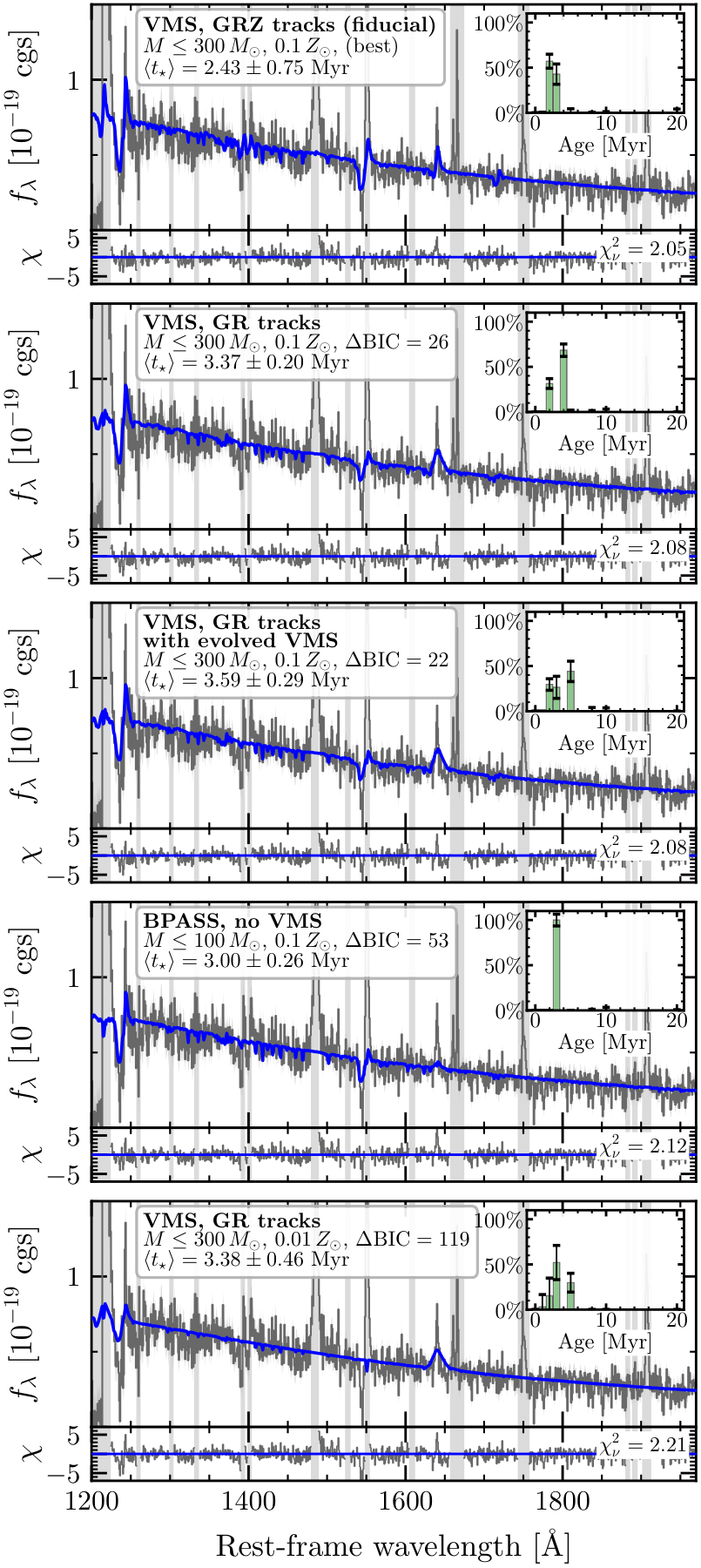
Tests whether UV stellar-population fits require VMS: the caption reports lower BIC for VMS/GRZ models than for non-VMS BPASS models and very young fitted ages.
Original caption
Figure 3 : Best-fit stellar population models explored in this work. We find a best-fit stellar population of 0.1 Z ⊙ Z_{\odot} which includes VMSs of up to 300 M ⊙ M_{\odot} , with GRZ tracks preferred to GR tracks ( Δ BIC = 22 \Delta\rm BIC=22 ; see Sect. 3.3 ). The models with VMS are preferred over BPASS non-VMS populations ( < 100 <100 M ⊙ M_{\odot} ; Δ BIC = 53 \rm\Delta BIC=53 ). The bottommost panel shows a fit to a stellar population including VMSs with a lower metallicity of 0.01 Z ⊙ Z_{\odot} , used for the emission line analysis in Sect. 3.6 . All the models prefer very young ages of 2.5–3.5 Myr. See Fig. 4 for a zoom in relevant features.
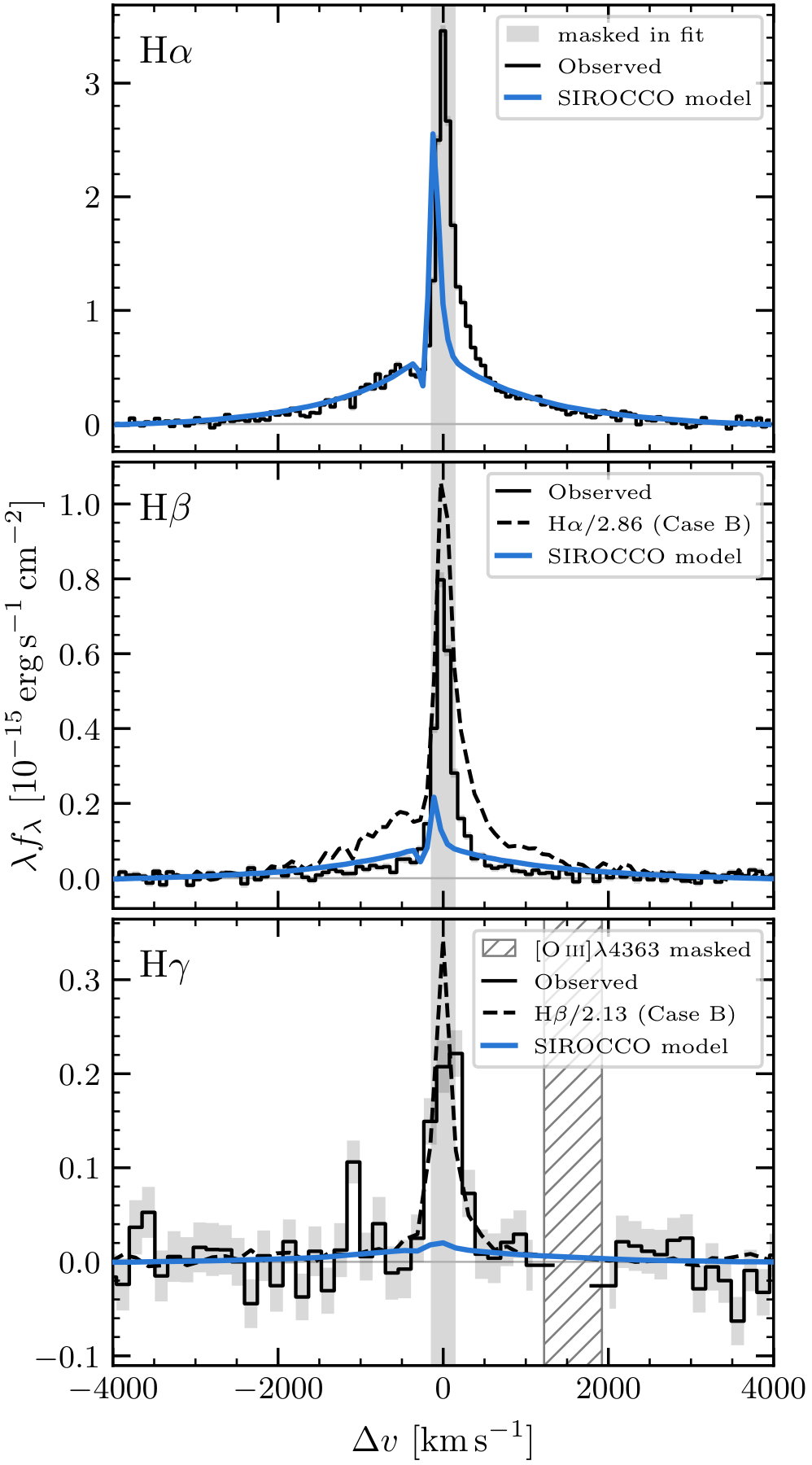
Tests whether a homologous-wind radiative-transfer model can reproduce broad Hα wings, P-Cygni-like absorption, and the elevated broad Balmer decrement without invoking strong dust attenuation.
Original caption
Figure 7 : Best-fit Sirocco model to the H α \alpha broad wings, and the predicted H β \beta and H γ \gamma profiles. We fit the continuum subtracted H α \alpha emission line masking the line center, v mask = − 150 v_{\rm mask}=-150 to 500 km s − 1 \mathrm{k}\mathrm{m}\,\mathrm{s}^{-1} , and we show the predicted unscaled H β \beta and H γ \gamma line from the best-fit model. The Sirocco homologous wind model broadly captures the H α \alpha tails and P Cygni-like absorption, and the high Balmer decrement of the broad component ( H α / H β ∼ 8 {\text{H}\alpha}/{\text{H}\beta}\sim 8 ) without the need for strong dust attenuation. For comparison, in the right panel we show the 1 / 2.86 1/2.86 downscaled version of H α \alpha , which would correspond to a dust-unattenuated Case B recombination line.
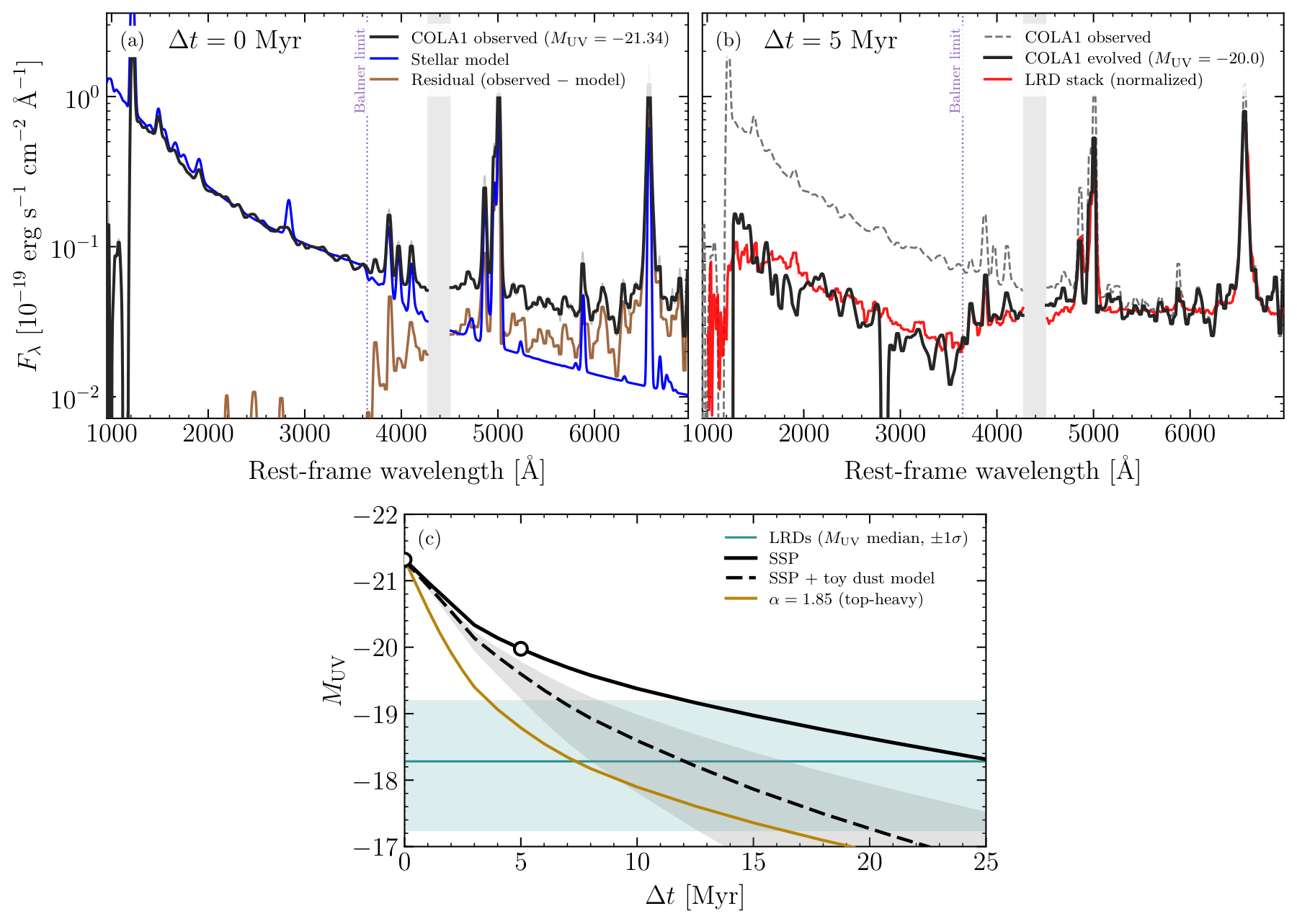
Tests the proposed evolutionary bridge to LRDs by subtracting the UV VMS model and by aging the fitted population; both comparisons are model constructions rather than time-resolved evidence.
Original caption
Figure 11 : (a) The observed spectrum of COLA1 (black; grating spectra degraded to prism resolution), the best VMS model to fit the rest-UV spectrum (blue), and the subtraction of the two, revealing a residual that remarkably resembles extreme LRDs ( Naidu et al., 2025 ; de Graaff et al., 2025c , e.g.,) . (b) Aging the best-fit stellar population by 5 Myr leaves a UV-to-optical spectrum (black) that fully resembles that of a typical Little Red Dot, including the characteristic V-shape with an inflection point at the Balmer limit. For comparison, a red solid line shows the spectrum of a stack of LRDs ( Matthee et al., 2026 ) . (c) The evolution of the UV luminosity, M UV M_{\rm UV} , of the best-fit stellar population model. A black solid line shows the aging of the fiducial stellar population. We use a toy model to illustrate the effect of SN dust production assuming a screen of 0.02 (0.01–0.04) M ⊙ M_{\odot} /SN at 200 pc (black dashed line and gray shaded area). We also show the evolution assuming a top-heavy IMF with high-mass slope α = 1.85 \alpha=1.85 instead of the original high-mass slope α = 2.35 \alpha=2.35 assumed by the SSP model. We compare to the median and 16,84 percentiles of the spectroscopic sample in de Graaff et al. ( 2025b ; teal solid line and shade).
Related research
Previous digest
Torralba et al. use new JWST/NIRSpec medium-resolution spectroscopy of the z=6.6 UV-luminous galaxy COLA1 to connect three early-Universe phenomena in one source: extreme nitrogen enrichment, a very-massive-star population, and Little Red Dot-like broad Balmer emission. Its blue UV spectrum, P Cygni wind features, and broad He II are best reproduced by a 2.4 Myr, roughly 10^8 Msun stellar population including stars up to 300 Msun, while the redder optical continuum and broad, absorbed Balmer profiles already resemble LRDs. A two-zone line analysis requires very dense gas with n_e ≳ 10^6.5 cm^-3 and extreme N/C enrichment, and stellar-population aging predicts that COLA1 could fade by 1–2 mag in about 5 Myr into a canonical V-shaped LRD. The result makes COLA1 a compelling transitional system in which dense-cluster VMS enrichment and possible runaway stellar collisions may be tied to the emergence of an intermediate-mass black-hole-powered LRD.
Sources and evidence (25)
- 2610.29887v1: A Little Red Dot emerging from a nitrogen-rich UV-luminous galaxy with Very Massive Stars
JWST is revealing abundant populations of high-$z$ galaxies with unforeseen properties: UV-luminous galaxies with high nitrogen enrichment, populations of very massive stars (VMSs; $>100\ M_\odot$), and early forms of massive black hole growth such as the Little Red Dots (LRDs). Here we present all these phenomena appearing simultaneously in COLA1, a luminous ($M_{\rm UV}=-21.3$) galaxy at $z=6.6$. New NIRSpec medium-resolution data reveal a blue UV continuum ($β_{\rm UV}=-2.5$) with strong emission lines including NIV] $\lambda1486$, stellar P Cygni profiles, and broad HeII $\lambda1640$. We fit the UV with stellar population models, and find that the models including VMSs (limited to $300\ M_\odot$) are statistically preferred. The best-fit stellar population has $M_*\approx10^8\ M_\odot$, and a young age of $2.4\pm0.8$ Myr. The rest-optical shows a redder continuum ($β_{\rm opt}=-1.1$) and broad Balmer lines with Balmer absorption akin to LRD spectra. By evolving the best-fit stellar population we find that the UV could dim by 1-2 mag in $\sim5$ Myr, and hence this system would be observed as a typical V-shaped LRD. We measure a supersolar $\rm log_{10}(N/O)=-0.07\pm0.05$ and subsolar $\rm log_{10}(C/O)=-0.64\pm0.11$; therefore $\rm log_{10}(N/C)=+0.58\pm0.12$. The independent density-sensitive NIV] $λ\lambda1483,1486$ and CIII] $λ\lambda1906/1909$ ratios require two zones with $n_e\gtrsim10^{6.5}$ cm$^{-3}$ and $n_e\lesssim10^{3.5}$ cm$^{-3}$, respectively. We estimate $\rm log_{10}(N/C)>1.3$ (2$σ$) for the dense zone, requiring extreme N/C enrichment mechanisms such as highly rotating $>100\ M_\odot$ VMSs, tidal disruption events, or supermassive stars. We speculate that runaway collisions of massive stars in a dense stellar cluster may have lead to the seeding of an intermediate-mass black hole resulting in the formation of an LRD.
- 2610.29887v1: A Little Red Dot emerging from a nitrogen-rich UV-luminous galaxy with Very Massive Stars
COLA1 also shows extraordinary ionizing properties, a high inferred escape fraction ( f esc LyC ≈ 0.67 f_{\rm esc}^{\rm LyC}\approx 0.67 ), and lives inside a > 0.3 >0.3 Mpc highly ionized bubble. We argue that if COLA1 represents a common phase in the LRD evolution, given the elevated number densities at z > 6 z>6 , this population may have a crucial impact on cosmic reionization. The light of the observed VMSs, but possibly also past intense starbursts may have been responsible for powering COLA1’s ionized bubble (Sects. 4.6 , 4.7 , and 4.8 ).
- 2610.29887v1: A Little Red Dot emerging from a nitrogen-rich UV-luminous galaxy with Very Massive Stars
Table 1 : General properties of COLA1.
- 2610.29887v1: A Little Red Dot emerging from a nitrogen-rich UV-luminous galaxy with Very Massive Stars
JWST has already delivered transformative results for our understanding of the earliest galaxies and black holes ( Matthee, 2025 ; Übler, 2026 ; Stark et al., 2026 , for a review, see e.g.,) . In particular, JWST has unveiled an abundant population of luminous galaxies ( M UV ≲ − 20 M_{\rm UV}\lesssim-20 ) up to z ≈ 14 z\approx 14 ( Castellano et al., 2022 ; Naidu et al., 2022b ; Harikane et al., 2023 ; Donnan et al., 2024 ; Whitler et al., 2025 ; Carniani et al., 2024 ; Naidu et al., 2026b , e.g.,) , exceeding the expectations based on pre-JWST predictions ( Bouwens et al., 2015 ; Bouwens et al., 2021 ; Oesch et al., 2018 , e.g.,) . What physical mechanisms are responsible for the prevalence of such UV-luminous galaxies at early times is a subject of debate. Some possible explanations include an increased star-formation efficiency in low-mass halos ( Inayoshi et al., 2022 ; Harikane et al., 2023 ; Dekel et al., 2023 , e.g.,) ; stochastic star-formation at early times, which introduces significant scatter biasing the bright end of the UV luminosity function ( Sun et al., 2023 ; Shen et al., 2023 ; Mirocha and Furlanetto, 2023 ; Mason et al., 2023 , e.g.,) ; or the presence of exotic AGN and/or stellar populations with possibly top-heavy initial mass functions ( Trinca et al., 2024 ; Yung et al., 2024 ; Harikane et al., 2023 ; Hutter et al., 2025 , IMFs; e.g.,) .
- 2610.29887v1: A Little Red Dot emerging from a nitrogen-rich UV-luminous galaxy with Very Massive Stars
Figure 11 : (a) The observed spectrum of COLA1 (black; grating spectra degraded to prism resolution), the best VMS model to fit the rest-UV spectrum (blue), and the subtraction of the two, revealing a residual that remarkably resembles extreme LRDs ( Naidu et al., 2025 ; de Graaff et al., 2025c , e.g.,) . (b) Aging the best-fit stellar population by 5 Myr leaves a UV-to-optical spectrum (black) that fully resembles that of a typical Little Red Dot, including the characteristic V-shape with an inflection point at the Balmer limit. For comparison, a red solid line shows the spectrum of a stack of LRDs ( Matthee et al., 2026 ) . (c) The evolution of the UV luminosity, M UV M_{\rm UV} , of the best-fit stellar population model. A black solid line shows the aging of the fiducial stellar population. We use a toy model to illustrate the effect of SN dust production assuming a screen of 0.02 (0.01–0.04) M ⊙ M_{\odot} /SN at 200 pc (black dashed line and gray shaded area). We also show the evolution assuming a top-heavy IMF with high-mass slope α = 1.85 \alpha=1.85 instead of the original high-mass slope α = 2.35 \alpha=2.35 assumed by the SSP model. We compare to the median and 16,84 percentiles of the spectroscopic sample in de Graaff et al. ( 2025b ; teal solid line and shade).
- 2610.29887v1: A Little Red Dot emerging from a nitrogen-rich UV-luminous galaxy with Very Massive Stars
Another surprising and extensively discussed JWST result is the discovery of an abundant population of red compact objects, the Little Red Dots ( Labbé et al., 2023 ; Kocevski et al., 2023 ; Matthee et al., 2024 ; Greene et al., 2024 , LRDs; e.g.,) . The origin and nature of the LRDs’ central engines is highly debated, with current hypothesis ranging from super-Eddington accreting supermassive black holes (SMBHs) obscured by nuclear dust ( Madau and Maiolino, 2026 ; Scholtz et al., 2026 ; Billand et al., 2026 , e.g.,) , to intermediate-mass black holes ( M BH ∼ 10 3 M_{\rm BH}\sim 10^{3} – 10 5 10^{5} M ⊙ M_{\odot} ; IMBHs) enshrouded in dense gas that reprocesses their radiation ( Ji et al., 2025 ; Naidu et al., 2025 ; de Graaff et al., 2025c ; Liu et al., 2025 ; Naidu et al., 2026a ; Sneppen et al., 2026 ; Kido et al., 2025 , e.g.,) , to supermassive stars ( Nandal and Loeb, 2026 ; Zwick et al., 2026 ; Chisholm et al., 2026 ; Kokorev et al., 2026a ; Lu, 2026 , e.g.,) , or quasi-stars ( Begelman and Dexter, 2026 ; Martins et al., 2026 ; Cantiello et al., 2026 ; Santarelli et al., 2026 , QS;) . Regardless of the physical interpretation, the LRDs seem to represent a common and distinct phase of massive black hole growth at high- z z , that becomes increasingly rare towards the nearby Universe ( Lin et al., 2026a ; Lin et al., 2026b ; Park et al., 2026b ; Kapoor et al., 2026 ; Loiacono et al., 2026 , e.g.,) .
- 2610.29887v1: A Little Red Dot emerging from a nitrogen-rich UV-luminous galaxy with Very Massive Stars
Interestingly, the galaxies CEERS-1019 and GN-z11, which have very similar UV spectra to COLA1 (see discussion in Sect. 4.6 ) are also strong Ly α \alpha emitters at z > 7 z>7 . Chen et al. (2026) have discussed that GN-z11 must reside in an ionized bubble of ∼ 0.5 \sim 0.5 pMpc, and Whitler et al. (2026) found evidence for a ∼ 0.5 \sim 0.5 –1 pMpc ionized bubble at z = 8.7 z=8.7 in an overdensity containing CEERS-1019. Moreover, the Ly α \alpha observed in some high- z z LRDs suggest that some of these sources also trace large ionized regions ( Tang et al., 2026b ; Tang et al., 2026a ) . All these results suggest a connection between the LRD and N-enhanced galaxy phenomenon and the presence of large ionized IGM regions. It is possible that a previous burst of ionizing photons powered the proximity zone before turning off ( Meyer et al., 2026 ) , which should have happened in the last ∼ 0.1 \sim 0.1 –0.7 Myr (for Δ = 0.5 \Delta=0.5 to 0.2), before the IGM naturally recombines ( Park et al., 2026a ) . This could suggest that there was a much more luminous episode of LRD or AGN activity in the past, or that there was recent even stronger burst of star formation. The latter case could be represented by the extremely luminous compact galaxies recently reported by Yang et al. (2026) , whose UV spectrum is dominated by the light of VMSs and presents very weak nebular emission lines pointing towards a very high f esc LyC f_{\rm esc}^{\rm LyC} ( Marques-Chaves et al., 2026a ; Wu et al., 2026 , see also) . Given the high number densities of LRDs at z > 6 z>6 ( Kocevski et al., 2025 ; Zhuang et al., 2026 , e.g.,) , if an early COLA1-like phase turns out to be common around most LRDs, these objects have the potential to have played a critical role in local reionization through short starburst episodes with high ionizing output powering Mpc-scale bubbles ( Naidu et al., 2020 ; Matthee et al., 2022 , e.g.,) .
- 2610.29887v1: A Little Red Dot emerging from a nitrogen-rich UV-luminous galaxy with Very Massive Stars
The spectrum of the galaxy COLA1 presents a striking combination: a UV spectrum dominated by very massive stars, a red LRD-like component in the optical, and extremely high nitrogen enhancement. Below we summarize our main findings.
- 2610.29887v1: A Little Red Dot emerging from a nitrogen-rich UV-luminous galaxy with Very Massive Stars
We fit the UV spectrum of COLA1 with stellar population synthesis models, favoring those containing VMS (limited to masses up to 300 300 M ⊙ M_{\odot} ). We find a best-fit stellar population with mean age 2.43 ± 0.75 2.43\pm 0.75 Myr, and stellar mass ≈ 10 8 \approx 10^{8} M ⊙ M_{\odot} (for an IMF with slope α = 2.35 \alpha=2.35 ). In particular, the VMSs are needed to reproduce the P Cygni-like profiles of N v λ λ 1239 , 1243 \lambda\lambda 1239,1243 , Si iv ] λ λ 1394 , 1403 \lambda\lambda 1394,1403 , and C iv λ λ 1548 , 1551 \lambda\lambda 1548,1551 , and the broad component of He ii λ 1640 \lambda 1640 (Sect. 3.3 ).
- 2610.29887v1: A Little Red Dot emerging from a nitrogen-rich UV-luminous galaxy with Very Massive Stars
While the rest-UV spectrum has a fairly blue slope ( β UV = − 2.5 \beta_{\rm UV}=-2.5 ), the rest-optical is significantly redder ( β opt = − 1.1 \beta_{\rm opt}=-1.1 ), shows strong He i , and broad H β \beta and H α \alpha with a narrow Balmer absorption. The narrow components of the Balmer lines follow Case B recombination ratios with little-to-no dust attenuation, while the broad components present high decrements ( H α / H β ∼ 9 {\text{H}\alpha}/{\text{H}\beta}\sim 9 ) that could be explained by attenuation by nuclear dust, but also by RT effects in a dense wind akin an LRD envelope (Sect. 3.4 ).
- 2511.13591v1: A Fleeting GLIMPSE of N/O Enrichment at Cosmic Dawn: Evidence for Wolf Rayet N Stars in a z = 6.1 Galaxy
We have presented the first discovery of extreme nitrogen enrichment from Wolf Rayet nitrogen stars (WN) in the metal-poor ( ∼ 10 % Z ⊙ \sim 10\%\ Z_{\odot} ), high surface-density ( 1.1 × 10 4 M ⊙ 1.1\times 10^{4}\ M_{\odot} pc -2 ), high-redshift ( z = 6.1025 z=6.1025 ), lensed galaxy RXCJ2248-ID3. These measurements were made possible by exceptionally deep JWST/NIRSpec medium-resolution spectroscopy of RXCJ2248-ID3, obtained as part of the GLIMPSE-D survey. The unprecedented depth and S/N of the GLIMPSE-D spectrum allow spectral measurements typically limited to the nearby universe, including consistent broad components in the Balmer series and [O III] λ \lambda 4364 and λ \lambda λ \lambda 4960,5008 lines, faint [Ar IV] λ \lambda λ \lambda 4713,4741 emission, and signatures of WR stars. Specifically, we detected emission characteristic of WN-type stars, including strong N III] λ \lambda 4642 and broadened He II λ \lambda 1640 and λ \lambda 4687 emission, marking RXCJ2248-ID3 as the most distant galaxy with direct WR features to date.
- 2511.13591v1: A Fleeting GLIMPSE of N/O Enrichment at Cosmic Dawn: Evidence for Wolf Rayet N Stars in a z = 6.1 Galaxy
The CNO abundance pattern is best reproduced by a modified version of the dual-burst chemical evolution model from Kobayashi and Ferrara [69] that reduces the contribution from WC stars relative to WN stars, as expected in metal-poor environments. The resulting short-lived WN phase and ejects N-rich, C-poor material. Further, we use this chemical evolution model to assess whether the observed N mass can plausibly arise from the recent star formation in RXCJ2248-ID3 and estimate an ionized N mass of 1250 M ⊙ 1250\ M_{\odot} . This value is consistent with the N mass estimated from the observed emission lines of ∼ 920 M ⊙ \sim 920\ M_{\odot} if ∼ 74 % \sim 74\% of the N gas is ionized.
- 2606.30711v1: Little Red Dots as Intermediate Mass, Super-Eddington Engines: Insights from Type IIn Supernovae and The 1837-1856 Great Eruption of $η$ Carinae
Stage II – The LRD Phase: The central engine drives fast winds into the pre-existing envelope. Kinetic energy from the resulting shocks is converted highly efficiently into radiation ( ≈ 50 % \approx 50\% efficiency vs. < 1 % <1\% in typical SNe). This explains the LRDs’ immense luminosity with physics similar to interaction transients, which rank among the most luminous transients. Accretion radiation may complement or act in lieu of CSM interaction luminosity.
- 2606.30711v1: Little Red Dots as Intermediate Mass, Super-Eddington Engines: Insights from Type IIn Supernovae and The 1837-1856 Great Eruption of $η$ Carinae
We estimate a mass-loss rate of ≈ 0.3 M ⊙ \approx 0.3M_{\rm{\odot}} yr -1 and a fast wind velocity of ≈ 8000 \approx 8000 km s -1 that crashes into a slow wind of ≈ 500 \approx 500 km s -1 . The wind velocities are comparable to IIn SNe and the GE, while the mass-loss rates are ≈ 10 − 100 × \approx 10-100\times higher, consistent with a more massive central engine. [§ 3.3 ]
- 2608.18212v1: Quasar Impostors: Two Extremely UV-Bright ($M_{\rm UV}\approx-23.5$) Reionisation-Epoch Galaxies Powered by Very Massive Stars
Massive cold gas reservoirs and contrasting obscured star formation. ALMA reveals luminous [C ii ] 158 μ 158\,\mu m emission in both sources ( L [ CII ] ≃ 0.8 L_{\rm[CII]}\simeq 0.8 and 4.1 × 10 9 L ⊙ 4.1\times 10^{9}\,L_{\odot} for J1450 − - 0144 and J1429 − - 0104, respectively) and a clear dust-continuum detection in J1429 − - 0104 ( L TIR ≃ 2.6 × 10 12 L ⊙ L_{\rm TIR}\simeq 2.6\times 10^{12}\,L_{\odot} , SFR IR ≃ 310 M ⊙ yr − 1 \mathrm{SFR_{IR}}\simeq 310\,M_{\odot}\,{\rm yr}^{-1} ), while J1450 − - 0144 remains undetected in the continuum. Both galaxies are ≳ 1 \gtrsim 1 mag brighter in the rest-frame UV than typical REBELS galaxies yet match the most [C ii ]-luminous REBELS sources, and the implied molecular gas masses of M mol ∼ 10 10 M_{\rm mol}\sim 10^{10} – 10 11 M ⊙ 10^{11}\,M_{\odot} correspond to depletion times of a few hundred Myr, sufficient to sustain the present star-formation episodes provided the gas reservoirs are not disrupted. The two galaxies nonetheless differ sharply in obscuration: J1429 − - 0104 sits in the ultra-luminous infrared regime with an obscured-to-total star-formation fraction of ≈ 70 \approx 70 per cent and lies well above the Calzetti-like and SMC-like IRX– β \beta relations, whereas the 2 σ 2\sigma IRX upper limit of J1450 − - 0144 is consistent with little obscured star formation. A potential explanation for the IRX excess of J1429 − - 0104 is that its UV and FIR emission arise from spatially distinct regions, consistent with the ∼ 1 ′′ \sim 1^{\prime\prime} ( ∼ 5.4 \sim 5.4 kpc) offset between its rest-UV centroid and the [C ii ]/dust peak, whose origin (a merger, an obscured central starburst, or feedback-driven dust displacement) require future high-resolution imaging (Sect. 3.3 and 4.1 ).
- 2608.18212v1: Quasar Impostors: Two Extremely UV-Bright ($M_{\rm UV}\approx-23.5$) Reionisation-Epoch Galaxies Powered by Very Massive Stars
A summary of the basic properties of J1429 − - 0104 and J1450 − - 0144 is presented in Table 1 . Note that we have updated the redshifts using the [C ii ] line from our ALMA observations (Sect. 3.3 ) and M 1450 M_{1450} from our JWST/NIRSpec data (Sect. 2.2.2 ). In Fig. 1 we show the two galaxies in the redshift versus M UV M_{\rm UV} plane with these updated values.
- 2609.11094v1: SPURS: An Ultra-deep View Inside the Compact, Nitrogen-Enriched Nuclei of Little Red Dots
2. The ultra-deep spectra reveal the first detections of broad high ionization lines in the UV. We detect a strong broad (FWHM = 2830 =2830 km s -1 ) C IV emission line in the G140M spectrum of GN-2 and a weaker broad C IV in CEERS-7902. The broad C IV to H β \beta flux ratios of both LRDs are well below those of typical type I AGN, consistent with previous results suggesting LRDs have soft ionizing spectra. We also detect many other narrow UV emission lines (N IV ], He II , O III ], Si III ], C III ]) in the four LRDs. We detect nitrogen emission lines in all four LRDs, which indicate nitrogen-enhanced abundance patterns with super-solar N/O and N/C ratios. In GN-2 we detect broad emission components in N IV ] (similar to that detected in GN-z11; Chen et al. 32 ), N III ], and C III ], indicating fast moving ionized gas. Using the density-sensitive N IV ], Si III ], and C III ] doublet ratios, we derive large electron densities for the four LRDs, well above that of typical galaxies at z ≃ 7 z\simeq 7 . In particular, GN-2 has an extremely high electron density ( ≳ 10 6 \gtrsim 10^{6} cm -3 ) that is two orders of magnitude above the typical z ≃ 7 z\simeq 7 value.
- 2609.11094v1: SPURS: An Ultra-deep View Inside the Compact, Nitrogen-Enriched Nuclei of Little Red Dots
4. Consistent with the picture from the absorption lines, we detect a suite of low-ionization fluorescent emission lines, indicating pumping by the UV continuum and Lyman series photons in dense neutral gas. Fluorescent O I* λ 1306 \lambda 1306 in GN-2 and GN-2004 requires Ly β \beta pumping in dense H I gas close to the ionizing sources, while the rare semi-forbidden O I] λ 1641 \lambda 1641 line detected in GN-2 implies extreme column densities N HI > 10 22.5 N_{\rm HI}>10^{22.5} cm -2 . The NUV spectra of all four LRDs also show a forest of strong, narrow, permitted Fe II emission, with the total NUV Fe II EWs ranging from 72 to 356 Å. (integrated over 2200 − 3090 2200-3090 Å). Three LRDs show extremely strong narrow Fe II λ 2508 \lambda 2508 emission (EW = 6 − 10 =6-10 Å, deconvolved FWHM ≲ 464 \lesssim 464 km s -1 ), requiring pumping by broad Ly α \alpha in a dense, iron-rich region. We suggest this region may regulate the visibility of broad Ly α \alpha from the central engine in the LRD population.
- 2602.15935v1: Little Red Dots as Globular Clusters in Formation
The discovery of broad ( ≳ 1000 \gtrsim 1000 km s -1 ) H α \alpha emission provided a concrete clue for the origin of LRDs [ 44 , 57 , 73 ] . Interpretations invoking accreting black holes quickly came to dominate their discussion [ 57 , 71 , 39 ] . If LRDs are powered by accreting black holes, they are remarkably distinct from other known black hole populations. LRDs rarely have detected X-rays [ 6 , 55 ] , many exhibit Balmer absorption even in H α \alpha [ 73 ] , lack the rest-frame mid-IR colors typical of a dusty torus [ 85 ] , occupy lower mass halos than standard quasars [ 87 ] , and have inferred black-hole-to-stellar-mass ratios approaching unity [ 31 , 71 ] . Individually, these properties can each be explained as black holes forming before the bulk of stars by accreting at super-Eddington rates [ 66 ] with their accretion disks enshrouded by dense neutral gas cocoons [ 51 , 78 ] . Since accreting black holes are expected to evolve strongly with redshift, the extreme accretion physics powering the LRD population was viewed as a natural extension of early black hole formation.
- 2602.15935v1: Little Red Dots as Globular Clusters in Formation
The resulting LRD mass function at z ∼ 7 z\sim 7 is shown as the solid gold curve in Figure 3 . We normalize by the total number of objects to emphasize its shape and enable a comparison to local objects. The inferred LRD initial mass function has a classic Schechter function shape: an exponential cut-off above log \log (M ∗ / M ⊙ M_{\odot} ) ∼ 6 \sim 6 and a steep power-law slope extending to lower masses.
- 2508.01372v1: A Nitrogen-rich AGN Powering a Large Ionizing Bubble at z=8.63
We report the detection of Ly$α$ in CANUCS-LRD-z8.6, a recently discovered AGN at z = 8.63 by Tripodi et al. (2024), in new NIRSpec/MSA G140H/F070LP observations. We detect broad Ly$α$ emission (FWHM $= 1540 \pm 260$ km/s) near the systemic velocity, which suggests a large ionizing bubble considering that the universe is almost fully neutral at the redshift. Through Ly$α$ line-shape modeling assuming a Stromgren sphere, we find a large bubble radius, $R_b = 1.5^{+0.3}_{-0.2}$ pMpc, and a moderately high Ly$α$ escape fraction, $f_{esc} = 11 \pm 3$ %. The intrinsic line width is inferred to be broad ($2200 \pm 280$ km/s), likely originating in the broad-line region. Existing data indicate that CANUCS-LRD-z8.6 is within a mild overdensity, $δ= 1.8^{+3.0}_{-0.6}$, suggesting that other galaxies in its proximity might have contributed to the formation of the bubble. The high N IV]$λ$1488 / C IV$λ$1548 and N IV]$λ$1488 / O III]$λ$1661 line ratios measured in existing NIRSpec/PRISM data indicate nitrogen enrichment in this metal-poor, low-luminosity AGN. The spectroscopic features are overall similar to other nitrogen-rich galaxies discovered in the literature, such as GN-z11 and GHZ2/GLASSz12. This suggests that CANUCS-LRD-z8.6 may represent one of the evolutionary phases of those nitrogen-rich galaxies.
- 2602.20247v1: Little Red Dots: One Photometric Tag Concealing Diverse Spectroscopic Flavors of Massive Star Formation and Black Hole Activity
Figure 15: Comparison of the BH and stellar masses for our stacks are shown with filled hexagons in colors, each one representing a different LRD subtype. Open hexagons show results if we consider that 50% of the bolometric luminosity of the LRD core is linked to stellar emission (see text for details). Open hexagons show results for our stacks using a calibration based on BH masses from single-epoch Balmer line data. We also show with a shaded area the z = 0 z=0 AGN in Reines and Volonteri [186] , and with brown lines the relationships found by Greene et al. [84] for all (continuous line), early-type (dotted), and late-type (dash-dot) z = 0 z=0 galaxies. The dots in black and gray depict the AGN in Jones et al. [110] , LRDs and non-LRDs, respectively. The squares are the AGN in Rusakov et al. [193] . The open triangles depict the AGN in Ma et al. [144] . Dashed oblique lines mark specific BH-to-stellar mass ratios.
- 2602.20247v1: Little Red Dots: One Photometric Tag Concealing Diverse Spectroscopic Flavors of Massive Star Formation and Black Hole Activity
We remark several points about this comparison. First, we are comparing total stellar masses for galaxies with BH masses. If LRDs probe the early formation of bulges, we should compare with results in, e.g., Kormendy and Ho [121] , which obtain larger BH-to-stellar mass ratios (as high as 0.7%). These ratios would be more consistent with our measurements for LRDs, especially if the LRD core is not completely dominated by an AGN but has some stellar contribution (cf. open hexagons in Figure 15 ).
- 2609.09271v1: The Ashes of Supermassive Stars: Globular Cluster-like Aluminum Enhancement in Little Red Dots
To assess the possible impact of unresolved saturation in Mg ii , we repeat the inference after increasing the measured [ Mg / Fe ] {\rm[Mg/Fe]} abundance by 0.5 dex. The resulting posterior distributions in T c T_{\rm c} and Δ Y \Delta Y become substantially broader, but remain consistent with the fiducial solution within the correspondingly larger uncertainties. This demonstrates that the inference is not driven solely by the extreme Mg depletion: the strong Al enhancement relative to ordinary star-forming galaxies which we show in Extended Data Figure 2 provides an independent constraint and remains the principal driver of the hot hydrogen-burning interpretation.
- 2609.09271v1: The Ashes of Supermassive Stars: Globular Cluster-like Aluminum Enhancement in Little Red Dots
We fit the resulting spectrum with a curved power-law continuum attenuated by a damped Ly α \alpha absorption profile. The continuum is parameterized by a normalization A A , slope β \beta , and curvature γ \gamma , while the absorption is described by the full Lorentzian natural-broadening profile with N HI N_{\rm HI} as a free parameter. Allowing continuum curvature is important because otherwise intrinsic spectral curvature can be absorbed into the inferred damping opacity and bias N HI N_{\rm HI} high. We allow | γ | ≤ 24 |\gamma|\leq 24 and marginalize over both β \beta and γ \gamma when deriving the N HI N_{\rm HI} posterior.
Abstract
JWST is revealing abundant populations of high-$z$ galaxies with unforeseen properties: UV-luminous galaxies with high nitrogen enrichment, populations of very massive stars (VMSs; $>100\ M_\odot$), and early forms of massive black hole growth such as the Little Red Dots (LRDs). Here we present all these phenomena appearing simultaneously in COLA1, a luminous ($M_{\rm UV}=-21.3$) galaxy at $z=6.6$. New NIRSpec medium-resolution data reveal a blue UV continuum ($β_{\rm UV}=-2.5$) with strong emission lines including NIV] $\lambda1486$, stellar P Cygni profiles, and broad HeII $\lambda1640$. We fit the UV with stellar population models, and find that the models including VMSs (limited to $300\ M_\odot$) are statistically preferred. The best-fit stellar population has $M_*\approx10^8\ M_\odot$, and a young age of $2.4\pm0.8$ Myr. The rest-optical shows a redder continuum ($β_{\rm opt}=-1.1$) and broad Balmer lines with Balmer absorption akin to LRD spectra. By evolving the best-fit stellar population we find that the UV could dim by 1-2 mag in $\sim5$ Myr, and hence this system would be observed as a typical V-shaped LRD. We measure a supersolar $\rm log_{10}(N/O)=-0.07\pm0.05$ and subsolar $\rm log_{10}(C/O)=-0.64\pm0.11$; therefore $\rm log_{10}(N/C)=+0.58\pm0.12$. The independent density-sensitive NIV] $λ\lambda1483,1486$ and CIII] $λ\lambda1906/1909$ ratios require two zones with $n_e\gtrsim10^{6.5}$ cm$^{-3}$ and $n_e\lesssim10^{3.5}$ cm$^{-3}$, respectively. We estimate $\rm log_{10}(N/C)>1.3$ (2$σ$) for the dense zone, requiring extreme N/C enrichment mechanisms such as highly rotating $>100\ M_\odot$ VMSs, tidal disruption events, or supermassive stars. We speculate that runaway collisions of massive stars in a dense stellar cluster may have lead to the seeding of an intermediate-mass black hole resulting in the formation of an LRD.
Discussion
Discussion access requires a security token. Register for the weekly digest.