2606.06005v1 · First listed 2026-06-05
The Multi-phase Biconical Outflow in the local IR-Luminous Merger IRASF01364-1042
Spatially resolved JWST, ALMA and KCWI data support a multiphase, minor-axis biconical outflow in the dusty local merger IRAS F01364-1042. The authors infer faster ionized than molecular gas and argue a nuclear starburst can energetically drive it despite an obscured AGN. [1][3]
Evidence
The study targets the z=0.048 IR-luminous late-stage merger (LIR=10^11.87 Lsun) with JWST/MIRI-MRS, ALMA, and Keck/KCWI IFUs. It maps [Ne II] and [O III] (ionized), H2 0–0 S(3) (warm molecular), and CO(2–1) (cold molecular), then decomposes spectra in spatially resolved regions. Enhanced linewidths trace a SE–NW bicone along the stellar-disk minor axis; ionized emission reaches about 5 kpc, versus about 2 kpc for molecular tracers. A simplified disk-plus-bicone interpretation yields velocities of about 500–600, 350, and 200–300 km/s for ionized, warm molecular, and cold molecular gas, respectively. The inferred cold-phase mass outflow rate is 38–240 Msun/yr and its kinetic power 0.5–6.8×10^42 erg/s; the broad range is explicitly sensitive to the CO-to-H2 conversion factor. [Ne V] 14.3 μm identifies an obscured AGN, but the authors estimate that the 40–60 Msun/yr nuclear starburst supplies sufficient energy. [1][3][8][9]
Earlier work
A concrete aperture-scale comparison supports unusually concentrated obscuration: Spitzer/IRS measured silicate strength s9.7=−1.27 through an approximately 10″×4″ slit, whereas the MIRI expanding-cone nuclear aperture gives −2.35; more than 60% of local LIRGs in the cited Spitzer comparison have s9.7>−1.0. The authors interpret this as centrally concentrated dust. Earlier high-resolution Paα, rovibrational H2, and CO(2–1) work found nuclear-disk orientation consistent with the present stellar field, reducing—though not eliminating—the case for strong disk misalignment as the explanation for the central multiphase kinematics. [4][5]
What changes
For this object, the paper combines cold, warm, and ionized gas kinematics into one biconical geometry and reports a JWST [Ne V] detection of a previously dust-obscured AGN. It further separates the nuclear rotating CO disk with 3D Barolo, whose model supplies 60% of CO(2–1) flux in the central extraction region; this guards against assigning all central CO emission to an outflow. [1][2]
Limits and open questions
The quoted outflow speeds come from a simplified geometric model rather than direct deprojection alone. Molecular morphology and velocity fields can also be affected by merger tidal structures; the authors argue that broadened minor-axis profiles favor an outflow in the central 3 kpc, while identifying a molecular loop/tail and major-axis double peaks as tidal contamination. Optical extinction is inadequate for the nucleus: its AV in region C is over 30 times lower than the MIR-based nuclear estimate. Dust optical depths inferred from multi-temperature CAFE fits may also be degenerate, so the authors adopt the directly measured silicate strength instead. [5][4]
Full-paper HTML excerpts support the principal measurements and caveats, but the supplied extraction does not include the detailed derivations of line fitting, mass conversions, or geometric-model uncertainties.
Key figures

Tests whether spatial morphology and linewidths agree across phases: compact [Ne II]/[Ne III] are contrasted with an approximately 3-kpc X-shaped warm-H2 distribution, while both show enhanced dispersion along SE–NW.
Original caption
Figure 5 : MRS maps of the integrated line flux, velocity and FWHM linewidth for [Ne III], [Ne II] and H 2 \text{H}{\vphantom{\text{X}}}_{\smash[t]{\text{2}}} 0-0 S(3) lines (see Section 3.1.3 ). Spaxels with SNR < 3 <3 in each line are masked. ALMA 334 GHz continuum contours from Figure 2 are overlaid in the [Ne III] maps, and the spectral extraction regions defined in Section 3.1.3 are overlaid on the H 2 \text{H}{\vphantom{\text{X}}}_{\smash[t]{\text{2}}} 0-0 S(3) maps. While ionized gas tracers ([Ne II], [Ne III]) show compact emission at the nucleus, molecular gas traced by the H 2 \text{H}{\vphantom{\text{X}}}_{\smash[t]{\text{2}}} line shows extended “X”-shaped morphology on ∼ \sim 3 kpc scales. Ionized and molecular gas both show enhanced gas dispersion along the SE-NW direction.

Tests the proposed common bicone by overlaying CO, warm H2, and [O III] and comparing central line profiles; the schematic places molecular gas on inner bicone edges relative to the rotating stellar disk.
Original caption
Figure 10 : Multi-phase gas morphology and kinematics derived from Keck/KCWI, JWST/MIRI-MRS , and ALMA data. Left: Comparison of line profiles of emission lines detected in the multi-wavelength datasets in the central 3 kpc in region C, defined in Section 3.1.1 (see also Figure 2 ). Profiles are normalized by the peak flux density and offset vertically for better visual distinction, with best-fit model and components shown in solid and dashed lines. Middle: Color-composite overlay of ALMA CO (1-0), MRS H 2 \text{H}{\vphantom{\text{X}}}_{\smash[t]{\text{2}}} 0-0 S(1) and Keck/KCWI [O III] λ \lambda 5007 emission on top of the F336W/F435W/F814W tri-color HST image from Figure 1 , showcasing the multi-phase biconical structure emerging from the dust-obscured nucleus of IRASF01364. The cyan ellipses highlight the regions defined in Section 3.3 for analyzing the large-scale ionized gas emission. Right: Simplified representation of the molecular and ionized outflow bicones with respect to the stellar disk (in yellow ellipse) and the nucleus (red star). The black curved arrow indicates the rotation of the stellar disk inferred from Figure 8 . The cold and warm molecular gas are co-spatial and trace the inner edges of the ionized bicone, and appear brighter and more extended on the near-side NW cone.
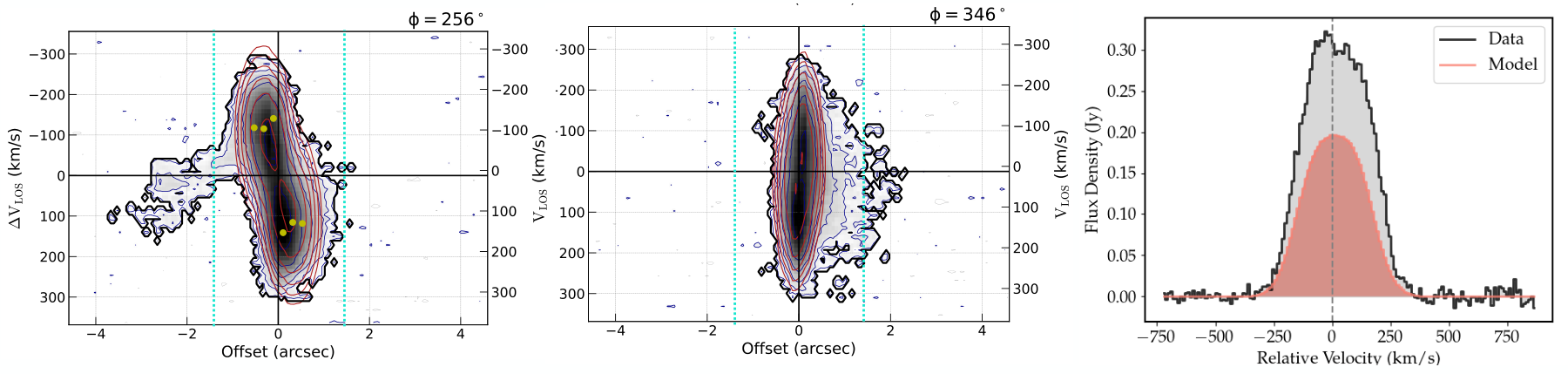
Tests disk contamination of the central cold-gas signal by fitting CO(2–1) position–velocity diagrams and the central profile with 3D Barolo; the modeled rotating disk contributes 60% of the region-C flux.
Original caption
Figure 19 : Modelling results of the central kpc of the CO (J = 2 - 1) emission from 3D Barolo. The left and middle panels show the PV diagrams of the fitted model of the nuclear rotating molecular disk (in red contours), along the major ( ϕ = 256 ∘ \phi=256^{\circ} ) and minor axis ( ϕ = 345 ∘ \phi=345^{\circ} ) previously determined by Agostino et al. (2026) . The observed emission are shown in grey scales, and area covered by region C is indicated with vertical dashed cyan lines. The right panel compares the observed and modeled CO ( J = 2 - 1) line profile extracted from region C, shown in grey and red, respectively. The modeled nuclear disk contributes 60% of the total flux contained within region C.
Related research
Previous digest
Using JWST/MIRI-MRS, ALMA, and Keck/KCWI, this paper maps the ionized, warm molecular, and cold molecular gas in the local late-stage merger IRASF01364-1042 and confirms a multi-phase biconical outflow emerging along the minor axis of a highly inclined rotating disk. The outflow is fastest in the ionized phase at about 500-600 km/s, slower in warm H2 at about 350 km/s, and slower still in cold CO at about 200-300 km/s, while the cold molecular component carries most of the mass and kinetic power. A key result is the first detection of a dust-obscured AGN in this system via [Ne V] 14.3 micron, but the inferred AGN luminosity is low enough that the compact nuclear starburst likely supplies the energy budget needed to drive the outflow, with a past stronger AGN phase remaining possible. The paper matters as a clean multi-wavelength case study showing how buried, low-luminosity AGN can coexist with starburst-dominated feedback in dusty merger remnants.
Sources and evidence (23)
- 2606.06005v1: The Multi-phase Biconical Outflow in the local IR-Luminous Merger IRASF01364-1042
We investigate the spatially-resolved ISM properties of the local ($z = 0.048$), IR-luminous ($L_{\rm IR} = 10^{11.87}$\,L$_\odot$), late-stage galaxy merger IRAS F01364-1042, combining multi-wavelength IFU observations from \textit{JWST/MIRI-MRS}, ALMA and Keck/KCWI. Using these datasets, we construct emission line maps of several key tracers of the ionized (e.g., [Ne\,II]\,12.8$μ$m, [O\,III]$\lambda5007$), warm molecular (e.g., \ce{H2}\,0-0\,S(3)), and cold molecular gas (e.g., CO (J$=2-1$)), and perform detailed decomposition of spectra extracted in resolved regions across the areas of emission. We confirm the presence of a multi-phase galactic biconical outflow along the minor axis of a highly inclined rotating disk. The inferred outflow velocities are $\sim\,$500 - 600\,km\,s$^{-1}$ $\sim\,$350\,km\,s$^{-1}$, and $\sim\,$200 - 300\,km\,s$^{-1}$, in the ionized, warm and cold molecular phase, respectively, with corresponding mass outflow rates of $\sim 0.3 - 2.3$, $\sim 31$, and $\sim 38 - 240$\,M$_\odot\,$yr$^{-1}$. The cold molecular phase dominates both the total mass outflow rate and the associated kinetic energy ($\sim\,2 - 8 \times 10^{42}$\,erg\,s$^{-1}$). We confirm, for the first time, a dust-obscured AGN in IRAS\,F01364-1042, via detection of the [Ne\,V]\,14.3$μ$m line. The low inferred AGN bolometric luminosity ($1.2 - 1.8 \times 10^{43}$\,erg\,s$^{-1}$) suggests that the nuclear starburst alone, with a star formation rate of $\sim 40 - 60$\,M$_\odot$\,yr$^{-1}$, can account for the energy required to drive the outflow, though a more active AGN phase in the recent past may have also played a role. Our work showcases the necessity of multi-wavelength observations for interpreting the gas dynamics in merger-driven dusty starbursts, and the capability of \textit{JWST/MIRI-MRS} to uncover obscured, low-luminosity AGN that may be common in these systems.
- 2606.06005v1: The Multi-phase Biconical Outflow in the local IR-Luminous Merger IRASF01364-1042
Figure 19 : Modelling results of the central kpc of the CO (J = 2 - 1) emission from 3D Barolo. The left and middle panels show the PV diagrams of the fitted model of the nuclear rotating molecular disk (in red contours), along the major ( ϕ = 256 ∘ \phi=256^{\circ} ) and minor axis ( ϕ = 345 ∘ \phi=345^{\circ} ) previously determined by Agostino et al. (2026) . The observed emission are shown in grey scales, and area covered by region C is indicated with vertical dashed cyan lines. The right panel compares the observed and modeled CO ( J = 2 - 1) line profile extracted from region C, shown in grey and red, respectively. The modeled nuclear disk contributes 60% of the total flux contained within region C.
- 2606.06005v1: The Multi-phase Biconical Outflow in the local IR-Luminous Merger IRASF01364-1042
Results. We confirm the presence of a multi-phase galactic biconical outflow along the minor axis of a highly inclined rotating disk, based on the multi-phase gas morphology and prominent line broadening (FWHM > 500 >500 km s -1 ) in the ionized gas tracers detected out to ∼ \sim 5 kpc from the nucleus. The molecular gas tracers are detected out to ∼ \sim 2 kpc, and exhibit a distinct “X”-shaped morphology and different velocity fields from the ionized gas, which we attribute to the higher concentration of molecular gas near the disk. We adopt a simple model to interpret the observed multiphase gas kinematics and infer an outflow velocity of ∼ \sim\, 500 - 600 km s -1 ∼ \sim\, 350 km s -1 , and ∼ \sim\, 200 - 300 km s -1 , in the ionized, warm and cold molecular phase, respectively, with corresponding mass outflow rates of ∼ 0.3 − 2.3 \sim 0.3-2.3 , ∼ 31 \sim 31 , and ∼ 38 − 240 \sim 38-240 M ⊙ {}_{\odot}\, yr -1 . The cold molecular phase dominates both the total mass outflow rate and the associated kinetic energy ( ∼ 2 − 8 × 10 42 \sim\,2-8\times 10^{42} erg s -1 ). Via JWST/MIRI-MRS detection of the [Ne V] 14.3 μ \mu m line, we identify, for the first time, a dust-obscured AGN in IRAS F01364-1042. The low inferred AGN bolometric luminosity ( 1.2 − 1.8 × 10 43 1.2-1.8\times 10^{43} erg s -1 ) suggests that the nuclear starburst alone, with a star formation rate of ∼ 40 − 60 \sim 40-60 M ⊙ yr -1 , can account for the energy required to drive the outflow, though a more active AGN phase in the recent past may have also played a role.
- 2606.06005v1: The Multi-phase Biconical Outflow in the local IR-Luminous Merger IRASF01364-1042
., 2013 ; Rich et al., 2023 , e.g.) . The resulting s 9.7 s_{9.7} values are − 2.35 -2.35 , − 2.12 -2.12 and − 1.66 -1.66 , in the expanding cone aperture, regions 5 and C, respectively. Compared to Spitzer/IRS measurements made with a ∼ 10 ′′ × 4 ′′ \sim 10^{\prime\prime}\times 4^{\prime\prime} slit, which yield s 9.7 = − 1.27 s_{9.7}=-1.27 for IRASF01364, and s 9.7 > − 1.0 s_{9.7}>-1.0 for more than 60% of local LIRGs ( Stierwalt et al., 2013 , e.g.) , these values indicate highly concentrated dusty materials at the nucleus of IRASF01364. Following Chiar et al. (2007) and Güver and Özel (2009) , these values indicate A V ≳ 60 A_{V}\gtrsim 60 and column density of N H ≳ 1.3 × 10 23 N{\rm{}_{H}}\gtrsim 1.3\times 10^{23} cm -2 . This result is consistent with the nuclear dust extinction derived by U et al. (2019) at 2.2 μ \mu m using Br γ \gamma /Br δ \delta line ratios, which yield A V ∼ 12 A 2.2 ≃ 46 ± 26.4 A_{V}\sim 12A_{2.2}\simeq 46\pm 26.4 assuming extinction law from Calzetti et al. (2000) . The high uncertainties were due to faint Br δ \delta emission. It is possible that the intrinsic nuclear extinction may be even higher, at up to A V ∼ A_{V}\sim 200 and N H ∼ 5 × 10 23 N_{H}\sim 5\times 10^{23} cm -2 , as inferred from the high silicate optical depth ( τ sil ∼ 12 \tau_{\rm sil}\sim 12 ) obtained from CAFE (see Appendix B ) assuming a mixed geometry ( Marshall et al., 2007 ) . However, potential degeneracy among the underlying multi-temperature dust model components could also impact the derived optical depths. Hence, we adopt the values derived from s 9.7 s_{9.7} as the main reference for the nuclear extinction, as this quantity is measured directly from the observed spectrum, independent of assumptions about how multiple dust components and their associated opacities are distributed within the galaxy. Lastly, we highlight that the A V A_{V} derived from the KCWI spectrum of region C is more than 30 times lower, demonstrating the limitation of optical lines in probing the heavy nuclear obscuration in local LIRGs.
- 2606.06005v1: The Multi-phase Biconical Outflow in the local IR-Luminous Merger IRASF01364-1042
Given the merger nature of IRASF01364, one may also question whether tidal effects play a role in driving the observed gas kinematics. For an example, the distinctly different velocity fields observed between the ionized and molecular may also result from disk counter-rotation/misalignment triggered by the merger ( Lu et al., 2021 , e.g.,) . However, we highlight that the disk inclination and position angle derived from the stellar velocity field shown in Figure 10 are in agreement with those derived from previous 10 pc-scale observations of the nuclear ionized and molecular gas disks of IRASF01364 in Pa α \alpha , rovibrational H 2 \text{H}{\vphantom{\text{X}}}_{\smash[t]{\text{2}}} , and CO(2-1) lines by Medling et al. (2015) and Agostino et al. (2026) . Hence, there is no evidence of strong disk misalignment among stars, ionized and molecular gas. Nevertheless, the effect of merger is clearly present, which manifests in the extended molecular loop and tail observed towards the NE and SW direction respectively in the CO (2-1) maps shown in Figure 7 . The narrow, double-peaked profiles of [O III] λ 5007 \lambda 5007 and H β \beta in the NE and SW regions along the major axis of the stellar disk shown in Figure 9 likely result from overlapping emission between the disk and tidal features. However, given the consistent disk rotation observed in this work and previous high-resolution studies of the nuclear disk ( Medling et al., 2015 ; Agostino et al., 2026 , i.e.,) , as well as broadened line profiles along the outflow direction observed across the multi-phase tracers, we argue that the multi-phase kinematics of the central 3 kpc of the system focused in this work are likely dominated by disk rotation and the outflow rather than tidal features.
- 2606.06005v1: The Multi-phase Biconical Outflow in the local IR-Luminous Merger IRASF01364-1042
med on the multi-wavelength datasets in Section 3 and present the key results in Section 4 where we identify the kinematic and morphological signature of the outflow, as well as characterize the spatially-resolved properties of the dust and multi-phase gas in the system. We combine these results to infer the energetics of the newly-confirmed outflow and its origin in Section 5 , in the context of similar galactic outflows reported in the literature. We summarize the main findings in Section 6 . Throughout this article, we adopt cosmological parameters H 0 = 70 H_{0}=70 km s -1 Mpc -1 , Ω vaccum = 0.72 \Omega_{\rm vaccum}=0.72 and Ω matter = 0.28 \Omega_{\rm matter}=0.28 based on the 5 yr Wilkinson Microwave Anisotropy Probe result ( Hinshaw et al., 2009 ) and the three-attractor model ( Mould et al., 2000 ) . IRASF01364 has a redshift of z = 0.04819 z=0.04819 determined from optical stellar absorption features (see Section 2.4 ), corresponding to a luminosity distance of D L = 214 D_{\rm L}=214\, Mpc, with a scale of 945 pc/ ′′ .
- 2606.06005v1: The Multi-phase Biconical Outflow in the local IR-Luminous Merger IRASF01364-1042
The key tracers of the ionized, warm, and cold molecular gas all show enhanced line width along the minor axis (SE-NW direction) of an inclined rotating stellar disk. The region of enhanced linewidths exhibits a clear biconical shape, signifying the presence of a multi-phase biconical outflow extending at least 5 kpc beyond the nucleus. Dust is present in the outflow, as visible from archival HST images, and from the derived visual extinction based on H α \alpha /H β \beta ratios measured from the KCWI datasets, which also supports a picture where the NW cone lies on the near-side, as inferred from the relatively stronger gas emission towards the NW direction.
- 2606.06005v1: The Multi-phase Biconical Outflow in the local IR-Luminous Merger IRASF01364-1042
The multi-phase gas exhibits different line profiles, with the ionized gas commonly showing a broad component with FWHM > 500 >500 km s -1 . We adopt a simplified kinematic model based on similar biconical outflows studied in the literature to explain the observed line profiles, which we attribute to the superposition of a gaseous nuclear disk and outflowing gas along the bicone. The molecular gas is likely more concentrated near the disk compared to the ionized gas, producing the apparent perpendicular motion observed between two. Based on this model, the observed line profiles and channel maps, we infer an outflow velocity of ∼ \sim\, 500 - 600 km s -1 , ∼ 350 \sim 350 km s -1 , and ∼ \sim\, 200 - 300 km s -1 in the ionized, warm, and cold molecular gas phase, respectively.
- 2606.06005v1: The Multi-phase Biconical Outflow in the local IR-Luminous Merger IRASF01364-1042
Focusing on measurements from the central ∼ \sim 3 kpc, we infer ∼ \sim\, 40 % flux contribution from the outflow, and estimate the multi-phase outflow energetics, which is heavily dominated by the cold molecular gas phase, similar to outflows found in other local LIRGs. We estimate a high cold molecular gas mass outflow rate of ∼ \sim\, 38 - 240 M ⊙ yr -1 , and kinetic power of ∼ 0.5 − 6.8 × 10 42 \sim 0.5-6.8\times 10^{42} erg s -1 , which are similar to those measured in AGN-dominated systems from the literature. However, these value are subject to high uncertainties related to the CO-to- H 2 \text{H}{\vphantom{\text{X}}}_{\smash[t]{\text{2}}} conversion factor.
- 2606.06005v1: The Multi-phase Biconical Outflow in the local IR-Luminous Merger IRASF01364-1042
Conclusions. Our work showcases the necessity of multi-wavelength observations in interpreting the gas dynamics in merger-driven dusty starbursts, and the capability of JWST/MIRI-MRS in uncovering obscured low-luminosity AGN that may be common in these systems.
- 2603.12200v1: GATOS N: The first direct kinematic evidence of dusty outflows from AGN via PAH kinematics of local Seyfert galaxies with JWST
Before applying the PCA decomposition, the cubes are prepared in the following way. First the spectral feature of interest is isolated in wavelength, creating a sub-cube. A local continuum is then fit assuming a simple straight line before it being subtracted. The resulting cube has the form 𝐈 x , y , λ \mathbf{I}_{x,y,\lambda} which is then collapsed into two dimensions where the spatial dimensions, x , y x,y are transformed by
- 2603.12200v1: GATOS N: The first direct kinematic evidence of dusty outflows from AGN via PAH kinematics of local Seyfert galaxies with JWST
resulting in a cube, 𝐈 β , λ \mathbf{I}_{\beta,\lambda} . The PCA is applied to this cube where
- 2604.24892v1: Decoupling the AGN outflow and star-forming disk kinematics in the nuclear region of NGC 7582 with JWST NIRSpec and MIRI/MRS
Three intermediate-IP species ([Ne III], [Ar III], and [S III]) are better fit by a double-Gaussian profile, but exhibit contributions from both kinematic components (Fig. 7 ). The outflow component is characterised by ∼ 50 % \sim 50\% higher velocity dispersion, ∼ 50 % \sim 50\% lower amplitude, and higher maximum speeds on average compared to the disk component.
- 2604.24892v1: Decoupling the AGN outflow and star-forming disk kinematics in the nuclear region of NGC 7582 with JWST NIRSpec and MIRI/MRS
We compare the observed outflow velocities with the gravitational potential of the SMBH and stellar bulge at 200 pc (as calculated by Wold et al. 2006 ), finding that the gas reaches deprojected speeds comparable to the local escape velocity ( ∼ 600 \sim 600 versus ∼ 580 \sim 580 km/s). This suggests that the outflow is capable of ejecting material into the CGM or even the IGM, where it is unlikely to be re-accreted.
- 2605.02663v1: Jet-driven shocks and turbulence in radio-loud Active Galactic Nuclei observed with JWST MIRI/MRS
Figure 3: Results of the Spearman correlation tests between H 2 S(3)/PAH 11.3 versus T H2 ( 3 , 1 ) T_{\rm H2}{\rm(3,1)} (H 2 temp.), [Fe ii ]/PAH 11.3 (Shocks), and [Ne iii ]/[Ne ii ] (AGN ion.), measured both along and perpendicular to the radio axis. The numbers in each cell correspond to the measured R S R_{\rm S} coefficients. Only correlations with statistical significance, defined by p < 0.05 p<0.05 (95% confidence level), are shown; cases that do not satisfy this criterion are marked as NC.
- 2605.02663v1: Jet-driven shocks and turbulence in radio-loud Active Galactic Nuclei observed with JWST MIRI/MRS
Detailed studies of individual sources based on MIRI/MRS have already been conducted for most objects in our sample ( Costa-Souza et al., 2024 ; Dasyra et al., 2024 ; Goold et al., 2024 ; Alonso-Herrero et al., 2025 ; Ogle et al., 2025 ; Riffel et al., 2025 ; Evangelista et al., 2026 ) . Here, we focus our analysis on the H 2 / PAH \mathrm{H_{2}/PAH} ratio and on the relation between the jet orientation and the gas kinematics.
- 2506.20896v1: Blowing star formation away in AGN Hosts (BAH) -- IV: Feeding and feedback in 3C 293 observed with JWST NIRSpec
We use JWST/NIRSpec observations of the radio galaxy 3C 293 to map the emission, extinction, and kinematics of hot molecular and ionized gas, as well as stellar kinematics, within the inner ~ 2 kpc. The stellar velocity field is well described by a rotating disk model, with its kinematical center offset by ~ 0.5 arcsec from the continuum peak. The hot molecular gas is traced by the H$_2$2.12$μ$m emission line, and the ionized gas by [Fe II]1.64$μ$m and Pa$α$. The gas presents three main kinematic components: a rotating disk seen as a narrow component ($σ$ ~ 100 kms$^{-1}$); a blueshifted broad outflow ($σ$ ~ 250 kms$^{-1}$); and a fast ionized outflow as a very broad component ($σ$ ~ 640 kms$^{-1}$). Extinction maps reveal high A$_V$ values, up to ~ 35, spatially coincident with dust lanes seen in optical images. In addition to the disk and outflows components, inflows along the dust lanes are detected in H$_2$ gas, with a mass inflow rate of $\dot{M}_{in}$ ~ 4 x 10$^{-4}$ M$_{\odot}$ yr$^{-1}$, which is lower than the AGN accretion rate. For the outflows, we derive peak mass-outflow rates of 0.08 $\pm$ 0.02 M$_{\odot}$yr$^{-1}$ (molecular) and 6.5 $\pm$ 1.7 M$_{\odot}$yr$^{-1}$ (ionized). The outflow, driven by the radio jet, has a kinetic power of 5.7% of the jet power - enough to suppress star formation. Our results highlight 3C 293's turbulent post-merger history and JWST's unique capability to probe dust-obscured AGN.
- 2512.11042v1: MIRACLE III. JWST/MIRI expose the hidden role of the AGN outflow in NGC 1068
We modeled the ionized outflow with the kinematic tool MOKA 3 D \mathrm{MOKA^{3D}} exploiting both the [O iv ] and [O iii ] emission lines. We found velocities ≥ \geq 2000 km s − 1 \mathrm{km\,s^{-1}} and a systematic difference of 300 km s − 1 \mathrm{km\,s^{-1}} between the warm ( [O iii ] ) and highly ionized ( [O iv ] ) phases. The large FoV of MUSE allows to trace the outflow properties up to ∼ \sim 700 pc from the center, showing evidence of gas acceleration starting at ∼ \sim 500 pc from the nucleus (Fig. 7 ) consistent with recent theoretical model predictions.
- 2512.11042v1: MIRACLE III. JWST/MIRI expose the hidden role of the AGN outflow in NGC 1068
In this section we present the result of the kinematic fit of the ordered motions within the galactic disc of NGC 1068 exploiting a multi-shell fit with MOKA 3 D \mathrm{MOKA^{3D}} of MUSE data. In particular, we fit a circular thin disc with inner and outer radius of 4-50 ′′ ( ∼ \sim 0.3-3.4 kpc), divided in 46 concentric annuli of fixed width of 1 ′′ (70 pc), comparable to the MUSE FWHM. Due to the outshining outflow emission within the central 4 ′′ we could not securely identify the narrow [O iii ] component in this region and therefore set the inner disc radius to 4 ′′ scale. The fit provides the inclination and circular velocity in each shell, similarly to the procedure carried out for the outflow fit in Sect. 3.4.1 . As a result we find that the disc is inclined of 57 ∘ ± \pm 3 ∘ with respect to the LOS, consistently with previous analysis ( Bland-Hawthorn et al. 1997 ) . The circular velocity as a function of the radius is shown in Fig. 12 , showing peak velocities of ∼ \sim 250 km s − 1 \mathrm{km\,s^{-1}} , consistently with Meena et al. (2023) . We derived the dynamical mass profile in NGC 1068 from the deprojected circular velocities in each shell assuming circular motion in a spherically symmetric potential:
- 2601.15384v1: An Analysis of AGN Feedback in the Compact Galaxy Group Stephan's Quintet
Compact galaxy groups are ideal laboratories for studying the effects of interactions between AGN and multiple nearby galaxies. Recent JWST observations of the nearby compact group Stephan's Quintet highlight tidal flows between the interacting galaxies as well as outflows from the active galaxy NGC 7319. To study the kinematics on a large scale throughout the group, we obtained spatially-resolved long-slit spectra of Stephan's Quintet at multiple slit positions with Apache Point Observatory's Kitt Peak Ohio State Multi-Object Spectrograph. We fit multiple Gaussians to the H$α$ $λ$6563 Å and [N II] $λλ$6548, 6583 Å emission lines to isolate the different kinematic components. We used the kinematics to develop the first biconical outflow model of the narrow-line region of NGC 7319. Using a combination of galactic rotation models, biconical outflow models, and kinematic maps of the ionized gas, we disentangled the outflows, rotation, and tidal flows in the group. We found outflow radial velocities up to 550 km s$^{-1}$ peaking at 2.6 kpc from the central supermassive black hole, and a transition from AGN-powered outflows to gravitationally-powered tidal flows at a projected distance between 2.4 -- 6.3 kpc. We performed a line ratio analysis and determined the gas shows Seyfert-like ionization out to 6.3 kpc (projected), which supports our finding that gas outside this radius is predominantly powered by tidal flows. Our separation of kinematic components in Stephan's Quintet will enable future studies of the physical conditions and dynamical forces in the ionized gas to better quantify the feeding and feedback processes of AGN in compact groups.
- 2507.06339v1: High-Resolution Optical IFU Spectroscopy of the Complex Galaxy Merger II Zw 096
Luminous and Ultra-luminous IR galaxies ((U)LIRGs) are critical for investigating feedback mechanisms due to a combination of intense star formation (SF) episodes and active galactic nuclei (AGN), particularly in the context of complex galaxy interactions. We conduct a detailed analysis of the II ZW 096 merging system using the Multi-Unit Spectroscopic Explorer (MUSE) on the Very Large Telescope (VLT), combining high-resolution Narrow Field Mode (NFM) and large-area Wide Field Mode (WFM) observations. We mapped the morphology, kinematics, and ionizing radiation of the system's gas by fitting atomic emission lines and the optical continuum. We identify three or more distinct galaxies within II ZW 096, revealing rotational patterns and complex interactions consistent with a collapsing small galaxy group. The kinematics and ionization structures suggest high star formation rates and shock-driven processes, which align with this proposed scenario. Focusing on the D1 compact region, which contributes 40-70% of the system's IR emission, and combining information from archival multi-wavelength observations, we find strong evidence of a heavily obscured AGN powering it. Our analysis of the internal structure, interactions, and merger state of II ZW 096 offers novel insights into the galaxy evolution processes in this dynamic and highly chaotic system
- 2601.00960v1: GA-NIFS: AGN activity in a Lyα emitter within a triple-AGN system anchored by a passive galaxy at z=3
Results. LAE2 exhibits rest-frame UV–optical line ratios fully consistent with an embedded AGN. Its [O iii ] and H α \alpha emission displays a clumpy morphology and irregular, non-rotating kinematics on sub-kpc scales. Except for Ly α \alpha , LAE1 remains undetected in all nebular lines and in JWST imaging; its Ly α \alpha emission is broad ( σ ∼ 200 \sigma\sim 200 km s -1 ) and asymmetric. The similarity of the LAE1 and LAE2 Ly α \alpha profiles in both velocity and flux suggests that LAE1 traces resonantly scattered emission powered by LAE2 rather than in-situ star formation (although the latter cannot be completely ruled out).
- 2601.00960v1: GA-NIFS: AGN activity in a Lyα emitter within a triple-AGN system anchored by a passive galaxy at z=3
We have presented new JWST/NIRSpec IFS observations of the environment of the massive quiescent galaxy GS10578 at z = 3.064 z=3.064 , targeting two nearby Ly α \alpha -emitters (LAE1 and LAE2) previously identified in deep VLT/MUSE data. Combined with the MUSE cube and ancillary JWST/NIRCam imaging, our analysis provides a spatially resolved view of ionised gas, kinematics, and AGN activity within ∼ 30 \sim 30 kpc of one of the earliest quenched galaxies known at high redshift. Our main conclusions are as follows:
Abstract
We investigate the spatially-resolved ISM properties of the local ($z = 0.048$), IR-luminous ($L_{\rm IR} = 10^{11.87}$\,L$_\odot$), late-stage galaxy merger IRAS F01364-1042, combining multi-wavelength IFU observations from \textit{JWST/MIRI-MRS}, ALMA and Keck/KCWI. Using these datasets, we construct emission line maps of several key tracers of the ionized (e.g., [Ne\,II]\,12.8$μ$m, [O\,III]$\lambda5007$), warm molecular (e.g., \ce{H2}\,0-0\,S(3)), and cold molecular gas (e.g., CO (J$=2-1$)), and perform detailed decomposition of spectra extracted in resolved regions across the areas of emission. We confirm the presence of a multi-phase galactic biconical outflow along the minor axis of a highly inclined rotating disk. The inferred outflow velocities are $\sim\,$500 - 600\,km\,s$^{-1}$ $\sim\,$350\,km\,s$^{-1}$, and $\sim\,$200 - 300\,km\,s$^{-1}$, in the ionized, warm and cold molecular phase, respectively, with corresponding mass outflow rates of $\sim 0.3 - 2.3$, $\sim 31$, and $\sim 38 - 240$\,M$_\odot\,$yr$^{-1}$. The cold molecular phase dominates both the total mass outflow rate and the associated kinetic energy ($\sim\,2 - 8 \times 10^{42}$\,erg\,s$^{-1}$). We confirm, for the first time, a dust-obscured AGN in IRAS\,F01364-1042, via detection of the [Ne\,V]\,14.3$μ$m line. The low inferred AGN bolometric luminosity ($1.2 - 1.8 \times 10^{43}$\,erg\,s$^{-1}$) suggests that the nuclear starburst alone, with a star formation rate of $\sim 40 - 60$\,M$_\odot$\,yr$^{-1}$, can account for the energy required to drive the outflow, though a more active AGN phase in the recent past may have also played a role. Our work showcases the necessity of multi-wavelength observations for interpreting the gas dynamics in merger-driven dusty starbursts, and the capability of \textit{JWST/MIRI-MRS} to uncover obscured, low-luminosity AGN that may be common in these systems.
Discussion
Discussion access requires a security token. Register for the weekly digest.