2603.27235v1 · First listed 2026-03-28
XRISM spectroscopy of a crowded Galactic center region -- II. Narrow emission lines in the Black Hole candidate MAXI J1744-294/Swift J174540.2-290037
XRISM Resolve spectroscopy of the crowded Galactic-centre field isolates narrow iron-line emission attributed to the black-hole candidate MAXI J1744-294, including static highly ionized gas and atypical features consistent with blueshifted material, though plasma origin and background systematics remain unresolved. [1][2]
Evidence
The study analyzes one BH-LMXB candidate, MAXI J1744-294, during its 2025 outburst, using XRISM/Resolve high-resolution spectra and broadband XMM-Newton and NuSTAR coverage. Because Resolve blends MAXI J1744-294 with AX J1745.6-2901 and diffuse Galactic-centre emission, the authors fit these contributions simultaneously and compare “big” and “small” source regions. After subtraction/modeling, they report a weak neutral Fe I Kα feature, static Fe XXV/XXVI Kα components with widths of roughly 5–15 eV, and features at 6.74, about 6.84, and 7.00 keV. Monte-Carlo significances accounting for look-elsewhere effects are generally at least 3σ; one Fe XXV component is only 99.6% significant in the large-region fit, although the authors report stronger significance in the small region. The non-standard-energy features are tentatively identified with blueshifted Fe XXV/XXVI, implying approximately −1,300 to −6,000 km s⁻¹. [9][2][6][5]
Earlier work
A concrete Resolve comparison is GX 13+1, a neutron-star binary where blueshifted absorption, rather than emission, resolves into slow and fast wind components of about 330 and 500–1,000 km s⁻¹. MAXI J1744-294’s proposed emission-line velocities are therefore higher, but the different compact object, accretion regime, and line geometry preclude a direct wind-physics equivalence. [11][12][2]
What changes
The authors’ central advance is attribution of several narrow residual lines to MAXI J1744-294 despite severe spatial-spectral confusion. They find that multiplying the Galactic-centre X-ray-emission model by 3.7 can qualitatively reproduce the static component but cannot produce the blueshifted features; campaign monitoring is said to tie long-term iron-line variability to the source continuum. Both photoionized and collisionally ionized multi-component models reproduce most features, but the collisional model adds continuum that worsens the NuSTAR high-energy fit. Thus the paper favors neither a unique jet nor wind mechanism, instead allowing hybrid ionization phases. [8][3]
Limits and open questions
Line identifications are model-dependent: no strong expected rest-frame transitions match the atypical energies, so the Doppler-shifted Fe interpretation is the authors’ most straightforward scenario, not a direct velocity measurement. The −1,300 km s⁻¹ component is problematic for both ionization frameworks because an Fe XXV counterpart is absent. Neutral-iron Kβ/Kα ratios initially appear unphysical and require additional modeled Kβ emission; a weak residual near 7.06–7.1 keV may instead reflect another component, iron-edge modeling, or unmodeled dust. XRISM dust-scattering-halo treatment and cross-instrument spatial-spectral mixing also motivate reliance on external broadband continuum constraints. [3][4][6][9]
Evidence includes the target paper’s abstract, conclusions, and selected HTML passages plus figure captions; supplied excerpts do not include the full parameter tables, observing exposure, or detailed continuum-fitting procedure.
Key figures
Tests whether photoionization models can account for full and 6.3–7.1 keV residuals in both extraction regions; AX J1745.6-2901 residuals are omitted because the physical-model substitution largely leaves them unchanged.
Original caption
Figure 9: Full residuals (left) and zoom in the 6.3-7.1 keV band (right) of the photoionization modeling of the line features in the “big” (top) and “small” (bottom) MAXI J1744-294 region. The residuals for the AX J1745.6-2901 spectrum, which are largely unaffected by the switch to physical models, are omitted for legibility. The spectra are visually rebinned at 20 σ \sigma and 10 σ \sigma in the left and right panels, respectively, and model components at a 3 σ \sigma significance level.
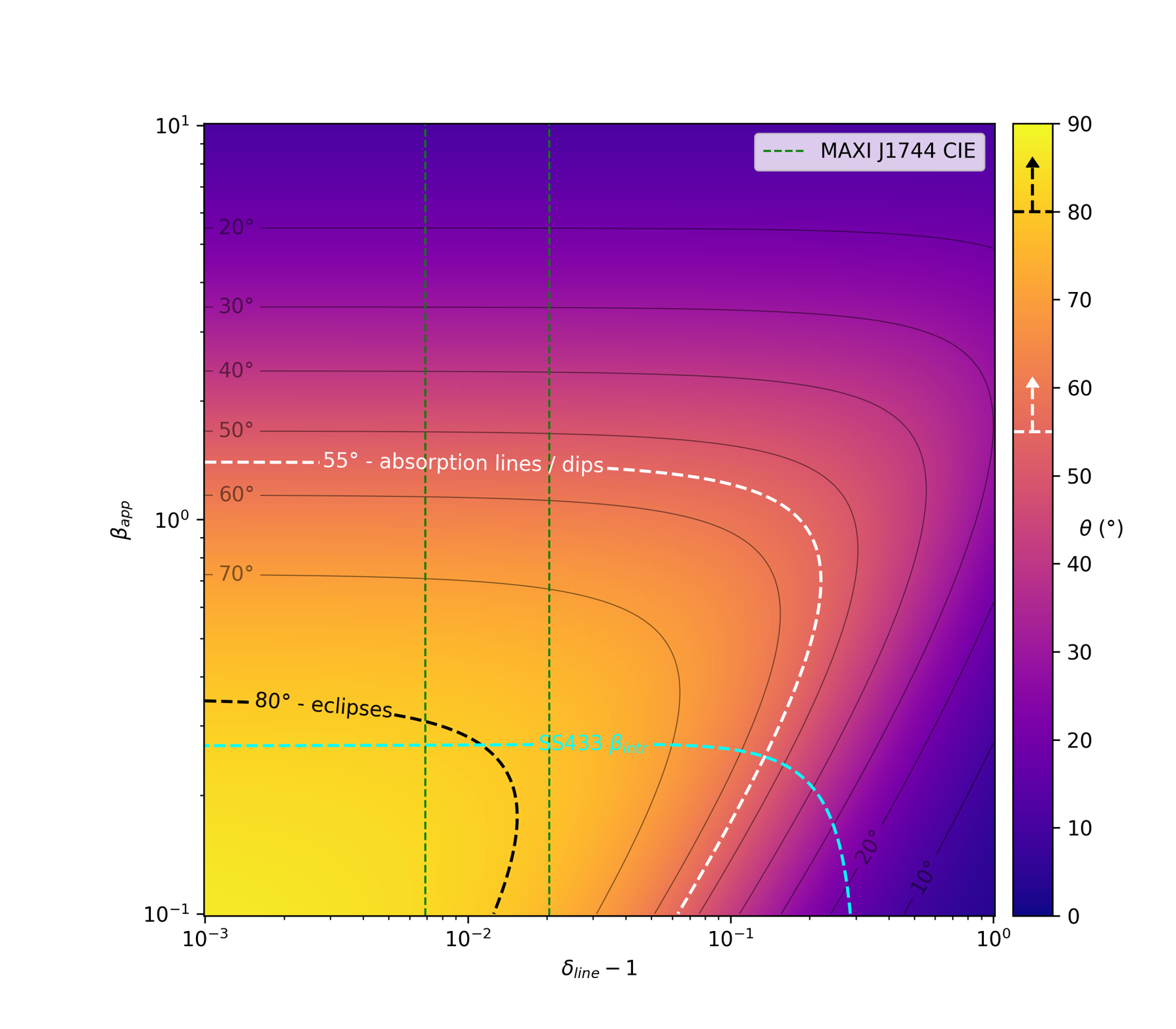
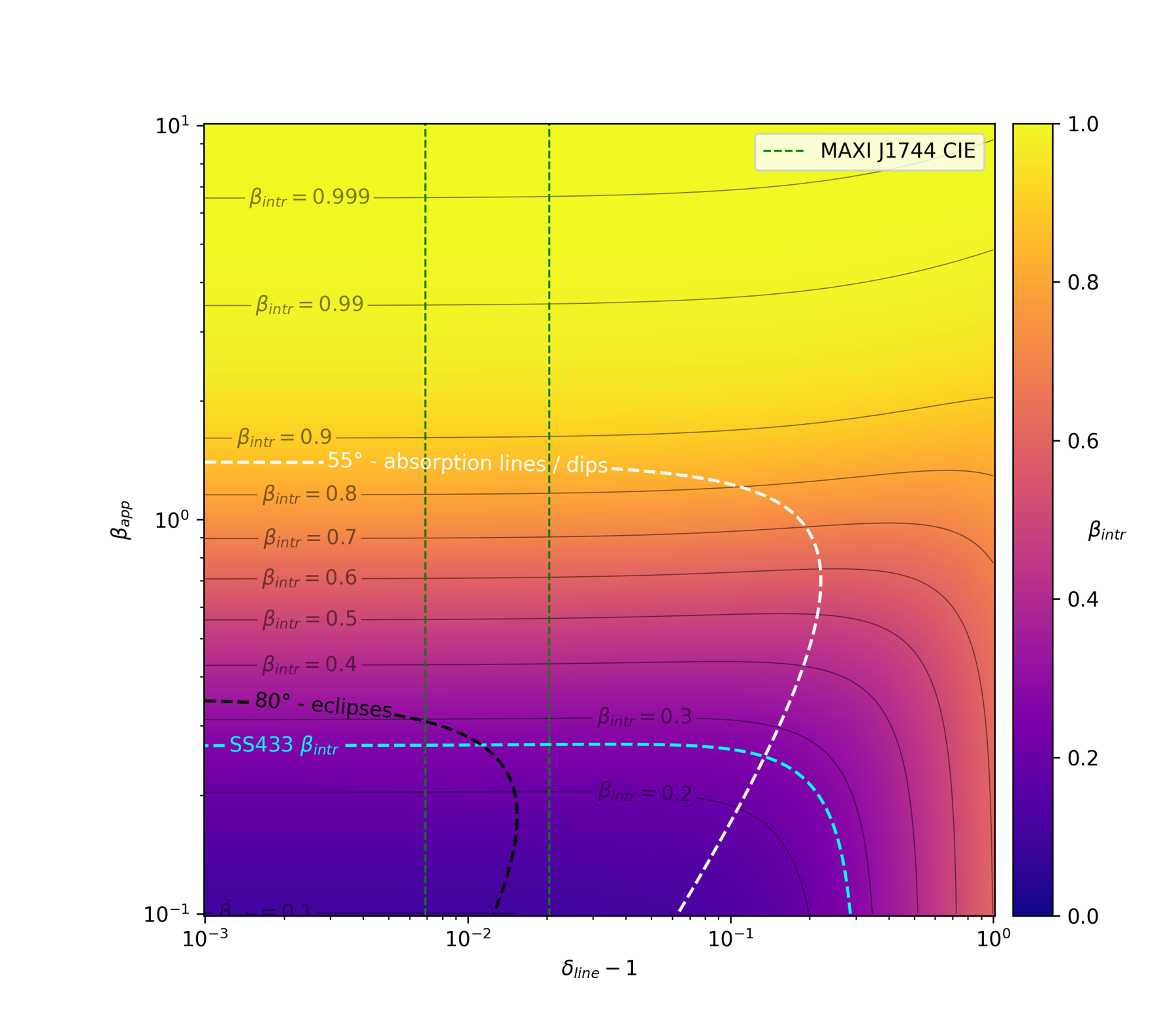
Shows the conditional geometric/kinematic inference from combining an X-ray-line Doppler factor with radio-ejecta apparent motion, explicitly assuming a common physical origin; it is not independent proof that the lines arise in a jet.
Original caption
Figure 13: Jet inclination angle (left) and intrinsic velocity (right) as a function of two observables: the Doppler factor measured from the X-ray emission lines δ l i n e \delta_{line} , and transverse velocity of radio ejecta β a p p \beta_{app} , assuming a common physical origin. The x-axis shows δ l i n e − 1 \delta_{line}-1 to allow a logarithmic scale. We highlight canonical inclination thresholds for wind absorption lines and dips in white, and for eclipsing systems in black. The intrinsic velocity of SS 433’s jet is shown in cyan for reference. Vertical green dashed lines highlight the Doppler factors of the two blueshifted components in the CIE models of Section IV.2 .
Tests a key contamination systematic by freely rescaling Galactic-centre diffuse emission, Sgr A East, or both, then repeating blind narrow-line searches for the small extraction region.
Original caption
Figure 28: Blind searches for narrow line features in the 6.3-7.1 keV range after freely rescaling the GCXE (top), Sgr A East (middle), and both models (bottom), for the “small” MAXI J1744-294 region in the DDT observation. All spectra are rebinned at a 10 σ \sigma significance level for visibility.
Related research
Previous digest
This paper reports on a detailed high-resolution spectral analysis of emission line features from the first XRISM observation of a BH-LMXB candidate in a bright soft state, MAXI J1744-294/Swift J174540.2-290037, in the central parsec region of our galaxy. The main result is that narrow, highly ionized X-ray emission lines in black hole low-mass X-ray binaries (BH-LMXBs) are rare and have been observed in only a few sources, during unusual, heavily obscured accretion states.. So the paper's core point is that narrow, highly ionized X-ray emission lines in black hole low-mass X-ray binaries (BH-LMXBs) are rare and have been observed in only a few sources, during unusual, heavily obscured accretion states..
Sources and evidence (25)
- 2603.27235v1: XRISM spectroscopy of a crowded Galactic center region -- II. Narrow emission lines in the Black Hole candidate MAXI J1744-294/Swift J174540.2-290037
Narrow, highly ionized X-ray emission lines in black hole low-mass X-ray binaries (BH-LMXBs) are rare and have been observed in only a few sources, during unusual, heavily obscured accretion states. We report on a detailed high-resolution spectral analysis of emission line features from the first XRISM observation of a BH-LMXB candidate in a bright soft state, MAXI J1744-294/Swift J174540.2-290037, in the central parsec region of our galaxy. The source was observed as part of an extensive, coordinated multi-wavelength campaign on its recurring X-ray outburst in early 2025. By carefully modeling the contributions of multiple point sources and diffuse emission within the XRISM/Resolve field of view, and combining these data with broadband X-ray coverage from XMM-Newton and NuSTAR (Paper I), we identified a narrow ($σ\sim 500-1000$ km s$^{-1}$), static emission component intrinsic to the system. This component likely arises from a highly ionized (log $ξ\gtrsim 5.5$) photoionized plasma in the inner disk atmosphere, and is accompanied by a weak, narrow Fe I K$α$ line at 6.4 keV. We also detected at least three narrow emission features at atypical energies between 6.7 and 7.1 keV. The lack of corresponding rest-frame atomic transitions points toward highly ionized blueshifted Fe lines with outflow velocities of $-1300$ to $-6000$ km s$^{-1}$, which we model with multiple layers of photoionized or collisional plasma. We explore scenarios in which these unprecedented features are produced by multiple phases in a jet and/or a disk wind, and discuss potential similarities between MAXI J1744- 294 and the exotic microquasar SS 433.
- 2603.27235v1: XRISM spectroscopy of a crowded Galactic center region -- II. Narrow emission lines in the Black Hole candidate MAXI J1744-294/Swift J174540.2-290037
Thirdly, the non-DSH corrected Resolve spectrum, modeled in Section III.3 , and for which we must model the MAXI J1744-294 (Black Hole), AX J1745.6-2901 (Neutron Star), and diffuse emission contributions simultaneously due to their overlap in the Resolve regions. After subtracting these other contributions, several narrow emission features remain in the M1744 spectra, whose consistency across our background subtraction methodologies and region choices ensures they can be attributed unambiguously to M1744, as we later quantitatively confirm in Section V.4 . These lines can be separated between a very weak neutral iron (Fe I) K line, narrow ( ∼ 5 − 15 \sim 5-15 eV) static components from Fe xxv and Fe xxvi K α \alpha , and three narrow features at 6.74, ∼ 6.84 \sim 6.84 (which can also be fit with two narrower components depending on our region choice), and 7.00 keV. All lines are significant at ≳ 3 σ \gtrsim 3\sigma confidence after MC simulations, and none of the non-standard energies match strong or expected transitions. The most straightforward scenario is thus that these lines are highly Doppler-shifted versions of the nearby, highly ionized Fe lines. To minimize the velocity shifts required, we tentatively associate them with blueshifted Fe xxv and Fe xxvi K α \alpha features with blueshifts of ∼ − 2000 \sim-2000 , ∼ − 5500 \sim-5500 (or ∼ − 3500 \sim-3500 and ∼ − 6000 \sim-6000 ), and − 1300 -1300 km s -1 respectively.
- 2603.27235v1: XRISM spectroscopy of a crowded Galactic center region -- II. Narrow emission lines in the Black Hole candidate MAXI J1744-294/Swift J174540.2-290037
While the detection of static highly ionized emission features is already a first for non-obscured BH-XRB systems, the high velocity features (whose attribution is discussed in Section V.2 ) are even more atypical. We thus attempted to model the different highly ionized features with photoionization (Section IV.1 ) and collisional ionization (Section IV.2 ) models. We restrict ourselves to the single combination of velocities highlighted above: in that case, both types of ionization can reproduce the majority of the line features, with the notable exception of the − 1300 -1300 km s -1 Fe xxvi K α \alpha component, due to the lack of Fe xxv counterpart. For photoionization, most components require particularly high ionization parameters due to a soft ionizing spectrum and the lack of line features from lower-ionization ions. For collisional ionization, the fit requires less extreme parameters, but the non-negligible continuum contribution significantly worsens the high-energy fit with NuSTAR . Unless a more complex continuum (e.g., including reflection or returning radiation) can alleviate this tension despite the very soft spectral state, this disfavors the theory that all ionized phases arise from collisional ionization. A hybrid configuration with some phases from photoionized emission and others from collisional emission may be investigated with further broadband spectral analysis.
- 2603.27235v1: XRISM spectroscopy of a crowded Galactic center region -- II. Narrow emission lines in the Black Hole candidate MAXI J1744-294/Swift J174540.2-290037
To explain the physically abnormal Fe I K β \beta /K α \alpha line flux ratios seen in the data, in Section IV.3 , we explored the physical parameters of neutral iron emitters. After deriving their possible parameter range using MYTORUS, we find that with the introduction of additional K β \beta lines, which are not significantly detected in the diffuse emission spectra, using physically motivated line ratios, we still obtain an intrinsic Fe I K α \alpha line with expected line ratio values in the M1744 spectrum. Remaining weak 7.06 keV residuals may trace an additional, weaker Fe XXVI K α \alpha component at -3500km s -1 .
- 2603.27235v1: XRISM spectroscopy of a crowded Galactic center region -- II. Narrow emission lines in the Black Hole candidate MAXI J1744-294/Swift J174540.2-290037
⋆ \star computed from the full model, including the line components, and all sources applied to the two spectra of MAXI J1744-294 and AX J1745.6-2901. † \dagger frozen or at the limit of the parameter space. ‡ \ddagger does not include the correction of -28 km/s due to the relative motion of Earth in the Solar System on the date of the observation. ⋄ Significance computed from Monte-Carlo simulations to consider the look elsewhere effect. See the main text for details. We quote the rest energy of all lines fitted with Gaussians. The Fe i complexes are described with feklor and fekblor . Widths and velocities are linked within a single complex. The normalization of the He α \alpha complexes are tied to a 2-1 ratio, and the EW and significance are computed for both transitions.
- 2603.27235v1: XRISM spectroscopy of a crowded Galactic center region -- II. Narrow emission lines in the Black Hole candidate MAXI J1744-294/Swift J174540.2-290037
Finally, we fit the residual feature at 7.06 keV using the newly introduced bfekblor component in XSPEC, which follows the 4 Lorentzian modeling of [ 31 ] . This results in a Δ \Delta C improvement of 14 for 3 d.o.f., and a narrow ( σ K β < 183 \sigma_{K\beta}<183 km s -1 ), static ( v K β = − 6 − 83 + 108 v_{K\beta}=-6_{-83}^{+108} km s -1 ) component. Since a detection of the Fe K β \beta line without its K α \alpha should be impossible, we will investigate this feature using physical models in Section IV.3 . We show the final residuals in the most “crowded” 6.3–7.1 keV band for M1744 in Fig. 5 . Additional residuals combining the spectra of M1744 and AXJ are shown in Fig. A. 19 in App. A.2.1 . To assess the quality of our final fit, we perform one final round of blind searches for the M1744 and AXJ spectra, which we show in the bottom-left panels of Fig. A. 21 and Fig. A. 22 in App. A.2.1 , respectively. Both significance maps confirm that no significant residuals remain in the final spectra, aside from a feature at 7.1 keV, possibly due to our imperfect fitting of the iron edge, and the lack of consideration for dust (see e.g. Rogantini et al. 88 ). As the edge profile is not trivial and has a very limited signal-to-noise, its detailed study is left for future work. We list the full M1744 model and line parameters in Tab. A. 2 in App. A.2.1 . The significance of each line is shown with both the raw Δ \Delta C differences and corresponding Monte-Carlo (MC) simulations. This MC significance is central to determine the “true” significance of the lines in regard to the look elsewhere effect (see e.g. Porquet et al. 86 ), and our methodology is detailed in App. A.2.2 . All lines are found to be highly significant and above the commonly adopted threshold of 3 σ \sigma , except for the Fe xxv 2 Ly α \alpha , which we find to be 99.6 % \% significant. We thus consider this line as marginally significant, but stress that this solution is, in any case, indistinguishable from the wider line blending the two contributions, and that the same configuration ends up much more than 3 sigma significant in the “small” M1744 region thanks to its lower continuum.
- 2603.27235v1: XRISM spectroscopy of a crowded Galactic center region -- II. Narrow emission lines in the Black Hole candidate MAXI J1744-294/Swift J174540.2-290037
Figure 12: Flux ratios of the MAXI J1744-294 line components to the deabsorbed continuum of the source, for the empirical (top) , photoionization (middle) , and collisional ionization (bottom) models, for the “big” (left) and “small” (right) MAXI J1744-294 region, from the results of Section III and Section IV , including the constrained Fe I line ratios from Section IV.3 . Empirical and photoionization components with width upper limits are put at a fiducial width of σ = \sigma= 2 eV ( ∼ 90 \sim 90 km -1 ) for visualization, which is within their allowed parameter space.
- 2603.27235v1: XRISM spectroscopy of a crowded Galactic center region -- II. Narrow emission lines in the Black Hole candidate MAXI J1744-294/Swift J174540.2-290037
We first tested rescaling the GCXE emission exclusively: this resulted in a normalization factor of c G C X E = 3.7 c_{GCXE}=3.7 , and an improvement of the fit statistic of Δ C \Delta C =115. We show the corresponding blind search for narrow features in the top panel of Fig. C. 28 in App. C . Both panels show that, after rescaling, the GCXE lines qualitatively reproduce the static component. Meanwhile, since the GCXE model doesn’t include any blueshifted component, none of the additional features between 6.7 and 7 keV are reproduced. We stress that an underestimation of the contribution of the GCXE by almost a factor 4 is a much higher discrepancy compared to any of the remaining systematic effects (DSH, PSF, non-uniformity of the GCXE) that may remain following our analysis, and the only possibility would thus be for the GCXE to have increased very significantly since 2024, and only at the position of M1744. Although we cannot fully rule out a spurious contribution by a background transient in our observation alone, the extensive monitoring presented in M26 clearly shows that the long-term variation of the iron lines was (expectedly) linked to the continuum of M1744 along its entire outburst, which heavily disfavors transient contamination.
- 2603.27235v1: XRISM spectroscopy of a crowded Galactic center region -- II. Narrow emission lines in the Black Hole candidate MAXI J1744-294/Swift J174540.2-290037
In this work, we presented a detailed analysis of the first XRISM spectrum of MAXI J1744-294 (M1744), a new BH-XRB candidate observed in March 2025 during its discovery outburst, building on the data analysis and background modeling presented in Parra et al. (submitted to ApJ, Paper I). This paper focuses on the intrinsic spectral properties of the Black Hole, most particularly the various narrow emission lines arising from highly ionized gas and, in part, unexpected energies. The simultaneous coverage from XMM-Newton and NuSTAR provides a complementary view to the broad-band X-ray continuum. Indeed, since we do not model the Dust Scattering Halo (DSH) around our sources with XRISM , and considering the difficulty of combining instruments with different angular resolutions and Spatial-Spectral Mixing (SSM), we split our analysis into 3 groups.
- 2603.27235v1: XRISM spectroscopy of a crowded Galactic center region -- II. Narrow emission lines in the Black Hole candidate MAXI J1744-294/Swift J174540.2-290037
First, the low-resolution, DSH corrected broadband continuum of XMM-Newton -PN and NuSTAR , which we modeled with a simple Comptonized disk in Section III.1 , reveals a very low temperature at such an Eddington ratio, along with an extremely weak but firmly detected hard tail. Here, a single broad Gaussian emission line is sufficient to reproduce a strong emission feature around 6.9keV. This continuum is used as the basis for subsequent physical models, reducing bias from Dust Scattering and SSM. The contextualization of these observations within the entire monitoring campaign of the source, along with a more holistic approach to continuum modeling, can be found in M26.
- 2509.14555v1: Stratified wind from a super-Eddington X-ray binary is slower than expected
GX 13+1 is a disk-accreting neutron star in a 24.5-day orbit 8 , 9 with a giant (K5 III) companion star 10 , which gives a large mass transfer rate through the Roche lobe 11 , resulting in a persistently bright X-ray source ( L ≈ 0.5 L Edd L\approx 0.5L_{\rm Edd} for a 1.4 M ⊙ 1.4M_{\odot} neutron star at a distance of 7 kpc; ref. 10 ). The presence of dips in the X-ray lightcurve indicates a high binary inclination 12 , which is optimal for observations of accretion disc winds 13 , 14 , 1 . Every X-ray observation of GX 13+1 with sufficient spectral resolution has shown blueshifted absorption lines 15 , 16 , 17 , 18 , making it an ideal target for Resolve, an X-ray micro-calorimeter onboard the new JAXA/NASA/ESA mission XRISM 19 . Resolve has an energy resolution of 4.5 eV at 6 keV, which is a factor 4 better than the previous state of the art equipment for bright binaries (third order data 20 from the High-Energy Transmission Grating Spectrometer 21 , hereafter HETGS), and with much larger effective area, especially above 7 keV. The combination of improved resolution and larger area enables more sensitive measurements of the velocity and ionisation structure of accretion disc winds, critical for diagnosing the physical properties and launch mechanisms of these outflows 22 .
- 2509.14555v1: Stratified wind from a super-Eddington X-ray binary is slower than expected
The resulting fit parameters are given in Extended Data Table 1 . The ions in the slow component all have similar outflow velocities of v out ∼ 330 km / s v_{\rm out}\sim 330~{\rm km/s} . The fast component appears to have a wider range of kinematics, with outflow velocities ranging from ∼ \sim 500 to ∼ \sim 1000 km s -1 depending on the ion, but both fast and slow components have line widths ∼ v o u t / 2 \sim v_{out}/2 .
- 2507.10674v1: BASS. XLIX. Characterization of highly luminous and obscured AGNs: local X-ray and [NeV]$λ$3426 emission in comparison with the high-redshift Universe
For sources with available multi-epoch spectroscopy, we performed a variability analysis for our sample. We found that 11 out of 13 sources ( 85 − 15 + 5 % 85^{+5}_{-15}\% ) exhibit variability either in flux (10/13, 77 − 15 + 8 % 77^{+8}_{-15}\% ) or N H N_{\rm H} (4/12, 33 − 10 + 15 % 33^{+15}_{-10}\% ). These results are in excellent agreement with recent findings on lower-luminosity ( log L X / erg s − 1 ∼ 43 \log L_{\rm X}/\mathrm{erg\,s^{-1}}\sim 43 ), Compton-thin AGNs.
- 2507.10674v1: BASS. XLIX. Characterization of highly luminous and obscured AGNs: local X-ray and [NeV]$λ$3426 emission in comparison with the high-redshift Universe
For 20/21 sources with adequate optical spectroscopy, we measured the [ Ne v ] λ 3426 \lambda 3426 emission line and found a detection rate of 85 − 11 + 5 % 85^{+5}_{-11}\% (17/20). This confirms that the [ Ne v ] λ 3426 \lambda 3426 emission line is a strong tracer of AGN activity even in cases of heavy obscuration, in agreement with previous studies;
- 2506.02289v1: Radiation GRMHD Models of Accretion onto Stellar-Mass Black Holes: I. Survey of Eddington Ratios
A second and perhaps more important difference between our results and previous models is the measured radiative efficiency of the disk. We find efficiencies of at most a few percent at the lowest Eddington ratios, and this drops to ∼ 0.5 \sim 0.5 % for super-Eddington flows. Other authors have reported much larger values, up to almost 100 100 % [ 78 , 25 , 15 ] . There are several possible reasons for this discrepancy. Firstly, the highest measured efficiencies are for disks that reach the MAD state, whereas our models do not. Secondly, the efficiencies are measured at different radii by different authors, and may include radiation emitted by the disk if it is initially hot (geometrically thick) rather than produced by accretion. Finally, it is possible that radiative efficiencies may depend on the radiation transport model adopted. We plan to explore radiation-dominated models of MAD accretion flows computed using the full transport algorithms adopted in this work in the near future.
- 2506.02289v1: Radiation GRMHD Models of Accretion onto Stellar-Mass Black Holes: I. Survey of Eddington Ratios
The overall radiative efficiency of accretion drops dramatically as the mass accretion rate is increased, from a few percent at sub-Eddington rates to ≲ 0.5 \lesssim 0.5 % for highly super-Eddington.
- 2508.09749v1: A dual AGN at z = 5.4 associated with a Lyman-alpha Nebula in the Center of a Cosmic Filament
In summary, we present the discovery of a spectroscopically confirmed dual AGN at z ∼ 5.4 z\sim 5.4 with a projected separation of ∼ 10.4 \sim 10.4 pkpc, among the highest-redshift examples known. The system is embedded in a prominent overdensity, likely marking the core of a protocluster or a node of a filamentary structure. Both nuclei show clear AGN signatures from SED fitting, emission-line diagnostics, and the detection of high-ionization lines. VLT/MUSE data reveal an extended Ly α \alpha nebula exceeding 22 22 kpc, consistent with AGN-driven photoionization or shocks, and indicative of substantial circumgalactic gas reservoirs.
- 2508.09749v1: A dual AGN at z = 5.4 associated with a Lyman-alpha Nebula in the Center of a Cosmic Filament
Different star formation histories (SFHs) can significantly impact the inferred stellar mass and SFR for the measured systems ( Furtak et al., 2021 ; Tacchella et al., 2022 ; Harvey et al., 2025 ; Wang et al., 2024 ) . We present results from our fiducial parametric SFH model - the log-normal SFH - and one non-parametric SFH, the continuity model Leja et al. (2019a) . These models are widely accepted and have been utilized in various works ( Carnall et al., 2023 ; Endsley et al., 2023 ; Tacchella et al., 2023 ; Whitler et al., 2023 ; Looser et al., 2023 , e.g.,) . The redshift is fixed to the spectroscopic redshift.
- 2509.09607v1: Discovery of Multiply Ionized Iron Emission Powered by an Active Galactic Nucleus in a z~7 Little Red Dot
We measure three Balmer lines: H α \mathrm{H}{\alpha} , H β \mathrm{H}{\beta} , and H γ \mathrm{H}{\gamma} . The detailed line decomposition procedure is reported in the Methods; in brief, we find complex line component features within the Balmer lines. In summary, all detected Balmer lines contain evidence of at least one broad component tracing gas at ∼ \sim 3000 km s -1 via the FWHMs of the respective features. The Balmer emission lines are significantly broad-line dominated – with narrow components comprising only a marginal percentage of their total flux. Though we note the H β \mathrm{H}{\beta} and H α \mathrm{H}{\alpha} complexes have strong central absorption components, this yields a significant degeneracy in accurately decomposing the narrow line components at their respective line centers. Figure 2 highlights the and respective multicomponent fits to the three detected Balmer lines.
- 2509.09607v1: Discovery of Multiply Ionized Iron Emission Powered by an Active Galactic Nucleus in a z~7 Little Red Dot
In summary, we report the first discovery of several rare iron transitions, including a possible [Fe vii ] λ 5160 \lambda 5160 detection, in the little red dot THRILS_46403 at z = 6.68476 z=6.68476 . We also measure significant narrow Balmer absorption in both H α \mathrm{H}{\alpha} and H β \mathrm{H}{\beta} . The small velocity widths of the absorber, in conjunction with the detected lines that require direct, unobscured attenuation from the accretion disk, indicate that the source of the absorber is on scales at (or beyond) the broad-line gas region and a covering fraction that does not completely occlude the broad-line region.
- 2501.12567v1: Exploring quasar evolution with proximate molecular absorbers: Insights from the kinematics of highly ionized nitrogen
We investigate the presence and kinematics of NV absorption proximate to high redshift quasars selected upon the presence of strong $H_{2}$ and HI absorption at the quasar redshift. Our spectroscopic observations with X-shooter at the VLT reveal a 70% detection rate of NV (9 of 13 quasars with 2.5 < z < 3.3), remarkably higher than the 10% detection rate in intervening DLA systems and the 30% rate observed within a few thousand km/s of the source in the general quasar population. While many NV components lie within the velocity range of the neutral gas, the kinematic profiles of high-ionization species appear decoupled from those of low-ionization species, with the former extending over much larger velocity ranges, particularly towards bluer velocities. We also observe significant variations in the NV/SiIV, which we attribute to varying ionization conditions, with a velocity-dependent trend: blueshifted NV components systematically exhibit higher ionization parameters compared to those near the quasar's systemic redshift. Furthermore, the most redshifted systems relative to the quasar show no evidence of NV absorption. The results suggest that proximate $H_{2}$ absorption systems select critical stages of quasar evolution, during which the quasar remains embedded in a rich molecular environment. Redshifted systems trace infalling gas, potentially associated with mergers, preceding the onset of outflows. Such outflows may reach or even carry out neutral and molecular gas.This latter stage would correspond to proximate $H_{2}$ systems located around or blueshifted relative to the quasar's systemic z. Finally, the only case in our sample featuring highly blueshifted neutral gas shows no evidence of an association with the quasar.Our findings highlight the need to account for the ionization state when defining a velocity threshold to distinguish quasar-associated systems from intervening.
- 2505.05942v1: Green Flash: Residual Emissions Enshrouded in Low-mass Balmer-break Galaxies at $z\sim5$
An in-depth analysis of one of the sample galaxies, ID52153, using medium- and broad-band imaging revealed that the [O iii ] emission is compact and centrally concentrated (effective radius ∼ 0.7 \sim 0.7 kpc), while the stellar continuum responsible for the Balmer break is more extended (effective radius ∼ 0.9 \sim 0.9 kpc). The spatial decoupling of the compact, young/active star-forming central region and the extended, older/quenched outer region in ID52153 suggests an “outside-in” quenching scenario, where star formation ceased in the outskirts before the central region. This contrasts with the “inside-out” quenching typically seen in massive galaxies, and could be driven by processes like wet compaction or mergers. While the exact nature of the central activity (star formation vs. AGN) remains uncertain, the evidence points towards that these high-redshift, low-mass galaxies quench via a pathway that preserves residual activity in a compact, dusty core.
- 2505.05942v1: Green Flash: Residual Emissions Enshrouded in Low-mass Balmer-break Galaxies at $z\sim5$
This paper is structured as follows: In Section II , we describe the data set we use and the details of the analyses we perform. In Section III , we show the results from the SED fitting and emission line analyses. In Section IV , we discuss the location of quenching within a galaxy and possible mechanisms. In Section V , we summarize the nature of these galaxies.
- 2512.05041v1: Probing AGN Feedback in Dwarf Galaxies with Spatially Resolved NIR Coronal Lines from JWST
We use Kendall’s τ \tau (appropriate for our small sample) to test for correlations between ionization potential (I.P.) and the extents (determined using the method listed in Section III ). The element-wise results are weakly consistent with smaller extents for higher-ionization lines, but are not statistically significant (likely due to the small sample size). Si shows the strongest possible trend ( τ = − 0.64 \tau=-0.64 , p = 0.055 p=0.055 ), S is also negative ( τ = − 1.00 \tau=-1.00 , p = 0.083 p=0.083 ), and Mg and the remaining species show negative τ \tau , while Ca shows no trend ( τ = − 0.11 \tau=-0.11 , p = 1.00 p=1.00 ). The Ca lines despite their relatively low I.P. compared to many other CLs, have among the smallest extents. This might possibly be linked to the strong depletion of Ca onto dust grains at larger radii [ 45 , 70 , 66 ] , which reduces the gas-phase Ca available for ionization. Pooling all lines in a stratified Kendall’s τ \tau that preserves galaxy identity yields τ = − 0.20 \tau=-0.20 ( p = 0.14 p=0.14 , 95% CI [ − 0.47 -0.47 , 0.10 0.10 ]), which is consistent with the same trend but not significant, which may be due to the fact that mixing different elements introduces abundance and depletion effects. Overall, the statistics point toward decreasing spatial extent with increasing I.P., but a larger sample is required for a definitive constraint.
- 2512.05041v1: Probing AGN Feedback in Dwarf Galaxies with Spatially Resolved NIR Coronal Lines from JWST
The average extents of the CLs across the four dwarf galaxies are ∼ \sim 0.5 kpc, which is similar to the extents found tracing NIR CL in massive galaxies. The small sizes of dwarf galaxies mean their CLRs can occupy ∼ \sim 10% of the host galaxy, about ten times the fractional extent seen in massive galaxies. In J0954, an outflow radius of ∼ \sim 0.5 kpc estimated from blueshifted UV absorption [ 61 ] agrees with the CL extents, supporting CLs as tracers of the ionized outflow.
Abstract
Narrow, highly ionized X-ray emission lines in black hole low-mass X-ray binaries (BH-LMXBs) are rare and have been observed in only a few sources, during unusual, heavily obscured accretion states. We report on a detailed high-resolution spectral analysis of emission line features from the first XRISM observation of a BH-LMXB candidate in a bright soft state, MAXI J1744-294/Swift J174540.2-290037, in the central parsec region of our galaxy. The source was observed as part of an extensive, coordinated multi-wavelength campaign on its recurring X-ray outburst in early 2025. By carefully modeling the contributions of multiple point sources and diffuse emission within the XRISM/Resolve field of view, and combining these data with broadband X-ray coverage from XMM-Newton and NuSTAR (Paper I), we identified a narrow ($σ\sim 500-1000$ km s$^{-1}$), static emission component intrinsic to the system. This component likely arises from a highly ionized (log $ξ\gtrsim 5.5$) photoionized plasma in the inner disk atmosphere, and is accompanied by a weak, narrow Fe I K$α$ line at 6.4 keV. We also detected at least three narrow emission features at atypical energies between 6.7 and 7.1 keV. The lack of corresponding rest-frame atomic transitions points toward highly ionized blueshifted Fe lines with outflow velocities of $-1300$ to $-6000$ km s$^{-1}$, which we model with multiple layers of photoionized or collisional plasma. We explore scenarios in which these unprecedented features are produced by multiple phases in a jet and/or a disk wind, and discuss potential similarities between MAXI J1744- 294 and the exotic microquasar SS 433.
Discussion
Discussion access requires a security token. Register for the weekly digest.