654 indexed papers · 430 research notes

Research archive

Reset
Figure 4 from Search for High-Ionization Nebular Emission (SHINE). I. A Systematically Selected [Ne V] Sample at z > 3 with JWST/NIRSpec PRISM

2026-09-24 · 2609.27130v1 · Research note

Search for High-Ionization Nebular Emission (SHINE). I. A Systematically Selected [Ne V] Sample at z > 3 with JWST/NIRSpec PRISM

Shobita Satyapal, Sara Doan, Daniel Schaerer, et al.

SHINE identifies 25 luminous [Ne V] emitters at z=3.06–9.44 from >9,000 JWST/NIRSpec PRISM galaxies. Their hard-ionization lines favor accretion, but heterogeneous selection and incomplete diagnostic overlap preclude an intrinsic AGN-incidence measurement.

Figure 9 from Inflated Supermassive Stars as Little Red Dots and Progenitors of Supermassive Black Holes

2026-09-22 · 2609.22507v1 · Research note

Inflated Supermassive Stars as Little Red Dots and Progenitors of Supermassive Black Holes

Wenbin Lu

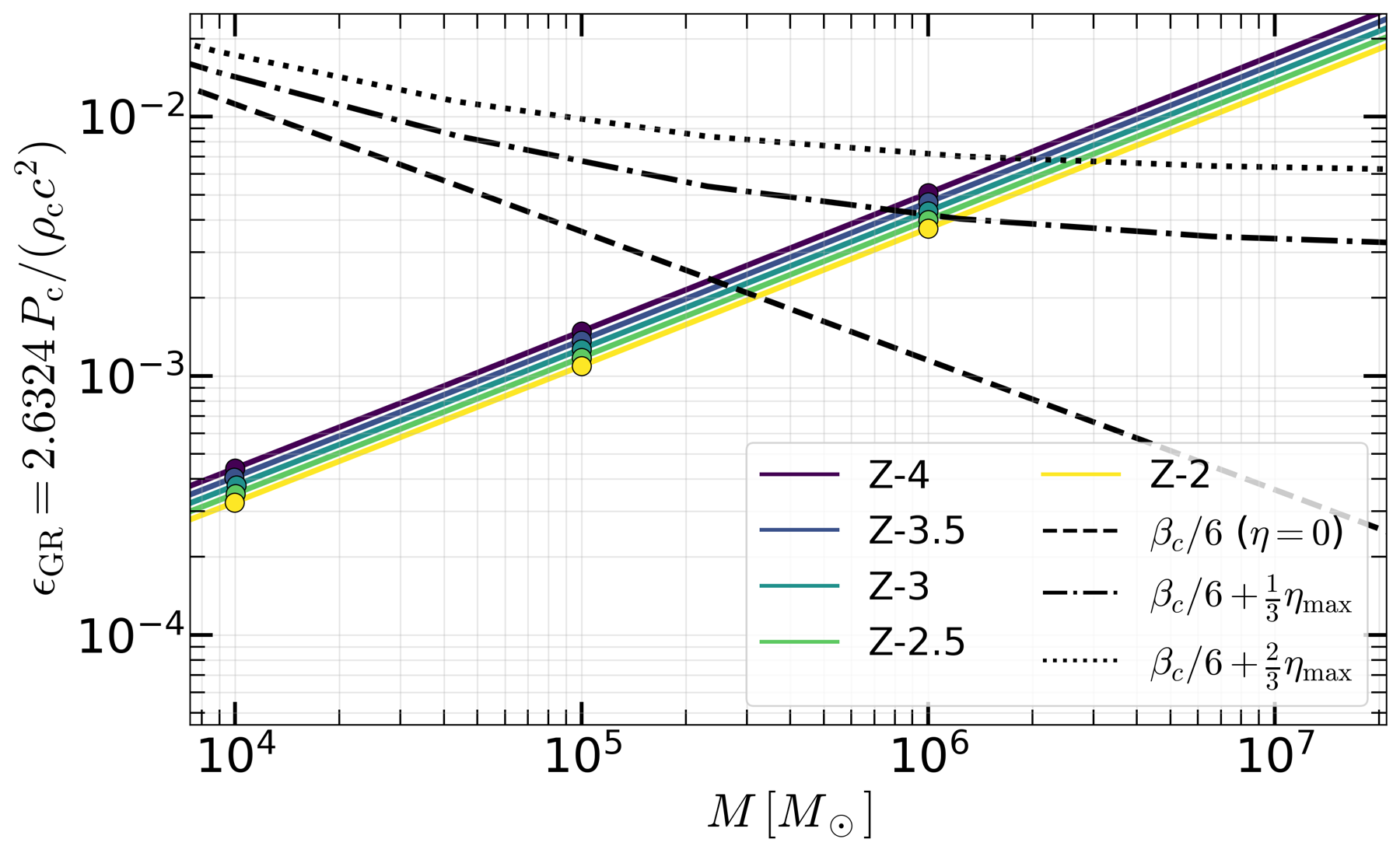
One-dimensional equilibrium models suggest that metal-enriched, hydrogen-burning supermassive stars can attain LRD-like cool photospheres through Fe-opacity-driven envelope inflation, while general-relativistic collapse could leave massive black-hole remnants. The proposed interpretation remains sensitive to atmospheric physics and formation assumptions.

Figure 4 from Extending the Little Red Dot population at intermediate redshift with VIPERS

2026-09-10 · 2609.10319v1 · Research note

Extending the Little Red Dot population at intermediate redshift with VIPERS

Krzysztof Lisiecki, Krzysztof Hryniewicz, Francesco Pistis, et al.

VIPERS yields 14 compact, LRD-like sources at 0.5<z<1.75 selected through V-shaped photometric slopes and broad lines. Their inferred abundance declines sharply below z~1, while one unresolved X-ray source is consistent with a low-inclination, radiatively efficient disk.

2026-09-09 · 2609.07825v1 · Research note

A Dusty Quenching-candidate AGN host at z=5.7: massive quiescent galaxies may quench already during the dust-obscured phase

Francesco D'Eugenio, Matilde Brazzini, Roberto Maiolino, et al.

RUBIES-EGS-9809 is a single, heavily obscured broad-line AGN host at z=5.7 whose resolved Balmer break and declining-SFR SED fit make it a quenching candidate, not a confirmed post-starburst. Outflow signatures make AGN feedback plausible but unproven.

2026-09-02 · 2609.00033v1 · Research note

Lynx2030 Science Analysis Group: Final Report

Lynx2030 Science Analysis Group, Simon R. Bandler, Laura W. Brenneman, et al.

This strategic report argues that Lynx-class subarcsecond, high-throughput X-ray imaging spectroscopy would test why JWST little red dots are X-ray weak, while simulations illustrate broader gains for feedback, accretion, and circumgalactic-gas studies.

2026-08-06 · 2608.04078v1

The most extreme high-z radio quasars in the eRASS:1 X-ray survey

L. Ighina, L. Palmieri, L. N. Martínez-Ramírez, et al.

Ighina et al. construct an eRASS:1-selected sample of extreme radio quasars by cross-matching eROSITA X-ray sources with RACS radio detections and DELVE optical/NIR dropout candidates, then spectroscopically following up 46 of 68 candidates. They confirm 39 quasars at z>3.5, including 14 new z>4 radio quasars, increasing the population above the same flux limits and area by about 65%. Their X-ray-to-optical and radio-loudness diagnostics identify a predominantly blazar-like subset, whose cumulative z>4 counts agree reasonably well with a fractional IC/CMB X-ray-enhancement model. The resulting uniformly selected sample provides a stronger basis for testing early jetted-SMBH growth and relativistic-jet evolution, although the redshift distribution remains affected by incomplete spectroscopy and blazar-classification choices.

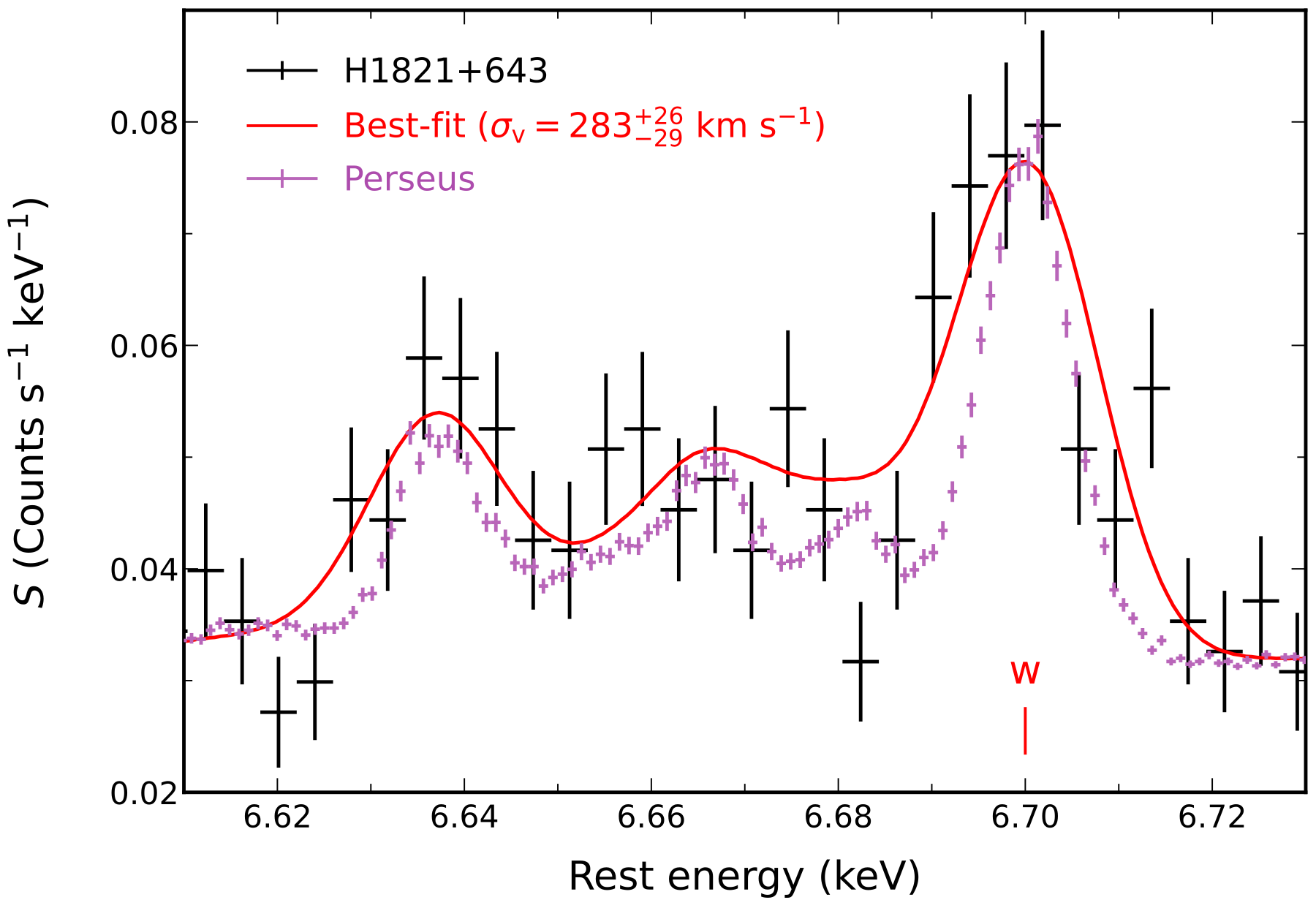
Figure 1 from Vigorous turbulence driven by quasar-mode feedback in a cluster core

2026-07-29 · 2607.24911v1 · Research note

Vigorous turbulence driven by quasar-mode feedback in a cluster core

Satoshi Yamada, Shutaro Ueda, Hirofumi Noda, et al.

XRISM/Resolve spectroscopy of the z=0.297 quasar cluster H1821+643 measures unusually broad ICM Fe XXV lines, implying substantial non-thermal motions on 20–100 kpc scales. The authors interpret these motions as quasar-feedback coupling, but resonance scattering and sloshing remain relevant alternatives.

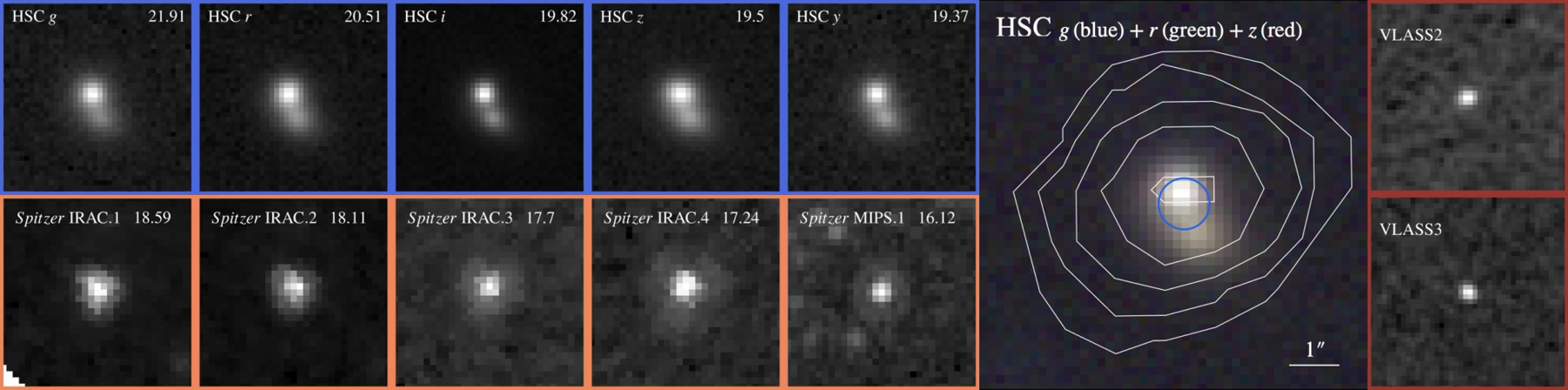
Figure 1 from Two Peas in a Pod: The First Confirmed Dual Active Galactic Nucleus within a Green Pea Galaxy System

2026-07-21 · 2607.17729v1 · Research note

Two Peas in a Pod: The First Confirmed Dual Active Galactic Nucleus within a Green Pea Galaxy System

Konstantinos Kouroumpatzakis, Peter G. Boorman, Jiří Svoboda, et al.

Chandra and Keck/DEIMOS observations identify two obscured, broad-line AGN in the interacting Green Pea system J1622+3521, separated by 8.4 kpc. The authors therefore report a confirmed dual AGN in a compact low-mass Green Pea environment.

Figure 2 from First detection of ultra-fast outflows in a quiescent galaxy

2026-07-09 · 2607.06844v1 · Research note

First detection of ultra-fast outflows in a quiescent galaxy

Yerong Xu, Malgorzata Siudek, Victor Rodríguez Morales, et al.

Using X-ray spectra of the single nearby, long-quenched galaxy KUG 1208+386, the authors report a ≈0.07c nuclear ultra-fast outflow. Its ≥3σ trial-corrected line evidence makes feedback in a quiescent host plausible, but not yet a demonstrated maintenance mechanism.

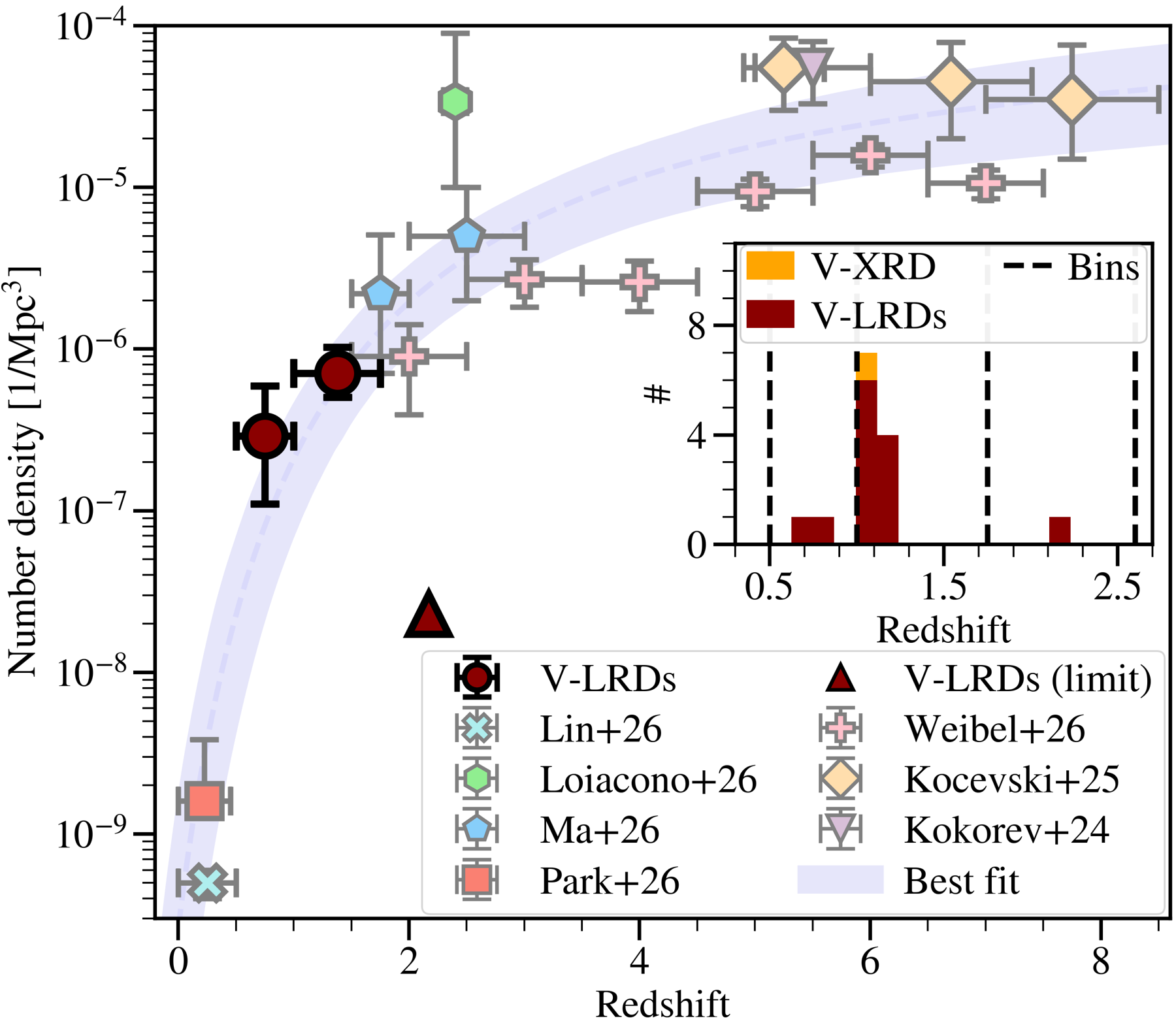
Figure 3 from No evolution in the number density of little red dots from cosmic dawn to cosmic noon

2026-06-30 · 2606.30253v1 · Research note

No evolution in the number density of little red dots from cosmic dawn to cosmic noon

Federica Loiacono, Roberto Gilli, Marco Mignoli, et al.

In one EIGER/J1030 field, five X-ray-undetected broad-line candidates imply an LRD density at z≈2.4 consistent with no decline from z≈7 above Lbol=3×10^44 erg s−1, but the large counting uncertainty and small sample preclude a precise evolutionary constraint.

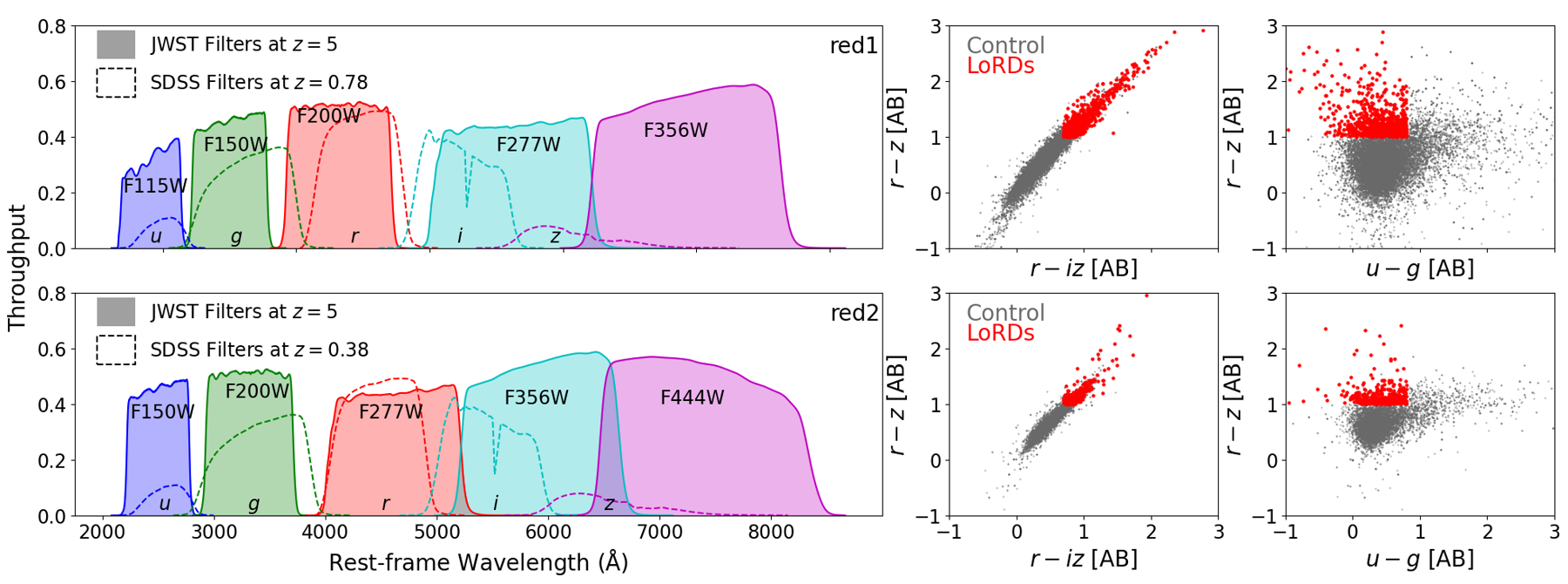
Figure 1 from A Population of Little Red Dot-like Quasars in SDSS

2026-06-25 · 2606.26098v1 · Research note

A Population of Little Red Dot-like Quasars in SDSS

Quinn O. Casey, Ryan C. Hickox, Nikko J. Cleri, et al.

SDSS color selection identifies ~1,300 low-redshift “LoRD” quasars whose V-shaped subset resembles LRD spectral energy distributions, but host contamination, unresolved morphology, and weak high-z X-ray limits prevent establishing them as a uniformly faithful analog population.

Figure 8 from X-rays Mark the Spot: The Effects of Reduced Metallicity on X-ray AGN Obscuration at High Redshift

2026-06-25 · 2606.25018v1 · Research note

X-rays Mark the Spot: The Effects of Reduced Metallicity on X-ray AGN Obscuration at High Redshift

Yash A. Gursahani, Christopher S. Reynolds

Monte Carlo torus calculations predict that metal-poor, Compton-thick AGN can transmit more X-ray flux than solar-metallicity counterparts, potentially aiding z≳10 detection. The result is model-based: geometry, viewing angle, abundance pattern, and cold-gas assumptions remain consequential.

2026-06-22 · 2606.21614v1 · Research note

Little Red and Blue Dots: AGN-excited narrow lines, Lyman-$α$ emission, and resemblance to standard quasars

Sophia Geris, Roberto Maiolino, Xihan Ji, et al.

In 36 GOODS LRDs/LBDs at z=2.26–7.89, the authors find AGN-like narrow-line excitation, extreme X-ray weakness, and LRD Lyα excess with a broad component resembling Hα. They argue against completely enclosing cocoon geometries, while retaining obscured-LBD interpretations.

2026-06-17 · 2606.18155v1 · Research note

X-ray eclipse tomography: Resolving the extent of X-ray-emitting region(s) in the Seyfert galaxy ESO362-G18

Laura Rueda-Nieto, Beatriz Agís-González, Giovanni Miniutti

Swift eclipse monitoring of ESO 362-G18 uses time-resolved absorption changes to constrain an X-ray source within ~35 Rg. The authors infer a structured cloud and a soft-excess region ~50% larger than, yet overlapping, the hot corona.

2026-06-17 · 2606.17144v1 · Research note

Decoupled Kinematics and Excitation in the Compton-thick AGN NGC 6552: Spatially Resolved KOOLS-IFU Observations

Kyuseok Oh, Yoshihiro Ueda, Kanta Fujiwara, et al.

KOOLS-IFU maps of NGC 6552 find broad [O III] emission declining with radius but no significant full-sample association between local kinematics and [O III]/Hβ excitation, favoring spatial dynamical structure over a detected excitation–kinematics coupling.

2026-06-11 · 2606.12076v1 · Research note

X-ray luminosity function of Compton-thick AGN in the early Universe (z > 3). Robustness and biases of the CTK population

Angel Ruiz, Ektoras Pouliasis, Ioannis Georgantopoulos

Using X-ray spectra and infrared-informed absorption priors, the authors infer that Compton-thick AGN comprise 17% of AGN at z=3–6. The revision sharply reduces candidate classifications, but supports no significant redshift evolution in this fraction.

2026-06-03 · 2606.03667v1 · Research note

Constraining AGN accretion physics with black hole mass-luminosity scaling relations

F. Fiore, M. Gaspari, S. Puccetti, et al.

Across a large SDSS–eROSITA quasar sample, bolometric luminosity scales nearly linearly with virial black-hole mass while hard X-rays rise more slowly. The authors argue this disfavors classical Bondi feeding and favors CCA, but redshift covariances and JWST line-based systematics limit interpretation.

2026-05-20 · 2605.21589v1 · Research note

A Magnetized Black Hole Envelope Model for Little Red Dots

Shinsuke Takasao, Kohei Inayoshi

This theoretical magnetized black-hole-envelope model links cool LRD continua, broad-line shapes, and weak X-rays to super-Eddington spherical inflow onto a rotating envelope, but its quantitative success remains conditional on assumed envelope structure, opacity, magnetism, and line-scattering physics.

Figure 1 from Population synthesis of active galactic nuclei based on the radiation-regulated unification model

2026-05-17 · 2605.17547v1 · Research note

Population synthesis of active galactic nuclei based on the radiation-regulated unification model

D. Gerolymatou, S. Paltani, C. Ricci, et al.

Using simulation-based inference on a synthetic local AGN population, the authors find an intrinsic Compton-thick fraction of 40±3%. Their radiation-regulated geometry broadly reproduces several X-ray observables, but depends materially on fixed, simplified broad-line-region and torus assumptions.

2026-05-14 · 2605.15263v1 · Research note

On the quenching of LRD X-ray emission by both Compton-thick gas and high accretion rates

Albert Sneppen, Darach Watson, James H. Matthews, et al.

Sirocco cocoon models suggest that current LRD X-ray non-detections require both moderately enriched, Compton-thick gas and intrinsically X-ray-weak/soft AGN emission. The inference is conditional on assumed intrinsic SEDs, metallicities, columns, and redshift-dependent observing bandpasses.

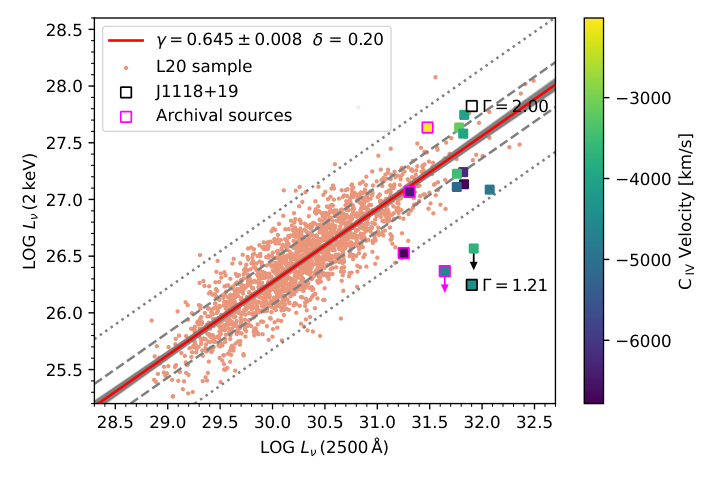
Figure 6 from A Changing-Look Seyfert Discovered by eROSITA Reveals a Two-Component Broad-Line Region

2026-05-08 · 2605.07965v1 · Research note

A Changing-Look Seyfert Discovered by eROSITA Reveals a Two-Component Broad-Line Region

Alex Markowitz, Mirko Krumpe, David Homan, et al.

eROSITA-triggered monitoring of HE 1237-2252/J1240−2309 links a changing-look transition to intrinsic accretion-rate recovery and an evolving two-component Balmer-line profile. A diskline-like component strengthens with UV flux, while the proposed corona/illumination mechanism remains interpretive.

2026-05-06 · 2605.05301v1 · Research note

An X-ray and optical spectral study of the changing-look narrow-line Seyfert 1 2MASX J0413-0050

A. Vietri, A. Tortosa, D. Ilić, et al.

Across four optical and three X-ray epochs, J0413-0050 changed from broad Balmer emission in 2004 to an Hβ-free 2021 state and back to broad plus narrow Hβ in 2023. The authors favor changing accretion over obscuration, but X-ray column density is unconstrained.

Figure 3 from PEARLS: Two Distinct Populations of AGN Hosts Moving Between Star Formation and Quiescence

2026-05-01 · 2605.00822v1 · Research note

PEARLS: Two Distinct Populations of AGN Hosts Moving Between Star Formation and Quiescence

Gibson B. Bowling, Rafael Ortiz, S. P. Willner, et al.

After image decomposition and host-only SED fitting, 36 NIRCam-selected NEP-TDF AGN candidates separate into a likely AGN “branch” and an ambiguous, largely early-type “bridge” near quenching; the reported SFR–AGN-fraction trend is weakly explanatory.

Figure 1 from A Rare Eddington-Limited, Heavily Obscured Low-Mass Active Galactic Nucleus Likely Triggered by a Galaxy Merger

2026-04-29 · 2604.26743v1 · Research note

A Rare Eddington-Limited, Heavily Obscured Low-Mass Active Galactic Nucleus Likely Triggered by a Galaxy Merger

Shouyi Wang, Fan Zou, Chang-Hao Chen, et al.

For the single $M_\star\sim10^{10}\,M_\odot$ host GAMA 376183, NuSTAR and multiwavelength data support a heavily obscured, rapidly accreting AGN in a disturbed system; the proposed merger-triggered starburst/accretion connection remains suggestive rather than demonstrated.

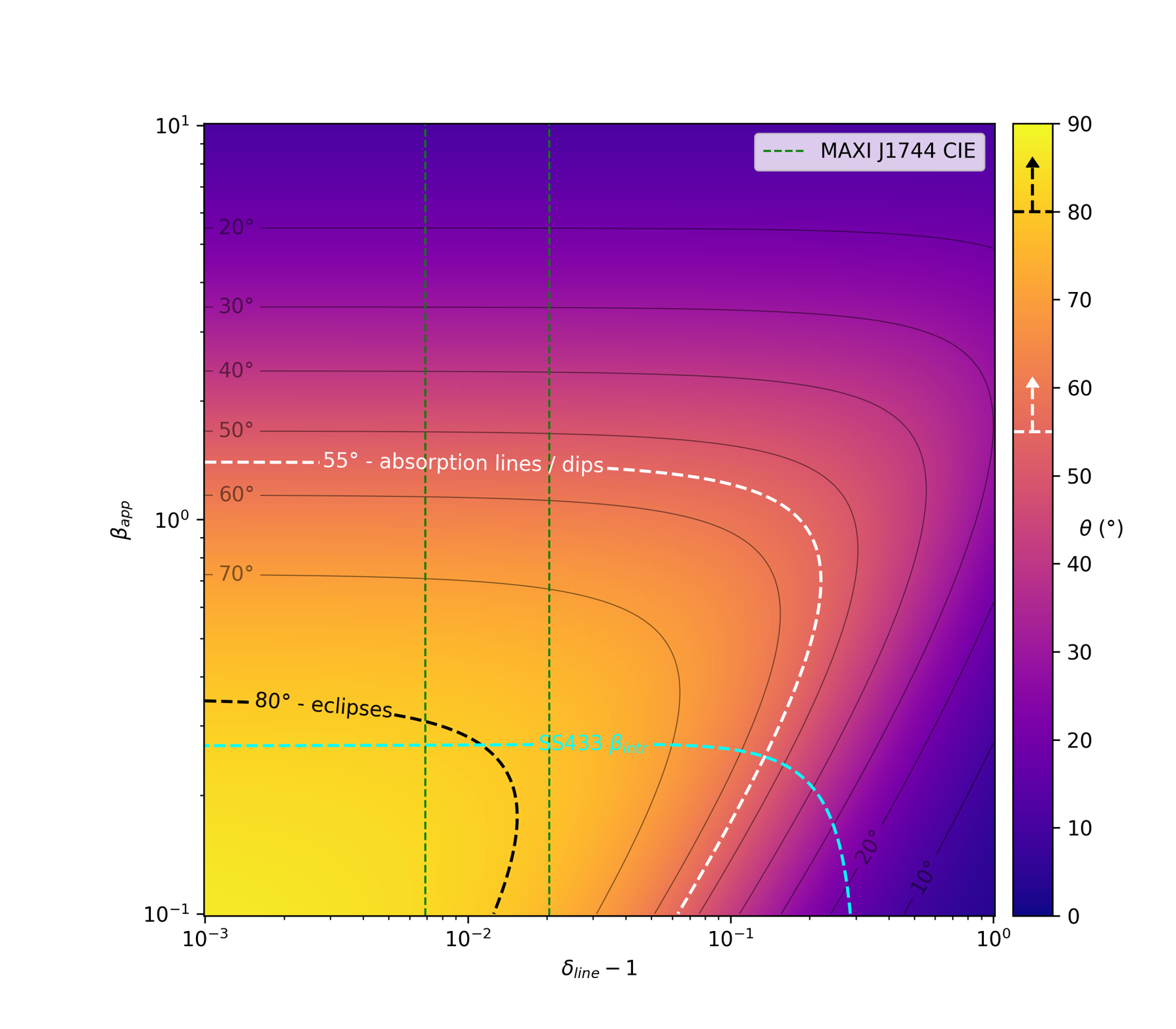
Figure 13 from XRISM spectroscopy of a crowded Galactic center region -- II. Narrow emission lines in the Black Hole candidate MAXI J1744-294/Swift J174540.2-290037

2026-03-28 · 2603.27235v1 · Research note

XRISM spectroscopy of a crowded Galactic center region -- II. Narrow emission lines in the Black Hole candidate MAXI J1744-294/Swift J174540.2-290037

Maxime Parra, Shifra Mandel, Kai Matsunaga, et al.

XRISM Resolve spectroscopy of the crowded Galactic-centre field isolates narrow iron-line emission attributed to the black-hole candidate MAXI J1744-294, including static highly ionized gas and atypical features consistent with blueshifted material, though plasma origin and background systematics remain unresolved.

2026-03-26 · 2603.24893v1 · Research note

Revisiting the Claim for a Direct-Collapse Black Hole in UHZ1 at $z=10.05$

Fan Zou, Elena Gallo, Zihao Zuo, et al.

A reanalysis of UHZ1’s full Chandra exposure and new MIRI non-detections reduces the evidence for its proposed luminous, Compton-thick direct-collapse black hole: the X-ray excess is marginal and non-persistent, while infrared limits exclude the originally inferred luminosity scale.

2026-03-23 · 2603.22425v1 · Research note

A large population of over-massive black hole quasars at z=0.3-0.8 revealed by eROSITA

Johannes Buchner, Isabelle Gauger, Qiaoya Wu, et al.

In a 140 deg² eROSITA field, the authors identify eight z=0.3–0.8/1 quasars with inferred M•/M⋆>5%. Their abundance supports recurrent black-hole/host offsets among rapidly accreting AGN, but single-epoch masses and often upper-limited host masses temper the conclusion.

2026-03-18 · 2603.17967v1 · Research note

JWST Reveals Two Overmassive Black Hole Candidates in Dwarf Galaxies at z $\approx$ 0.7: Pushing Black Hole Searches into the Dwarf-Galaxy Regime

E. Iani, P. Rinaldi, A. Torralba, et al.

Two z≈0.7 compact dwarfs combine blue, burst-dominated UV–optical emission with a MIRI hot-dust excess. SED-inferred AGN luminosities imply candidate black holes disproportionately massive for ≈10^7 M⊙ hosts, but masses depend strongly on the assumed Eddington ratio.

Figure 5 from The X-ray weakness of Little Red Dots and JWST-selected AGN: comparison with local AGN in different accretion regimes

2026-03-10 · 2603.10162v1 · Research note

The X-ray weakness of Little Red Dots and JWST-selected AGN: comparison with local AGN in different accretion regimes

A. Tortosa, C. Ricci, P. Du, et al.

High-redshift LRDs and JWST-selected broad-line AGN are X-ray weak relative to broad Hα, plausibly resembling highly accreting local systems; however, predominantly upper-limit-based X-ray constraints leave intrinsic coronal suppression and obscuration unresolved.

Figure 4 from You can't see me: super-Eddington growth hindering X-ray detection in high-z broad-line AGNs

2026-02-25 · 2602.22305v1 · Research note

You can't see me: super-Eddington growth hindering X-ray detection in high-z broad-line AGNs

Alessandro Trinca, Alessandro Lupi, Francesco Haardt, et al.

Joint modelling of broad lines and Chandra non-detections for 14 JWST high-redshift broad-line AGNs favors low-mass, highly super-Eddington black holes with over-cooled coronæ over massive, weakly accreting alternatives, but the inference remains model-dependent and bimodal.

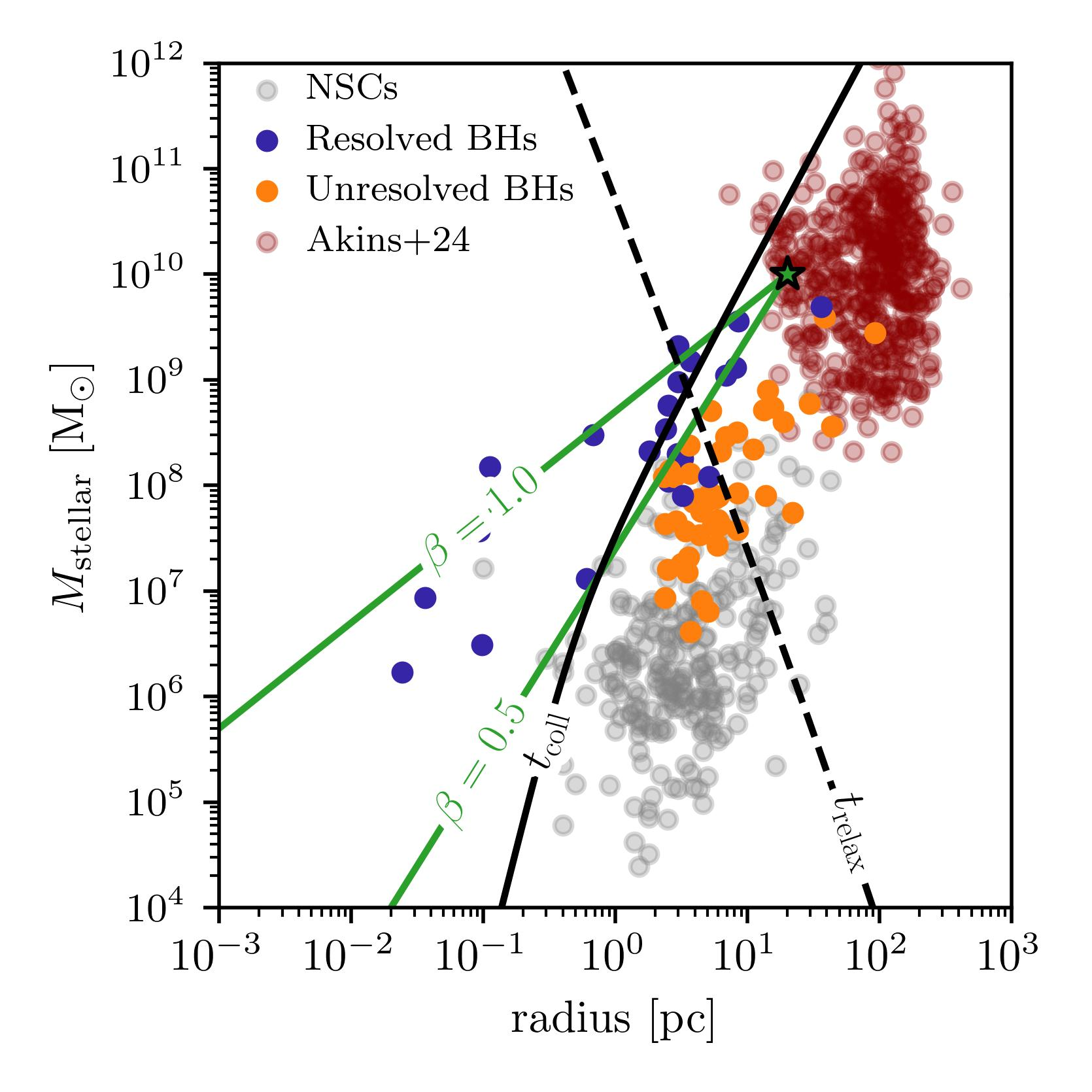
Figure 3 from Constraints on dynamically-formed massive black holes in Little Red Dots from X-ray non-detections

2026-02-24 · 2602.21002v1 · Research note

Constraints on dynamically-formed massive black holes in Little Red Dots from X-ray non-detections

M. Liempi, D. R. G. Schleicher, M. A. Latif, et al.

Using X-ray non-detections of Little Red Dots, the authors model collisionally formed black-hole seeds and argue that heavy-seed evolutionary tracks can meet flux limits, conditional on degenerate assumptions about structural evolution, accretion, metallicity, and absorption.

Figure 9 from Obscured AGN at z < 1.5: X-ray to Far-Infrared SEDs and Host Galaxy Morphologies in the GOODS Fields

2026-01-29 · 2601.22227v1 · Research note

Obscured AGN at z < 1.5: X-ray to Far-Infrared SEDs and Host Galaxy Morphologies in the GOODS Fields

William W. H. Jarvis, Connor Auge, David Sanders, et al.

For 194 X-ray AGN at z<1.5 in GOODS, the authors find predominantly obscured SEDs and mainly disk-dominated hosts. A statistically distinct, faint obscured SED class is more spheroid-rich, while the observed interaction fraction does not establish triggering causality.

2026-01-29 · 2601.22214v1 · Research note

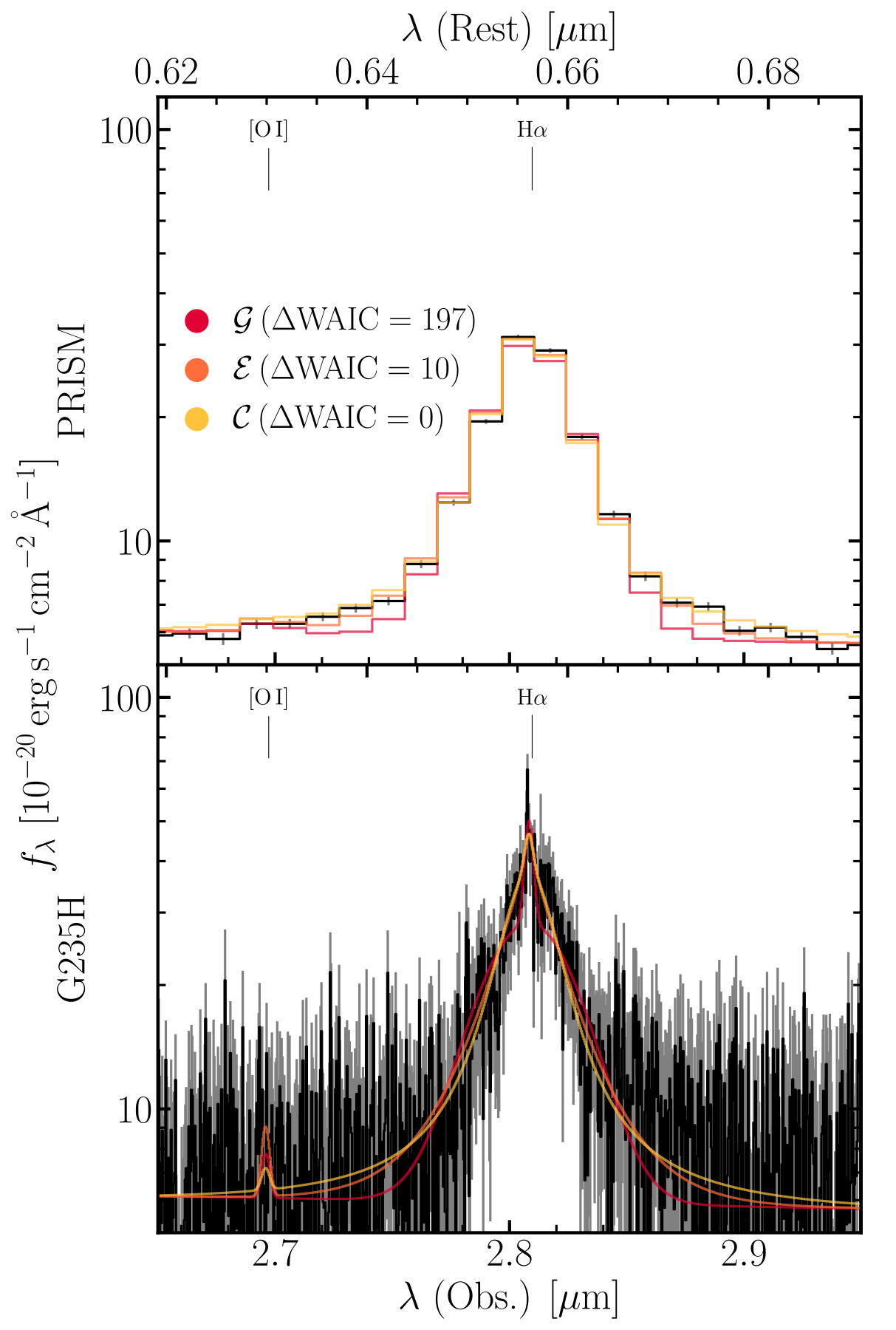
The Little Blue and Red Dots Rosetta Stones: Non-Gaussian broad lines, hot dust, and X-ray weakness

M. Brazzini, F. D'Eugenio, R. Maiolino, et al.

A two-object JWST comparison finds that a prototypical Little Red Dot and Little Blue Dot share broad, non-Gaussian Balmer emission, weak hot dust, and X-ray weakness, but differ sharply in helium emission and Balmer absorption.

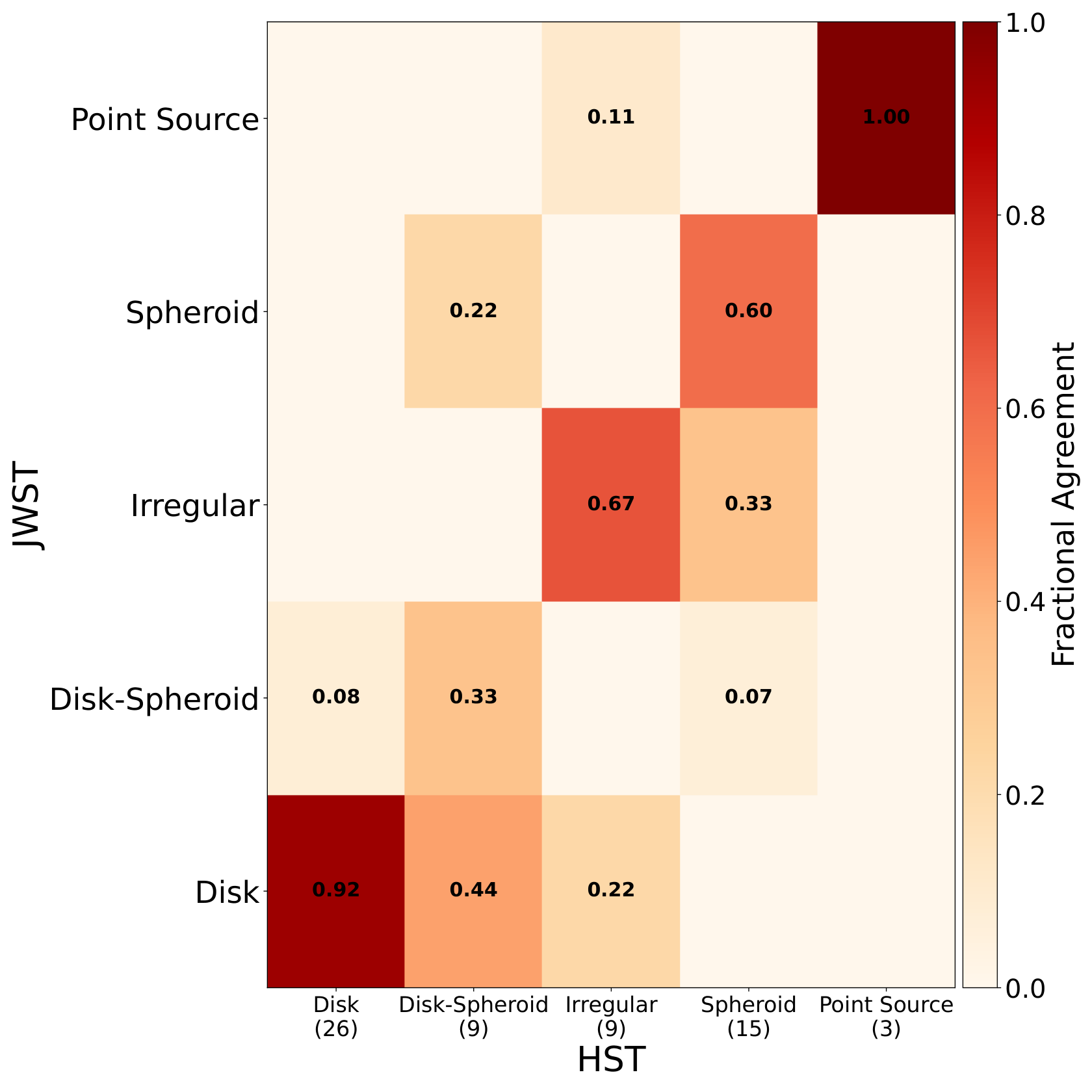
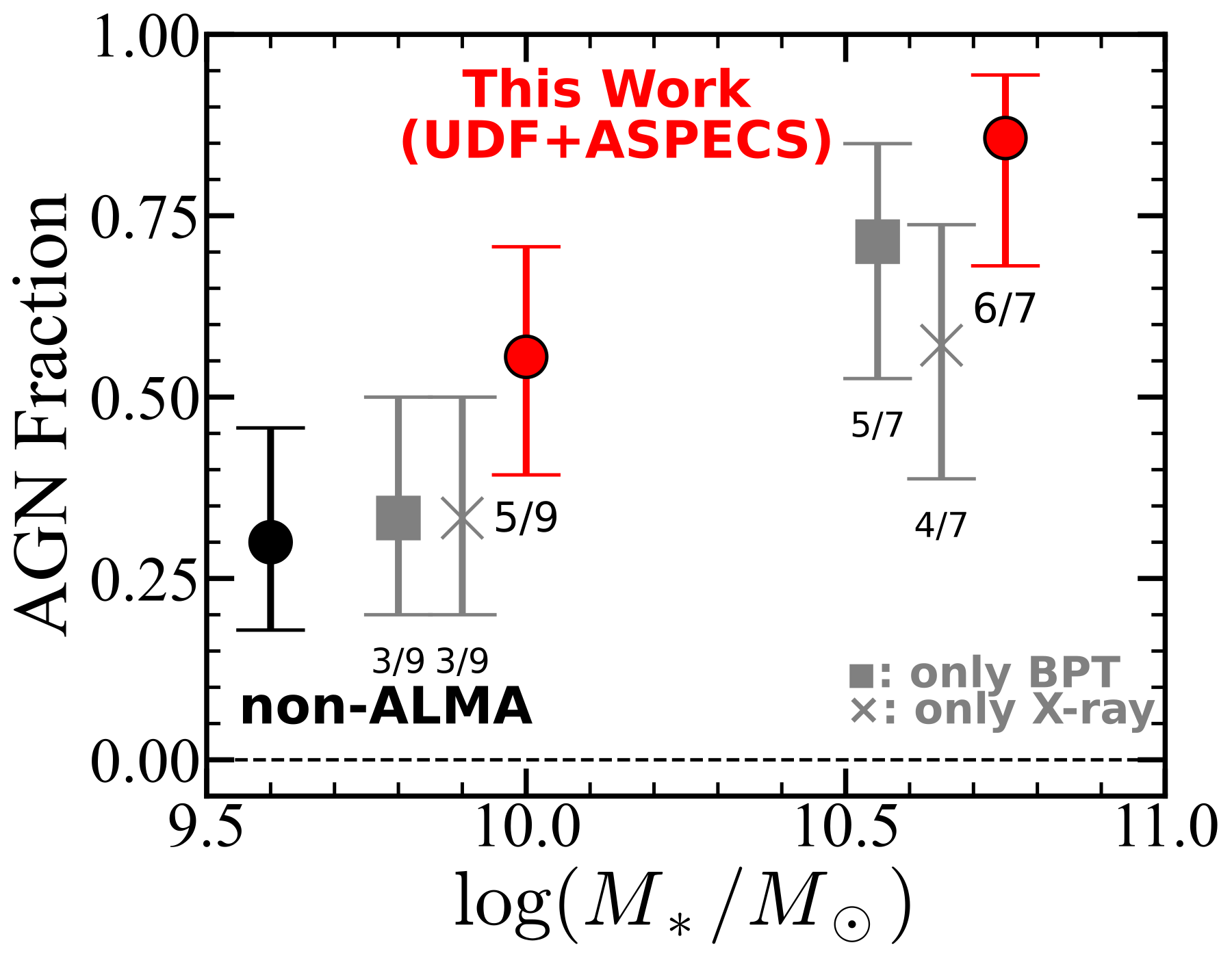
Figure 10 from JWST Spectroscopic Census of ALMA Faint Submillimeter Galaxies in the Hubble Ultra Deep Field

2026-01-26 · 2601.18149v1 · Research note

JWST Spectroscopic Census of ALMA Faint Submillimeter Galaxies in the Hubble Ultra Deep Field

Tomokazu Kiyota, Masami Ouchi, Daisuke Iono, et al.

JWST/NIRSpec spectroscopy of 16 ALMA-selected HUDF faint SMGs finds dusty, massive z=1–4 galaxies with mostly obscured AGN classifications, yet star-formation, metallicity, and bulk-ISM properties broadly consistent with comparable high-redshift star-forming populations.

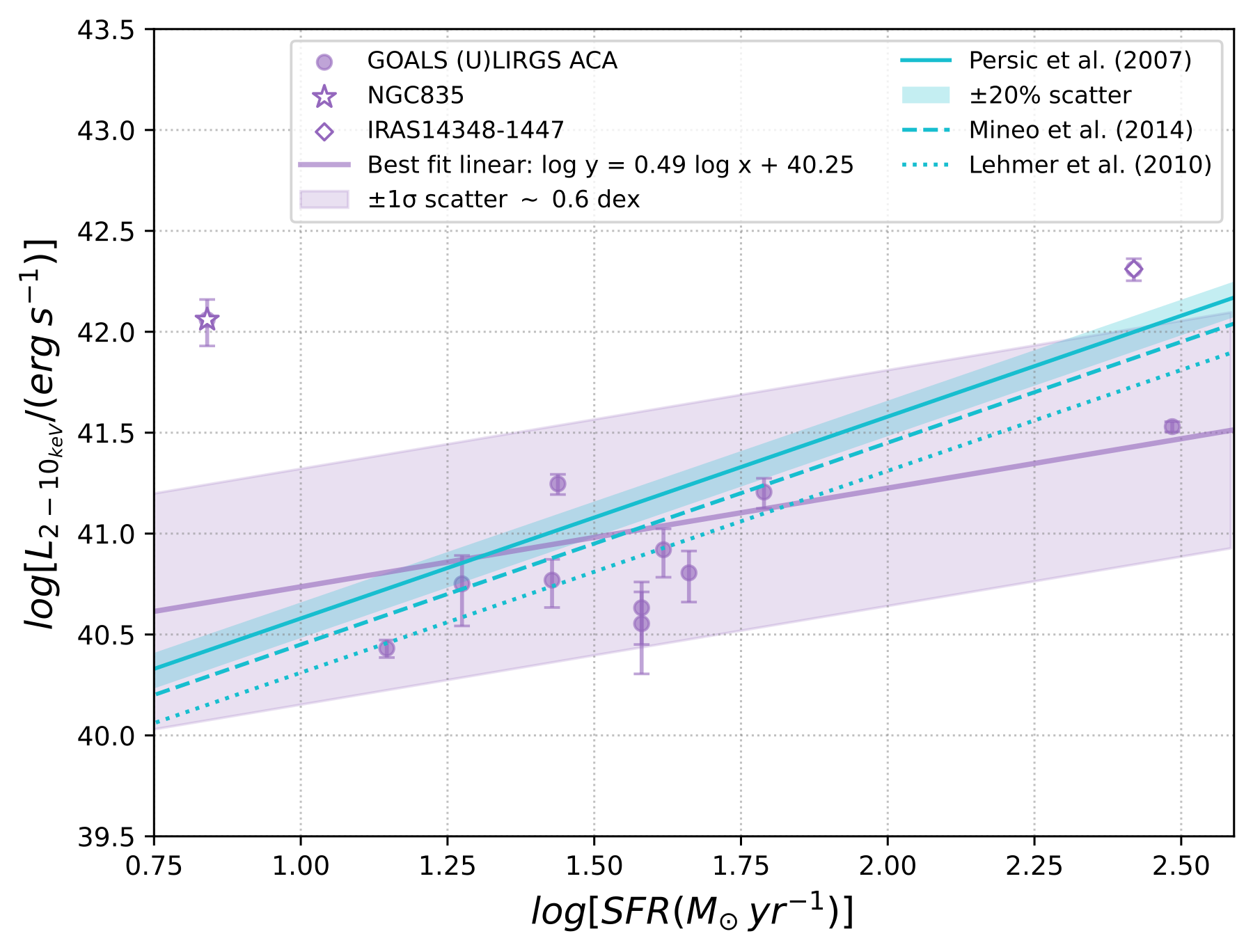
Figure 1 from Probing Heavily Obscured AGN in Major Galaxy Mergers Using the mm-X-ray Correlation

2026-01-21 · 2601.15186v1 · Research note

Probing Heavily Obscured AGN in Major Galaxy Mergers Using the mm-X-ray Correlation

M. Droguett-Callejas, E. Treister, L. Barcos-Muñoz, et al.

In local merging (U)LIRGs, 230-GHz continuum combined with X-ray luminosity and IR-based SFR can conservatively separate star-formation-compatible systems from candidate obscured AGN; the authors identify one confirmed AGN and two strong candidates, but calibration remains preliminary.

2026-01-20 · 2601.14368v1 · Research note

The Little Red Dots Are Direct Collapse Black Holes

Fabio Pacucci, Andrea Ferrara, Dale D. Kocevski

A radiation-hydrodynamic direct-collapse black-hole model can fit one prototypical Little Red Dot spectrum with low residuals while producing Compton-thick obscuration. The result is a model-based explanation, not yet a population-level demonstration that all LRDs are DCBHs.

Figure 1 from Little Red Dots: The Assembly of Early Supermassive Black Holes in the JWST Era

2025-12-31 · 2601.00089v1 · Research note

Little Red Dots: The Assembly of Early Supermassive Black Holes in the JWST Era

David D Vaida, Ryan Jeffrey Farber

This mini-review argues that little red dots are probably heterogeneous: broad Balmer lines and compact, V-shaped SEDs support accretion in some, whereas pervasive multiwavelength non-detections and viable stellar fits prevent a population-wide AGN identification.

2025-12-31 · 2601.00044v1 · Research note

Born in the Dark: The Catastrophic Collapse of Fuzzy Dark Matter Solitons as the Origin of Little Red Dots

Tak-Pong Woo

The authors propose that LRDs are transient, Compton-thick inflows within fuzzy-dark-matter soliton cores. Their size-and-column arguments favor boson masses of a few ×10^-22 eV, but the mechanism remains an analytic, idealized-merger scenario requiring radiation-hydrodynamic tests.

2025-12-01 · 2512.02096v1

Discovery of two little red dots transitioning into quasars

Shuqi Fu, Zijian Zhang, Danyang Jiang, et al.

Reports two COSMOS LRDs—Forge I (z=2.868) and Forge II (z=2.925)—whose V-shaped UV–optical SEDs, compact morphologies, and broad Paschen/He I lines meet LRD criteria. Unlike typical LRDs, they show strong X-ray, radio, and mid-IR emission, moderate X-ray obscuration, a 6.4 keV Fe K line in Forge II, and unusually large year-scale X-ray variability while UV broad lines remain weak/absent. The spectra reveal strong He I absorption in both and rare Pa absorption in Forge II, indicating dense, low-ionization gas with mixed inflow/outflow kinematics as the envelope thins. Authors argue these hybrids are LRDs in transition, with dispersing dense gas and an emerging dust torus, implying some LRDs evolve into normal AGN/quasars.

2025-12-01 · 2512.02093v1 · Research note

COSMOS-3D: Dense Circumnuclear Gas across Black Hole Growth Phases at z ~ 3

Zi-Jian Li, Siwei Zou, Jianwei Lyu, et al.

Two z~3 X-ray AGNs with He I λ10830 absorption indicate dense, broad-line-region-scale circumnuclear gas, but their contrasting obscuration, accretion rates, and outflow signatures provide only a two-object, model-dependent case for an evolutionary sequence.

2025-11-24 · 2511.19602v1 · Research note

Tracing AGN-Galaxy Co-Evolution with UV Line-Selected Obscured AGN

Luigi Barchiesi, Lucia Marchetti, Mattia Vaccari, et al.

A 184-object COSMOS sample selected through [Ne V] or C IV combines X-ray–radio SED fitting with Simba analogues. The authors infer obscured, high-accretion transitional populations, with [Ne V] hosts pre-quenching and C IV hosts more often quenched.

Figure 1 from Discovery of an X-ray Luminous Radio-Loud Quasar at $z=3.4$: A Possible Transitional Super-Eddington Phase

2025-11-07 · 2511.05029v1 · Research note

Discovery of an X-ray Luminous Radio-Loud Quasar at $z=3.4$: A Possible Transitional Super-Eddington Phase

Sakiko Obuchi, Kohei Ichikawa, Satoshi Yamada, et al.

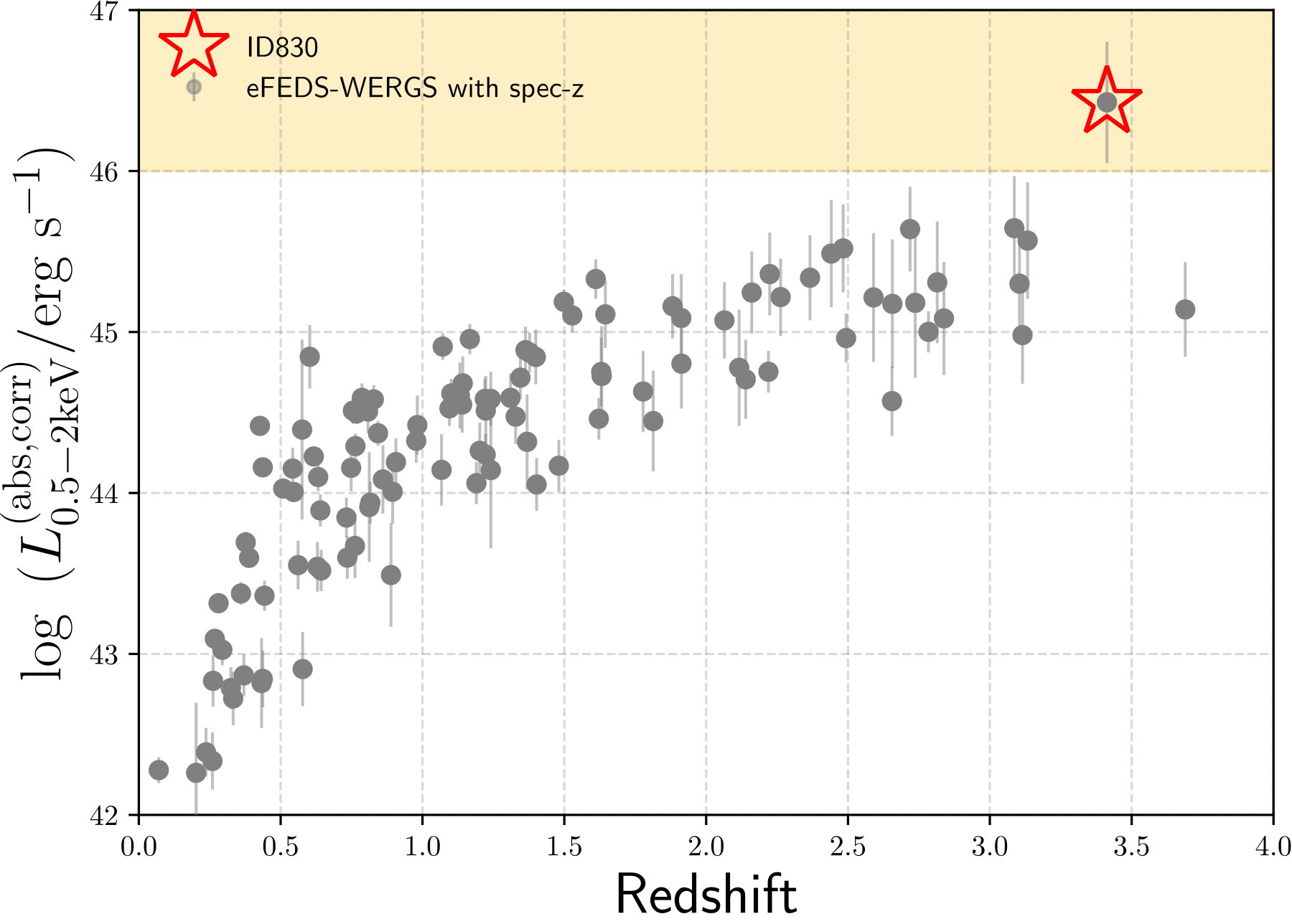
ID830 is a z=3.4351 radio-loud quasar with extreme, steep X-ray emission and a UV-based super-Eddington estimate. The authors interpret its X-ray excess as corona-plus-jet emission during a possible post-burst transition, not a demonstrated evolutionary state.

2025-10-30 · 2510.26990v1 · Research note

Faint active galactic nuclei supplied 31-75% of hydrogen-ionizing photons at z>5

Mainak Singha, Sangeeta Malhotra, James Ely Rhoads

A joint luminosity-function and escape-fraction model attributes 31–75% of z>5 ionizing photons to AGN, but the result depends on assumed galaxy escape fractions and an outflow-based AGN LyC-escape prescription available here only in the abstract.

2025-10-30 · 2510.26884v1 · Research note

Constraining the AGN tori at cosmic noon using high-resolution JWST imaging and simultaneous SED fitting

Devang H. Liya, David J. Rosario, Matthaios Charidis

For 88 X-ray-selected CEERS AGN at 0.7≤z≤3.5, simultaneous central and integrated JWST/archival SED fitting yields tighter torus constraints. Among 66 luminous sources, torus covering fraction peaks near 0.25 and is not statistically distinguishable from a luminosity-matched local comparison.

2025-10-29 · 2510.25089v1 · Research note

XRISM Spectroscopy of the Stellar-mass Black Hole GRS 1915+105

Jon M. Miller, Liyi Gu, John Raymond, et al.

XRISM/Resolve resolves a Compton-thick, warm-obscured yet sub-Eddington GRS 1915+105 into narrow photoionized emission zones, supporting outer-disk occultation. A warped, precessing disk is favored over inner-disk thickening, but residual spectral structure and geometry remain unresolved.

2025-10-13 · 2510.11010v1 · Research note

The Relation Between AGN and Host Galaxy Properties in the JWST Era: II. The merger-driven evolution of Seyferts at Cosmic Noon

Nina Bonaventura, Jianwei Lyu, George H. Rieke, et al.

JWST/NIRCam morphologies and matched controls indicate that obscured, Seyfert-luminosity AGN hosts at cosmic noon are more disturbed than inactive galaxies. The authors interpret the combined trends with column density and X-ray/IR selection as a major-merger evolutionary branch.