654 indexed papers · 430 research notes

Research archive

Reset
Figure 3 from The lifetimes and properties of Little Red Dots in the AMBRA simulation

2026-09-24 · 2609.26999v1 · Research note

The lifetimes and properties of Little Red Dots in the AMBRA simulation

Patrick LaChance, Yihao Zhou, Aklant Kumar Bhowmick, et al.

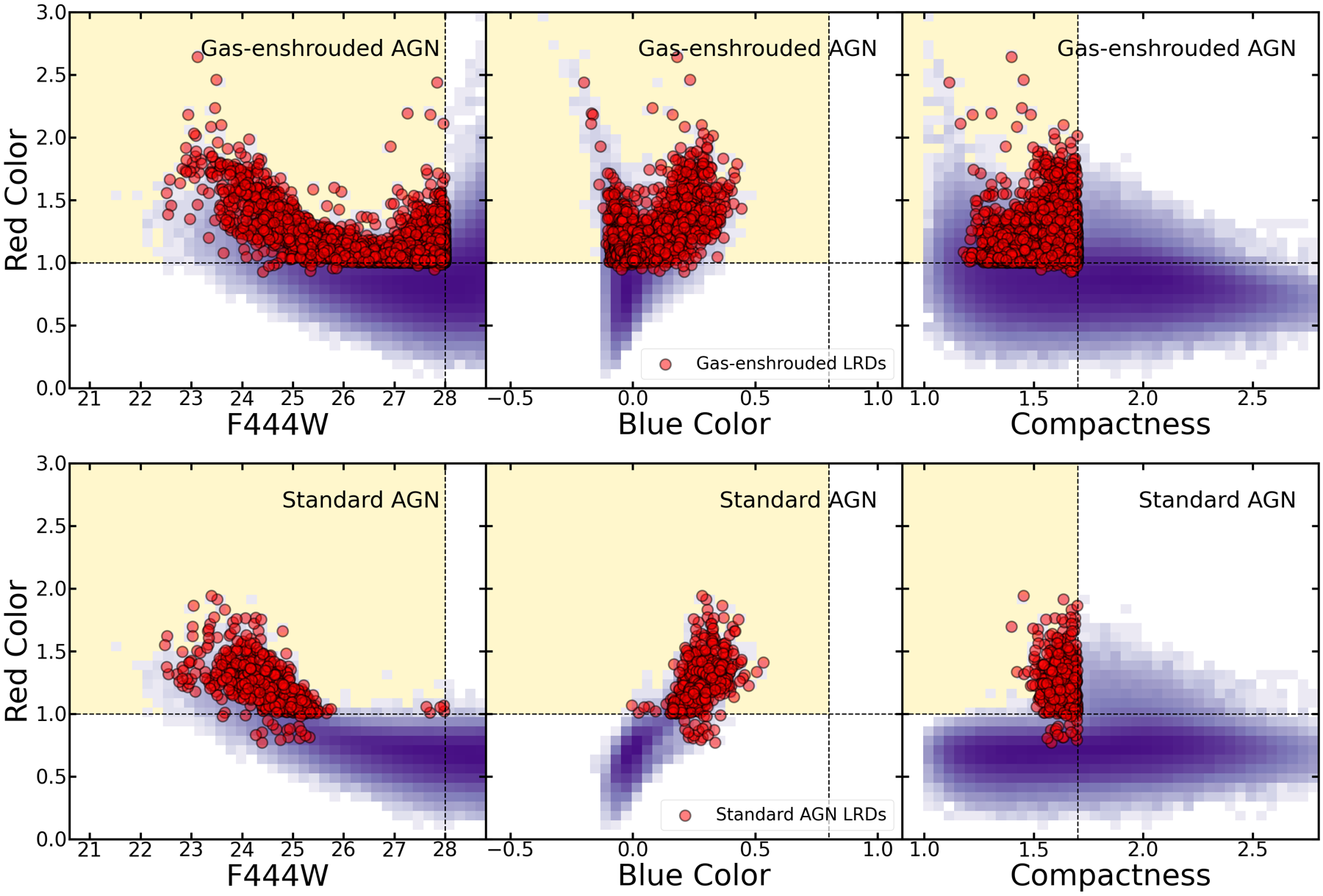
Mock JWST selection in AMBRA suggests LRDs are transient appearances of existing black hole–galaxy systems: dim sources require a gas-enshrouded AGN model, while massive compact hosts yield longer-lived phases. Redshift counts remain model-sensitive.

Figure 2 from Overmassive No More: The Case for Little Red Dots Hosting Black Hole Seeds as Massive as Single Supermassive Stars

2026-09-10 · 2609.09274v1 · Research note

Overmassive No More: The Case for Little Red Dots Hosting Black Hole Seeds as Massive as Single Supermassive Stars

Wendy Q. Sun, Rohan P. Naidu, Hanpu Liu, et al.

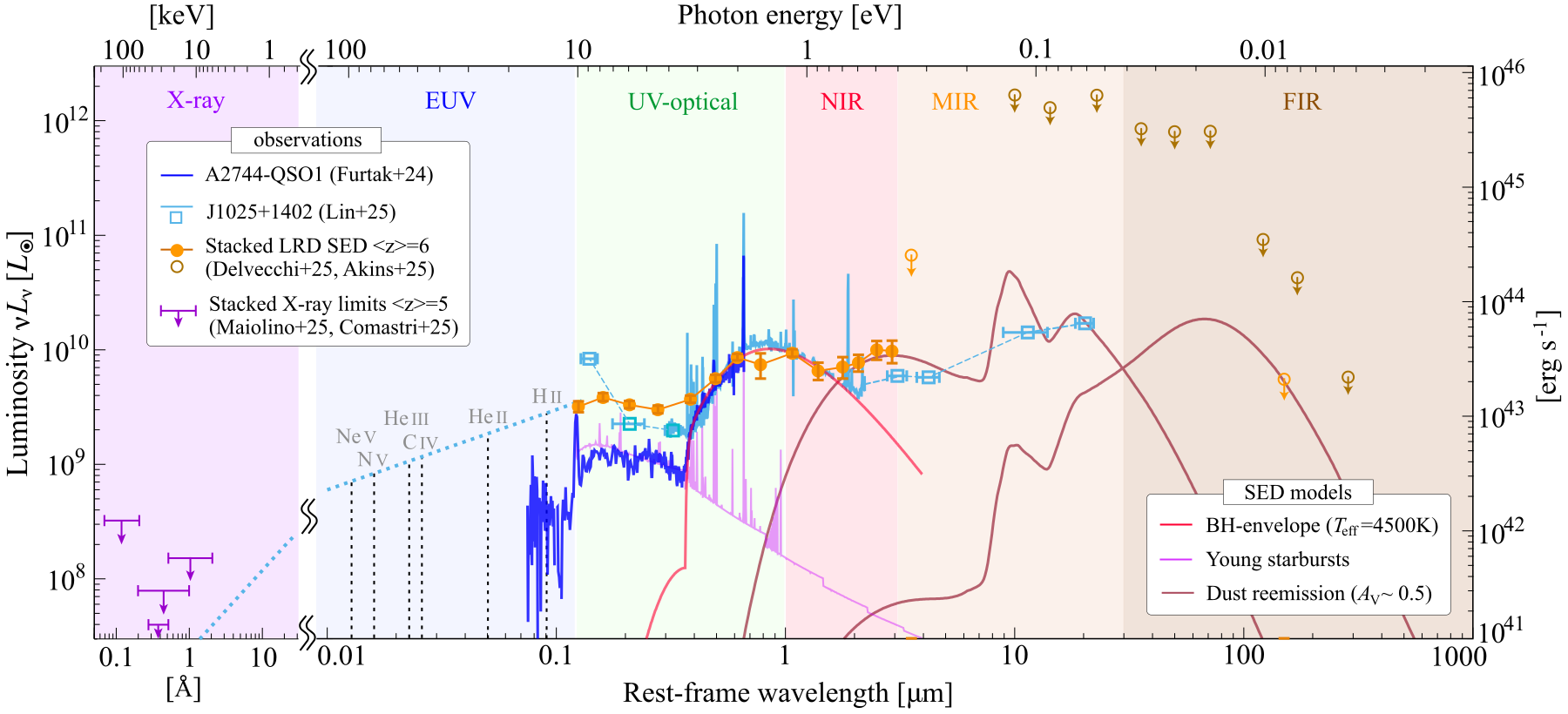
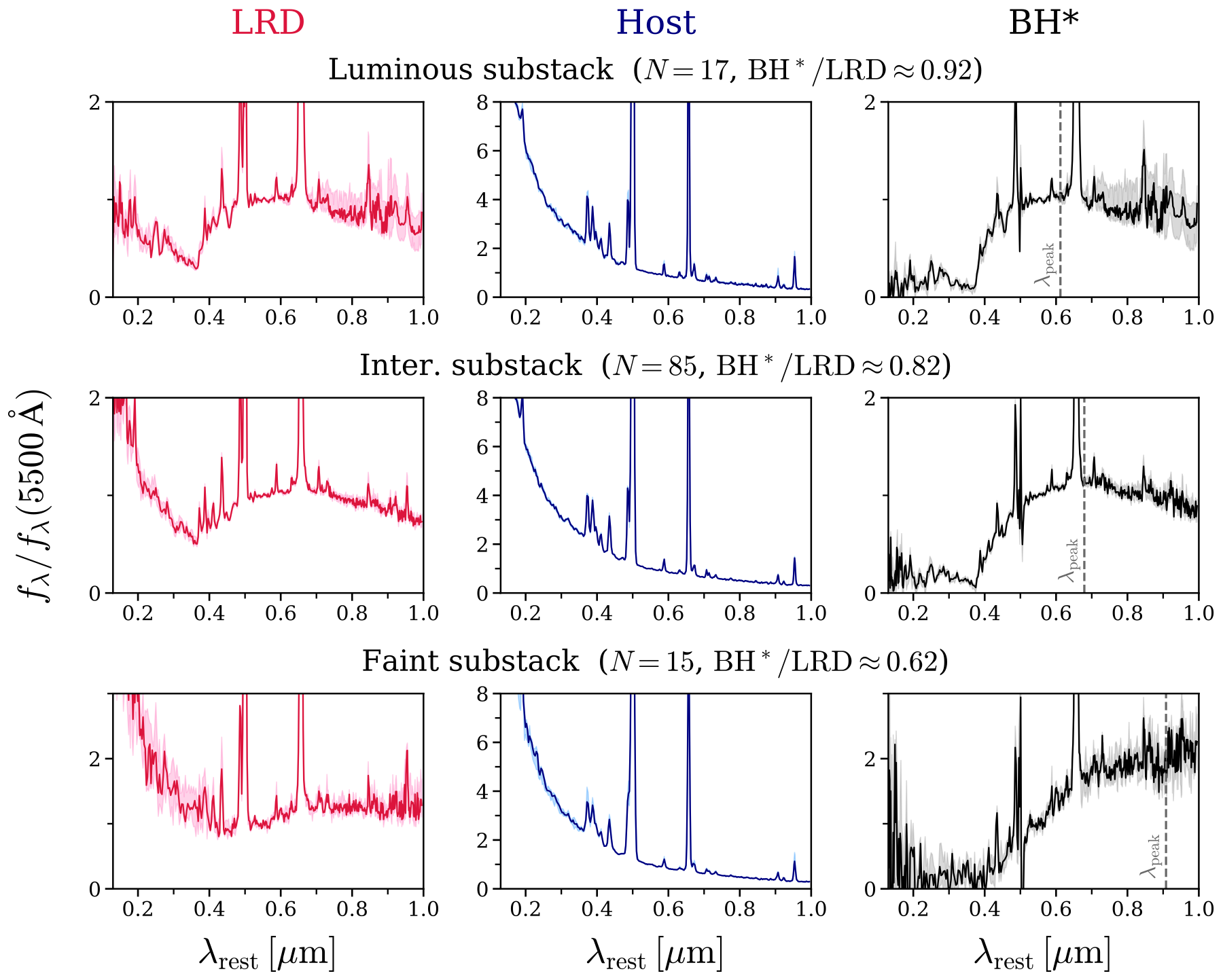
Using stacked, host-subtracted spectra of 117 little red dots, the authors infer cool, luminous pseudo-photospheres and non-virial central-engine masses of about 10^4–10^5 solar masses. They argue this removes the apparent overmassiveness and permits, but does not establish, a supermassive-star seed origin.

2026-09-09 · 2609.08145v1 · Research note

The Roman eXtreme Deep Field (RXDF)

Haojing Yan, Anton M. Koekemoer, Yue Shen, et al.

RXDF is an approved Roman seven-band, multi-epoch imaging program designed to combine AB≈30 depth with a 678.75 arcmin² full-depth footprint. For LRD science it is prospective: it extends the luminosity–redshift discovery space, but supplies neither an LRD selection nor predicted counts.

Figure 2 from Extreme AGN Variability in WISE: Powerful Flares and Candidate Tidal Disruption Events in AGN

2026-09-02 · 2609.01421v1 · Research note

Extreme AGN Variability in WISE: Powerful Flares and Candidate Tidal Disruption Events in AGN

Satya Teja Anuraag Upadhyayula, Daniel Stern, Kishalay De, et al.

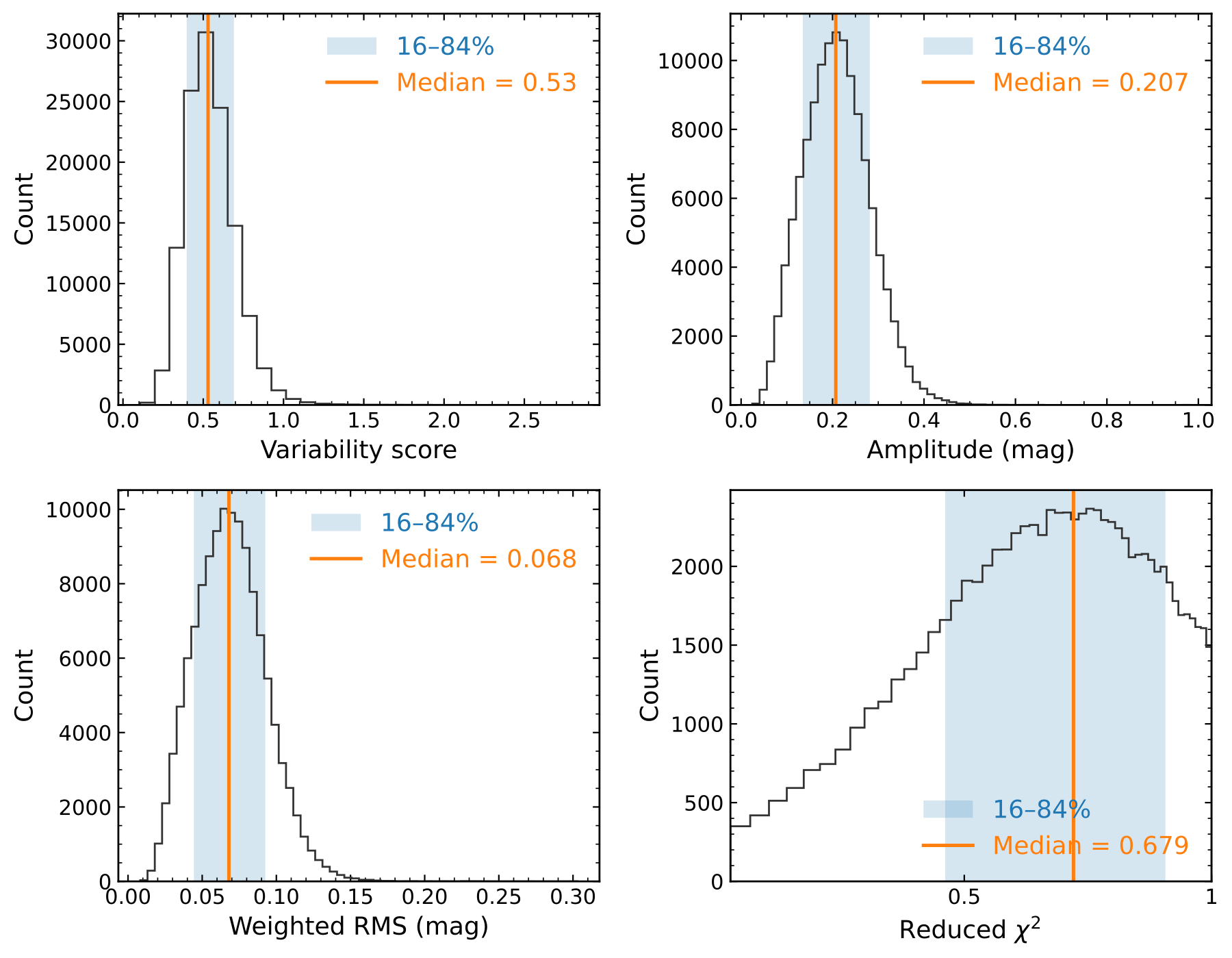
A WISE pilot search finds two extreme mid-infrared AGN flares, modeled as dust echoes and interpreted as candidate TDEs. Their high inferred energies and contrasting optical/spectroscopic behavior make them promising, but not definitive, disruptions in active nuclei.

Figure 2 from Weighing Little Red Dots with Transient Events

2026-09-02 · 2609.00113v1 · Research note

Weighing Little Red Dots with Transient Events

Vinh Tran, Xuejian Shen, Oliver Zier, et al.

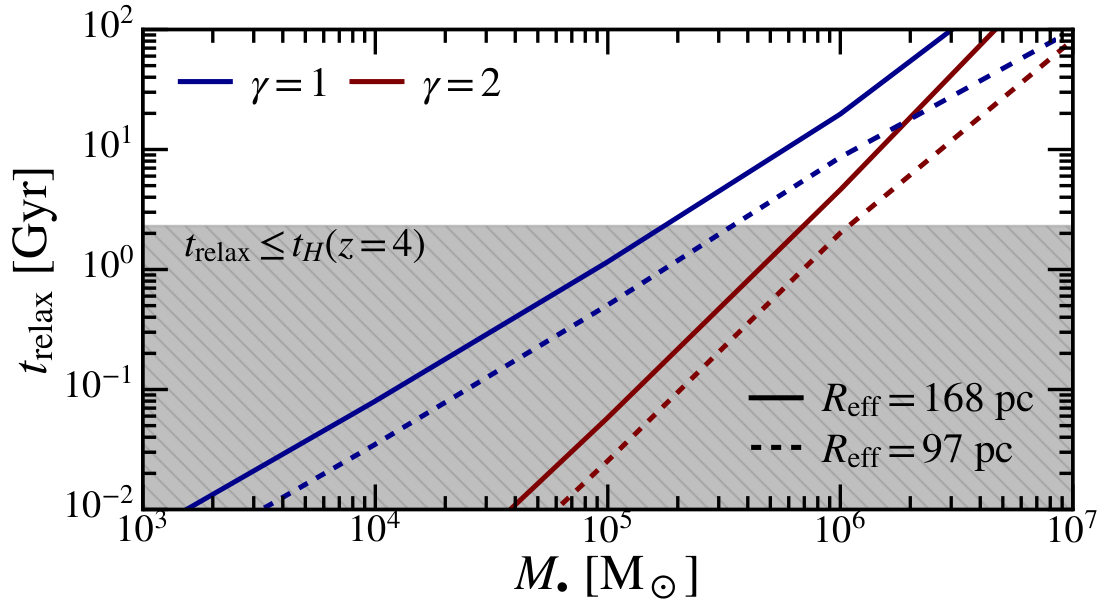
This modelling study proposes tidal-disruption and quasi-periodic-eruption event rates as population-level probes of LRD black-hole masses. Its predictions depend strongly on assumed stellar cusps, black-hole–stellar-mass relations, and the possibility that most LRDs are obscured.

Figure 3 from Ripples in the OCEANS: Broad Line Variability of Little Red Dots

2026-08-14 · 2608.12487v1 · Research note

Ripples in the OCEANS: Broad Line Variability of Little Red Dots

Madisyn Brooks, Kelcey Davis, Jonathan R. Trump, et al.

Across six z=4.95–6.68 little red dots, multi-epoch JWST spectroscopy yields only marginal broad-Hα variability in two objects and no significant continuum changes. The results offer tentative AGN support, but calibration-driven uncertainties and four non-detections preclude a definitive population-level conclusion.

Figure 3 from NEXUS: Spectral Variability of Little Red Dots and Blue Active Galactic Nuclei at $2 \lesssim z \lesssim 6$

2026-08-04 · 2608.01647v1 · Research note

NEXUS: Spectral Variability of Little Red Dots and Blue Active Galactic Nuclei at $2 \lesssim z \lesssim 6$

Zachary Stone, Yue Shen, Ming-Yang Zhuang, et al.

Multi-epoch JWST/NIRSpec monitoring finds that 17 little red dots have large Balmer decrements but weak month-scale continuum and Hα variability. The authors interpret the variability contrast with ordinary AGNs as evidence for differing broad-line emission and/or ionizing-driver properties.

2026-07-27 · 2607.21869v1 · Research note

Stacked Reverberation Mapping of High Redshift Quasars in DESI. I. Feasibility Analysis

Rahma Alfarsy, R. E. A. Canning, Eva-Maria Mueller, et al.

DESI-like sparse spectroscopy plus ZTF-like photometry can, in simulations, recover stacked C IV reverberation lags and the input radius–luminosity relation within 1σ. Recovery depends especially on multi-hundred-day spectral baselines; this is feasibility evidence, not a measurement from DESI quasars.

2026-07-01 · 2606.30757v1 · Research note

Unveil the nature of JWST-AGN and Little Red Dots with SKAO continuum surveys

Giovanni Mazzolari, Dharam V. Lal, Isabella Prandoni, et al.

This forecasting study argues that multi-frequency SKAO continuum observations could separate intrinsically weak, Compton-thick, and ionized-cocoon interpretations of radio-faint JWST AGN and LRDs, but it presents sensitivity-based predictions rather than new radio detections.

2026-06-17 · 2606.18155v1 · Research note

X-ray eclipse tomography: Resolving the extent of X-ray-emitting region(s) in the Seyfert galaxy ESO362-G18

Laura Rueda-Nieto, Beatriz Agís-González, Giovanni Miniutti

Swift eclipse monitoring of ESO 362-G18 uses time-resolved absorption changes to constrain an X-ray source within ~35 Rg. The authors infer a structured cloud and a soft-excess region ~50% larger than, yet overlapping, the hot corona.

2026-06-16 · 2606.16343v1 · Research note

Optical Variability as a Probe of Hidden Nuclear Activity in Type 2 AGNs

Maša Lakićević

In 412 Stripe 82 Type 2 AGNs, optical RMS variability anticorrelates with several narrow-line luminosities, equivalent widths, and widths. The authors interpret this as variability retaining information about obscured accretion, although controls and photometric-noise limits temper causal inference.

2026-06-05 · 2606.05281v1 · Research note

Little red dots as a cosmological probe: constraining $H_0$ with quasi-periodic pulsations

Zijian Zhang, Kohei Inayoshi, Masamune Oguri, et al.

Using one lensed, decades-variable little red dot, the authors turn an idealized pulsation period–luminosity–temperature relation into a preliminary, period-limited H0 estimate. Ten-year monitoring could improve statistical precision, but calibration of the relation remains the decisive uncertainty.

2026-06-04 · 2606.04712v1 · Research note

The Extreme Rarity and Physical Properties of Low-redshift AGNs with Balmer Absorption

Jinyi Shangguan, Chang-Hao Chen, Luis C. Ho, et al.

Among 14,584 SDSS type-1 AGNs at z<0.35, seven robust Balmer absorbers imply a ∼0.05% incidence. Joint, resolution-aware Balmer fitting finds narrow, generally saturated absorbers; a rare high-Eddington, weak-Fe II subset may be preferentially affected.

Figure 2 from Transient Signatures of Star-Envelope Collisions in Little Red Dots

2026-05-29 · 2605.29895v1 · Research note

Transient Signatures of Star-Envelope Collisions in Little Red Dots

Tomoya Suzuguchi, Kohei Inayoshi

This modeling study predicts optical/UV transients when cluster stars strike proposed gaseous LRD envelopes. Red-supergiant impacts on envelopes near the SMBH mass are favored; rates could reach 0.3 yr⁻¹ per compact LRD, but detectability depends critically on low-redshift LRD abundance.

Figure 2 from A new sample of Little Red Dots at $z<0.45$ in DESI DR1: Broad Balmer lines, low ionization spectrum and no variability

2026-05-14 · 2605.14233v1 · Research note

A new sample of Little Red Dots at $z<0.45$ in DESI DR1: Broad Balmer lines, low ionization spectrum and no variability

Kevin Park, Alberto Torralba, Jorryt Matthee, et al.

A DESI DR1 line-selected search identifies eight compact z=0.20–0.44 LRD candidates with broad, steep-decrement Balmer emission, low-excitation spectra, and generally weak multi-year variability, extending detailed LRD tests to the nearby Universe.

Figure 6 from A Changing-Look Seyfert Discovered by eROSITA Reveals a Two-Component Broad-Line Region

2026-05-08 · 2605.07965v1 · Research note

A Changing-Look Seyfert Discovered by eROSITA Reveals a Two-Component Broad-Line Region

Alex Markowitz, Mirko Krumpe, David Homan, et al.

eROSITA-triggered monitoring of HE 1237-2252/J1240−2309 links a changing-look transition to intrinsic accretion-rate recovery and an evolving two-component Balmer-line profile. A diskline-like component strengthens with UV flux, while the proposed corona/illumination mechanism remains interpretive.

2026-05-06 · 2605.05301v1 · Research note

An X-ray and optical spectral study of the changing-look narrow-line Seyfert 1 2MASX J0413-0050

A. Vietri, A. Tortosa, D. Ilić, et al.

Across four optical and three X-ray epochs, J0413-0050 changed from broad Balmer emission in 2004 to an Hβ-free 2021 state and back to broad plus narrow Hβ in 2023. The authors favor changing accretion over obscuration, but X-ray column density is unconstrained.

Figure 1 from The GlimmIr: Spectroscopic Variability in a z~7 LRD Indicates Rapid Changes in Both the Narrow and Broad Line Regions

2026-04-28 · 2604.25991v1 · Research note

The GlimmIr: Spectroscopic Variability in a z~7 LRD Indicates Rapid Changes in Both the Narrow and Broad Line Regions

Erini Lambrides, Taylor A. Hutchison, Rebecca L. Larson, et al.

Multi-epoch JWST/NIRSpec spectra of one z~7 little red dot show coordinated continuum, broad-Balmer, and [O III] changes over ~13 rest-frame days. If intrinsic, the variability ties at least some narrow-line gas to the central engine and disfavors complete dense-gas coverage.

Figure 3 from How I Wonder What You Are -- JWST's Little Red Dots do not TWINKLE

2026-04-14 · 2604.13000v1 · Research note

How I Wonder What You Are -- JWST's Little Red Dots do not TWINKLE

Zhaoran Liu, Rohan P. Naidu, Amy Secunda, et al.

Across a complete Hα-flux-limited GOODS-N sample, 18 LRDs and nine other broad-Hα emitters show no detected continuum, line-flux, or line-shape variability over 139–220 rest-frame days, challenging their interpretation as ordinary broad-line AGN.

2026-03-02 · 2603.01473v1 · Research note

Local Analogs of Little Red Dots: Optical Variability and Evidence for an AGN Origin

Ruqiu Lin, Zhen-Ya Zheng, Junxian Wang, et al.

Six-year ZTF monitoring of seven z~0.3 LRD analogs detects multiband excess variance in three and DRW-like variability in two, supporting—but not establishing—an AGN interpretation. Simulations suggest present JWST high-z variability upper limits can be biased low by short baselines.

2026-01-29 · 2601.22214v1 · Research note

The Little Blue and Red Dots Rosetta Stones: Non-Gaussian broad lines, hot dust, and X-ray weakness

M. Brazzini, F. D'Eugenio, R. Maiolino, et al.

A two-object JWST comparison finds that a prototypical Little Red Dot and Little Blue Dot share broad, non-Gaussian Balmer emission, weak hot dust, and X-ray weakness, but differ sharply in helium emission and Balmer absorption.

2026-01-13 · 2601.08212v1 · Research note

Diverse Origins of Broad H$α$ Lines in Heavily Obscured AGNs Revealed by Multi-epoch Spectroscopy

Shoichiro Mizukoshi, Takeo Minezaki, Subaru Ubukata, et al.

Five-epoch spectroscopy of three AGNs with A_V>50 mag finds broad-Hα behavior is not uniform: Mrk 268 varies at 4.3σ, consistent with direct BLR emission, whereas MCG -3-34-64 and UGC 5101 favor outflow and/or scattering contributions.

2025-12-20 · 2512.18421v1 · Research note

The evolution of obscured AGN across cosmic time -- A large quasar survey for the 2040s

Tanya Urrutia, Darshan Kakkad, Paula Sánchez-Sáez, et al.

This is a survey proposal, not a new AGN measurement: it argues that repeat optical MOS spectroscopy of >50 million multi-selected candidates to z~6.5 could quantify obscuration demographics while exposing selection biases among obscured populations.

Figure 5 from Pulsational Instability of Quasi-Stars: Interpreting the Variability of Little Red Dots

2025-12-19 · 2512.17997v1 · Research note

Pulsational Instability of Quasi-Stars: Interpreting the Variability of Little Red Dots

Matteo Cantiello, Jake B. Hassan, Rosalba Perna, et al.

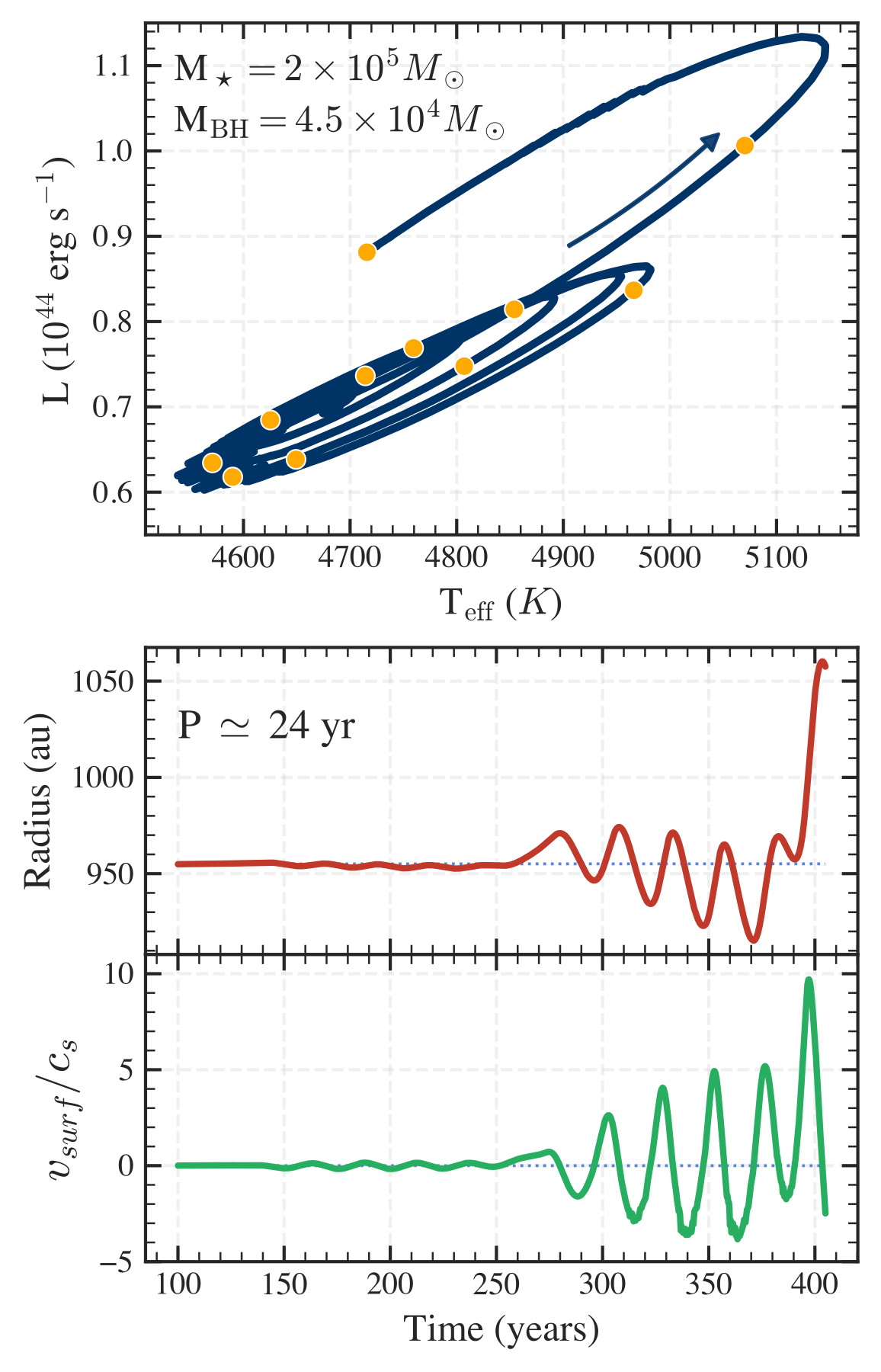
Stellar-evolution and pulsation models place cool quasi-star envelopes in an instability strip whose radial-mode timescales are compatible with R2211-RX1, but sparse monitoring and unresolved nonlinear mass loss prevent a demonstrated periodic or uniquely quasi-star interpretation.

Figure 3 from Little red dot variability over a century reveals black hole envelope via a giant Einstein cross

2025-12-04 · 2512.05180v1 · Research note

Little red dot variability over a century reveals black hole envelope via a giant Einstein cross

Zijian Zhang, Mingyu Li, Masamune Oguri, et al.

Four lensed views of the z≈4.3 LRD RX1 provide an ≈80–130-year observed-frame baseline and show up to 0.7-mag intrinsic color/brightness differences. Blackbody fits are consistent with a changing, ∼2000-AU photosphere, but do not yet establish pulsation over accretion variability.

Figure 1 from A Critical Evaluation of the Physical Nature of the Little Red Dots

2025-12-02 · 2512.03130v1 · Research note

A Critical Evaluation of the Physical Nature of the Little Red Dots

Kohei Inayoshi, Luis C. Ho

This review argues that LRD broad Balmer lines, red optical continua, Balmer absorption/breaks, and weak infrared/X-ray behavior favor embedded accreting black holes over a purely stellar origin, while leaving the gas geometry and evolutionary interpretation unresolved.

Figure 2 from OzDES Reverberation Mapping of Active Galactic Nuclei: Final Data Release, Black-Hole Mass Results, & Scaling Relations

2025-12-01 · 2512.01261v1 · Research note

OzDES Reverberation Mapping of Active Galactic Nuclei: Final Data Release, Black-Hole Mass Results, & Scaling Relations

H. McDougall, T. M. Davis, Z. Yu, et al.

Final OzDES analysis uses multi-year optical monitoring to calibrate high-redshift BLR radius–luminosity relations from Hβ, Mg II, and C IV reverberation lags, yielding 62 RM black-hole masses and single-epoch estimates for 246 additional AGN.

Figure 2 from Too Quiet for Comfort: Local Little Red Dots Lack Variability over Decades

2025-11-20 · 2511.16082v1 · Research note

Too Quiet for Comfort: Local Little Red Dots Lack Variability over Decades

Colin J. Burke, Zachary Stone, Yue Shen, et al.

Three nearby proposed Little Red Dot analogs show <3–4% optical-continuum variability over rest-frame five years; two also have broad-Hα changes below a few percent over roughly 15 years, challenging ordinary variable, photoionized broad-line interpretations.

2025-11-19 · 2511.15359v1 · Research note

Changing-look Active Galactic Nuclei from the Dark Energy Spectroscopic Instrument. V. Dramatic Variability in High-Ionization Broad Emission Lines

Zhi-Qiang Chen, Jun-Jie Jin, Wei-Jian Guo, et al.

A DESI–SDSS comparison identifies 97 z>0.9 changing-look quasars with high-ionization broad-line transitions. Their lower Eddington ratios, line–luminosity co-variability, and ∼3-year rest-frame transition times are consistent with—though do not prove—accretion-state changes.

2025-11-12 · 2511.09304v1 · Research note

Variability of optical spectral index to support a central sub-parsec binary black hole system in quasar SDSS J001224-102226.51

Zhang XueGuang

Using two SDSS epochs of the z=0.228 quasar SDSS J0012-1022, the authors argue that an anomalous luminosity–optical-slope change is consistent with phase-dependent obscuration of two accreting black holes. It supports, but does not establish, a sub-parsec binary interpretation.

Figure 1 from Probing the Physical Origin of the Balmer Decrement in the Broad-line Region of Nearby Active Galactic Nuclei via Spectral Variability

2025-11-11 · 2511.07714v1 · Research note

Probing the Physical Origin of the Balmer Decrement in the Broad-line Region of Nearby Active Galactic Nuclei via Spectral Variability

Suyeon Son, Minjin Kim, Luis C. Ho, et al.

Multi-epoch SDSS spectroscopy of 1,116 nearby type-1 AGNs finds broad-line Hα/Hβ decreases as individual AGNs brighten. The authors argue continuum-driven BLR radiative-transfer and excitation changes, rather than variable intrinsic dust reddening, predominantly drive this variability.

2025-09-23 · 2509.19585v1

NEXUS: A Search for Nuclear Variability with the First Two JWST NIRCam Epochs

Zachary Stone, Yue Shen, Ming-Yang Zhuang, et al.

NEXUS uses two NIRCam epochs (Wide-1.1 in Sep 2024 and Deep-1 in Jun 2025; 9-month baseline) to run a nuclear-variability search across ~25k sources in F200W and F444W with PSF-matched difference imaging. The pipeline reaches ~0.18 mag (F200W) and ~0.15 mag (F444W) sensitivity at 28 mag (0.2″ aperture), improving to ~0.01–0.02 mag at <25 mag, and outperforms single-epoch aperture photometry by >30%. They flag 465 high-confidence extragalactic variables whose photo-z distribution mirrors the parent sample to zphot>10. Crucially, ten spectroscopically confirmed broad-line LRDs at 3≲z≲7 show no detectable variability, yielding 3σ F444W limits of ~3–10% (median ~5%), implying weak rest-optical continuum variability; rare nuclear transients remain to be confirmed with continued monitoring and spectroscopy.

2025-09-03 · 2509.03571v1

Do Little Red Dots Vary?

Amy Secunda, Rachel S. Somerville, Yan-Fei Jiang, et al.

Simulated light curves for little red dots are generated under two variability prescriptions: an empirical sub‑Eddington DRW tuned to low‑z AGN and a radiation‑MHD–motivated super‑Eddington disk model. With today’s 2–4‑epoch JWST sampling, the DRW case would have produced far more rest‑UV/optical variability than is seen, while the super‑Eddington model naturally matches the near‑steady continua. The high‑cadence nexus imaging should yield Δm>1 mag if DRW holds, but only the lowest‑mass LRDs vary appreciably in the super‑Eddington scenario; meanwhile, twinkle spectroscopy is still expected to detect broad‑line variability if soft X‑rays can reach the BLR. Net result: super‑Eddington accretion neatly explains the missing continuum variability while allowing line changes.

2025-08-22 · 2508.16795v1

On the Variability Features of Active Galactic Nuclei in Little Red Dots

Shuying Zhou, Mouyuan Sun, Zijian Zhang, et al.

Applies the CHAR (corona-heated disk reprocessing) model to the Tee et al. (2025) 22-object LRD sample to interpret their multi-epoch photometry. Finds that the measured |Δm| is dominated by photometric uncertainties; within CHAR the non-detections are consistent with either AGN light fractions ≲30% or intrinsically luminous AGN whose fractional variability is small. Simulations specify what it would take to break this degeneracy: ≈200 LRDs, two epochs separated by ≥2 years (observed frame), and σ_phot ≤0.07 mag. If variability still fails to appear, it would point to accretion modes unlike those of low‑z quasars, offering independent constraints on what powers LRDs.

2025-08-21 · 2508.15905v1

Glimmers in the Cosmic Dawn. III. On the Photometrically Determined Black Hole Mass to Stellar Mass Relation Across Cosmic Time

Alice R. Young, Matthew J. Hayes, Alberto Saldana-Lopez, et al.

Photometric SED decomposition of 121 variability-selected HUDF nuclei using HST+JWST (0.2–4.8 μm) isolates stellar and AGN components and estimates MBH from L5100 via local scalings. AGN contributions are significant in 26 sources across 0<z<7, including a zphot=6.74 object with a lower limit log10(MBH/M⊙)>7.36. In the MBH–M* plane, low‑z sources align with local relations while higher‑z systems—and two z<1 dwarf hosts flagged as IMBH candidates—are increasingly overmassive. A NIRISS‑confirmed BL‑AGN exemplifies successful recovery, with the AGN providing ≈95% of the flux in at least one band, underscoring accelerated early BH growth relative to hosts.

2025-07-31 · 2508.00209v1

Accretion disc reverberation mapping in a high-redshift quasar

F. Pozo Nuñez, E. Bañados, S. Panda, et al.

Six months of medium-band photometric reverberation mapping on the MPG/ESO 2.2 m captured inter-band lags in the z=2.66 quasar QSO J0455-4216, isolating continuum windows with ~7% variability and day-scale micro-variations. GPCC-derived lags follow a wavelength-dependent delay spectrum consistent with an SS73 thin disc plus lamp-post, placing the ultraviolet-emitting outermost radius at 3.02(+0.33/−0.57) light-days (~500 AU). Transfer-function modeling shows the light curves are disc-dominated, with only minor diffuse BLR continuum allowed; large DCE fractions oversmooth the variability. This delivers the first direct disc-size measurement at this redshift for an ~9×10^8 M⊙ black hole, validating thin-disc expectations and enabling faster high‑z mass estimates.

2025-07-21 · 2507.15556v1

Signatures of Exploding Supermassive PopIII Stars at High Redshift in JWST, EUCLID and Roman Space Telescope

Cédric Jockel, Kyohei Kawaguchi, Sho Fujibayashi, et al.

Semi-analytic models, anchored to stellar-evolution and GR collapse simulations, follow ejecta–CSM shocks from exploding supermassive Pop III stars to predict light curves, spectra, and photometry. The events peak at ~10^45–10^47 erg/s and last 10–200 yr in the source frame (observed 250–3000 yr), yielding quasi-persistent variability indistinguishable from little red dots/AGN on 0.5–9(1+z) yr baselines. Bright explosions should be detectable in long-wavelength JWST filters to z≤20 at 24–26 mag, with pulsating SMSs to z≤15; Euclid and Roman reach z<11–12. Deep fields could constrain the event rate to ~10^-11 Mpc^-3 yr^-1 and yield several hundred (Euclid) to dozens (Roman) detections, directly testing heavy-seed SMBH pathways.

2025-07-14 · 2507.10674v1

BASS. XLIX. Characterization of highly luminous and obscured AGNs: local X-ray and [NeV]$λ$3426 emission in comparison with the high-redshift Universe

Alessandro Peca, Michael J. Koss, Kyuseok Oh, et al.

A BAT-selected local analog set of 21 highly luminous, obscured Seyfert 1.9–2 AGN at z<0.6 (log L_X,2–10keV>44.6) is modeled with NuSTAR, XMM-Newton, Suzaku, and Chandra to recover N_H, Γ, intrinsic L_X, covering factor, Fe Kα, and [NeV] λ3426. The sample is highly variable: 82% vary overall (73% in 2–10 keV flux; 33% in line-of-sight N_H), and 6/12 with M_BH estimates fall in the N_H–λ_Edd “forbidden region,” where they also show enhanced N_H variability/outflow signatures—consistent with a clearing phase. [NeV] λ3426 is detected in 85% and, when renormalized to the same [OIII] peak, is significantly stronger than in JWST-selected z=2–9 narrow-line AGN. These local benchmarks calibrate [NeV]-based obscured AGN searches and frame expectations for future high‑z X-ray follow-up.

2025-07-10 · 2507.07380v1

AT2019cmw: A highly luminous, cooling featureless TDE candidate from the disruption of a high mass star in an early-type galaxy

Jacob L. Wise, Daniel A. Perley, Nikhil Sarin, et al.

This paper presents dense optical/UV monitoring plus X-ray and radio follow-up of the ZTF nuclear transient AT2019cmw (z=0.519), which reached an extraordinary peak bolometric luminosity of ~10^45.6 erg s^-1. Spectra remained featureless while the continuum cooled steadily from ~30 kK to ~10 kK over the first ~300 days, supporting a classification as a luminous, “featureless” TDE in an early-type host. Deep non-detections in X-ray and radio constrain on-axis jets and any visible inner accretion disk. Light-curve modeling (cooling-envelope, with a reprocessing-outflow alternative) favors the disruption of a tens-of-solar-masses star by an SMBH, hinting at localized nuclear star formation despite the quiescent host.

2025-07-02 · 2507.01355v1

The birth of young radio jets in changing-look AGN: a population study

Sufia Birmingham, Charlotte Ward, Kristina Nyland, et al.

A population study of 474 spectroscopically confirmed changing-look AGN tracks their radio behavior with ASKAP VAST and VLASS to test whether optical state changes spawn newborn radio jets. Across 20 VAST-detected CLAGN, the authors see no Mrk 590– or 1ES 1927+654–like radio fading within ~10 years of the changing-look epoch, and for six low‑z, high‑mass objects they rule out a Mrk 590–like flare. Population-wide, CLAGN show higher VAST/VLASS detection and 1 GHz variability rates but lower radio‑loud fractions than a control AGN sample, and VLA SEDs plus Magellan spectra do not support a link to VLASS sources that transitioned from radio‑quiet to radio‑loud. The results imply enhanced accretion episodes often stir compact radio activity but rarely mirror the decadal jet turn‑on channel seen in RL-transition systems, constraining when and how young radio jets are born.

2025-06-17 · 2506.14870v1

JADES and BlackTHUNDER: rest-frame Balmer-line absorption and the local environment in a Little Red Dot at z = 5

Francesco D'Eugenio, Ignas Juodžbalis, Xihan Ji, et al.

Reports a broad-line Little Red Dot at z=5.077 (JADES-GS+033223.41-275404.5/159717) with NIRSpec MSA+IFU, revealing multi-component Hα including two broad Gaussians. A virial black hole mass of log(MBH/M⊙)=7.65 and a narrow [O III] λ5007-based dynamical mass of log(Mdyn/M⊙)=9.1 imply a BH overmassive relative to its host. The source sits in a 7-kpc pool of ionized gas with three neighbors (a satellite, a possible satellite/gas cloud, and a tentatively detected spatially detached outflow). A deep rest-frame Hα absorber (deeper than the continuum; v=-13 km s−1, σ=120 km s−1) appears in G395H but not G395M, with tentative EW variability over two rest-frame months (2.6σ), underscoring resolution- and time-dependent incidence of absorbers in LRDs.

2025-05-27 · 2505.20821v1

A candidate for True Type-2 AGN without hidden central BLRs Identified by central Tidal Disruption Event

Gu Ying, Zheng Qi, Cheng Peizheng, et al.

Reports SDSS J233454.07+145712.9 as a candidate true type‑2 AGN uncovered via a central TDE singled out in 20‑year optical light curves (CSS/PTF/PanSTARRS/ZTF), with a 2009–2013 outburst showing the steep‑rise/smooth‑decline template and otherwise quiescent behavior. TDE modeling (TDEFIT/MOSFIT) favors disruption of a 4.7 Msun main‑sequence star by a 1.17×10^7 Msun black hole, implying an unobscured line‑of‑sight to within ≈20 light‑days of the nucleus. Spectroscopy shows only narrow lines and BPT AGN classification; hypothetical broad Balmer components yield virial masses inconsistent with M–sigma at >6σ, disfavoring hidden BLRs. Together this positions SDSS J2334 as a TT2AGN candidate and demonstrates TDE flares as a practical route to identify BLR‑less nuclei among type‑2 spectra.

2025-05-13 · 2505.08885v1

XMM-Newton Conclusively Identifies an Active Galactic Nucleus in a Green Pea Galaxy

Peter G. Boorman, Jiří Svoboda, Daniel Stern, et al.

Deep XMM-Newton monitoring of the Green Pea SDSS J082247.66+224144.0 (z=0.216) tests for an elusive low-luminosity AGN long hinted by its Γ≈2, L2–10 keV≈10^42 erg s^-1 spectrum. Across 6.2 years (rest-frame), the hard 2–10 keV luminosity remains stable while the soft 0.5–2 keV flux drops by ~60%, yielding a markedly harder second epoch. Swapped-epoch spectral posterior checks and SDSS line decomposition (requiring a broad Hα despite BPT star-forming narrow lines) point to transient, low-column obscuration as the only viable explanation. This work delivers the first conclusive X-ray AGN identification in a Green Pea, strengthening the case that faint AGN could have contributed to reionisation and clarifying local analogs of JWST Little Red Dots.

2025-05-11 · 2505.06965v1

Black Hole Envelopes in Little Red Dots

Daisaburo Kido, Kunihito Ioka, Kenta Hotokezaka, et al.

Proposes that little red dots host super-Eddington black holes wrapped in a massive, optically thick envelope that gravitationally confines otherwise destructive winds, effectively making outflows a no-go. The envelope radiates near the system Eddington limit with a photosphere at 5000–7000 K, naturally producing the red optical continuum and the hallmark V-shaped SED while explaining weak X-ray/radio and low short-term variability. A sustained ISM infall of ~1 M_sun/yr feeds the envelope, and a photospheric radius ~0.01 pc sets year-scale variability, linking LRD nuclear structure to Hayashi-limit physics. The envelope both regulates feedback and provides a reservoir enabling rapid early BH growth.

2025-04-23 · 2504.17007v1

The First Photometric Evidence of a Transient/Variable Source at z>5 with JWST

Christa DeCoursey, Eiichi Egami, Fengwu Sun, et al.

Reports AT 2023adya, a transient/variable source in a z_spec=5.274 GOODS-N galaxy, detected via a 0.19 mag fade in F356W over ~2 rest-frame months with a significant difference-image residual (SN_var≈6). No contemporaneous variability is seen in the rest-UV (F090W/F115W), and the rest-frame V-band absolute magnitude is MV≈−18.48. NIRCam/Grism data show no broad Hα (FWHM=130±26 km s−1), disfavoring an AGN origin; Ia is possible but unlikely given low high‑z rates, with CCSN remaining plausible while TDEs are disfavored by low event rates. The result establishes practical JWST sensitivity to transient/variable phenomena beyond z>5, nudging discovery space toward the reionization era.

2025-04-18 · 2504.13658v1

SRGAJ230631.0+155633: an extremely X-ray luminous, heavily obscured, radio-loud quasar at z=0.44 discovered by SRG/ART-XC

Grigory Uskov, Sergey Sazonov, Igor Lapshov, et al.

SRGA J230631.0+155633 is a z=0.4389, type 2, radio‑loud quasar uncovered by SRG/ART‑XC (4–12 keV) and followed up near‑simultaneously with ART‑XC and Swift/XRT in June 2023, revealing heavy absorption with N_H ≈ 2×10^23 cm^-2. Its intrinsic 2–10 keV luminosity declined from (6^{+6}_{−3})×10^45 erg s^-1 during the 2020–2021 all‑sky scans to (1.0^{+0.8}_{−0.3})×10^45 erg s^-1 in 2023, indicating strong rest‑frame ~1 yr variability while remaining quasar‑luminous. Radio imaging shows a core plus two extended lobes consistent with a giant FR II radio galaxy. Multi‑wavelength constraints imply L_bol ~6×10^46 erg s^-1 and M_BH ~1.4×10^9 M_⊙ (λ_Edd ~0.3), making this one of the most luminous obscured quasars out to z ≈ 0.5 and a nearby laboratory for buried SMBH growth.

2025-02-18 · 2502.12664v1

Where to search for supermassive binary black holes

Paola Marziani, Edi Bon, Natasa Bon, et al.

This note argues that the best hunting ground for supermassive binary black holes is a specific, evolved segment of the quasar main sequence—Population B/B1 sources with weak Fe II and broad Balmer lines—where BLR kinematics most clearly betray companions. On a flux-limited sample, the authors decompose Hβ and Mg II with broad/very-broad components and measure centroids at multiple fractional intensities, finding characteristic offsets and asymmetries suggestive of perturbed BLR dynamics. In the M•–L plane, these targets cluster at low Eddington ratios (Population B), reinforcing a focused search strategy. They advocate time-domain spectroscopy to confirm periodic profile changes, cautioning that photometric periodicities alone are vulnerable to red-noise false positives.

2025-02-11 · 2502.07875v1

Investigating photometric and spectroscopic variability in the multiply-imaged Little Red Dot A2744-QSO1

Lukas J. Furtak, Amy R. Secunda, Jenny E. Greene, et al.

Exploiting the three lensed images of the z=7.045 LRD A2744-QSO1 with 22 yr (observer; 2.7 yr rest) delays, the authors test variability using two NIRSpec epochs and multi-epoch NIRCam. Magnification-insensitive EWs of broad Hα and Hβ vary by up to 18±3% and 22±8%, respectively, over 875 d (2.4 yr) in the rest frame, coherently across images. No significant broadband photometric variability is detected beyond ≈0.3 mag systematics, so the EW changes cannot yet be tied to line- versus continuum-driven variability. A DRW model for MBH≈4×10^7 M⊙ matches the sparse sampling, bolstering the AGN interpretation and motivating continued monitoring.

2025-01-21 · 2501.12449v1

Intervening nuclear obscuration changing the X-ray look of the $z\approx6$ QSO CFHQS J164121+375520

Fabio Vito, William Nielsen Brandt, Andrea Comastri, et al.

The authors re-monitor the z=6.025 QSO CFHQS J164121+375520 (J1641) with Chandra and rest‑UV imaging in 2022–2024 after a dramatic X-ray dimming seen between 2018 and 2021. J1641 is now detected only in the hard 2–7 keV band, while its soft 0.5–2 keV flux has faded by >20× relative to 2018, establishing it as an X‑ray changing‑look quasar at z>6. They attribute the transition to intervening, ongoing Compton‑thick obscuration along our line of sight—potentially a thickened inner disk/failed wind or an occultation by dust‑free sub‑pc clouds—with the near‑constant rest‑UV light curve supporting obscuration over intrinsic fading. Catching such events in the reionization era offers a new handle on how rapidly growing SMBHs are fueled and shrouded.

2025-01-16 · 2501.09602v1

The NuSTAR view of five changing-look active galactic nuclei

Bing Lyu, Zhen Yan, Xue-bing Wu, et al.

NuSTAR multi-epoch X-ray spectra of five CLAGNs (ESO 362-G18, NGC 1365, NGC 4151, NGC 5548, NGC 7582) are fit with phenomenological and clumpy-torus models to track Γ, L2–10 keV/LEdd, and NH,los. The authors find a positive Γ–(L2–10 keV/LEdd) correlation and, for four objects, a strong anti-correlation between NH,los and L2–10 keV/LEdd, with ESO 362-G18 standing out as an exception. They argue this links changing-obscuration to accretion-driven evolution: a disc wind that strengthens with accretion rate pushes line-of-sight clouds outward, lowering NH at moderate inclinations. The trends persist across model choices, tying CLAGN absorption changes to the same engine that drives changing-state behavior.
2025-01-06 · 2501.03309v1

Little Red Dots are Tidal Disruption Events in Runaway-Collapsing Clusters

Jillian Bellovary

Proposes that Little Red Dots are recurrent tidal disruption events triggered during runaway collapse of the first dense star clusters, forming intermediate-mass black hole seeds. Matching JWST LRD number densities to seed-formation predictions implies a required TDE rate of ~10^-4 yr^-1; analytic (loss-cone) and simulation-based scalings show this rate is feasible in dense clusters. The scenario naturally explains compact, UV-bright emission with broad H-alpha and links LRDs to early black-hole growth. A top-heavy IMF may be needed to satisfy ΛCDM mass-function limits, and the hypothesis is testable via TDE-like variability in JWST follow-up.