654 indexed papers · 430 research notes

Research archive

Reset
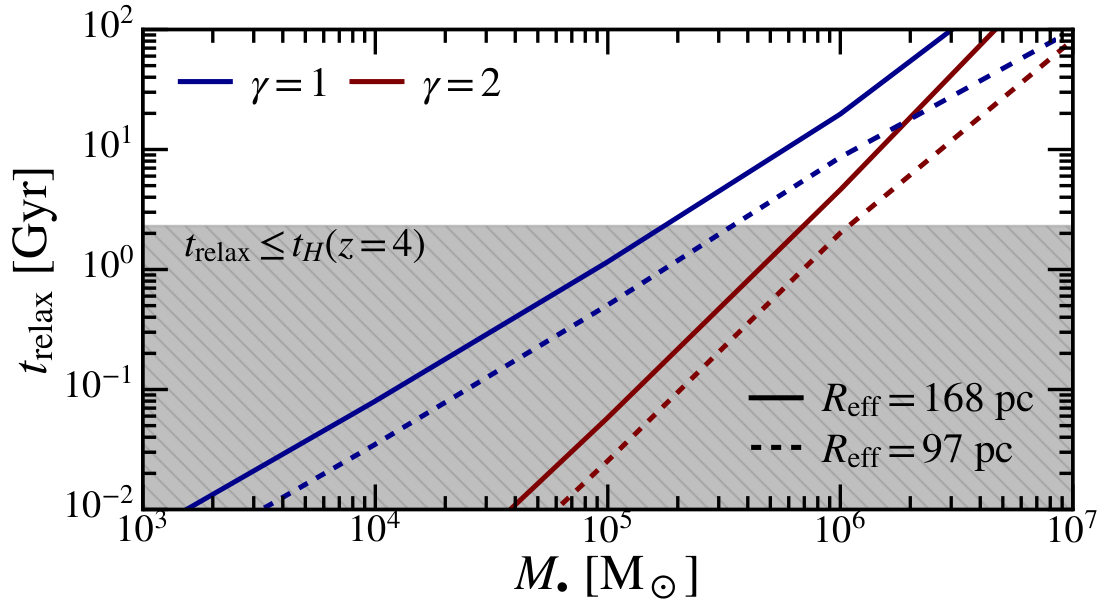
Figure 3 from The lifetimes and properties of Little Red Dots in the AMBRA simulation

2026-09-24 · 2609.26999v1 · Research note

The lifetimes and properties of Little Red Dots in the AMBRA simulation

Patrick LaChance, Yihao Zhou, Aklant Kumar Bhowmick, et al.

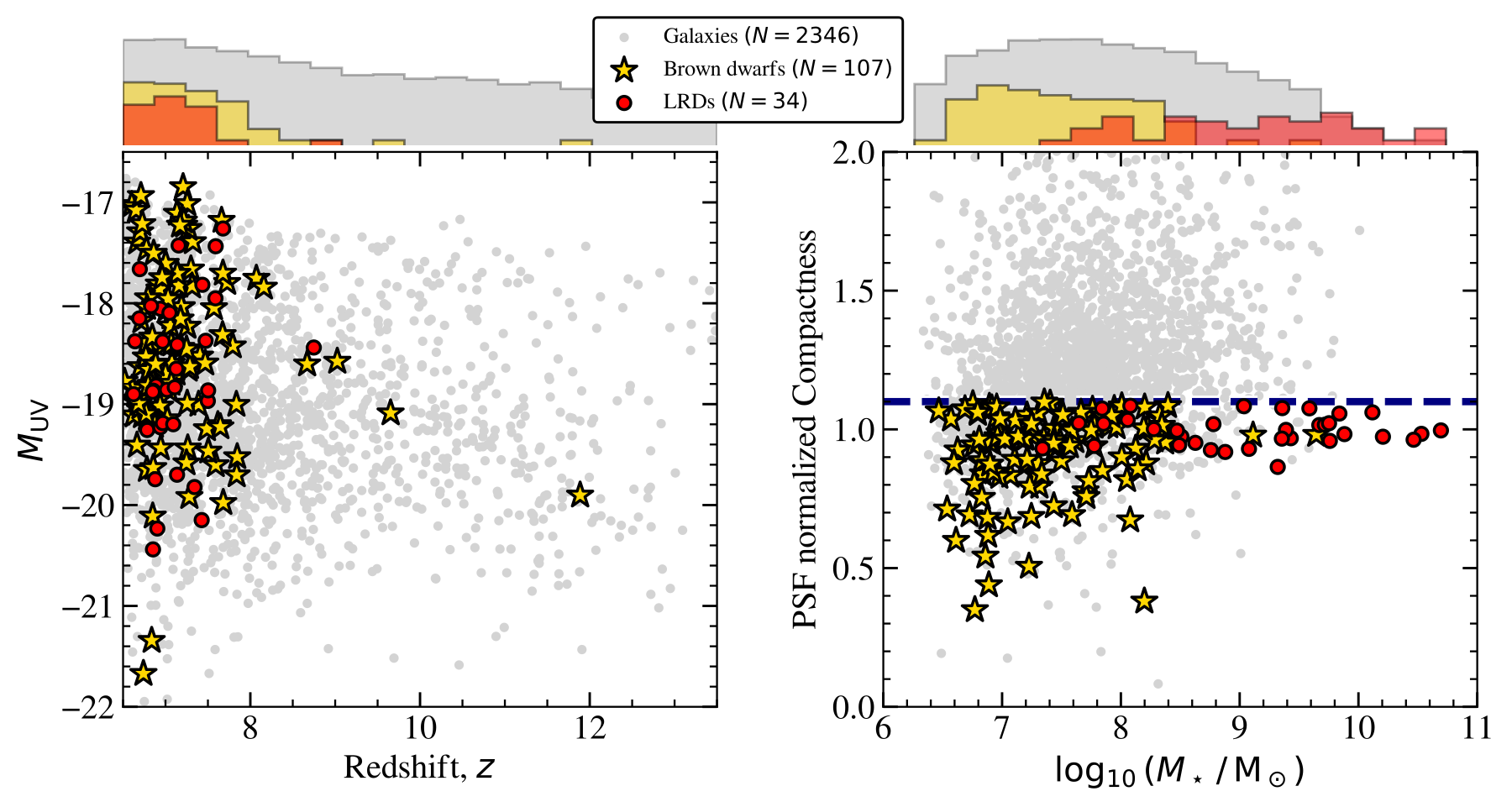
Mock JWST selection in AMBRA suggests LRDs are transient appearances of existing black hole–galaxy systems: dim sources require a gas-enshrouded AGN model, while massive compact hosts yield longer-lived phases. Redshift counts remain model-sensitive.

2026-09-23 · 2609.26553v1 · Research note

Constraining Inflation with Little Red Dots

Dionysios Karagiannis, P. Daniel Meerburg

A 14,000-deg² spectroscopic LRD survey at 4<z<9 is forecast to constrain local, equilateral, and orthogonal primordial non-Gaussianity at σ(fNL)=0.32, 32, and 10, respectively, if modeled clustering, abundance, and covariance assumptions hold.

Figure 4 from EPOCHS-DR2 I: Expanded data release and properties of $6.5<z<16.5$ photometrically selected galaxies across NIRCam deep fields covering $\sim700\,\rm arcmin^2$ with the galfind software

2026-09-22 · 2609.24987v1 · Research note

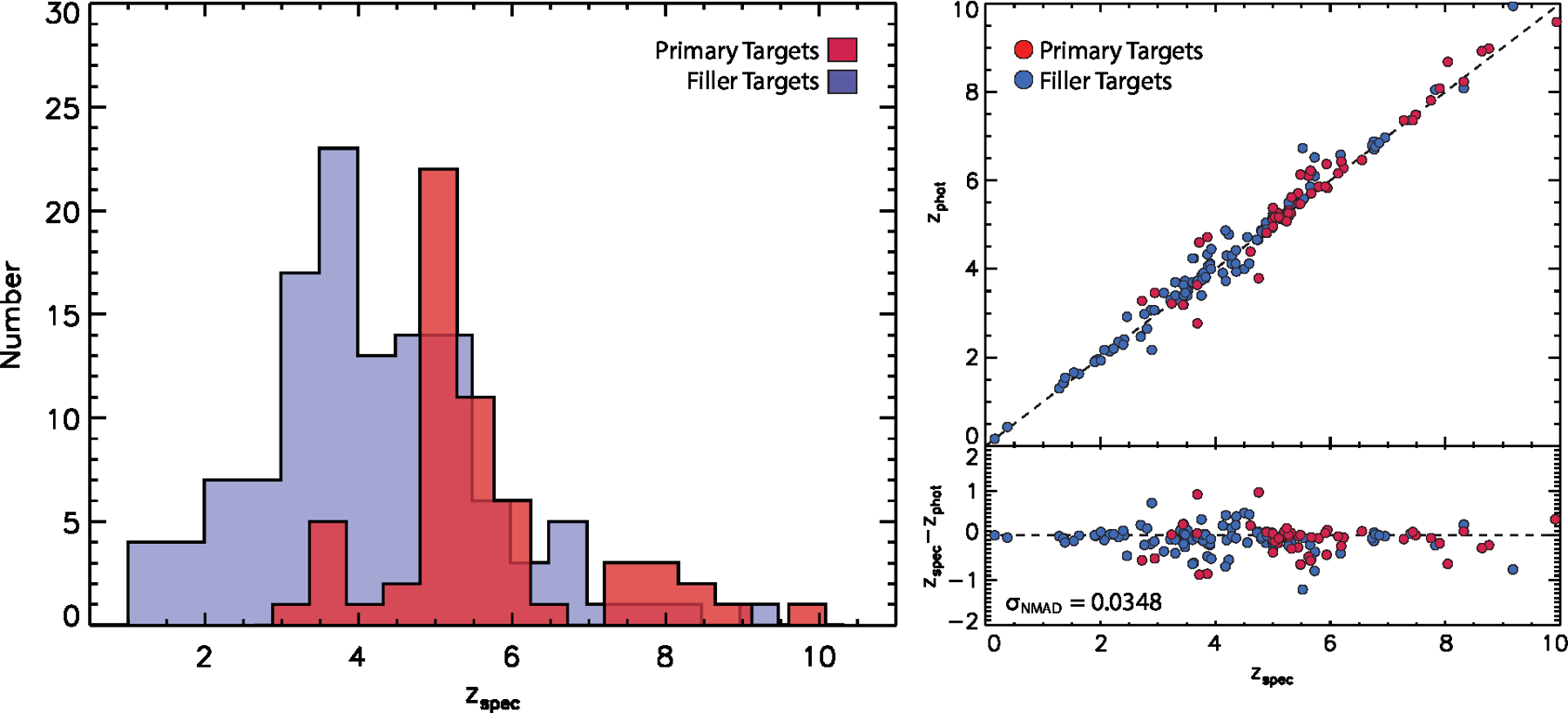
EPOCHS-DR2 I: Expanded data release and properties of $6.5<z<16.5$ photometrically selected galaxies across NIRCam deep fields covering $\sim700\,\rm arcmin^2$ with the galfind software

Duncan Austin, Christopher J. Conselice, Thomas Harvey, et al.

EPOCHS-DR2 releases a large JWST/NIRCam photometric census at 6.5<zphot<16.5, validated against NIRSpec but explicitly incomplete under its conservative selection. It identifies a small V-shaped-SED LRD subset and high-redshift candidates whose nature requires spectroscopy.

2026-09-21 · 2609.21337v1 · Research note

A large overdensity of LRD-like galaxies discovered by JWST in the SPT2349-56 protocluster at z=4.30

Scott C. Chapman, Kedar A. Phadke, Nikolaus Sulzenauer, et al.

JWST identifies 11 ultra-red, mostly resolved galaxies in the z=4.3 SPT2349-56 core. Their extreme concentration and ALMA-constrained low star formation suggest a likely protocluster population transitioning beyond the dusty-starburst phase, pending spectroscopy.

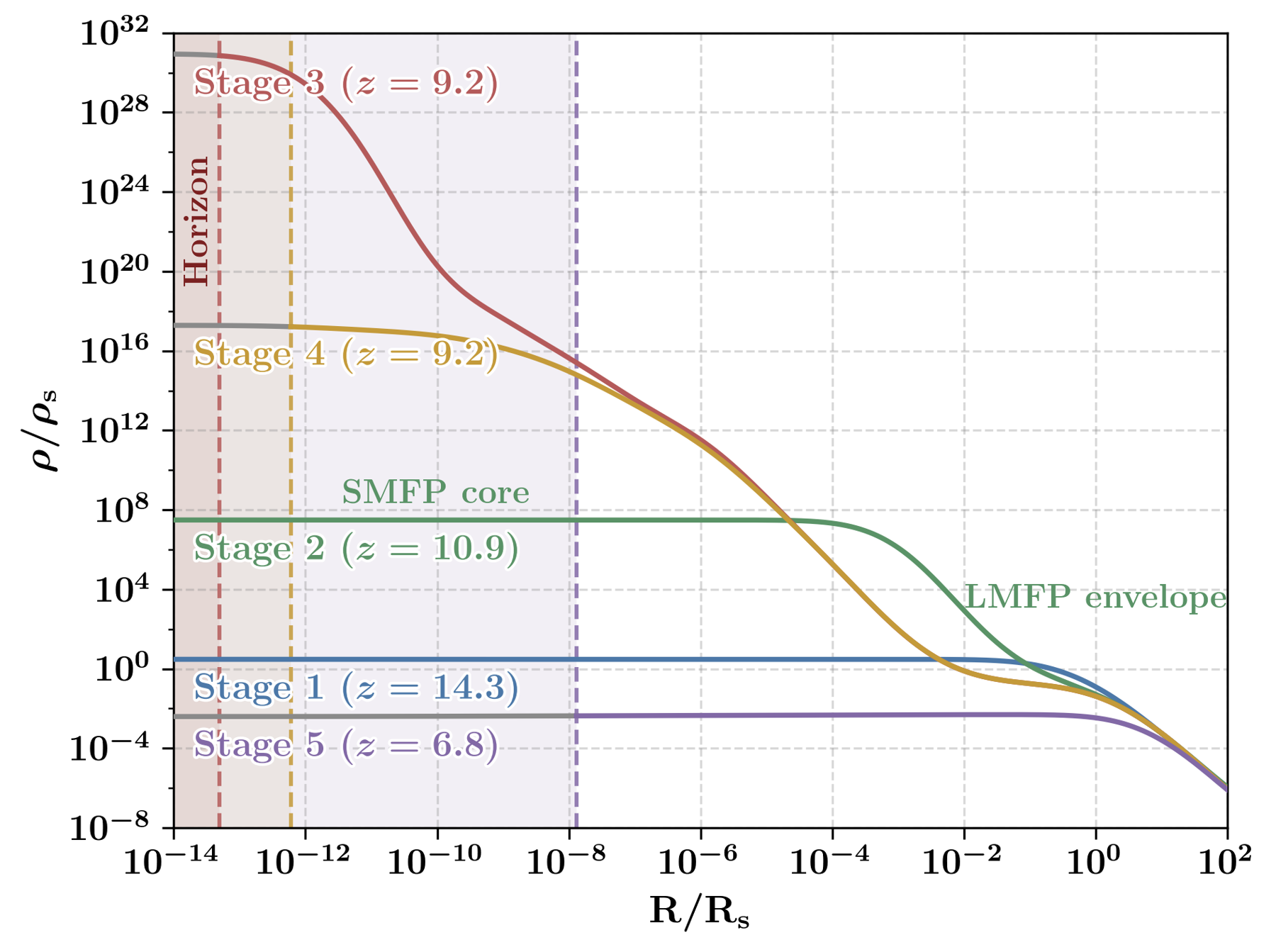
Figure 2 from A Dark-matter Origin of Little Red Dots: Early Seeding and Super-Bondi Accretion

2026-09-16 · 2609.16122v1 · Research note

A Dark-matter Origin of Little Red Dots: Early Seeding and Super-Bondi Accretion

Hua-Peng Gu, Fangzhou Jiang, Xian Chen, et al.

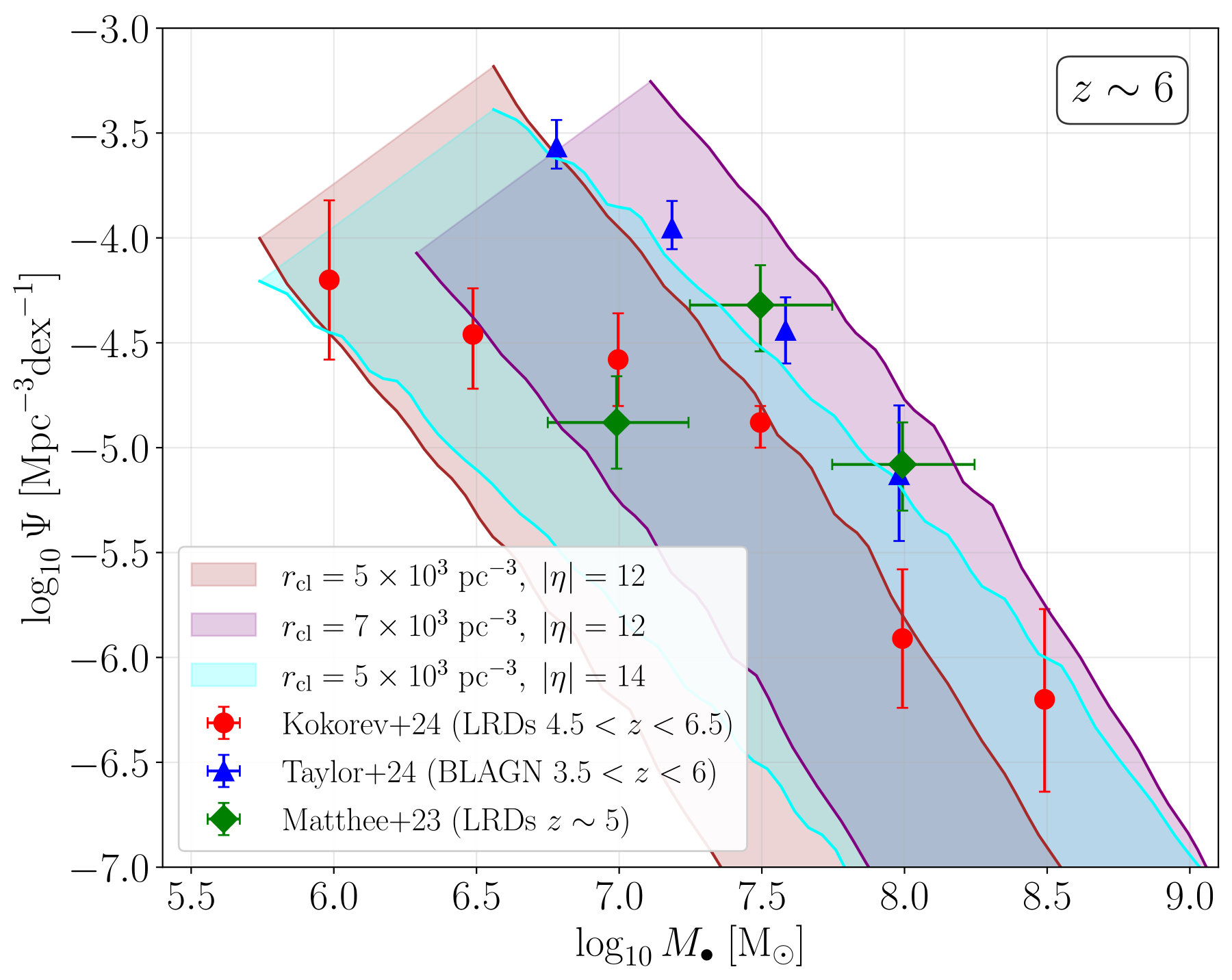
Using relativistic SIDM-halo evolution, the authors argue that pre-reionization, concentrated halos can make stellar-mass seeds and grow them through dark-matter inflow to LRD-like SMBHs by z≈6; late-time fluid-model breakdown makes final masses upper limits.

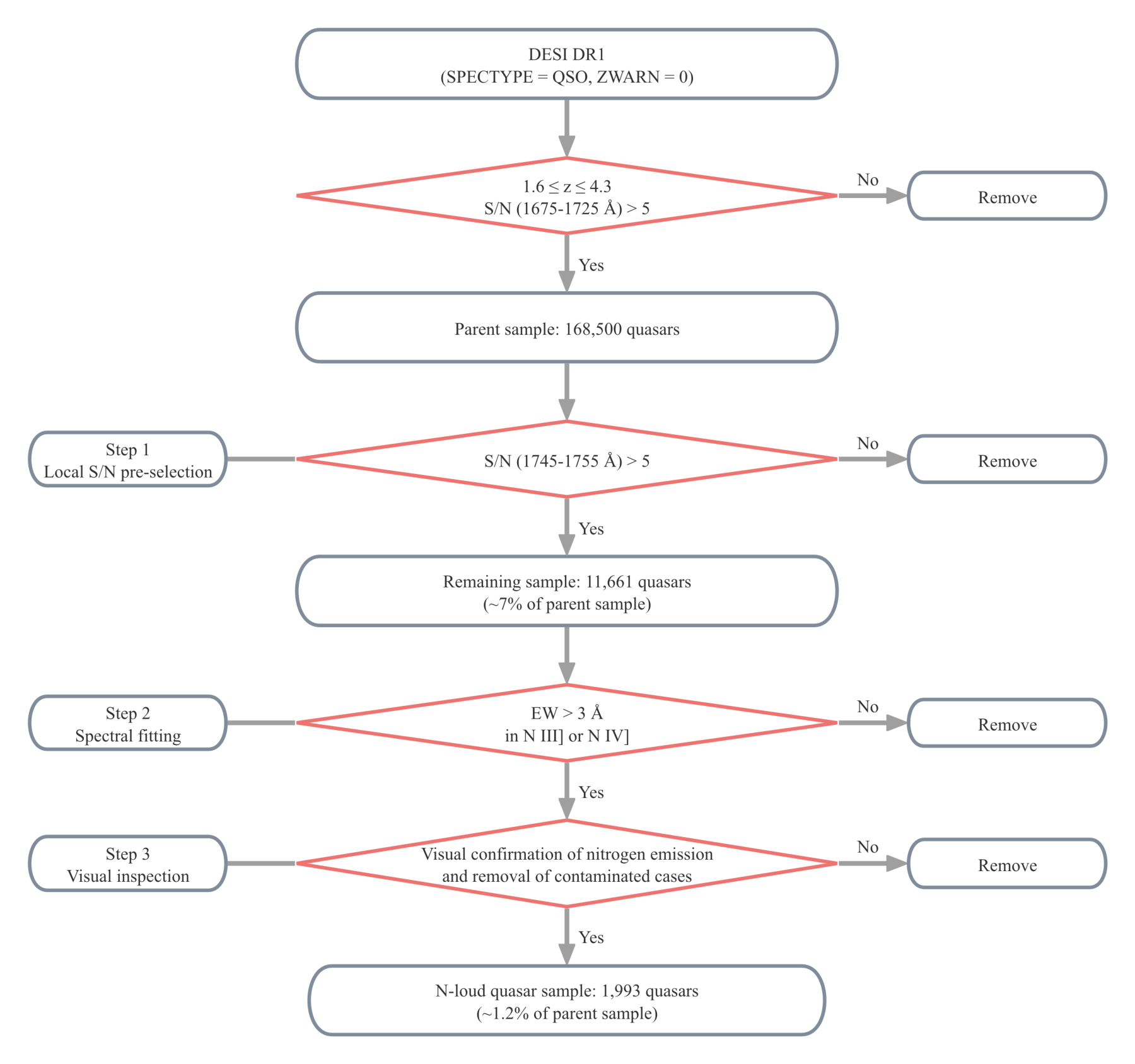
Figure 1 from Nitrogen-Loud Quasars from the Dark Energy Spectroscopic Instrument. I. Sample Selection and Basic Properties

2026-09-11 · 2609.11104v1 · Research note

Nitrogen-Loud Quasars from the Dark Energy Spectroscopic Instrument. I. Sample Selection and Basic Properties

Shuo Zhai, Wei-Jian Guo, Yong-Jie Chen, et al.

DESI DR1 yields 1,993 nitrogen-loud quasars at 1.6<z<4.3 (1.2% of the parent sample). Matched-control comparisons associate nitrogen-loud spectra with narrower broad lines, lower virial masses, and higher inferred Eddington ratios.

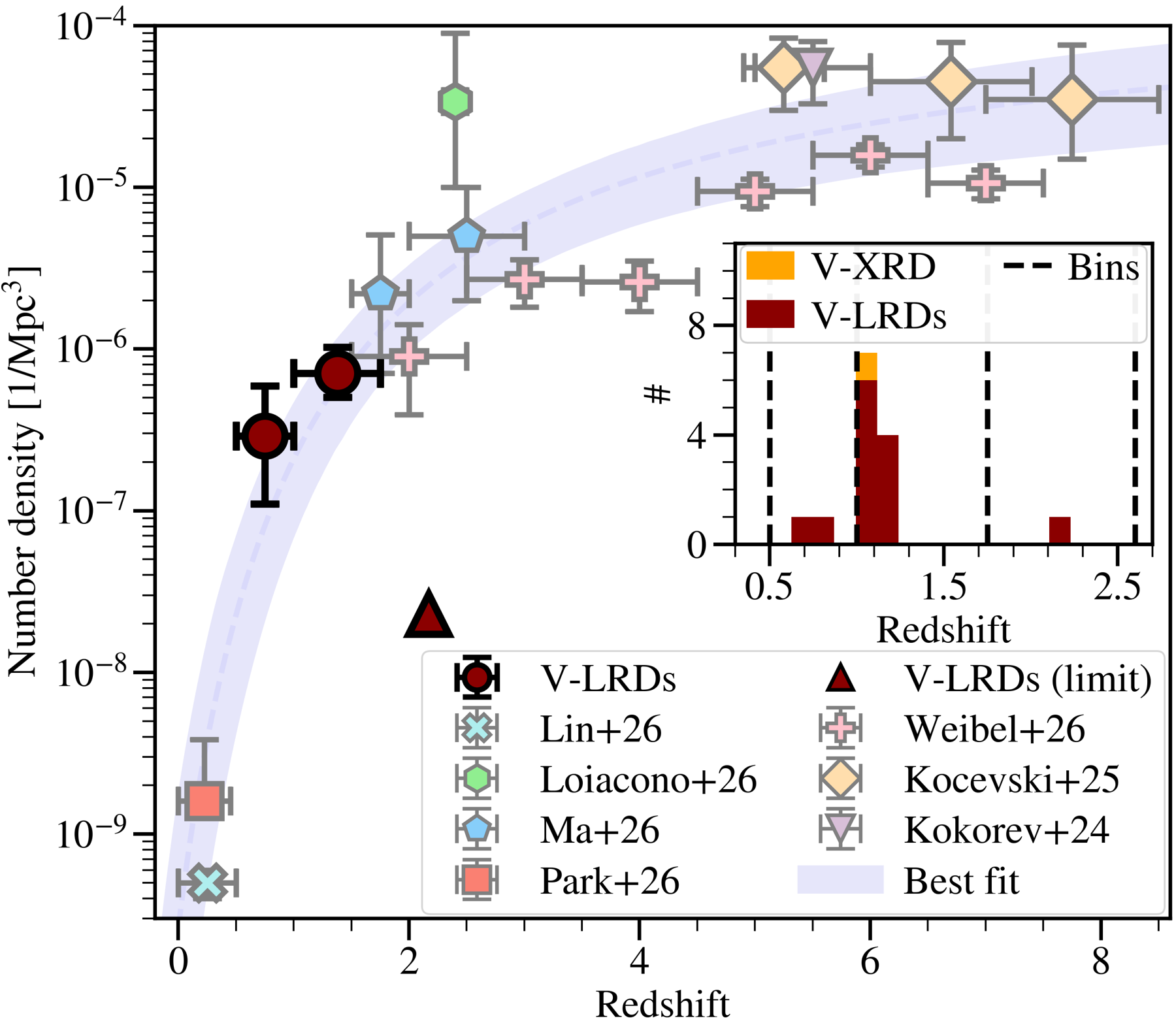
Figure 4 from Extending the Little Red Dot population at intermediate redshift with VIPERS

2026-09-10 · 2609.10319v1 · Research note

Extending the Little Red Dot population at intermediate redshift with VIPERS

Krzysztof Lisiecki, Krzysztof Hryniewicz, Francesco Pistis, et al.

VIPERS yields 14 compact, LRD-like sources at 0.5<z<1.75 selected through V-shaped photometric slopes and broad lines. Their inferred abundance declines sharply below z~1, while one unresolved X-ray source is consistent with a low-inclination, radiatively efficient disk.

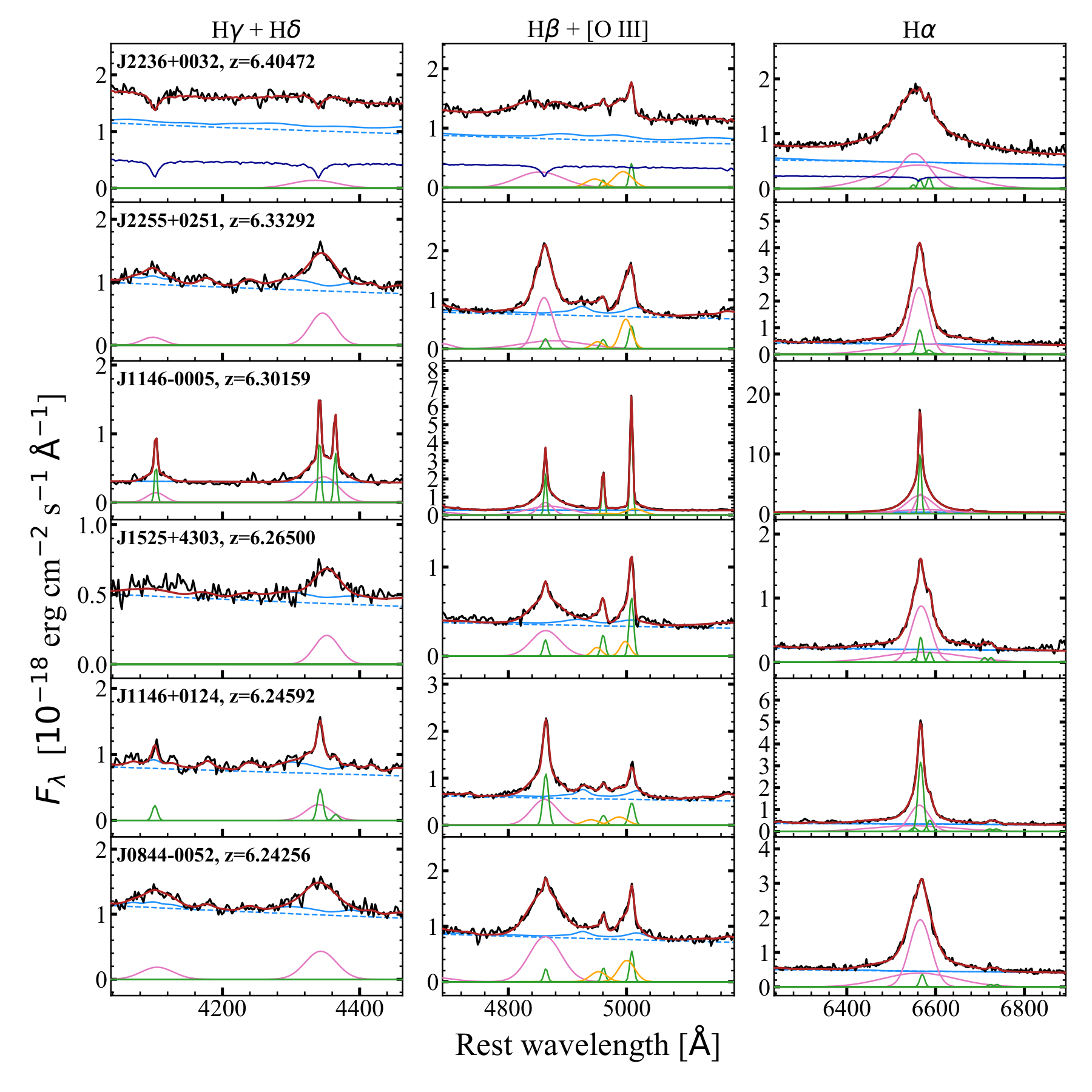
Figure 3 from SHELLQs. Black Hole Mass and Eddington Ratio Distributions of Intermediate-Luminosity Quasars at 6<z<7

2026-09-10 · 2609.09266v1 · Research note

SHELLQs. Black Hole Mass and Eddington Ratio Distributions of Intermediate-Luminosity Quasars at 6<z<7

Masafusa Onoue, John D. Silverman, Yoshiki Matsuoka, et al.

Near-IR spectroscopy of intermediate-luminosity SHELLQs quasars finds lower median virial black-hole masses and higher Eddington ratios than luminosity-matched z≈1.3 quasars, with 11–22% inferred near/super-Eddington depending on the single-epoch mass calibration.

Figure 1 from Small-Scale Clustering of Primordial Black Holes: The Little Red Dot Mass Function and the High-Redshift Galaxy Tension

2026-09-09 · 2609.09078v1 · Research note

Small-Scale Clustering of Primordial Black Holes: The Little Red Dot Mass Function and the High-Redshift Galaxy Tension

Borui Zhang, Wei-Xiang Feng, Haipeng An

This analytic PBH-cluster framework claims that runaway mergers can reproduce the LRD SMBH mass function with a 1–10% accretion duty cycle while linking overmassive, compact hosts to seed-driven halo evolution; key gas dynamics remain unmodeled.

2026-09-09 · 2609.08145v1 · Research note

The Roman eXtreme Deep Field (RXDF)

Haojing Yan, Anton M. Koekemoer, Yue Shen, et al.

RXDF is an approved Roman seven-band, multi-epoch imaging program designed to combine AB≈30 depth with a 678.75 arcmin² full-depth footprint. For LRD science it is prospective: it extends the luminosity–redshift discovery space, but supplies neither an LRD selection nor predicted counts.

Figure 3 from Between Little Red Dots and Star-Forming Galaxies: A Sequence in the Optical Continuum Slope

2026-09-08 · 2609.07025v1 · Research note

Between Little Red Dots and Star-Forming Galaxies: A Sequence in the Optical Continuum Slope

Kristiphong Boonmee, Akio K. Inoue, Masafusa Onoue, et al.

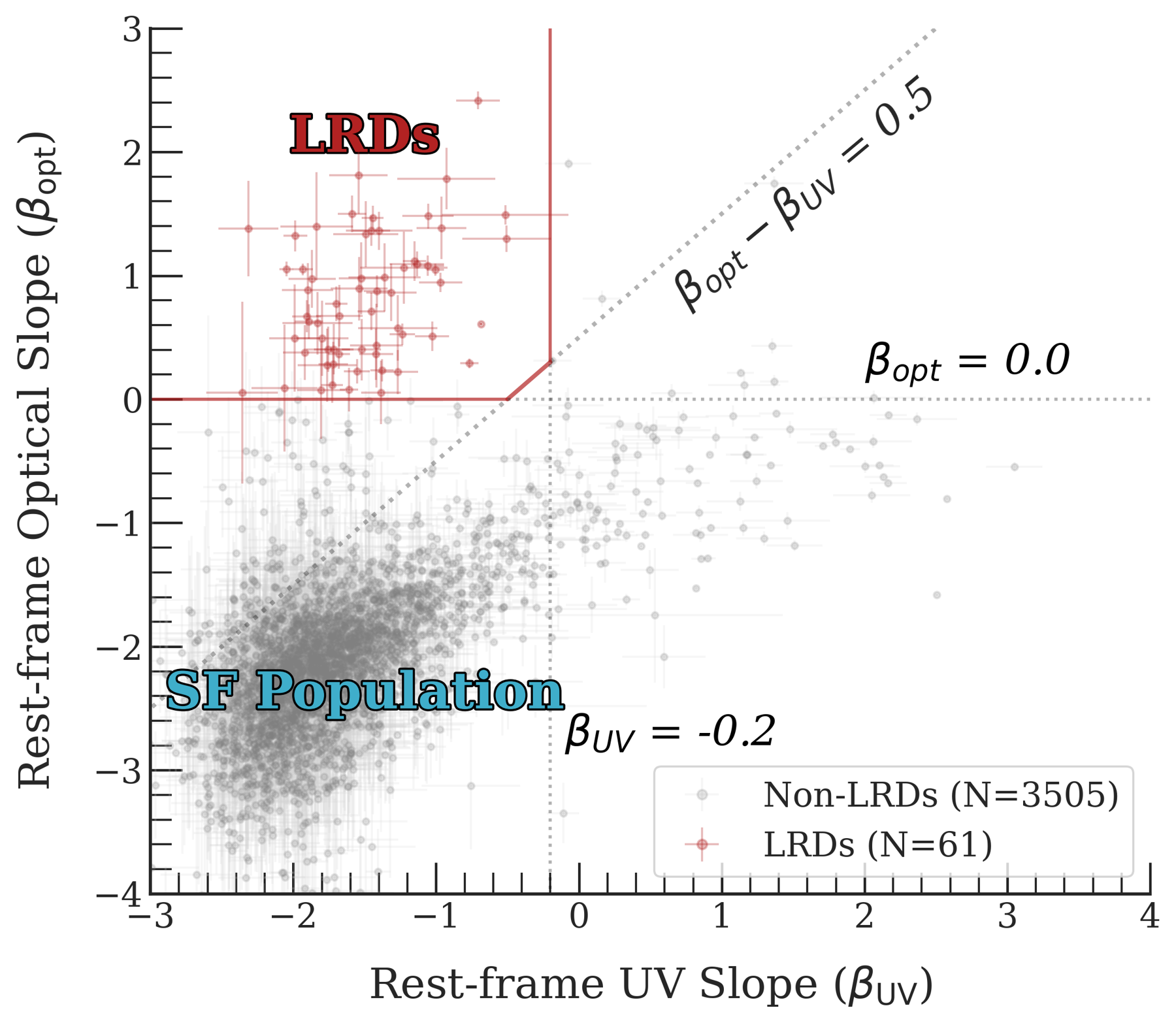
In 3,566 JWST/NIRSpec galaxies at z=3.0–8.1, UV–optical continuum slopes reveal a continuously populated path from star-forming galaxies to LRDs. The authors interpret it as changing host/BH* continuum contributions, while stressing model-dependent mass-ratio limits.

Figure 5 from Early Supermassive Black Holes and Little Red Dots Require Free-Fall Growth

2026-09-02 · 2609.00115v1 · Research note

Early Supermassive Black Holes and Little Red Dots Require Free-Fall Growth

Junehyoung Jeon, Volker Bromm, Michael Boylan-Kolchin, et al.

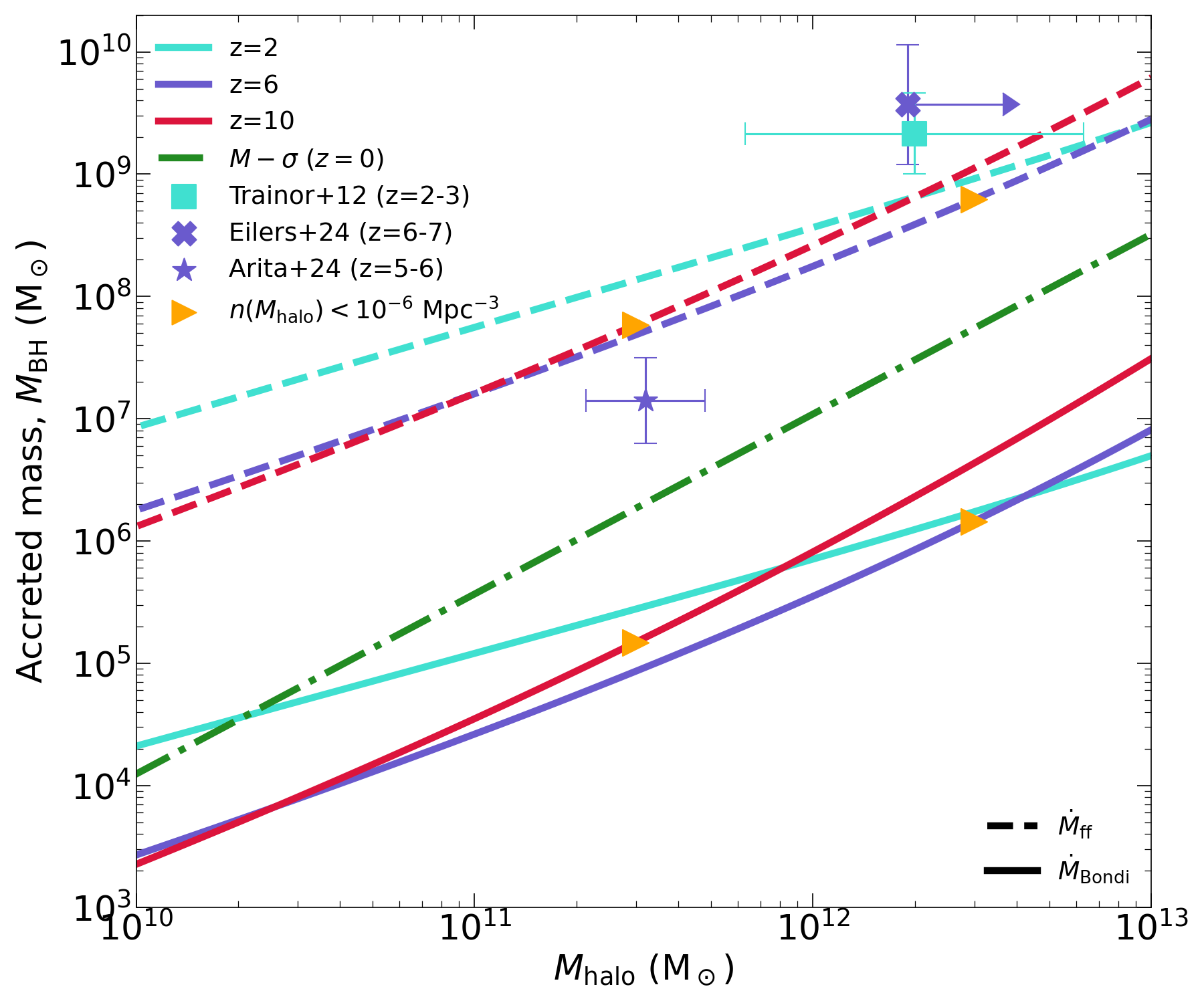
An analytic halo-inflow model argues that observed early AGN and, conditionally, little red dots (LRDs) require near-free-fall cold gas supply rather than Bondi–Hoyle inflow; it treats this as an upper-limit fuel budget, not a direct measurement of black-hole accretion.

Figure 2 from Weighing Little Red Dots with Transient Events

2026-09-02 · 2609.00113v1 · Research note

Weighing Little Red Dots with Transient Events

Vinh Tran, Xuejian Shen, Oliver Zier, et al.

This modelling study proposes tidal-disruption and quasi-periodic-eruption event rates as population-level probes of LRD black-hole masses. Its predictions depend strongly on assumed stellar cusps, black-hole–stellar-mass relations, and the possibility that most LRDs are obscured.

Figure 3 from Skyfire: A Spectroscopic Census of Little Red Dots and Broad-Line AGN in the CEERS Field

2026-09-02 · 2609.00112v1 · Research note

Skyfire: A Spectroscopic Census of Little Red Dots and Broad-Line AGN in the CEERS Field

Dale D. Kocevski, Anthony J. Taylor, Masafusa Onoue, et al.

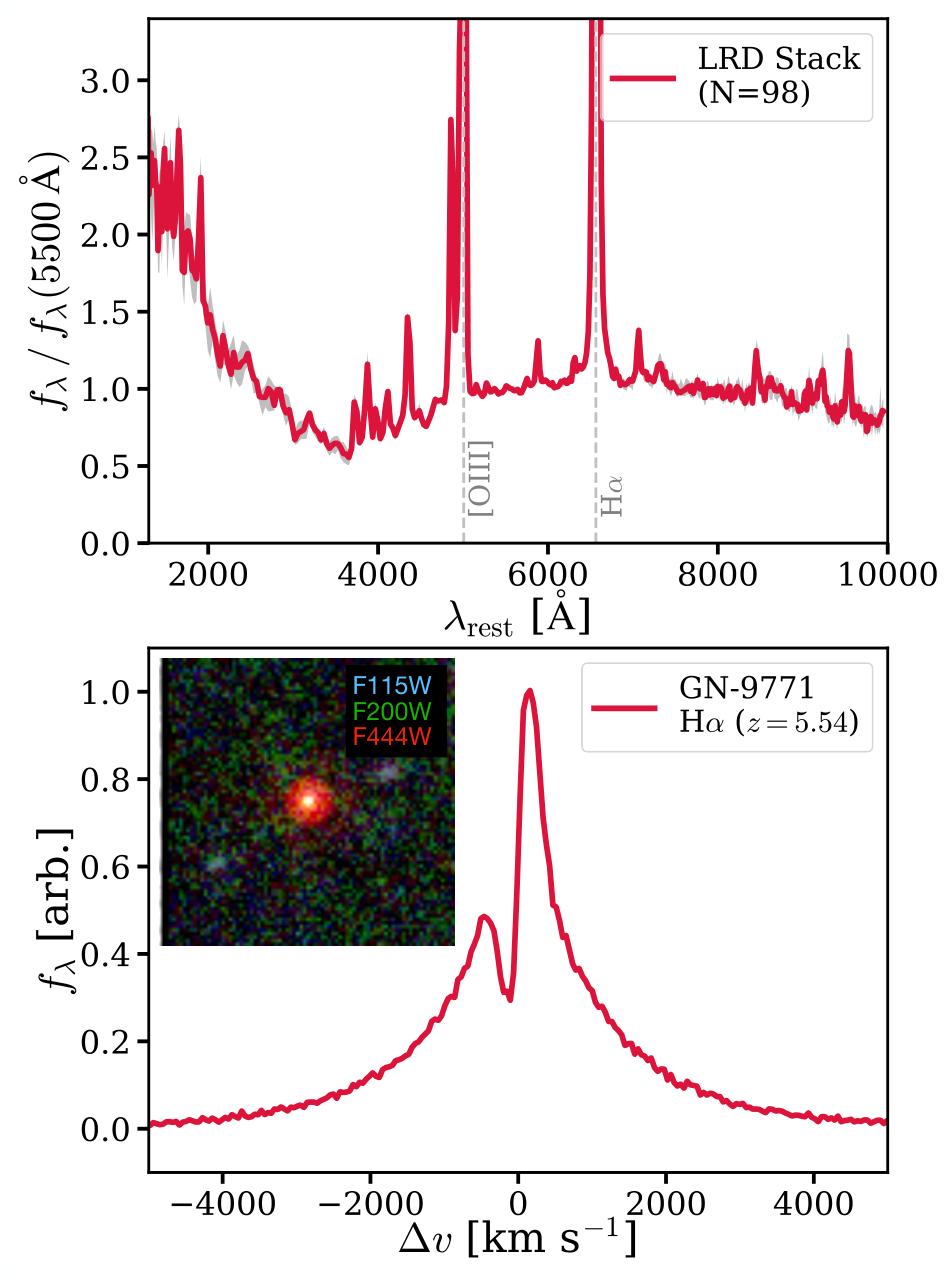
Skyfire’s CEERS NIRSpec census finds broad Balmer emission across redder LRDs and somewhat bluer candidates, motivating an expanded continuum-slope selection. The color trend is suggestive of continuity with blue broad-line sources, but uneven targeting prevents a definitive population-unification claim.

2026-08-26 · 2608.23671v1 · Research note

More Numerous and Bluer: Companions of the Brightest Little Red Dots Differ from Control Galaxies at $>3σ$, Hinting at Synchronized Black Hole Seed Formation

Fabio Pacucci, C. Megan Urry

Among 253 JWST-selected LRDs, only the brightest quartile shows a statistically significant excess of very close blue companions: 18/65 within 0.5–2 kpc. The association supports, but does not establish, synchronized seed formation.

2026-08-24 · 2608.21280v1 · Research note

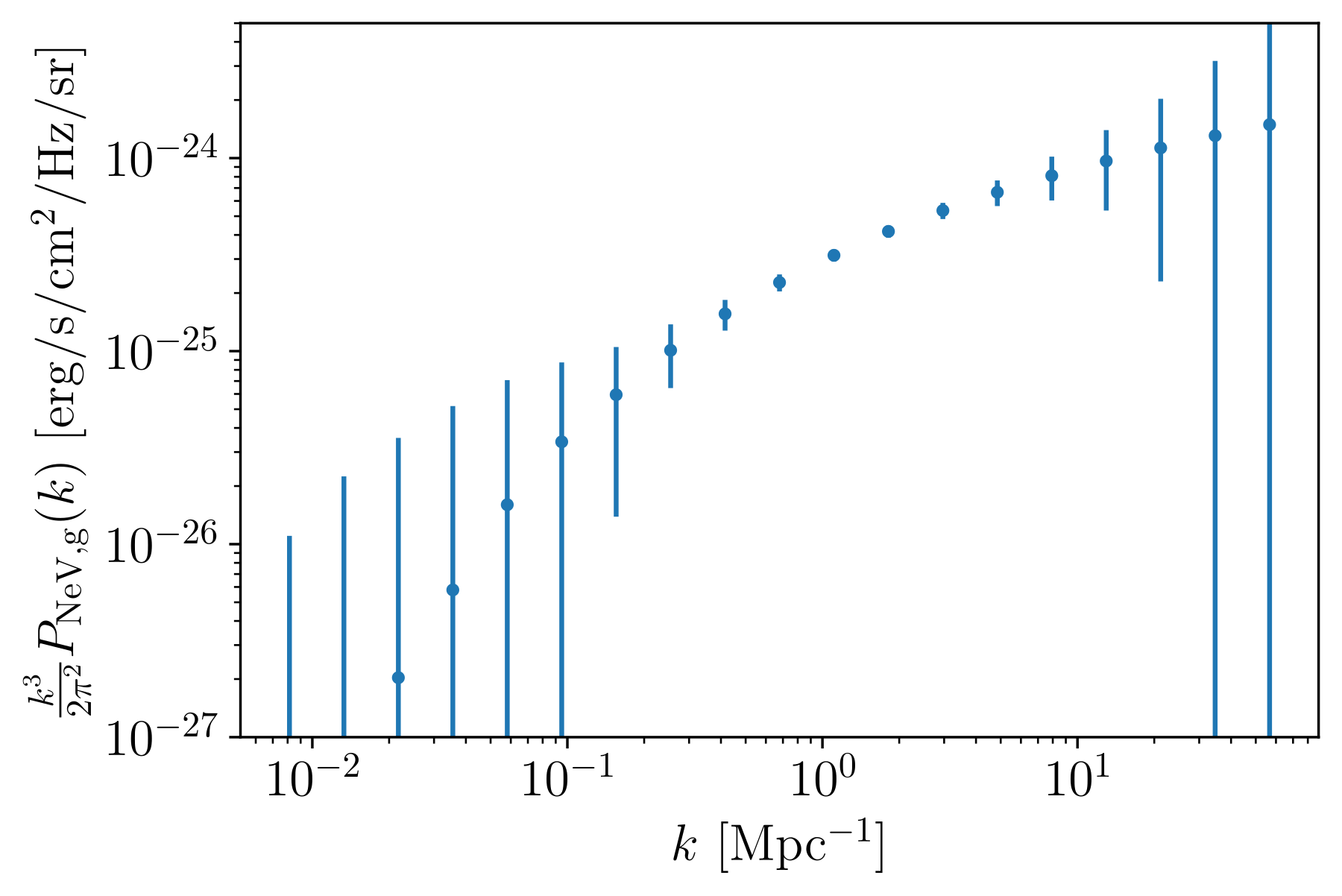
The [Ne V] AGN Diagnostic in SDSS-IV/eBOSS: An Anticorrelation Between Ionization State and AGN Luminosity in Low-Redshift Coronal-Line Galaxies

Owen S. Matthews Acuña, Christy A. Tremonti, Nikko J. Cleri, et al.

In SDSS-IV/eBOSS, [Ne V] produces a large, high-purity but incomplete AGN sample: detection favors less-obscured, higher-Eddington-ratio nuclei. Stacking indicates many individual non-detections are sensitivity-limited, while [Ne V]/[O III] declines with AGN luminosity.

2026-08-20 · 2608.18212v1 · Research note

Quasar Impostors: Two Extremely UV-Bright ($M_{\rm UV}\approx-23.5$) Reionisation-Epoch Galaxies Powered by Very Massive Stars

Daming Yang, Joseph F. Hennawi, Sarah E. I. Bosman, et al.

JWST and ALMA reclassify two z=6.63–6.80, MUV≈−23.5 SHELLQs “quasars” as extreme star-forming galaxies. Their UV wind and broad He II features are better matched by VMS-inclusive population models, although inferred IMF cutoffs remain strongly model dependent.

2026-08-12 · 2608.10280v1

Tabular foundation models for the estimation of probabilistic quasar photometric redshifts in S-PLUS

Raquel R. Valença, Lilianne Nakazono, Rafael Izbicki, et al.

This paper tests whether frozen tabular foundation models can deliver full probabilistic quasar photo-z posteriors for the 12-band S-PLUS DR6 survey, where colour-redshift degeneracies and spectroscopic-to-photometric covariate shift make single-value estimates inadequate. Across training sets spanning 500 to 121,626 quasars and comparisons with eight specialised baselines, TabPFN 2.5 is best or statistically tied for best on nearly every density and point-estimation metric, with especially strong gains for small training samples, bright or faint sources, and high-redshift quasars. Its posteriors remain close to nominally calibrated after importance-weighted evaluation intended to emulate the photometric target catalogue, making it a strong default for catalogue-scale quasar redshift inference; the practical limitation is the accelerator-memory cost of inference on large support and target sets. SHAP results further identify WISE W1/W2 as the most informative individual inputs, with UV and optical bands providing useful refinements.
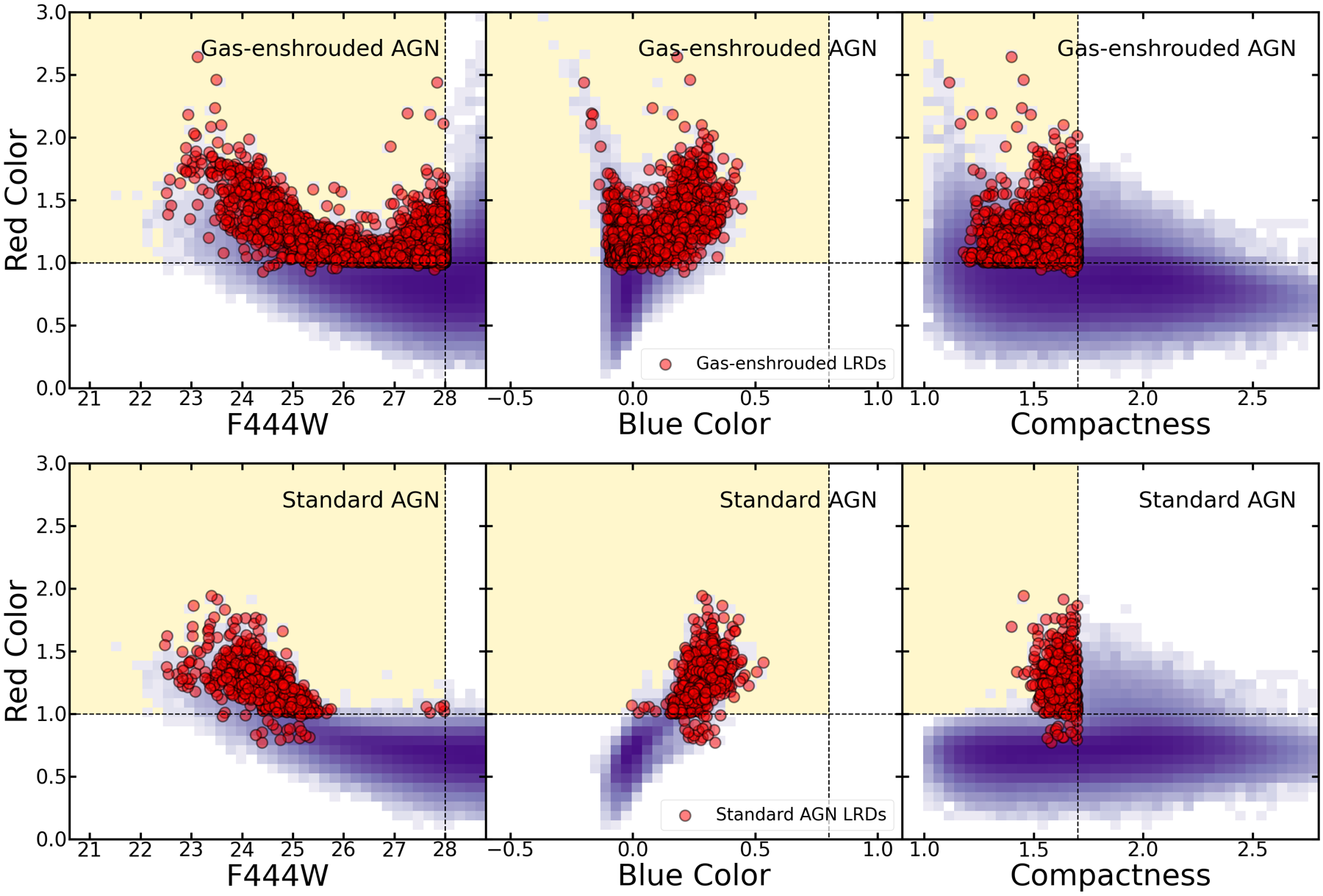
2026-08-07 · 2608.05267v1 · Research note

Where did all the Little Red Dots go? The abundance of LRD analogues among objects with broad lines at $z < 0.35$

Lasse Seyberlich, Sarah E. I. Bosman

In an SDSS broad-line sample at z<0.35, the authors identify nine SED-selected local LRD analogues and infer an abundance of 0.08%, supporting rarity at late times but with important spectral-coverage and contamination caveats.

Figure 9 from An Exploratory Analysis of New Large Gaia-informed Quasar Samples in SDSS-V

2026-07-31 · 2607.27329v1 · Research note

An Exploratory Analysis of New Large Gaia-informed Quasar Samples in SDSS-V

Shir Aviram, Benny Trakhtenbrot, Tom Dwelly, et al.

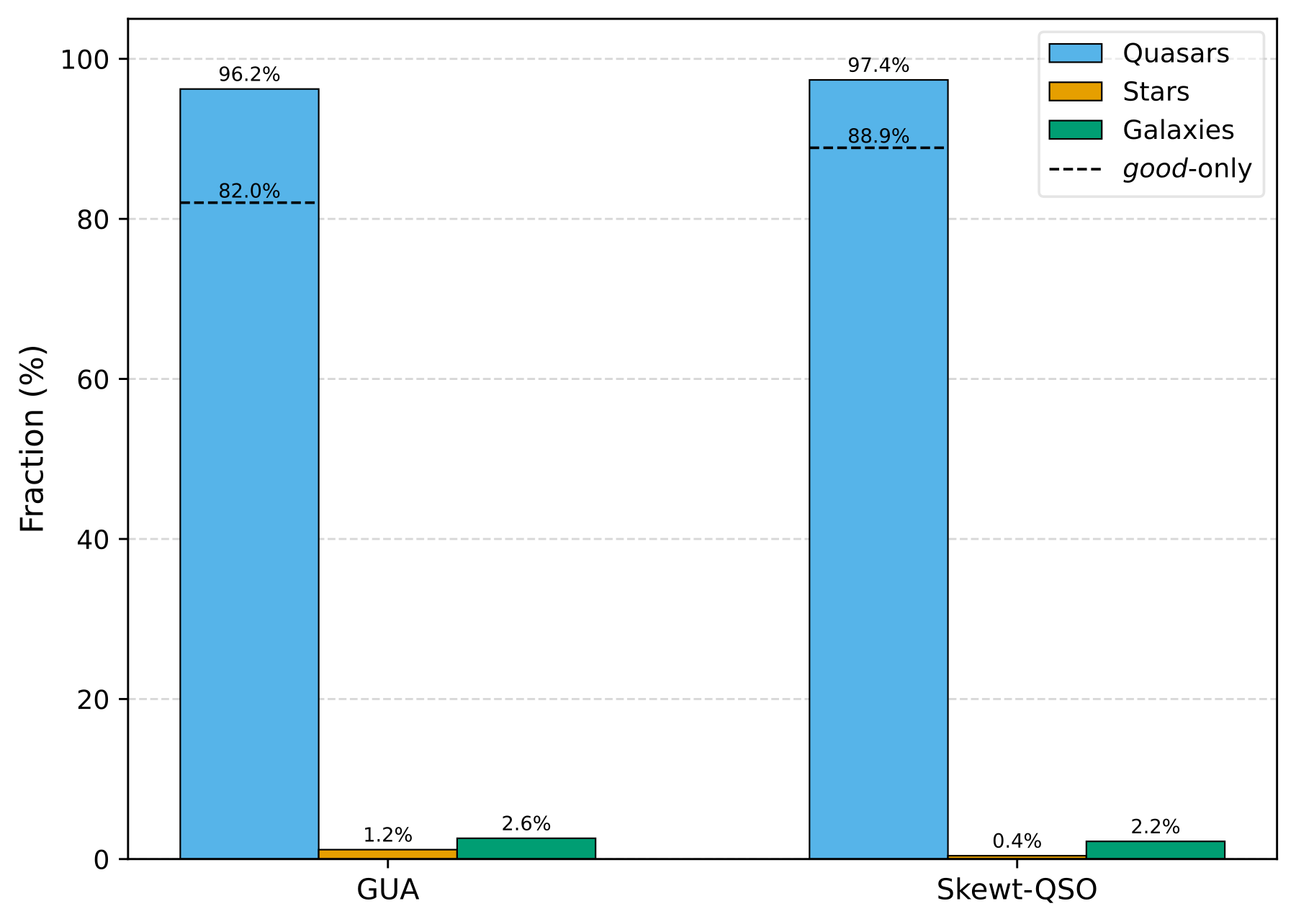
SDSS-V’s Gaia/WISE-informed GUA and Skewt_QSO targeting yields a large, mostly southern extension of spectroscopic quasars with broad physical-property coverage; after controlling redshift–luminosity selection differences, its black-hole and Eddington-ratio distributions agree with SDSS DR16Q.

2026-07-29 · 2607.25696v1 · Research note

Tracing Obscured AGN Contribution and Number Fraction Across 0 < z < 6 with JWST

Angel Rodriguez Barbosa, Tomotsugu Goto, Daryl Joe D. Santos, et al.

Using GOODS-S JWST SMILES+JADES photometry and CIGALE fits, the authors report that obscured-AGN incidence and infrared contribution rise toward high redshift, but are consistent with no systematic dependence on total infrared luminosity within their uncertainties.

Figure 3 from Unsupervised selection and characterisation of Little Red Dots in JWST surveys with manifold learning

2026-07-28 · 2607.22835v1 · Research note

Unsupervised selection and characterisation of Little Red Dots in JWST surveys with manifold learning

Michele Ginolfi, Filippo Mannucci, Alessandro Marconi, et al.

UMAP applied to 242,327 JWST sources localises spectroscopic LRDs into two colour-linked regions and selects roughly 100 candidates. Against the available spectroscopic subset, the main region attains ~0.78 purity and ~0.82 completeness, but preprocessing disfavors the reddest high-z objects.

Figure 2 from The MIRI Early Obscured-AGN Wide Survey (MEOW): A Population of Hidden AGN at $z \gtrsim 5$ Revealed by JWST/MIRI Imaging

2026-07-07 · 2607.02666v1 · Research note

The MIRI Early Obscured-AGN Wide Survey (MEOW): A Population of Hidden AGN at $z \gtrsim 5$ Revealed by JWST/MIRI Imaging

Gene C. K. Leung, Anna-Christina Eilers, Ryan Endsley, et al.

MEOW uses JWST/MIRI hot-dust selection over GOODS to identify 16 z≳5 AGN candidates, mostly not previously selected as broad-line AGN. Its luminosity-function comparison suggests an obscured population comparable in abundance to broad-line AGN near log Lbol≈45, but faint-end constraints remain limited.

2026-07-02 · 2607.00084v1 · Research note

Little Red Dots at z~2 in EIGER reveal a gentle decline with respect to their peak number density at z~5

Shrriya Kapoor, Jorryt Matthee, Alberto Torralba, et al.

EIGER slitless spectroscopy identifies five z=1.93–3.18 little red dots among 19 near-infrared broad-line emitters. Their inferred z≈2 density is ≈7×10⁻⁶ cMpc⁻³, supporting a decline from z≈5, but less sharply than prior photometric work suggested.

Figure 3 from No evolution in the number density of little red dots from cosmic dawn to cosmic noon

2026-06-30 · 2606.30253v1 · Research note

No evolution in the number density of little red dots from cosmic dawn to cosmic noon

Federica Loiacono, Roberto Gilli, Marco Mignoli, et al.

In one EIGER/J1030 field, five X-ray-undetected broad-line candidates imply an LRD density at z≈2.4 consistent with no decline from z≈7 above Lbol=3×10^44 erg s−1, but the large counting uncertainty and small sample preclude a precise evolutionary constraint.

Figure 9 from OzSSy1: The Australian Southern Seyfert-1 Spectroscopic Atlas and Catalogue at z < 0.1

2026-06-29 · 2606.27675v1 · Research note

OzSSy1: The Australian Southern Seyfert-1 Spectroscopic Atlas and Catalogue at z < 0.1

Neelesh Amrutha, Christian Wolf, Christopher A. Onken, et al.

OzSSy1 releases uniform WiFeS spectroscopy, decompositions, and line measurements for 887 southern broad-line AGNs at z<0.1, providing a local reference sample while retaining incompleteness from host dilution at the lowest redshifts.

2026-06-17 · 2606.17271v1 · Research note

Black Hole Stars Across the Universe: Identifying Central Engine Dominated Little Red Dots at $z\sim1.5-9.5$

Andrea Weibel, Rohan P. Naidu, Pascal A. Oesch, et al.

A BH*-template SED selection yields 241 compact, rest-optical central-engine-dominated candidates over z~1.7–9.3, extending beyond conventional V-shaped LRD criteria; inferred luminosities and Eddington-based masses remain model-dependent.

2026-06-11 · 2606.12076v1 · Research note

X-ray luminosity function of Compton-thick AGN in the early Universe (z > 3). Robustness and biases of the CTK population

Angel Ruiz, Ektoras Pouliasis, Ioannis Georgantopoulos

Using X-ray spectra and infrared-informed absorption priors, the authors infer that Compton-thick AGN comprise 17% of AGN at z=3–6. The revision sharply reduces candidate classifications, but supports no significant redshift evolution in this fraction.

2026-06-10 · 2606.10455v1 · Research note

The Extreme Quasar Main Sequence of Super-Eddington DESI-DR1 NLSy1 Galaxies

Alberto Domínguez</name> <arxiv:affiliation>UCM</arxiv:affiliation> </author> <author> <name>Suvendu Rakshit, Vaidehi S. Paliya, D. J. Saikia, et al.

In 18,749 DESI-DR1 NLSy1s, stronger Fe II and lower single-epoch virial masses than SDSS-DR17 correspond to a larger inferred super-Eddington fraction. Two mass calibrations preserve the population difference, but virial-mass systematics remain consequential.

Figure 6 from NEXUS: Abundance, Environments, and Spectral Diversity of Little Red Dots from the NIRSpec MSA Sample

2026-06-09 · 2606.09721v1 · Research note

NEXUS: Abundance, Environments, and Spectral Diversity of Little Red Dots from the NIRSpec MSA Sample

Zhiwei Pan, Ming-Yang Zhuang, Yue Shen, et al.

NEXUS combines JWST imaging and PRISM spectroscopy to census LRDs at z=2.3–7.5. Its 36 confirmed objects are predominantly broad-line sources, while selection calibration, abundance, clustering, and continuum diversity remain limited by contamination, resolution, and sample size.

2026-06-08 · 2606.06585v1 · Research note

A Population of Red Galaxies with Very Strong Emission Lines at $z > 5$ Revealed by the NIRCam Medium Bands: ''Classic'' LRDs, Dusty Star-Forming Galaxies, and a Missing Population of LRDs

Sunna Withers, Adam Muzzin, Swara Ravindranath, et al.

Medium-band NIRCam colors identify 26 red, strong-line galaxies at z=5.01–8.60. Nine unresolved objects evade common Little Red Dot cuts; the authors favor a missed LRD population, but dusty star formation and AGN remain viable alternatives.

2026-06-01 · 2605.31077v1 · Research note

Super-Eddington accretion of black holes in early nuclear bursts gives birth to Little Red Dots

Yangyao Chen, Houjun Mo

A cosmological black-hole/galaxy model interprets z≈5 Little Red Dots as luminous, short super-Eddington nuclear-burst phases of previously seeded black holes. It reproduces the reported number-density shape, but the proposed triggering, seeding mix, and descendants remain model-dependent.

2026-05-26 · 2605.24112v1 · Research note

The Lumina Project: The Demographics of Active Galactic Nuclei from Quasars to Little Red Dots at $z\geq 3$

Xuejian Shen, Oliver Zier, Aaron Smith, et al.

Lumina couples a large radiation-hydrodynamic volume to an empirical SMBH-to-observable prescription, and its authors report simultaneous consistency with high-redshift quasar and LRD luminosity functions and LRD clustering. The agreement depends on assumed LRD demographics and spectral properties.

Figure 1 from Population synthesis of active galactic nuclei based on the radiation-regulated unification model

2026-05-17 · 2605.17547v1 · Research note

Population synthesis of active galactic nuclei based on the radiation-regulated unification model

D. Gerolymatou, S. Paltani, C. Ricci, et al.

Using simulation-based inference on a synthetic local AGN population, the authors find an intrinsic Compton-thick fraction of 40±3%. Their radiation-regulated geometry broadly reproduces several X-ray observables, but depends materially on fixed, simplified broad-line-region and torus assumptions.

Figure 2 from A new sample of Little Red Dots at $z<0.45$ in DESI DR1: Broad Balmer lines, low ionization spectrum and no variability

2026-05-14 · 2605.14233v1 · Research note

A new sample of Little Red Dots at $z<0.45$ in DESI DR1: Broad Balmer lines, low ionization spectrum and no variability

Kevin Park, Alberto Torralba, Jorryt Matthee, et al.

A DESI DR1 line-selected search identifies eight compact z=0.20–0.44 LRD candidates with broad, steep-decrement Balmer emission, low-excitation spectra, and generally weak multi-year variability, extending detailed LRD tests to the nearby Universe.

2026-05-11 · 2605.11077v1 · Research note

The Impact of Cosmic Variance and Satellites on JWST Clustering Measurements at Redshift around 6

Jiamu Huang, Elia Pizzati, Joseph F. Hennawi, et al.

For ASPIRE-like JWST clustering at z≈6, mock-based covariances—not Poisson pair-count errors—are needed for calibrated halo-mass inference: Poisson intervals are systematically too narrow because they omit cosmic variance and correlated radial bins.

2026-05-06 · 2605.05074v1 · Research note

Little red dots as obscured little blue dots: relative abundances, luminosities, and black-hole masses

Piero Madau, Roberto Maiolino

A forward model treating little red dots as dust-intercepted, inclined counterparts of compact broad-line AGN matches the currently measured UV luminosity function, but dust covering fraction and cloud extinction remain substantially degenerate.

Figure 3 from PEARLS: Two Distinct Populations of AGN Hosts Moving Between Star Formation and Quiescence

2026-05-01 · 2605.00822v1 · Research note

PEARLS: Two Distinct Populations of AGN Hosts Moving Between Star Formation and Quiescence

Gibson B. Bowling, Rafael Ortiz, S. P. Willner, et al.

After image decomposition and host-only SED fitting, 36 NIRCam-selected NEP-TDF AGN candidates separate into a likely AGN “branch” and an ambiguous, largely early-type “bridge” near quenching; the reported SFR–AGN-fraction trend is weakly explanatory.

Figure 3 from 4MOST ChANGES: Catalog of high-redshift quasar candidates (4.5 < $z$ < 7) selected with SED fitting

2026-04-14 · 2604.13178v1 · Research note

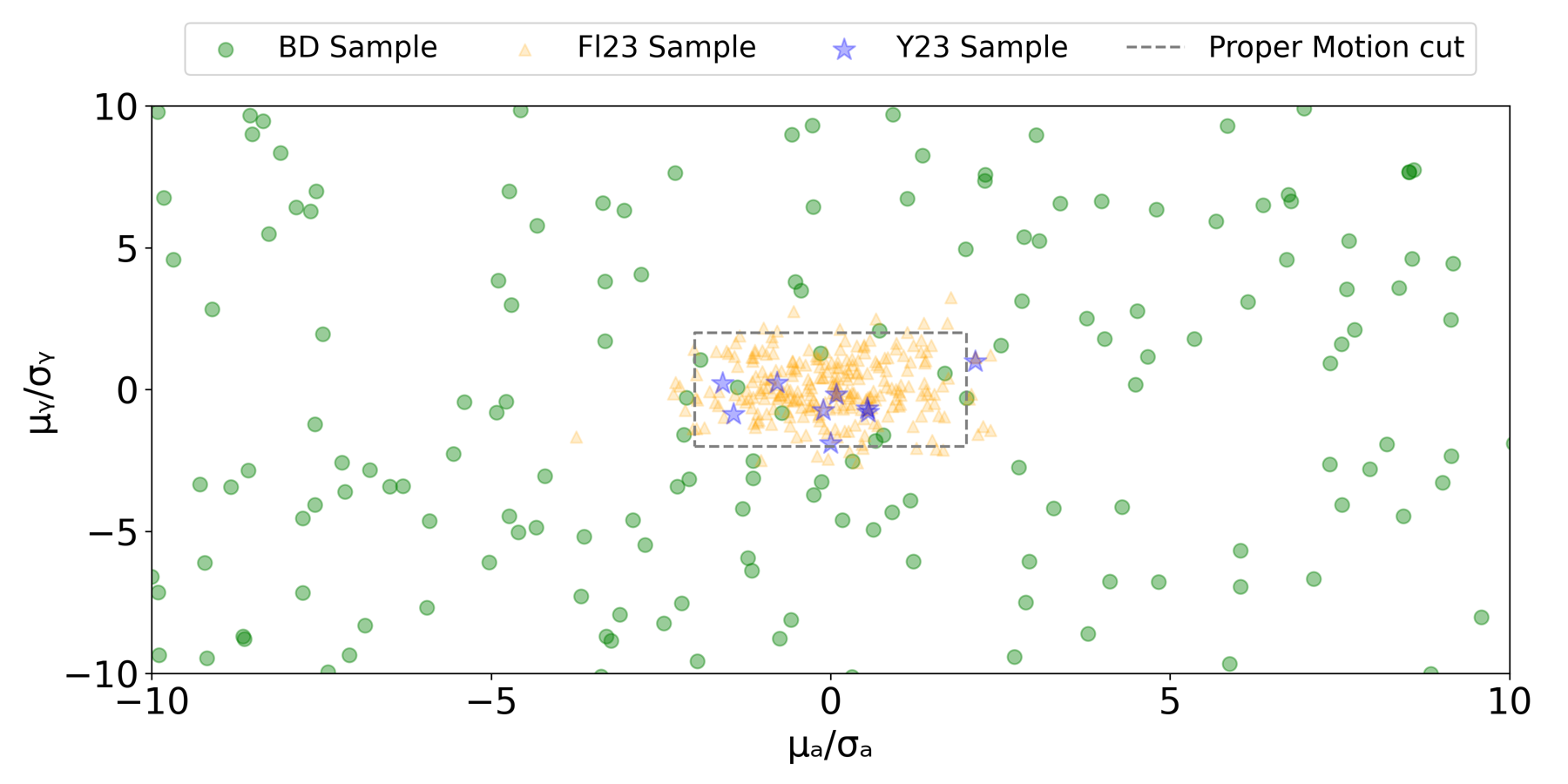
4MOST ChANGES: Catalog of high-redshift quasar candidates (4.5 < $z$ < 7) selected with SED fitting

T. Mkrtchyan, C. Mazzucchelli, R. J. Assef, et al.

Using southern-sky multi-band photometry and quasar-versus-brown-dwarf SED fitting, the authors compile 6,104 z=4.5–7 quasar candidates. Three of six bright, visually screened follow-up targets are confirmed at z>5, but catalog-wide purity remains weakly constrained.

Figure 2 from Do little red dots really form a distinct class of astronomical objects?

2026-04-13 · 2604.11677v1 · Research note

Do little red dots really form a distinct class of astronomical objects?

Jean-Baptiste Billand, David Elbaz, Maximilien Franco, et al.

Across ∼48,000 photometric and ∼5,000 spectroscopic galaxies, the authors find LRD-like colour, compactness, and broad-Hα properties vary continuously, arguing that most LRDs are an extreme tail rather than a discrete class; only ∼3% show very strong Balmer breaks.

2026-04-08 · 2604.07138v1 · Research note

The Way We Tally Becomes the Tale: the Impact of Selection Strategies on the Inferred Evolution of Little Red Dots Across Cosmic Time

Pierluigi Rinaldi, Kevin Hainline, Francesco D'Eugenio, et al.

A broad JADES photometric census finds that extreme-red color cuts recover at most one quarter of compact LRD candidates, so inferred luminosity functions and number-density evolution depend strongly on selection rather than necessarily on population evolution.

Figure 2 from A striking excess of red quasars with steep radio spectral slopes: a dusty blow-out phase revealed through AGN-driven shocks?

2026-03-25 · 2603.24739v1 · Research note

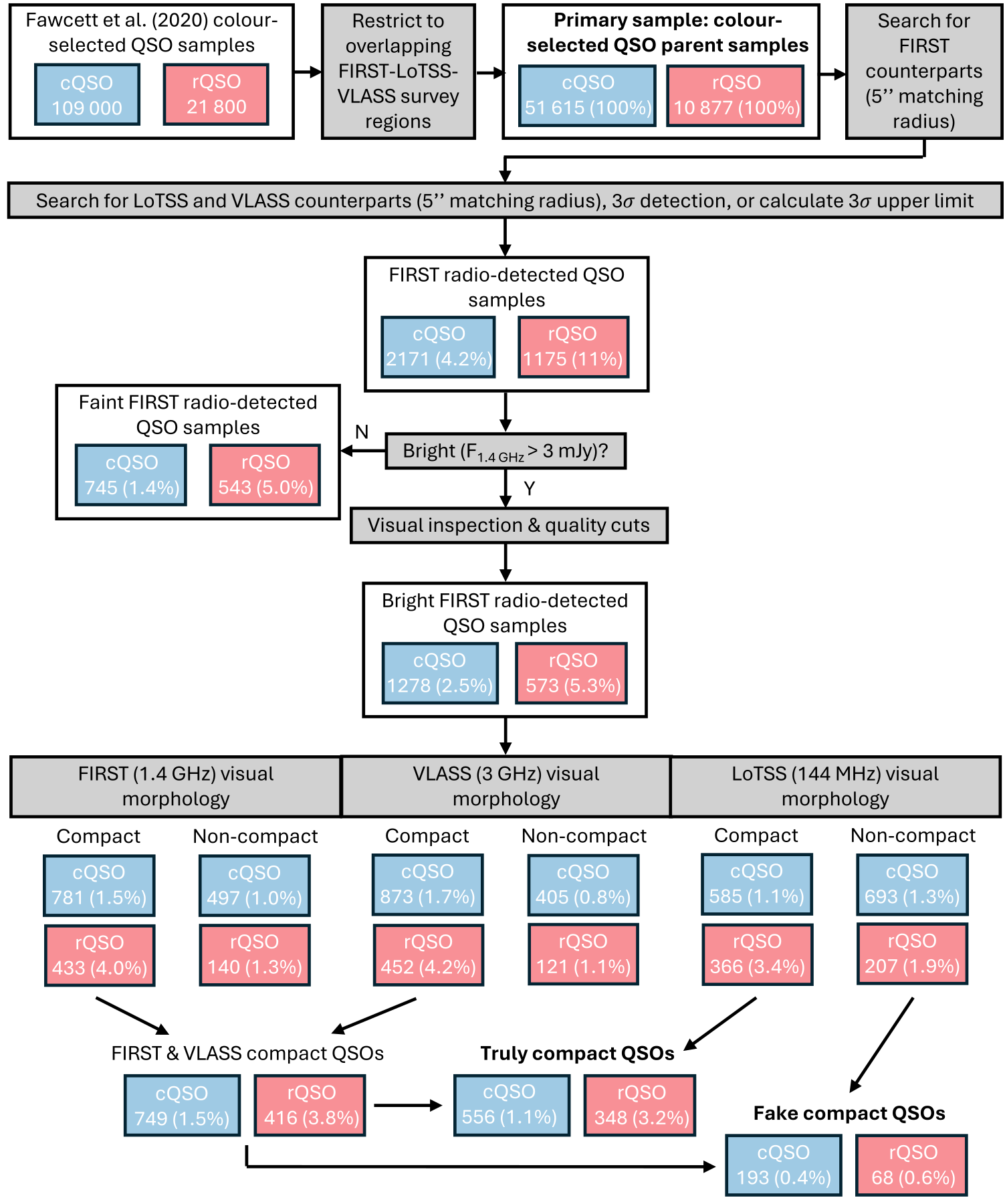
A striking excess of red quasars with steep radio spectral slopes: a dusty blow-out phase revealed through AGN-driven shocks?

Ciera L. Sargent, David M. Alexander, Claire L. Greenwell, et al.

Across SDSS quasars at 0.2<z<2.4, compact red quasars show an excess near α1.4–3 GHz≈−1 that strengthens with dust extinction. The authors interpret this as wind/jet–ISM shocks during a dusty blow-out phase, but radio spectra alone do not establish that mechanism.

2026-03-23 · 2603.22393v1 · Research note

MEOW: The increase in the obscured AGN fraction in mid-infrared from 0 < z < 6 with JWST MIRI

Teodora-Elena Bulichi, Gene C. K. Leung, Anna-Christina Eilers, et al.

Using JWST/MIRI-selected sources, MEOW infers that obscured AGN become increasingly dominant with redshift: its SED-based luminosity functions imply a 98–99% obscured fraction at z=4.5–6 for luminous AGN, relative to UV type-1 quasars.

2026-03-16 · 2603.15761v1 · Research note

Out of oxygen: Extremely metal-poor galaxy candidates identified at $2.5 < z < 6.5$ with deep JADES medium-band imaging

James A. A. Trussler, Daniel J. Eisenstein, Andrew J. Bunker, et al.

Deep JADES medium-band photometry identifies 22 candidate near-pristine starbursts at 2.5<z<6.5 from strong Hα but weak [O III]+Hβ. Their inferred metallicities are photometric, however, and dust, dense gas, or obscured AGN can mimic the selection.

2026-03-16 · 2603.15736v1 · Research note

Halo assembly bias in the early Universe: a clustering probe of the origin of the Little Red Dots

Zihao Wang, Fangzhou Jiang, Haonan Zheng, et al.

Shin-Uchuu predictions indicate that early halo assembly bias can materially alter LRD clustering interpretations: DCBH hosts should be most biased, whereas low-spin and SIDM channels are weaker for different reasons. Forthcoming LRD cross-correlations could therefore discriminate host selections.

Figure 4 from Merger-driven buildup of the $M_{\rm BH}$ - $M_*$ relation bridging high-$z$ overmassive black holes with the local relation

2026-03-12 · 2603.11747v1 · Research note

Merger-driven buildup of the $M_{\rm BH}$ - $M_*$ relation bridging high-$z$ overmassive black holes with the local relation

Takumi S. Tanaka, John D. Silverman, Kazuhiro Shimasaku, et al.

Monte Carlo merger evolution can reduce an assumed 0.8–1.0 dex scatter in the z~6 black-hole–stellar-mass relation to the ~0.3 dex local scatter, but the result depends strongly on merger mass ratios and rates; major mergers alone are insufficient.