654 indexed papers · 430 research notes

Research archive

Reset

2026-03-16 · 2603.15736v1 · Research note

Halo assembly bias in the early Universe: a clustering probe of the origin of the Little Red Dots

Zihao Wang, Fangzhou Jiang, Haonan Zheng, et al.

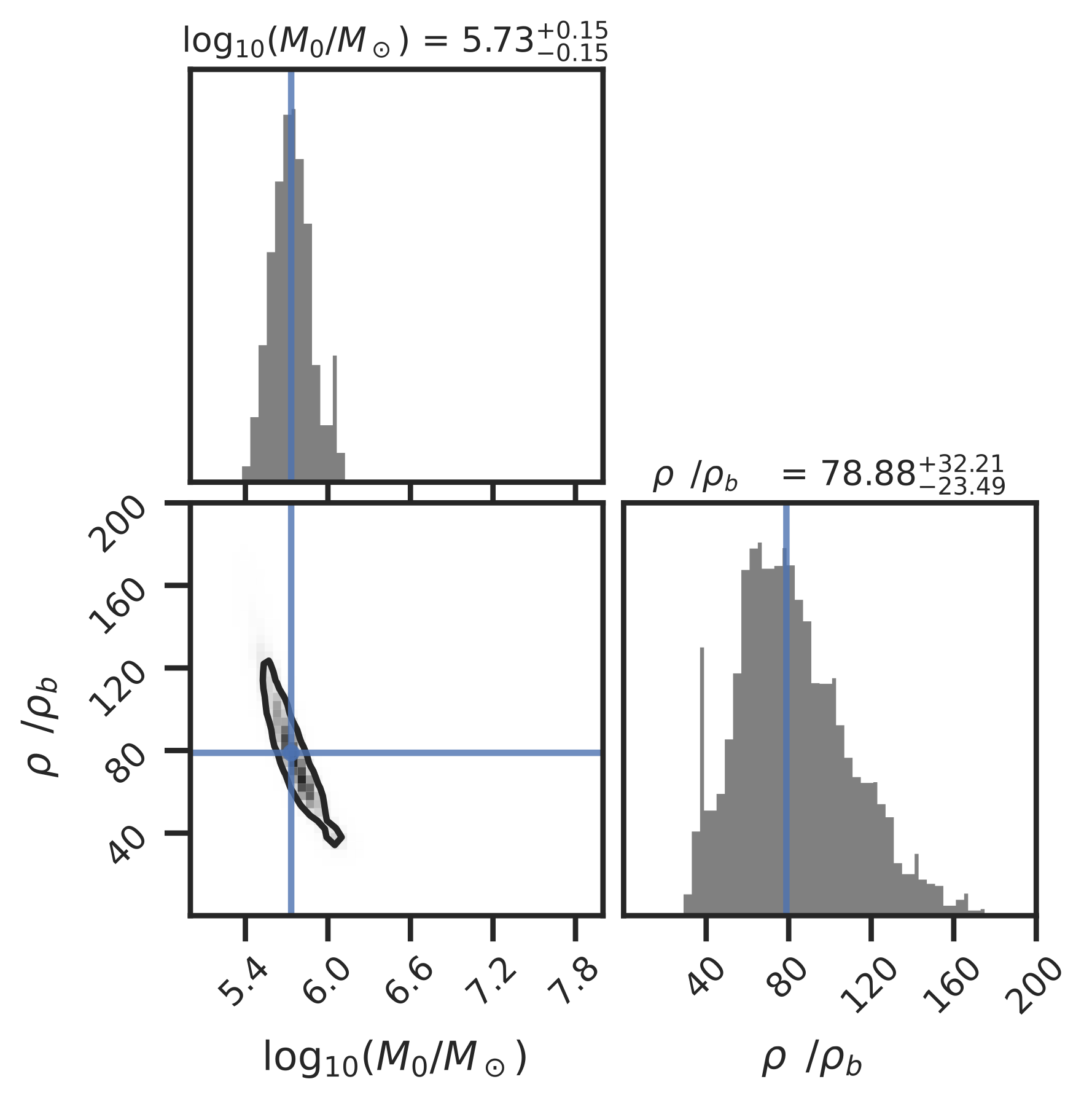
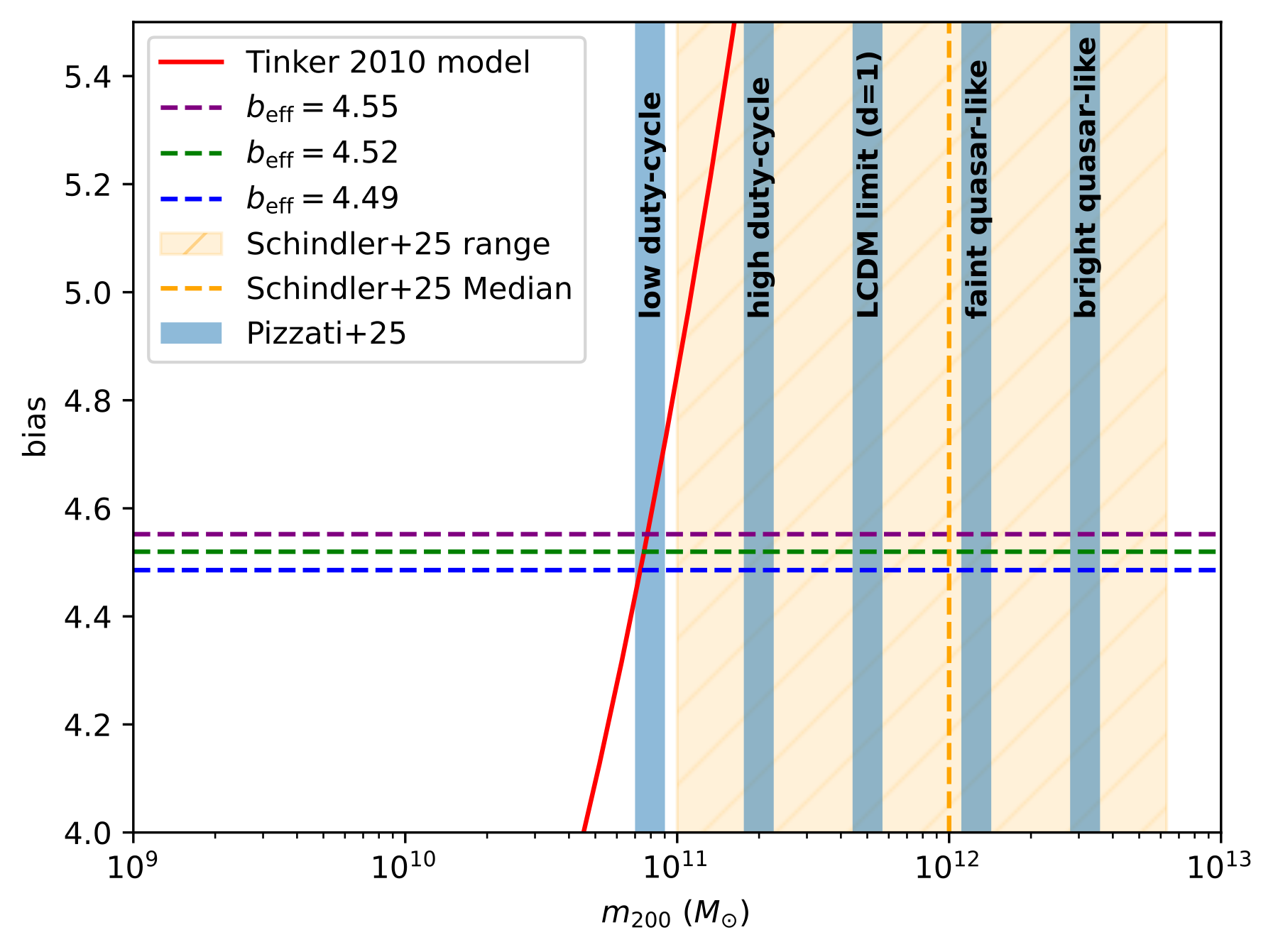
Shin-Uchuu predictions indicate that early halo assembly bias can materially alter LRD clustering interpretations: DCBH hosts should be most biased, whereas low-spin and SIDM channels are weaker for different reasons. Forthcoming LRD cross-correlations could therefore discriminate host selections.

Figure 4 from Merger-driven buildup of the $M_{\rm BH}$ - $M_*$ relation bridging high-$z$ overmassive black holes with the local relation

2026-03-12 · 2603.11747v1 · Research note

Merger-driven buildup of the $M_{\rm BH}$ - $M_*$ relation bridging high-$z$ overmassive black holes with the local relation

Takumi S. Tanaka, John D. Silverman, Kazuhiro Shimasaku, et al.

Monte Carlo merger evolution can reduce an assumed 0.8–1.0 dex scatter in the z~6 black-hole–stellar-mass relation to the ~0.3 dex local scatter, but the result depends strongly on merger mass ratios and rates; major mergers alone are insufficient.

Figure 5 from The X-ray weakness of Little Red Dots and JWST-selected AGN: comparison with local AGN in different accretion regimes

2026-03-10 · 2603.10162v1 · Research note

The X-ray weakness of Little Red Dots and JWST-selected AGN: comparison with local AGN in different accretion regimes

A. Tortosa, C. Ricci, P. Du, et al.

High-redshift LRDs and JWST-selected broad-line AGN are X-ray weak relative to broad Hα, plausibly resembling highly accreting local systems; however, predominantly upper-limit-based X-ray constraints leave intrinsic coronal suppression and obscuration unresolved.

2026-03-04 · 2603.04358v1 · Research note

A Selection Aware View of Black Hole-Galaxy Coevolution at High Redshift

Francesco Ziparo, Stefano Carniani, Simona Gallerani, et al.

Forward-modeling broad-Hα selection in a JADES broad-line AGN sample at z≳4 yields an M_BH–M★ relation consistent in mean with local relations but with 0.63 dex intrinsic scatter, implying diverse early black-hole growth histories.

2026-03-02 · 2603.01668v1 · Research note

A Unified Explanation for JWST Little Red Dots and High-Redshift Low-Mass Disk-like Galaxies: Prolate Galaxies Viewed End-on vs Side-on

Yingjie Peng

Peng proposes that many JWST little red dots are ordinary low-mass prolate galaxies viewed close to their long axes: projection and maximal columns could jointly produce compact red continua and broadened Balmer profiles, while side-on counterparts appear elongated.

Figure 2 from Extreme Emission Line Galaxies in CEERS Are Powered by Star Formation, not AGN

2026-02-26 · 2602.23310v1 · Research note

Extreme Emission Line Galaxies in CEERS Are Powered by Star Formation, not AGN

Kelcey Davis, Madisyn Brooks, Jonathan R. Trump, et al.

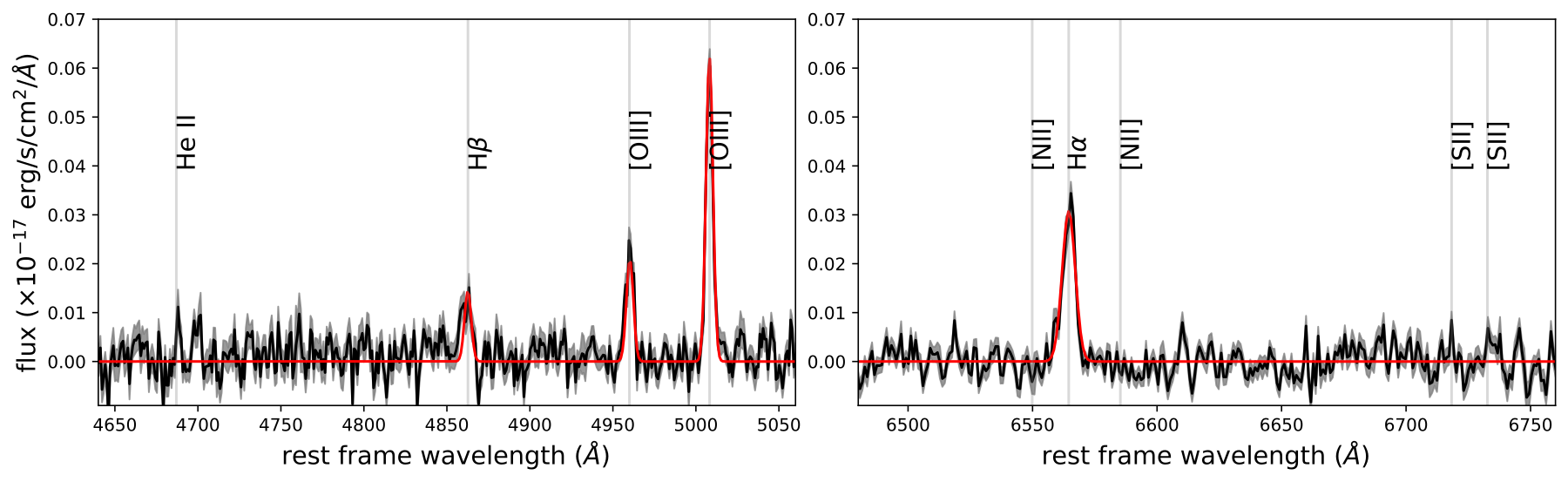
JWST/NIRSpec follow-up of CEERS extreme emission-line galaxies finds broad-line AGN contamination, but for spectroscopically extreme sources the narrow Hα component dominates. The authors therefore attribute the most extreme nebular emission primarily to young star formation, not AGN.

Figure 4 from You can't see me: super-Eddington growth hindering X-ray detection in high-z broad-line AGNs

2026-02-25 · 2602.22305v1 · Research note

You can't see me: super-Eddington growth hindering X-ray detection in high-z broad-line AGNs

Alessandro Trinca, Alessandro Lupi, Francesco Haardt, et al.

Joint modelling of broad lines and Chandra non-detections for 14 JWST high-redshift broad-line AGNs favors low-mass, highly super-Eddington black holes with over-cooled coronæ over massive, weakly accreting alternatives, but the inference remains model-dependent and bimodal.

Figure 3 from Constraints on dynamically-formed massive black holes in Little Red Dots from X-ray non-detections

2026-02-24 · 2602.21002v1 · Research note

Constraints on dynamically-formed massive black holes in Little Red Dots from X-ray non-detections

M. Liempi, D. R. G. Schleicher, M. A. Latif, et al.

Using X-ray non-detections of Little Red Dots, the authors model collisionally formed black-hole seeds and argue that heavy-seed evolutionary tracks can meet flux limits, conditional on degenerate assumptions about structural evolution, accretion, metallicity, and absorption.

2026-02-23 · 2602.20247v1 · Research note

Little Red Dots: One Photometric Tag Concealing Diverse Spectroscopic Flavors of Massive Star Formation and Black Hole Activity

Pablo G. Pérez-González, Guillermo Barro, Stefano Carniani, et al.

A 249-object JWST spectroscopic compilation argues that photometrically selected Little Red Dots are spectroscopically heterogeneous composites of accreting black holes and young stars, but its mass, duty-cycle, and Wolf–Rayet interpretations remain model-dependent.

Figure 3 from MIDIS: The identification of deep MIRI-red sources as candidates for extreme Balmer-break and line emitting galaxies at high-z

2026-02-19 · 2602.17329v1 · Research note

MIDIS: The identification of deep MIRI-red sources as candidates for extreme Balmer-break and line emitting galaxies at high-z

I. Jermann, G. Brammer, S. Gillman, et al.

Ultra-deep MIDIS F560W imaging yields five robust red F444W–F560W candidates after reliability assessment. Their colors permit extreme nebular lines or strong Balmer breaks, rather than uniquely establishing Little Red Dots or any single physical origin.

Figure 5 from Causal Reversal in the $M_\unicode{x25CF}\unicode{x2013}σ_0$ Relation: Implications for High-Redshift Supermassive Black Hole Mass Estimates

2026-02-18 · 2602.16775v1 · Research note

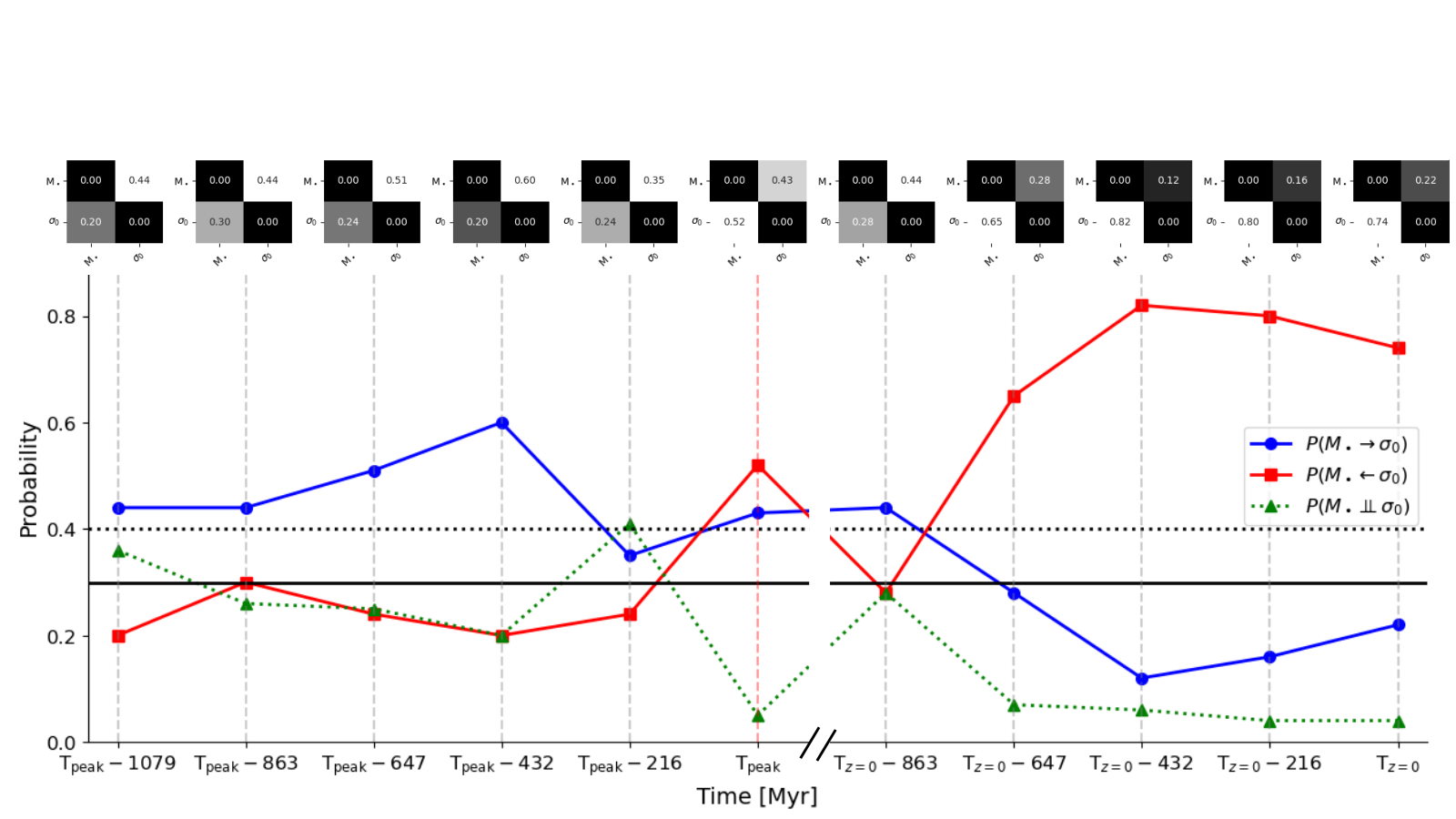
Causal Reversal in the $M_\unicode{x25CF}\unicode{x2013}σ_0$ Relation: Implications for High-Redshift Supermassive Black Hole Mass Estimates

Benjamin L. Davis, Saakshi More, Zehao Jin, et al.

NIHAO simulations suggest that the inferred causal direction of the black-hole mass–velocity-dispersion relation changes across star-forming and quenched phases. Applying a star-forming calibration to 13 z=4.1–10.6 systems lowers their estimated black-hole masses by a median 1.93±0.51 dex.

2026-02-17 · 2602.15952v1

Gas Accretion versus BH Merger driven Growth Modes of Supermassive Black Holes and Implications for the Little Red Dots

Paramita Barai

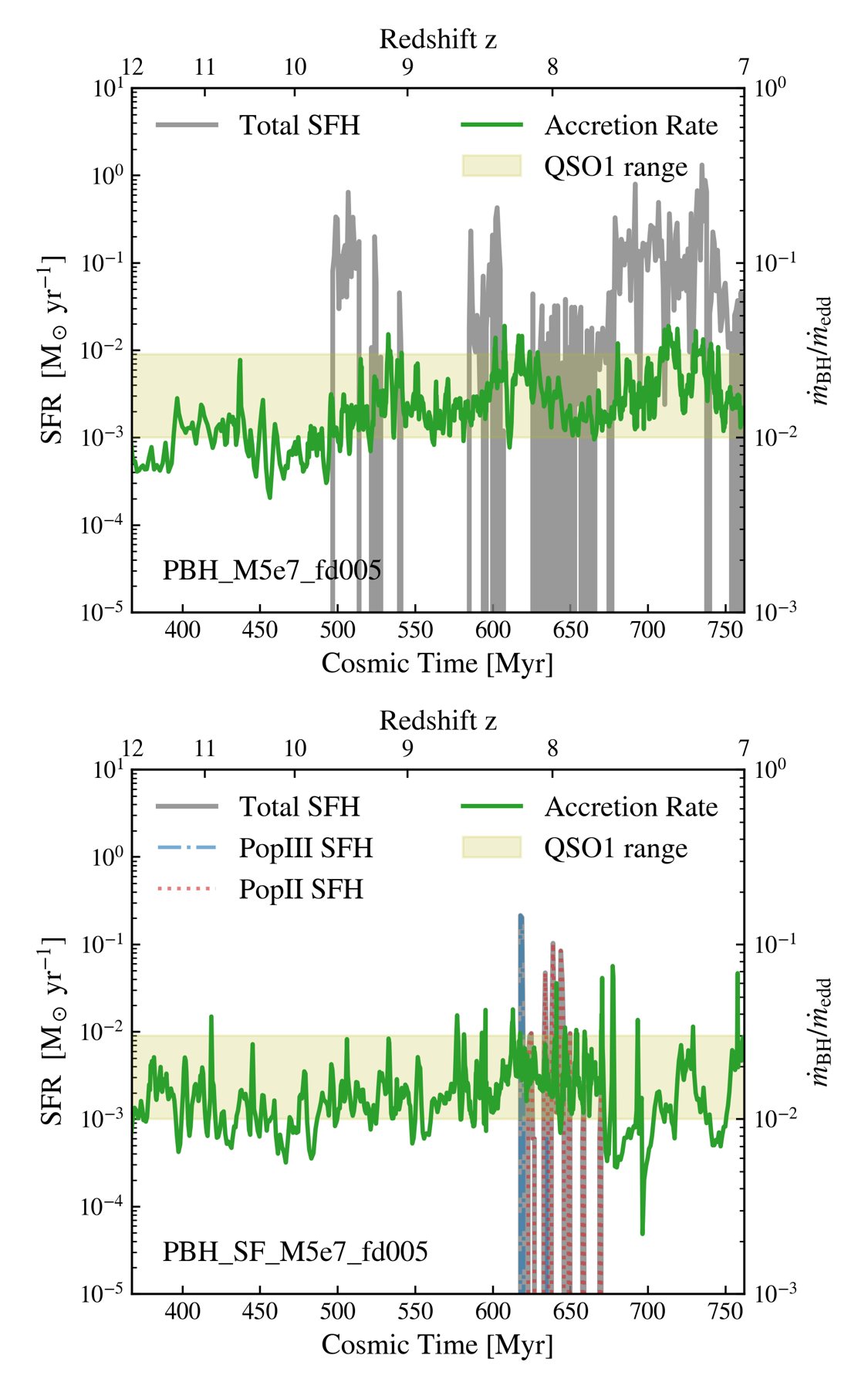
Cosmological hydrodynamical boxes (50 Mpc)^3 are used to separate merger- from gas-accretion–driven SMBH growth and test feedback choices against SMBH–host coevolution. Seeded at 10^5 Msun, black holes first build up via BH–BH mergers to ~10^7 Msun; only after 7–9 Gyr does accretion reach Eddington, triggering 600–700 Myr bursts that amplify masses by 10^2–10^3 to 10^9–10^10 Msun. AGN-feedback-driven central gas depletion then curtails growth, keeping SMBHs below 10^10 Msun by z=0 and moving systems upward toward the M_BH–M_star relation from below. Implication for JWST little red dots: normal-mass objects are consistent with merger-dominated histories, while overmassive systems require Eddington or super-Eddington accretion episodes.

2026-02-17 · 2602.15929v1 · Research note

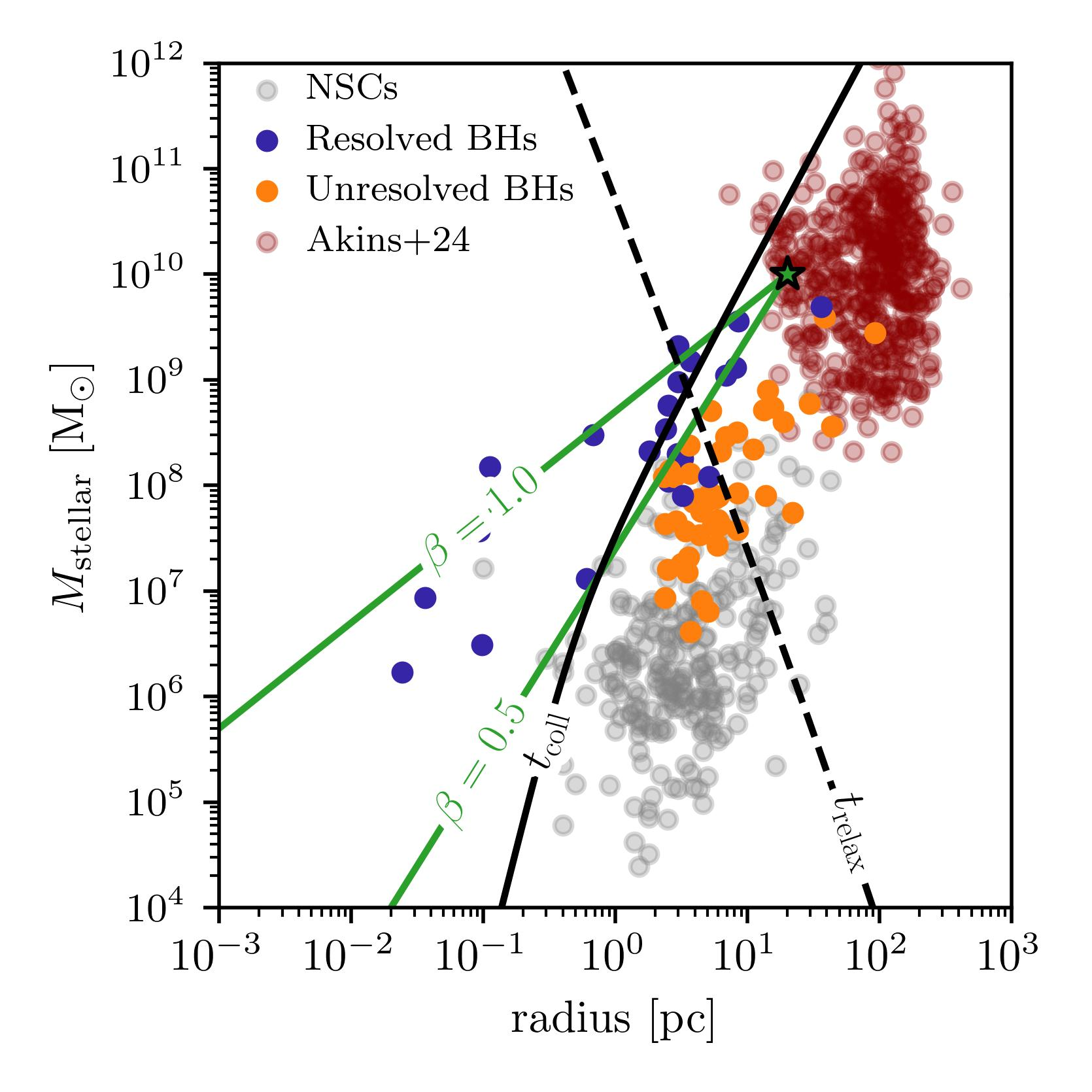
Toward Black Hole Stars: supermassive black hole growth in nuclear clusters via stellar-object and gas accretion

Konstantinos Kritos, Joseph Silk

This nuclear-star-cluster model attributes high-redshift electromagnetic and gravitational-wave signatures to stellar feeding of growing SMBHs, but concludes gas accretion dominates their mass assembly. Its LRD connection is a proposed interpretation rather than a direct fit to an observed LRD sample.

Figure 2 from Back to Normal Again: Possible Destinies of JWST overmassive SMBHs and "Little Red Dots" in the View of Shin-Uchuu Simulation

2026-02-16 · 2602.14496v1 · Research note

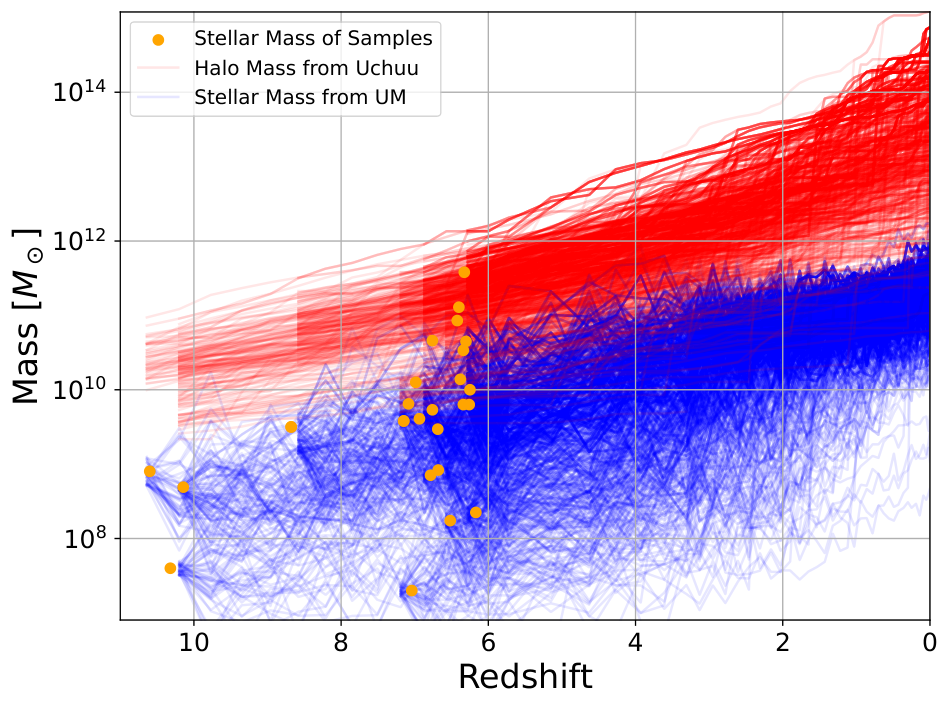
Back to Normal Again: Possible Destinies of JWST overmassive SMBHs and "Little Red Dots" in the View of Shin-Uchuu Simulation

Haojie Hu, Hiroto Yanagisawa, Moka Nishigaki, et al.

Using halo merger histories plus empirical prescriptions, the authors project 26 z>6 JWST overmassive SMBHs/LRDs toward lower BH-to-stellar mass ratios by z=0. This is a model-dependent extrapolation, not evidence that individual observed systems will converge.

2026-02-14 · 2602.13902v1 · Research note

J-PAS: Semi-Supervised Sim-to-Obs Transfer for Robust Star--Galaxy--Quasar Classification

Daniel López-Cano, L. Raul Abramo, L. Nakazono, et al.

Semi-supervised adaptation from DESI-derived mocks to J-PAS observations improves held-out four-class photometric classification over mocks-only and equally label-limited J-PAS-only baselines, chiefly for quasars. Results demonstrate mitigation of this specific simulation-to-observation shift, not a general guarantee of transferability.

Figure 1 from Direct pathway to the Early Supermassive Black Holes: A Red Super-Eddington Quasar in a Massive Starburst Host at $z=7.2$

2026-02-12 · 2602.12325v1 · Research note

Direct pathway to the Early Supermassive Black Holes: A Red Super-Eddington Quasar in a Massive Starburst Host at $z=7.2$

Qinyue Fei, Seiji Fujimoto, Gabriel Brammer, et al.

GNz7q at z=7.1899 combines a 10^7.55-M⊙, apparently super-Eddington black hole with a massive, rapidly star-forming host. The authors argue that its near-local BH-to-stellar mass ratio makes it a plausible progenitor channel for luminous z≈6 quasars.

2026-02-05 · 2602.05921v1 · Research note

Early growth of massive black holes in dynamical dark energy models with negative cosmological constant

N. Menci, M. Castellano, P. Mukherjee, et al.

Under deliberately maximal, continuous Eddington growth from ∼100 M⊙ Pop III seeds, the authors find negative-cosmological-constant dynamical-dark-energy models (ΩΛ≈−1) can yield ∼10^7 M⊙ black holes by z∼10 while increasing early galaxy and AGN abundances.

2026-02-04 · 2602.04974v1 · Research note

Clustering of z~6.6 Quasars and [O III] Emitters Constrains Host Halo Masses and Duty Cycles in 25 ASPIRE Fields

Jiamu Huang, Joseph Hennawi, Elia Pizzati, et al.

JWST/ASPIRE clustering across 25 z≈6.6 quasar fields associates UV-bright quasars with substantially more massive minimum host halos than [O III] emitters, but the inferred ≈Myr quasar lifetime has a highly asymmetric, large uncertainty.

Figure 4 from Connecting the Dots: UV-Bright Companions of Little Red Dots as Lyman-Werner Sources Enabling Direct Collapse Black Hole Formation

2026-02-02 · 2602.02702v1 · Research note

Connecting the Dots: UV-Bright Companions of Little Red Dots as Lyman-Werner Sources Enabling Direct Collapse Black Hole Formation

Josephine F. W. Baggen, Matthew T. Scoggins, Pieter van Dokkum, et al.

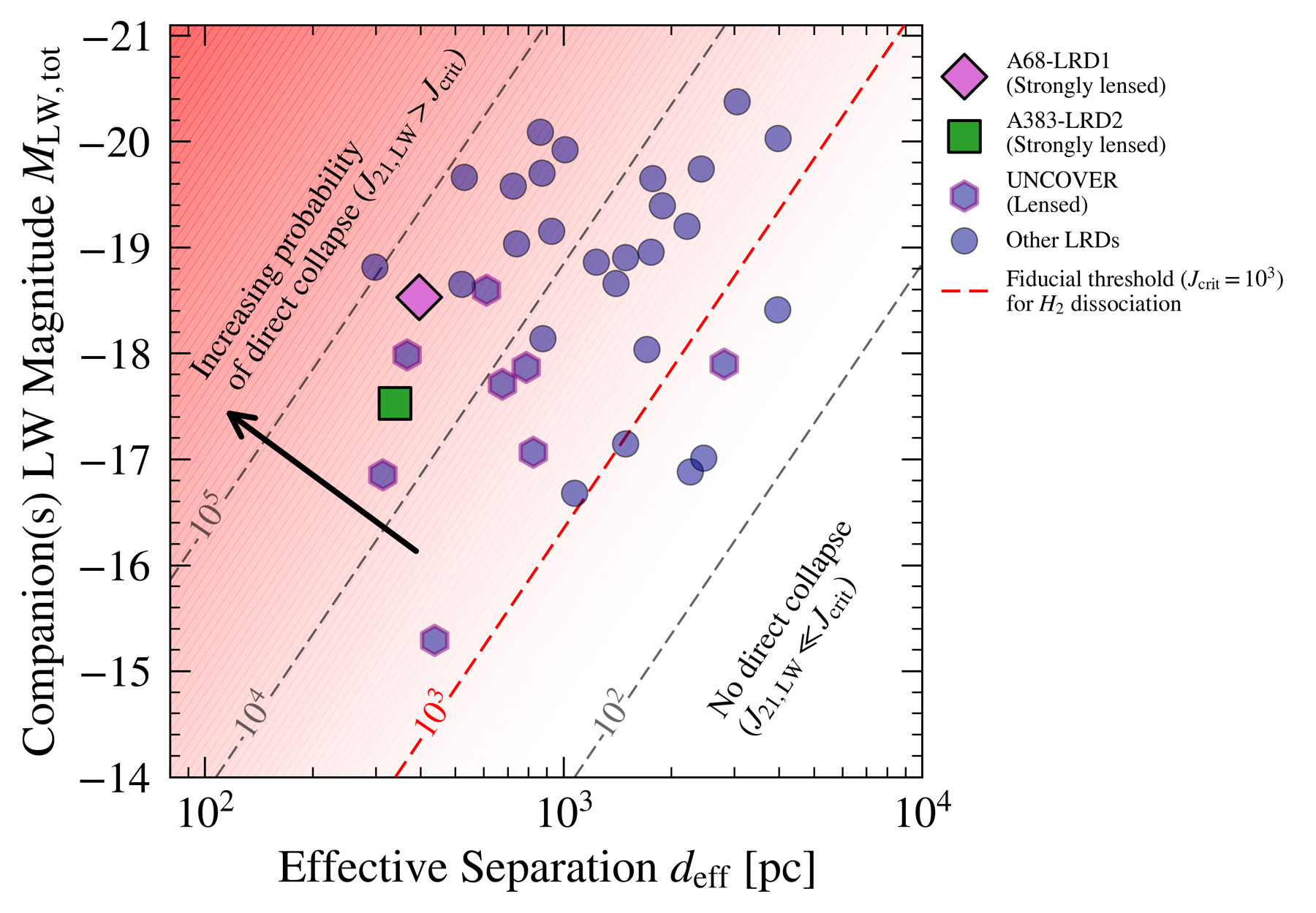
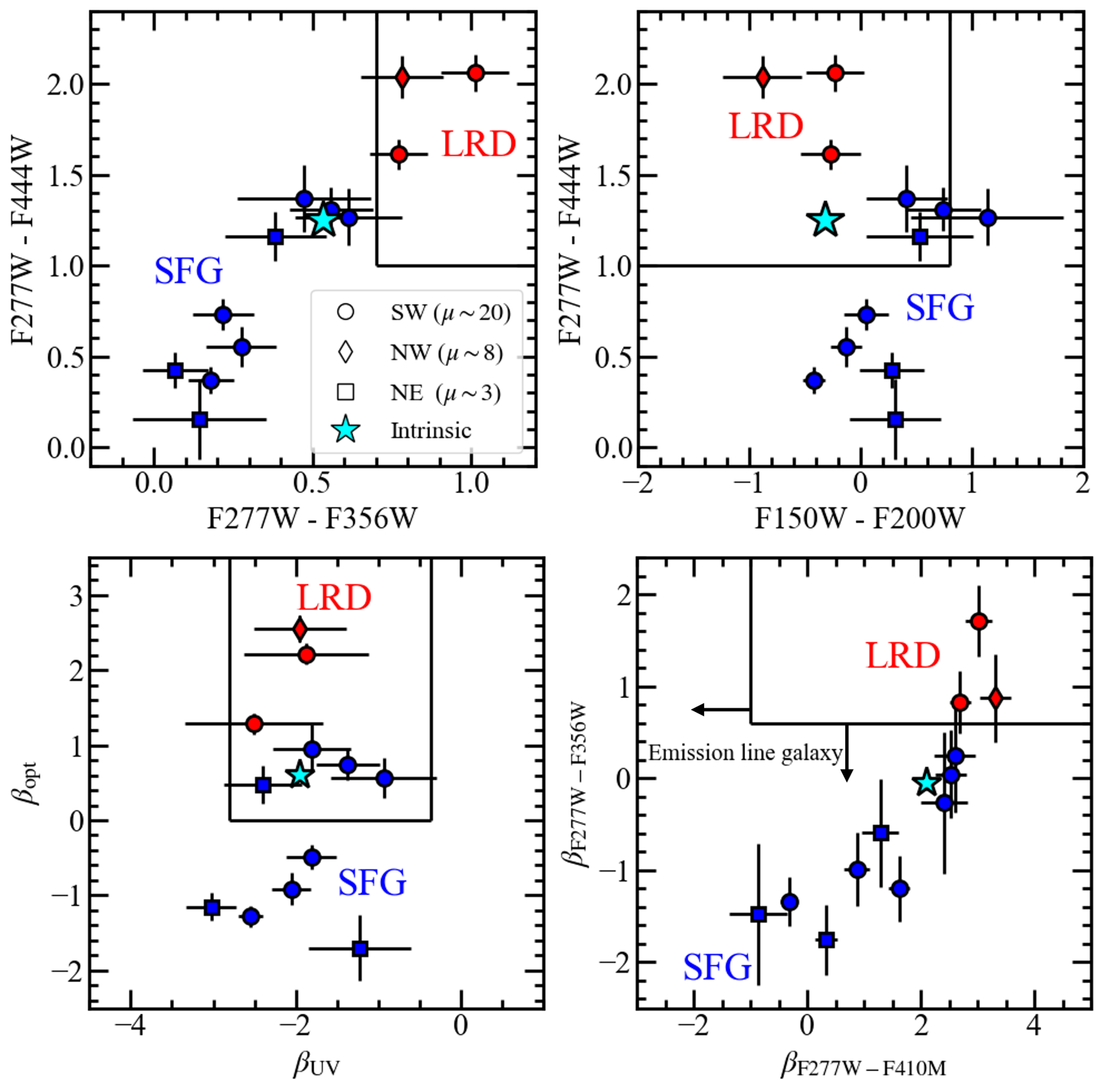
Component-resolved JWST imaging of 83 little red dots finds frequent, close UV-bright neighbors whose inferred Lyman–Werner fields are compatible with—though do not establish—a direct-collapse pathway for compact red sources.

2026-01-30 · 2601.23250v1 · Research note

Too many or too massive? Investigating the high-$z$ demography of active SMBHs from JWST

Daniel Roberts, Francesco Shankar, Vieri Cammelli, et al.

A data-driven demographic consistency test finds that the abundant faint JWST AGN at z≈5.5 can be explained by moderately elevated black-hole–stellar-mass scaling relations and ∼50% duty cycles, without requiring the most extreme inferred black-hole masses.

2026-01-29 · 2601.22214v1 · Research note

The Little Blue and Red Dots Rosetta Stones: Non-Gaussian broad lines, hot dust, and X-ray weakness

M. Brazzini, F. D'Eugenio, R. Maiolino, et al.

A two-object JWST comparison finds that a prototypical Little Red Dot and Little Blue Dot share broad, non-Gaussian Balmer emission, weak hot dust, and X-ray weakness, but differ sharply in helium emission and Balmer absorption.

2026-01-29 · 2601.22213v1 · Research note

Little Red Dots on FIRE: The Ability of Bursty Galaxies to Host an Abundant Population of High-Redshift AGN

Andrew Marszewski, Claude-André Faucher-Giguère, Guochao Sun, et al.

Post-processed FIRE-2 galaxies can yield enough intermittent AGN at z=5–7 to match LRD-scale abundances, but fiducial models overproduce faint sources. The authors’ conditional remedy selects super-Eddington inflow, Eddington-limited luminosities, and moderately massive hosts.

2026-01-29 · 2601.21676v1

Little Red Dots and Supermassive Black Hole Seed Formation in Ultralight Dark Matter Halos

Dongsu Bak, Jae-Weon Lee

Proposes a ULDM-assisted direct-collapse route where baryons confined by central solitonic cores shock-heat above ~10^4 K, suppressing fragmentation without an external UV background. Semi-analytic scalings link halo mass, soliton mass, baryonic core size, and gas thermodynamics (including baryonic contraction) to predict a characteristic SMBH seed mass ~1e5 Msun and an upper BH mass scale ~1e10 Msun. The preferred ULDM particle mass m ≈ 10^-22 eV reproduces the seed scale and aligns with galactic-core inferences, with efficient seeding at z ≳ 10. The framework naturally interprets JWST little red dots as SMBHs embedded in compact, hot, ionized gas clouds.

2026-01-28 · 2601.20929v1 · Research note

Little Red Dot $-$ Host Galaxy $=$ Black Hole Star: A Gas-Enshrouded Heart at the Center of Every Little Red Dot

Wendy Q. Sun, Rohan P. Naidu, Jorryt Matthee, et al.

Using empirical [O III]-matched host subtraction for 98 JWST/NIRSpec LRDs, the authors infer a red, dense-envelope central component that dominates rest-optical light. The conclusion depends critically on assigning all [O III] to the host and on stack-based decomposition.

Figure 10 from JWST Spectroscopic Census of ALMA Faint Submillimeter Galaxies in the Hubble Ultra Deep Field

2026-01-26 · 2601.18149v1 · Research note

JWST Spectroscopic Census of ALMA Faint Submillimeter Galaxies in the Hubble Ultra Deep Field

Tomokazu Kiyota, Masami Ouchi, Daisuke Iono, et al.

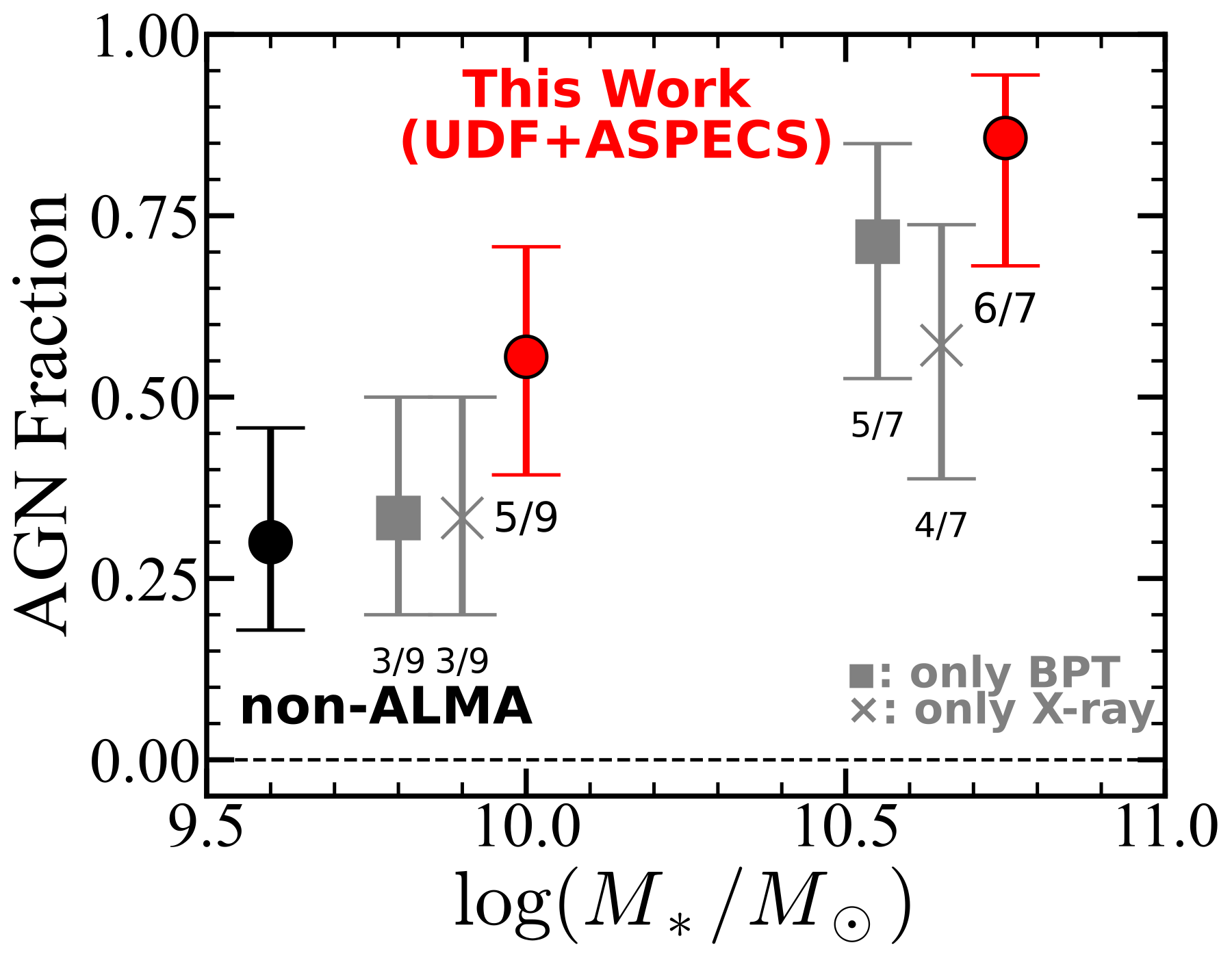
JWST/NIRSpec spectroscopy of 16 ALMA-selected HUDF faint SMGs finds dusty, massive z=1–4 galaxies with mostly obscured AGN classifications, yet star-formation, metallicity, and bulk-ISM properties broadly consistent with comparable high-redshift star-forming populations.

2026-01-23 · 2601.16710v1 · Research note

One H2 molecule per ten million H-atoms reveals sub-pc scale cold overdensities at z~4

P. Noterdaeme, S. Balashev, T. Berg, et al.

R≈120,000 ESPRESSO spectroscopy resolves exceptionally weak H2 at z=4.24 into cold, dense and warmer components. The authors interpret the narrow component as a ~0.01-pc atomic-gas overdensity, demonstrating that trace H2 can reveal otherwise elusive small-scale structure.

Figure 2 from Undermassive Hosts of $z = 4-6 $ AGN from JWST/NIRCam Image Decomposition with CONGRESS, FRESCO, and JADES

2026-01-22 · 2601.15962v1 · Research note

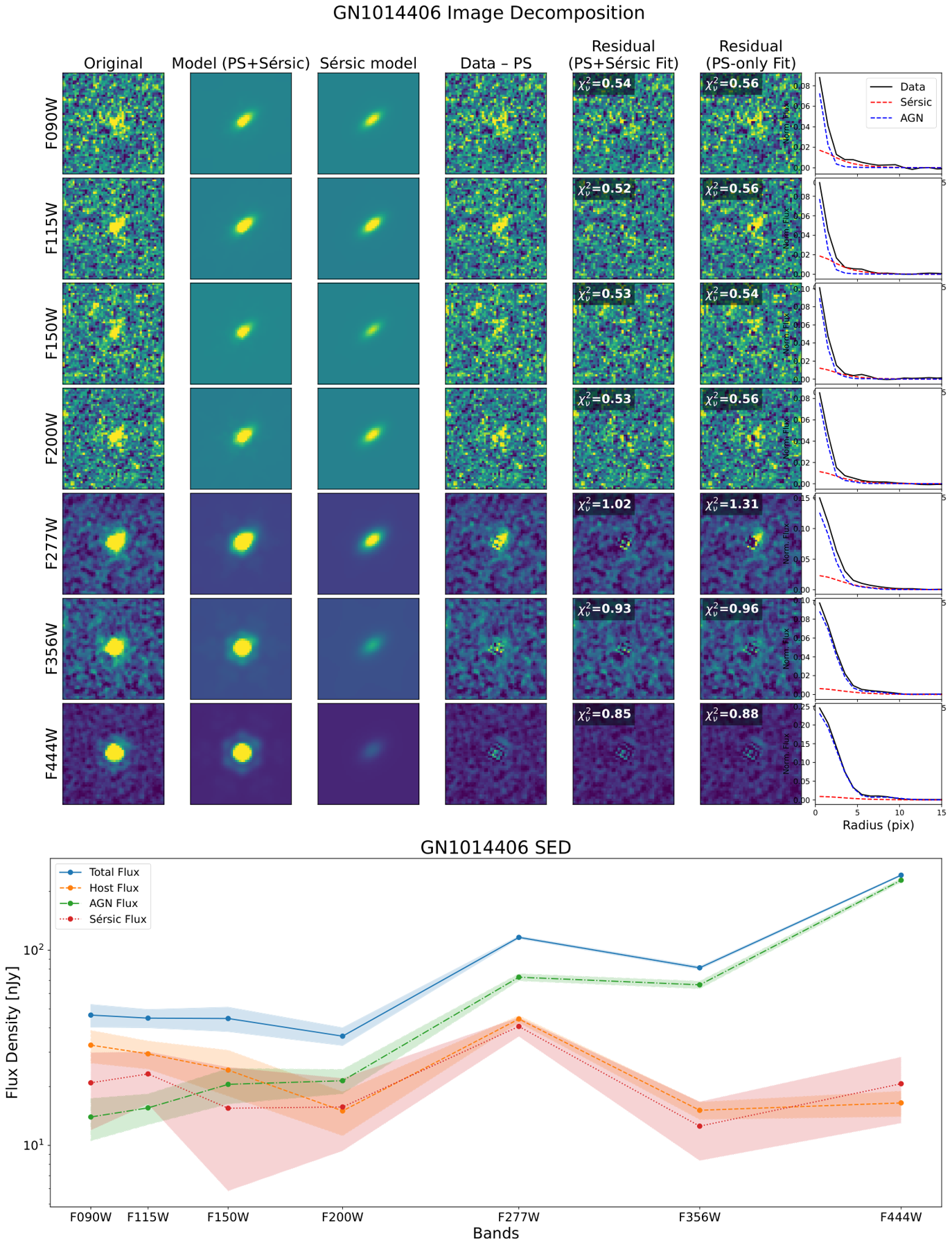
Undermassive Hosts of $z = 4-6 $ AGN from JWST/NIRCam Image Decomposition with CONGRESS, FRESCO, and JADES

Zheng Ma, Eichi Egami, Yongda Zhu, et al.

JWST/NIRCam decomposition detects extended host emission in 9 of 17 broad-Hα AGN at z≈4–6. Separating point-source light can reduce inferred host masses by 1–2 dex, yielding high BH-to-stellar mass ratios, although unresolved compact hosts remain a viable alternative.

Figure 1 from JADES: A Prominent Galaxy Overdensity Candidate within the First 500 Myr

2026-01-22 · 2601.15960v1 · Research note

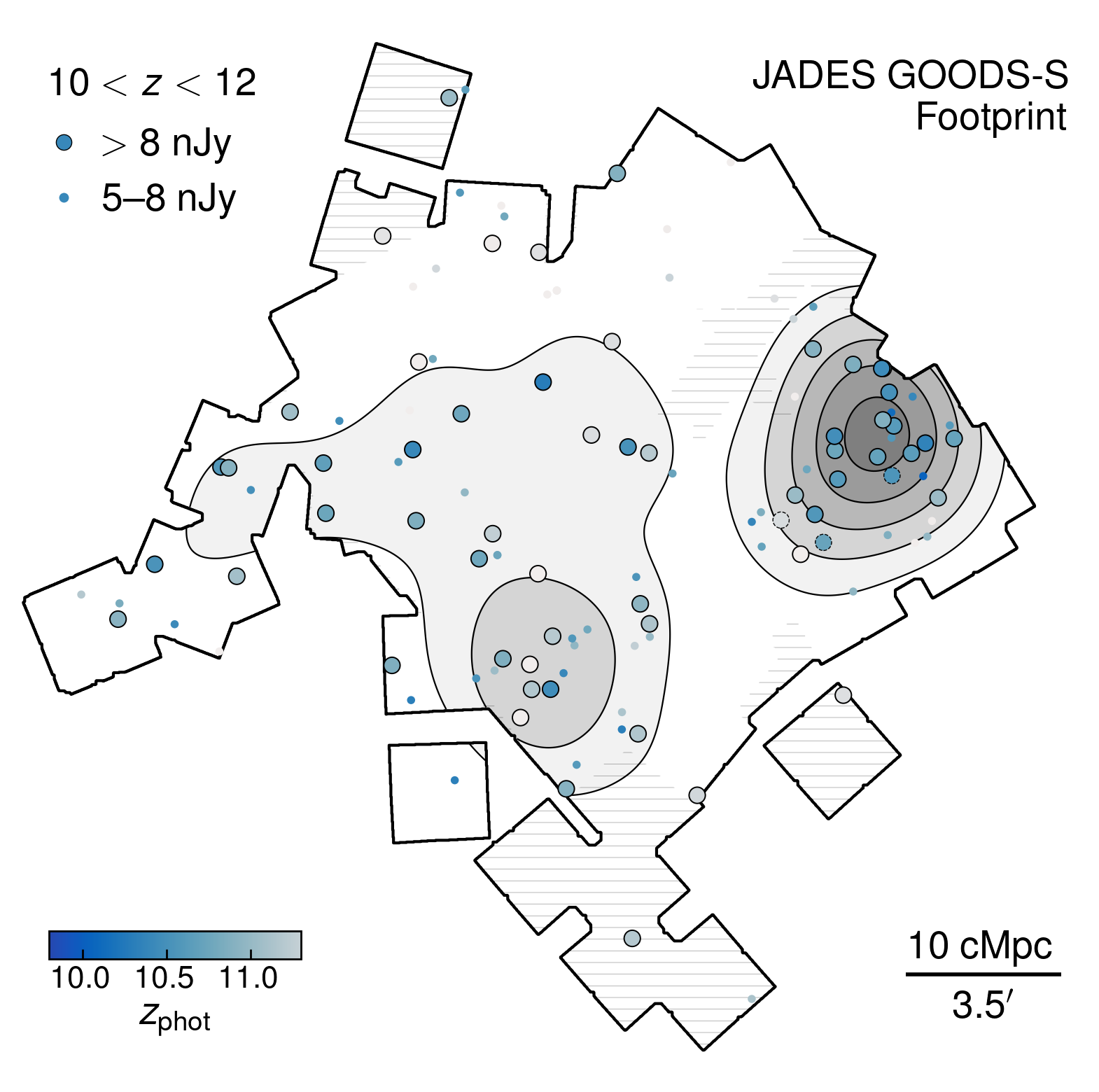
JADES: A Prominent Galaxy Overdensity Candidate within the First 500 Myr

Zihao Wu, Daniel J. Eisenstein, Benjamin D. Johnson, et al.

JADES identifies a photometric z≈10.5 concentration of 18 galaxies, four times the field surface density. Its compact, otherwise typical members show tentative environmental signatures—close associations, two optical-excess sources, and spatially varying inferred Lyα transmission.

2026-01-16 · 2601.11466v1 · Research note

Pseudo Little Red Dot: an Active Black Hole Embedded in a Dense and Dusty, Metal-Poor Starburst Galaxy at z=5.96

Karina I. Caputi, Ryan A. Cooper, Pierluigi Rinaldi, et al.

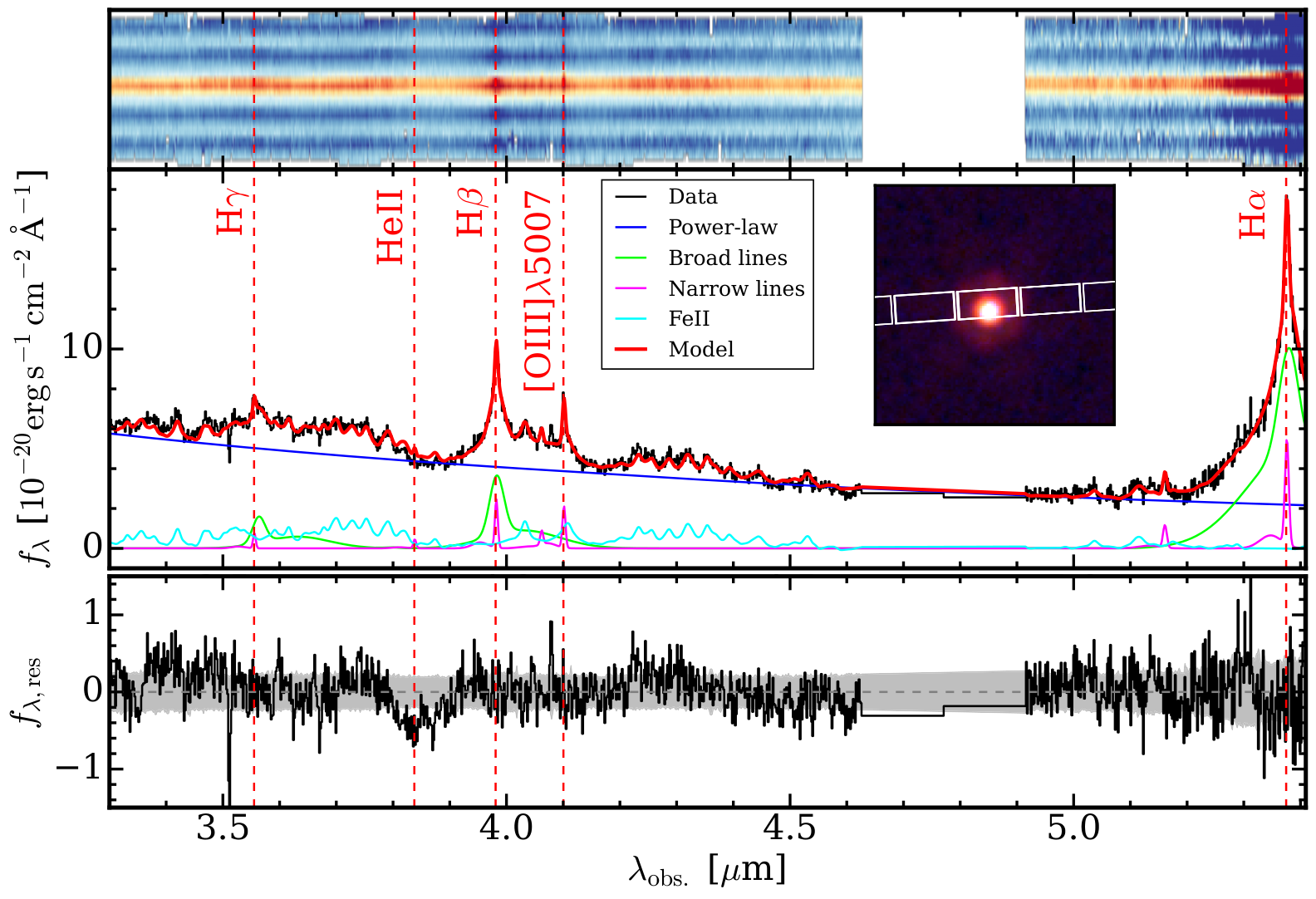
JWST spectroscopy identifies a lensed z=5.96 “pseudo-LRD” whose red optical colour is Hα-line driven, yet whose broad Hα supports a ∼3×10^6 M⊙ black hole embedded in a dusty, dense, very metal-poor starburst.

2026-01-16 · 2601.11125v1 · Research note

Discovery of a gas-enshrouded broad-line AGN at z $\sim$ 7

Qianqiao Zhou, Xin Wang, Hang Zhou, et al.

JWST/HST observations of the lensed z≈6.87 galaxy A2744-z7DLA reveal damped Lyα absorption plus a statistically preferred broad Hα component, supporting a gas-enshrouded broad-line AGN interpretation while its UV–optical continuum remains predominantly stellar.

2026-01-15 · 2601.10573v1 · Research note

Origins of the UV continuum and Balmer emission lines in Little Red Dots: observational validation of dense gas envelope models enshrouding the AGN

Yoshihisa Asada, Kohei Inayoshi, Qinyue Fei, et al.

Across 28 z=5–7.2 LRDs, UV-to-Hα behavior resembles young starbursts rather than unobscured AGN, while nine blue broad-line controls resemble Type 1 AGN. The authors therefore favor opaque black-hole envelopes, but the correlations do not uniquely establish the ionizing mechanism.

2026-01-13 · 2601.08936v1 · Research note

A possible pathway to UHZ1-type systems at z~10 by heterogeneous mass primordial black holes as dark matter

Alexander Kashlinsky, Fernando Atrio-Barandela, Diego Martín-González

This analytic PBH-dark-matter scenario argues that PBH shot noise advances low-mass halo collapse and dynamical friction concentrates massive PBHs, potentially assembling UHZ1-like central black-hole masses by z≈10 without super-Eddington gas accretion; viability remains parameter-dependent.

2026-01-09 · 2601.06255v1 · Research note

GA-NIFS: high prevalence of dusty and metal-enriched outflows in massive and luminous star-forming galaxies at $z\sim3-9$

B. Rodríguez Del Pino, S. Arribas, M. Perna, et al.

JWST/NIRSpec IFU data identify ionized-outflow signatures in 14 of 40 regions of massive, non-AGN star-forming systems at z≈3–9. The authors infer dusty, metal-enriched but gravitationally retained gas, implying redistribution rather than efficient ejective feedback.

Figure 2 from VENUS: Two Faint Little Red Dots Separated by $\sim70\,\mathrm{pc}$ Hidden in a Single Lensed Galaxy at $z\sim7$

2026-01-09 · 2601.06015v1 · Research note

VENUS: Two Faint Little Red Dots Separated by $\sim70\,\mathrm{pc}$ Hidden in a Single Lensed Galaxy at $z\sim7$

Hiroto Yanagisawa, Masami Ouchi, Miriam Golubchik, et al.

Strong lensing resolves “Red Eyes” into two faint, off-centre LRDs in a z≈7 star-forming galaxy, separated by ≈70 pc. The result demonstrates that host light can conceal LRD-like components in otherwise ordinary high-redshift galaxies.

Figure 1 from Little Red Dots: The Assembly of Early Supermassive Black Holes in the JWST Era

2025-12-31 · 2601.00089v1 · Research note

Little Red Dots: The Assembly of Early Supermassive Black Holes in the JWST Era

David D Vaida, Ryan Jeffrey Farber

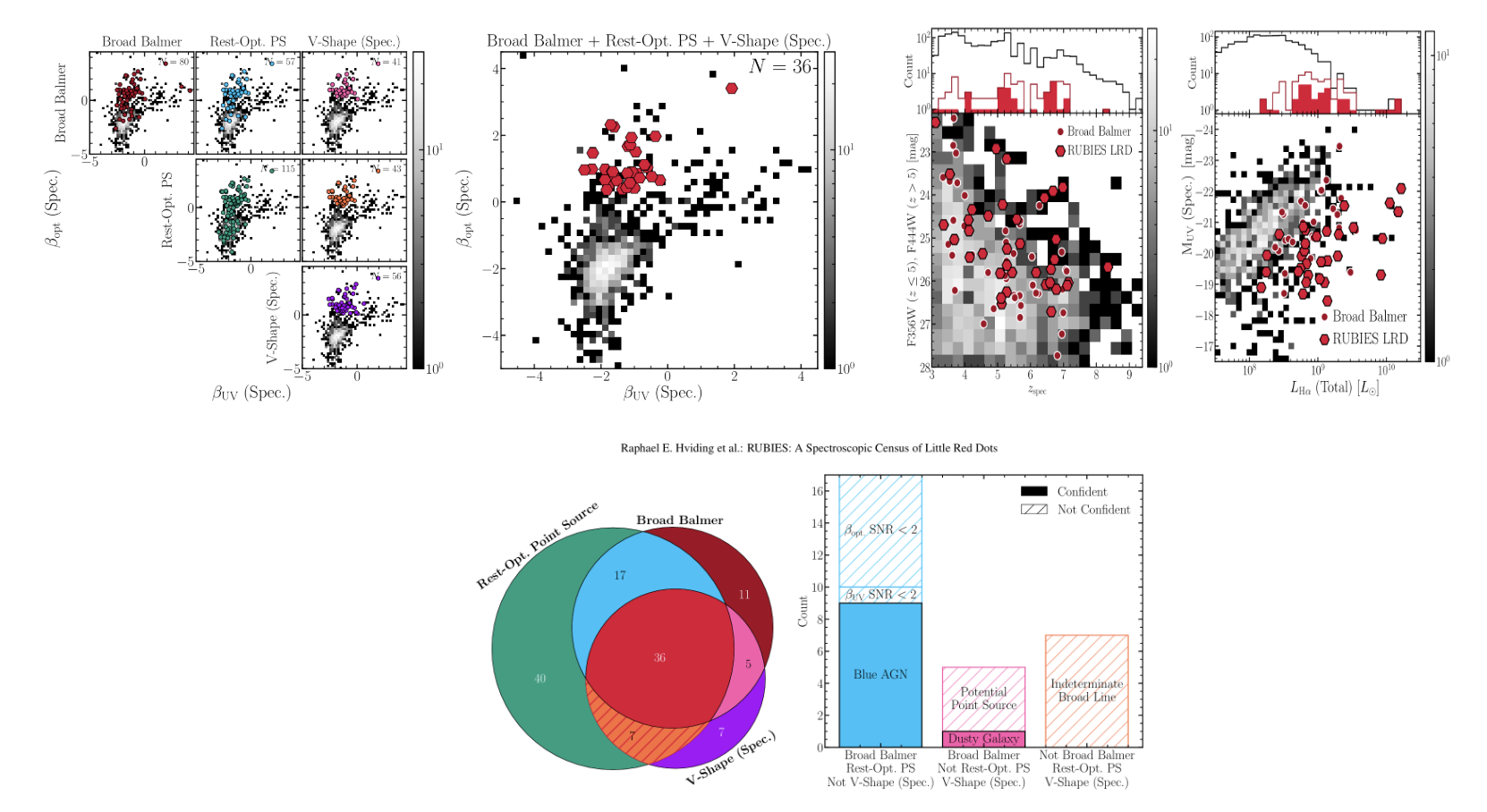
This mini-review argues that little red dots are probably heterogeneous: broad Balmer lines and compact, V-shaped SEDs support accretion in some, whereas pervasive multiwavelength non-detections and viable stellar fits prevent a population-wide AGN identification.

2025-12-31 · 2601.00044v1 · Research note

Born in the Dark: The Catastrophic Collapse of Fuzzy Dark Matter Solitons as the Origin of Little Red Dots

Tak-Pong Woo

The authors propose that LRDs are transient, Compton-thick inflows within fuzzy-dark-matter soliton cores. Their size-and-column arguments favor boson masses of a few ×10^-22 eV, but the mechanism remains an analytic, idealized-merger scenario requiring radiation-hydrodynamic tests.

2025-12-20 · 2512.18421v1 · Research note

The evolution of obscured AGN across cosmic time -- A large quasar survey for the 2040s

Tanya Urrutia, Darshan Kakkad, Paula Sánchez-Sáez, et al.

This is a survey proposal, not a new AGN measurement: it argues that repeat optical MOS spectroscopy of >50 million multi-selected candidates to z~6.5 could quantify obscuration demographics while exposing selection biases among obscured populations.

Figure 4 from The accretion of quasars at the epoch of reionisation: $JWST$ catches the primeval monsters slowly feasting

2025-12-18 · 2512.16981v1 · Research note

The accretion of quasars at the epoch of reionisation: $JWST$ catches the primeval monsters slowly feasting

B. Trefoloni, E. Nardini, S. Carniani, et al.

JWST/NIRSpec disc fits for eight luminous z≥5.9 quasars yield a sub-Eddington distribution, ⟨log λEdd⟩=−0.86. The authors argue that self-consistent disc luminosities and masses reduce apparent super-Eddington incidence relative to conventional single-epoch estimates.

Figure 1 from Shedding the envelope: JWST reveals a kiloparsec-scale [OIII]-weak Balmer shell around a z=7.64 quasar

2025-12-17 · 2512.15881v1 · Research note

Shedding the envelope: JWST reveals a kiloparsec-scale [OIII]-weak Balmer shell around a z=7.64 quasar

Julien Wolf, Eduardo Bañados, Xiaohui Fan, et al.

JWST/NIRSpec IFU data reveal Hβ emission to ~1.8 kpc around the z=7.64 quasar J0313−1806 but no significant [O III]. The authors favor dense, clumpy fossil-outflow gas, while the single-object data leave its geometry and evolutionary interpretation uncertain.

Figure 1 from From "The Cliff" to "Virgil": Mapping the Spectral Diversity of Little Red Dots with JWST/NIRSpec

2025-12-17 · 2512.15853v1 · Research note

From "The Cliff" to "Virgil": Mapping the Spectral Diversity of Little Red Dots with JWST/NIRSpec

Guillermo Barro, Pablo G. Perez-Gonzalez, Dale Kocevski, et al.

JWST/NIRSpec spectroscopy of 118 little red dots reveals a continuum–line sequence: red, curved Balmer-break SEDs give way to bluer, power-law-like systems. A galaxy plus enshrouded-black-hole model can reproduce the trend, but its physical decomposition remains non-unique.

2025-12-16 · 2512.14844v1

Doubling NIRSpec/IFS capability to calibrate the single epoch black hole mass relation at high redshift

Eleonora Parlanti, Bartolomeo Trefoloni, Stefano Carniani, et al.

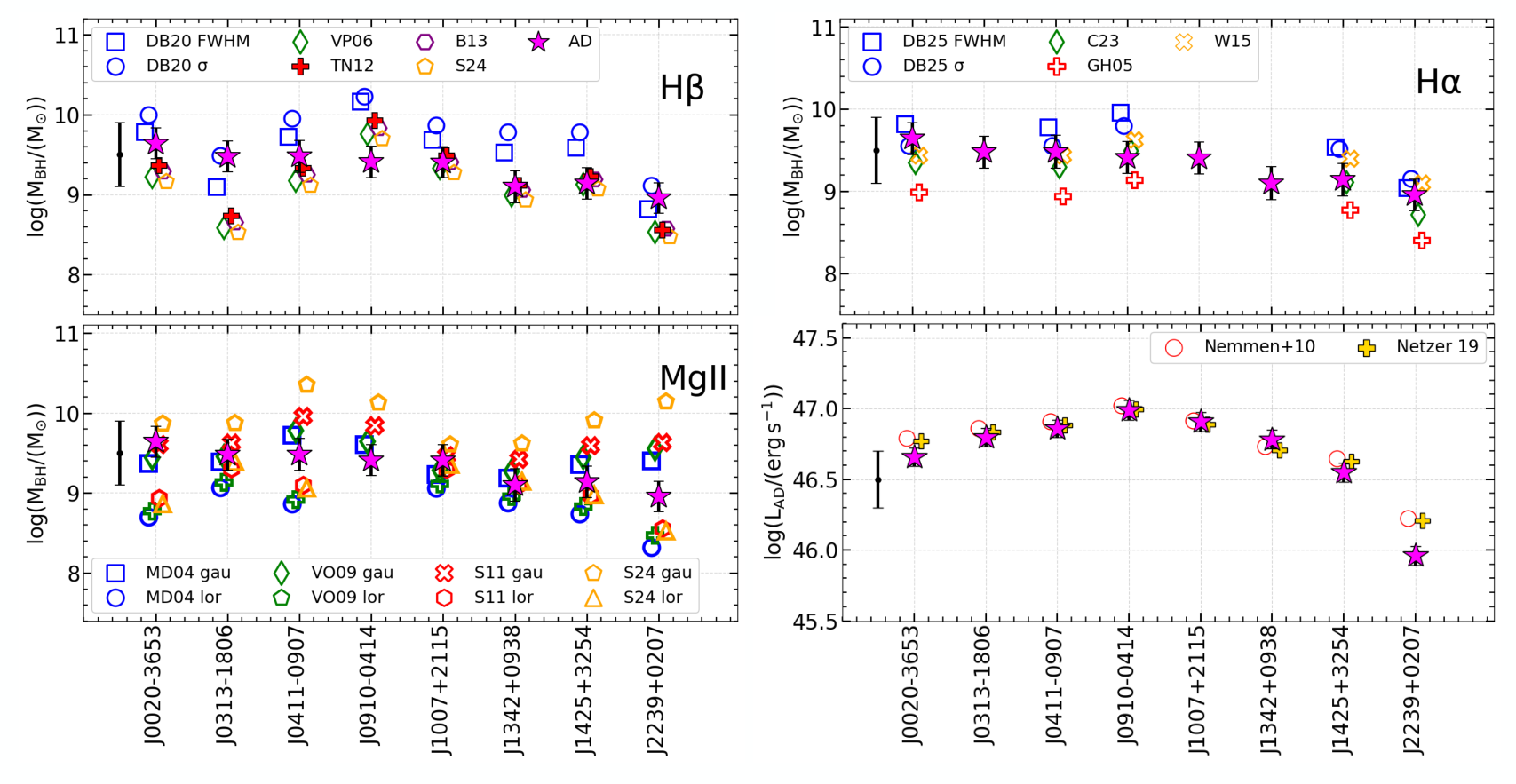
Presents a NIRSpec/IFU reduction that exploits the red signal on NRS2 for medium‑resolution gratings, effectively doubling the usable wavelength coverage and recovering Hα beyond the nominal range; the authors also note the exposure‑time trade‑off when using adjacent dispersers. Applied to five z≈2 quasars with reverberation‑mapped MBH, the extended cubes enable joint Hβ–Hα measurements at R≈1000. Hβ‑based single‑epoch masses best match RM, while Hα recipes show ≈0.5 dex larger scatter; for the least‑massive, high‑λEdd object (MBH,RM≈10^7.5 M⊙, λEdd=0.8) all SE estimators overpredict by ~1 dex, suggesting a bias at high accretion. The work delivers the first high‑z SE calibrations from Hβ and Hα for the newfound early‑BH population, with uncertainties still limited by sample size.

2025-12-14 · 2512.12509v1 · Research note

THRILS -- The High-(Redshift+Ionization) Line Search: Program Description & Redshift Catalog

Taylor A. Hutchison, Rebecca L. Larson, Pablo Arrabal Haro, et al.

THRILS delivers deep JWST/NIRSpec G395M spectroscopy in two pointings, yielding 89 measured redshifts and empirical magnitude thresholds. Its >8-hour integrations expose faint lines inaccessible to shallower EGS spectroscopy, enabling targeted follow-up rather than population-level physical conclusions.

2025-12-05 · 2512.06159v1

From the Intergalactic to the Interstellar Scales -- EQUALS: a High-resolution Legacy Survey of Gas in the Distant Universe Using ESPRESSO

Trystyn Berg, Valentina D'Odorico, Elisa Boera, et al.

EQUALS is an ESPRESSO Large Programme delivering R ≈ 140,000 spectra for 23 bright z ≈ 4 QUBRICS quasars, reaching ~20 per 1 km s−1 pixel in the Lyα forest and ~40 redward via hour-long, Fabry–Pérot–calibrated blocks. The survey is tuned to the small-scale Lyα forest (k > 0.1 s km−1), promising a ~20× tighter IGM temperature measurement at z ~ 4 and, consequently, 5–15× stronger constraints on dark-matter particle mass. The resolution enables weak-line work (e.g., Mg II) to separate thermal from turbulent broadening, and isotopic C II shifts (~3 km s−1) in ~8 high-N(H I) systems to probe early stellar yields. Data products will be released via CANFAR and the ESO Archive as a legacy benchmark for future epoch measurements.

2025-12-04 · 2512.05213v1 · Research note

GA-NIFS: A smouldering disk galaxy undergoing ordered rotation at z=4.26

Gareth C. Jones, Roberto Maiolino, Francesco D'Eugenio, et al.

JWST/NIRSpec plus ALMA data indicate that the single z=4.2603 galaxy DLA0817g1 has matched Hα–[C II] disk morphology and rotation, enriched but weakly excited gas, and a revised molecular-gas budget consistent with a dynamically relaxed “smouldering” system.

Figure 3 from Little red dot variability over a century reveals black hole envelope via a giant Einstein cross

2025-12-04 · 2512.05180v1 · Research note

Little red dot variability over a century reveals black hole envelope via a giant Einstein cross

Zijian Zhang, Mingyu Li, Masamune Oguri, et al.

Four lensed views of the z≈4.3 LRD RX1 provide an ≈80–130-year observed-frame baseline and show up to 0.7-mag intrinsic color/brightness differences. Blackbody fits are consistent with a changing, ∼2000-AU photosphere, but do not yet establish pulsation over accretion variability.

Figure 5 from Highly-ionized gas in lensed z = 6.027 Little Red Dot seen through [OIII] 88$μ$m with ALMA

2025-12-04 · 2512.05097v1 · Research note

Highly-ionized gas in lensed z = 6.027 Little Red Dot seen through [OIII] 88$μ$m with ALMA

Kirsten K. Knudsen, Johan Richard, Mathilde Jauzac, et al.

Deep ALMA spectroscopy detects [O III] 88 μm from the lensed z=6.027 Little Red Dot A383-5.1. Its high [O III]/[C II] ratio and dust-continuum limits favor a dust-poor, strongly ionized ISM, but do not directly measure ionizing-photon escape.

Figure 1 from A Comprehensive JWST/NIRSpec Census of Broad-Line Active Galactic Nuclei: Faint, Tiny, but Highly Accreting Sources in the Remote Universe

2025-12-02 · 2512.03281v1 · Research note

A Comprehensive JWST/NIRSpec Census of Broad-Line Active Galactic Nuclei: Faint, Tiny, but Highly Accreting Sources in the Remote Universe

Caroline Baccus, Xinfeng Xu

A JWST/NIRSpec search of roughly 80,000 spectra identifies 252 broad-line AGN to z=7.2, extending census statistics to fainter, lower-mass systems. The authors find high-redshift objects commonly at inferred Eddington ratios of 0.1–1, subject to heterogeneous depth and line-detection limits.

2025-12-02 · 2512.03239v1 · Research note

(Re)solving the complex multi-scale morphology and V-shaped SED of a newly discovered strongly-lensed Little Red Dot in Abell 383

Josephine F. W. Baggen, Pieter van Dokkum, Ivo Labbé, et al.

JWST imaging of a z=6.027, doubly lensed Little Red Dot resolves red and blue compact components separated by about 300 pc. Their blended light can produce an LRD-like V-shaped SED, but the red component remains ambiguously stellar or AGN-powered.