654 indexed papers · 430 research notes

Research archive

Reset

2026-09-11 · 2609.11094v1 · Research note

SPURS: An Ultra-deep View Inside the Compact, Nitrogen-Enriched Nuclei of Little Red Dots

Mengtao Tang, Daniel P. Stark, Charlotte A. Mason, et al.

Ultra-deep JWST/SPURS rest-UV spectra of four UV-bright Little Red Dots find dense, nitrogen-enhanced, neutral-gas-embedded nuclei and diverse broad-line/wind signatures. The authors infer compact nuclear activity, while stellar and AGN contributions remain degenerate.

Figure 4 from Extending the Little Red Dot population at intermediate redshift with VIPERS

2026-09-10 · 2609.10319v1 · Research note

Extending the Little Red Dot population at intermediate redshift with VIPERS

Krzysztof Lisiecki, Krzysztof Hryniewicz, Francesco Pistis, et al.

VIPERS yields 14 compact, LRD-like sources at 0.5<z<1.75 selected through V-shaped photometric slopes and broad lines. Their inferred abundance declines sharply below z~1, while one unresolved X-ray source is consistent with a low-inclination, radiatively efficient disk.

2026-09-09 · 2609.07825v1 · Research note

A Dusty Quenching-candidate AGN host at z=5.7: massive quiescent galaxies may quench already during the dust-obscured phase

Francesco D'Eugenio, Matilde Brazzini, Roberto Maiolino, et al.

RUBIES-EGS-9809 is a single, heavily obscured broad-line AGN host at z=5.7 whose resolved Balmer break and declining-SFR SED fit make it a quenching candidate, not a confirmed post-starburst. Outflow signatures make AGN feedback plausible but unproven.

2026-09-03 · 2609.01711v1 · Research note

JWST Reveals a Candidate Supermassive Black Hole Binary at z=4.3 in the Brightest Sub-millimeter Galaxy in COSMOS-Web

Jed McKinney, Ansh Gupta, Julian B. Munoz, et al.

JWST spectra of the single dusty galaxy AzTEC-1 at z=4.3419 reveal a broad Hα component blueshifted by 1245 km s⁻¹. The authors favor a candidate sub-pc SMBH binary or recoiling SMBH over an ionized outflow, but confirmation requires resolved follow-up.

Figure 3 from Skyfire: A Spectroscopic Census of Little Red Dots and Broad-Line AGN in the CEERS Field

2026-09-02 · 2609.00112v1 · Research note

Skyfire: A Spectroscopic Census of Little Red Dots and Broad-Line AGN in the CEERS Field

Dale D. Kocevski, Anthony J. Taylor, Masafusa Onoue, et al.

Skyfire’s CEERS NIRSpec census finds broad Balmer emission across redder LRDs and somewhat bluer candidates, motivating an expanded continuum-slope selection. The color trend is suggestive of continuity with blue broad-line sources, but uneven targeting prevents a definitive population-unification claim.

2026-09-01 · 2608.28745v1 · Research note

Super-Eddington Little Blue Dots May Reionize Helium Too Early

Christopher Cain, Brent Smith, Gibson B. Bowling, et al.

A reionization-budget calculation argues that, if faint z=3–7 Little Blue Dots are common and leak ionizing radiation efficiently, most cannot be highly super-Eddington: their hard EUV spectra would complete He II reionization earlier than allowed.

Figure 2 from ATLAS. II. Extremely High Incidence of Balmer Line Absorption with Predominant Blueshifts in LRDs: Statistical Insights through Comparison with Type 1 AGNs

2026-07-30 · 2607.26269v1 · Research note

ATLAS. II. Extremely High Incidence of Balmer Line Absorption with Predominant Blueshifts in LRDs: Statistical Insights through Comparison with Type 1 AGNs

Hiroto Yanagisawa, Masami Ouchi, Tomokazu Kiyota, et al.

Among 40 JWST-selected LRDs, 14 show Hα absorption, far exceeding SDSS type-1 AGNs; the compiled absorbers are mostly blueshifted and kinematically narrower, consistent with line-of-sight outflows but not uniquely establishing their fate.

2026-07-27 · 2607.21869v1 · Research note

Stacked Reverberation Mapping of High Redshift Quasars in DESI. I. Feasibility Analysis

Rahma Alfarsy, R. E. A. Canning, Eva-Maria Mueller, et al.

DESI-like sparse spectroscopy plus ZTF-like photometry can, in simulations, recover stacked C IV reverberation lags and the input radius–luminosity relation within 1σ. Recovery depends especially on multi-hundred-day spectral baselines; this is feasibility evidence, not a measurement from DESI quasars.

Figure 3 from An (in)complete NIRSpec census of Balmer absorption in Type 1 AGN -- radiation-driven outflows in little red dots, quasars and variable stars

2026-07-22 · 2607.19057v1 · Research note

An (in)complete NIRSpec census of Balmer absorption in Type 1 AGN -- radiation-driven outflows in little red dots, quasars and variable stars

Ignas Juodžbalis, Xihan Ji, Francesco D'Eugenio, et al.

Completeness-corrected JWST/NIRSpec fits indicate strong Hα absorption is common in little red dots (LRDs) but not detected in little blue dots, favoring blueshifted, likely outflowing gas while leaving rest-frame absorption substantially incomplete.

Figure 1 from Two Peas in a Pod: The First Confirmed Dual Active Galactic Nucleus within a Green Pea Galaxy System

2026-07-21 · 2607.17729v1 · Research note

Two Peas in a Pod: The First Confirmed Dual Active Galactic Nucleus within a Green Pea Galaxy System

Konstantinos Kouroumpatzakis, Peter G. Boorman, Jiří Svoboda, et al.

Chandra and Keck/DEIMOS observations identify two obscured, broad-line AGN in the interacting Green Pea system J1622+3521, separated by 8.4 kpc. The authors therefore report a confirmed dual AGN in a compact low-mass Green Pea environment.

2026-07-08 · 2607.05523v1 · Research note

BlackTHUNDER Reveals a Massive Filament around a Compact AGN at $z\simeq5.23$

Giulia Tozzi, Hannah Übler, Eleonora Parlanti, et al.

JWST IFU spectroscopy and NIRCam imaging resolve GN-77652 at z=5.229 beside a ≈12-kpc, four-source filament. Its modest internal velocity gradient is modelled as rotation, while the filament’s coherent kinematics and a possible nearby second AGN indicate an assembling, complex environment.

2026-07-02 · 2607.00084v1 · Research note

Little Red Dots at z~2 in EIGER reveal a gentle decline with respect to their peak number density at z~5

Shrriya Kapoor, Jorryt Matthee, Alberto Torralba, et al.

EIGER slitless spectroscopy identifies five z=1.93–3.18 little red dots among 19 near-infrared broad-line emitters. Their inferred z≈2 density is ≈7×10⁻⁶ cMpc⁻³, supporting a decline from z≈5, but less sharply than prior photometric work suggested.

Figure 1 from Hunting Wandering 3<z<8 Black Holes: via Spatial Offsets in Ionization Ratio and Continuum Emission

2026-07-01 · 2606.30715v1 · Research note

Hunting Wandering 3<z<8 Black Holes: via Spatial Offsets in Ionization Ratio and Continuum Emission

Urvi Thakurdesai, Anthony J. Taylor, Steven L. Finkelstein, et al.

JWST/NIRSpec slit spectroscopy finds offset peaks in [O III]/Hβ relative to continuum light in 12 CEERS galaxies at 3<z<8. These are candidate off-nuclear ionizing regions, not direct detections of wandering black holes.

Figure 3 from No evolution in the number density of little red dots from cosmic dawn to cosmic noon

2026-06-30 · 2606.30253v1 · Research note

No evolution in the number density of little red dots from cosmic dawn to cosmic noon

Federica Loiacono, Roberto Gilli, Marco Mignoli, et al.

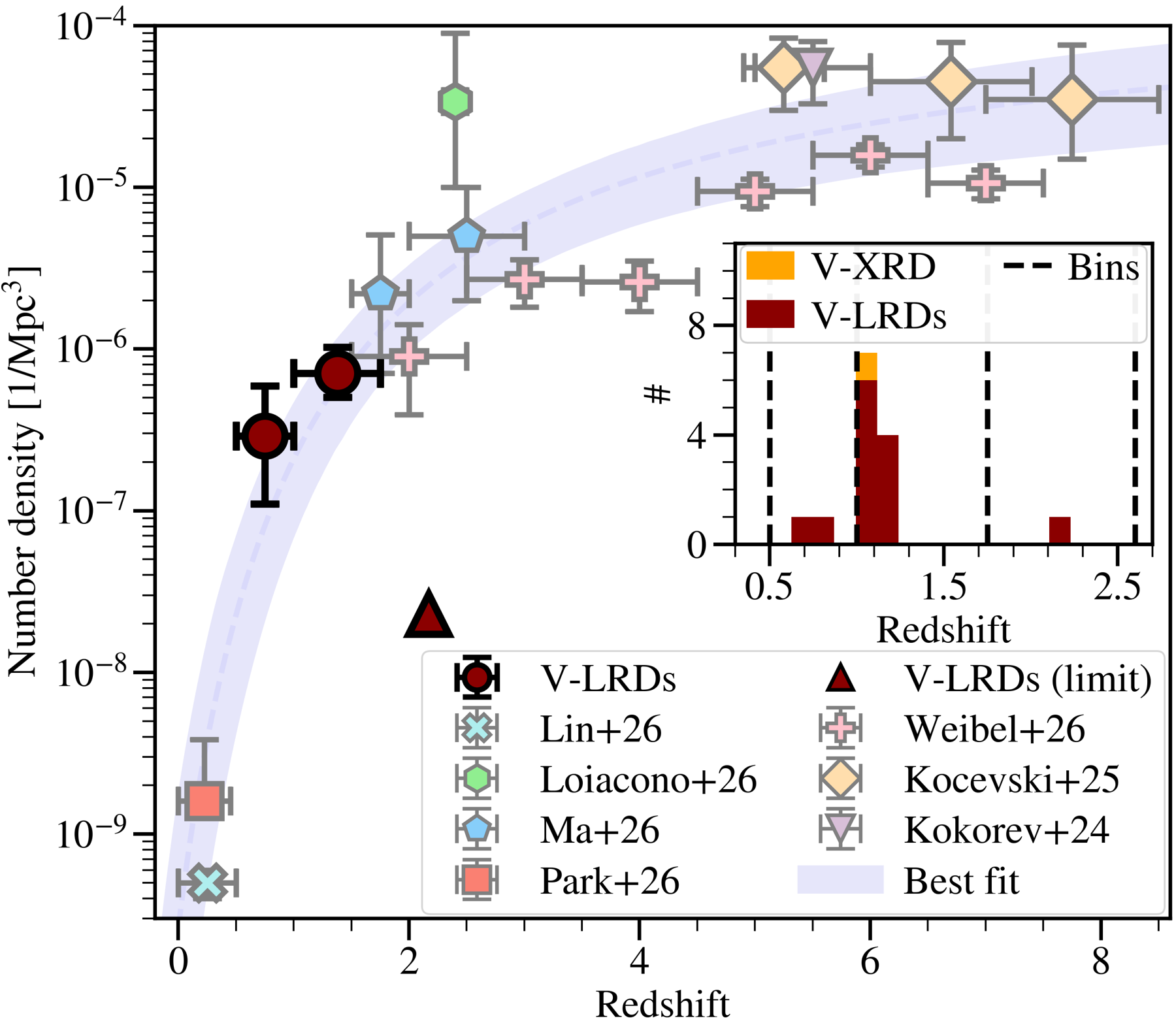
In one EIGER/J1030 field, five X-ray-undetected broad-line candidates imply an LRD density at z≈2.4 consistent with no decline from z≈7 above Lbol=3×10^44 erg s−1, but the large counting uncertainty and small sample preclude a precise evolutionary constraint.

Figure 9 from OzSSy1: The Australian Southern Seyfert-1 Spectroscopic Atlas and Catalogue at z < 0.1

2026-06-29 · 2606.27675v1 · Research note

OzSSy1: The Australian Southern Seyfert-1 Spectroscopic Atlas and Catalogue at z < 0.1

Neelesh Amrutha, Christian Wolf, Christopher A. Onken, et al.

OzSSy1 releases uniform WiFeS spectroscopy, decompositions, and line measurements for 887 southern broad-line AGNs at z<0.1, providing a local reference sample while retaining incompleteness from host dilution at the lowest redshifts.

2026-06-10 · 2606.10455v1 · Research note

The Extreme Quasar Main Sequence of Super-Eddington DESI-DR1 NLSy1 Galaxies

Alberto Domínguez</name> <arxiv:affiliation>UCM</arxiv:affiliation> </author> <author> <name>Suvendu Rakshit, Vaidehi S. Paliya, D. J. Saikia, et al.

In 18,749 DESI-DR1 NLSy1s, stronger Fe II and lower single-epoch virial masses than SDSS-DR17 correspond to a larger inferred super-Eddington fraction. Two mass calibrations preserve the population difference, but virial-mass systematics remain consequential.

Figure 2 from Aether-SHELLQs: JWST integral-field spectroscopy of candidate obscured quasars at z ~ 6

2026-06-10 · 2606.10160v1 · Research note

Aether-SHELLQs: JWST integral-field spectroscopy of candidate obscured quasars at z ~ 6

Yoshiki Matsuoka, Roberto Decarli, Emanuele Paolo Farina, et al.

JWST/NIRSpec IFU spectroscopy of six z~6 SHELLQs narrow-Lyα candidates finds secure broad Balmer components in two, while extended, largely non-rotating ionized gas characterizes several non-broad-line systems. Broad-line incidence rises sharply with Lyα luminosity.

2026-06-04 · 2606.04712v1 · Research note

The Extreme Rarity and Physical Properties of Low-redshift AGNs with Balmer Absorption

Jinyi Shangguan, Chang-Hao Chen, Luis C. Ho, et al.

Among 14,584 SDSS type-1 AGNs at z<0.35, seven robust Balmer absorbers imply a ∼0.05% incidence. Joint, resolution-aware Balmer fitting finds narrow, generally saturated absorbers; a rare high-Eddington, weak-Fe II subset may be preferentially affected.

2026-06-03 · 2606.03667v1 · Research note

Constraining AGN accretion physics with black hole mass-luminosity scaling relations

F. Fiore, M. Gaspari, S. Puccetti, et al.

Across a large SDSS–eROSITA quasar sample, bolometric luminosity scales nearly linearly with virial black-hole mass while hard X-rays rise more slowly. The authors argue this disfavors classical Bondi feeding and favors CCA, but redshift covariances and JWST line-based systematics limit interpretation.

2026-06-01 · 2605.30424v1

High-ionization coronal lines trace quasar-like activity in recently quenched galaxies at high redshift

F. Valentino, K. Ito, M. Farcy, et al.

This paper searches JWST/NIRSpec archival spectra of 87 massive quenched galaxies at z≈1.5-4.5 and finds [NeV] λ3427 in six, arguing that this coronal line cleanly isolates luminous SMBH accretion in systems where residual star formation is not a viable explanation. Four of the six [NeV] hosts also show broad Hα with FWHM ≳ 4000 km s^-1, implying MBH ≈ 10^8.5-10^9.5 Msun, while the [NeV] luminosities indicate quasar-like power outputs of roughly 10^45-10^46 erg s^-1 and Eddington ratios of about 10-50%. The strongest [NeV] emitters sit in the youngest post-starburst galaxies with Dn4000 ≲ 1.3, whereas older quenched systems lack comparable activity, pointing to intense radiatively efficient black-hole growth that can continue for several hundred Myr after the main quenching event. That timing matters because it links early quenching to delayed but still powerful SMBH growth, and provides a concrete empirical target for models that aim to produce the first massive passive galaxies.

Figure 4 from A Rapid Evolution in the Observed Mbh/M* Relation at z > 3 Revealed via Spectro-photometric SED-Modeling

2026-06-01 · 2605.30414v1 · Research note

A Rapid Evolution in the Observed Mbh/M* Relation at z > 3 Revealed via Spectro-photometric SED-Modeling

Ansh R. Gupta, Anthony Taylor, Emma Curtis-Lake, et al.

Using AGN-aware fits to JWST spectra, the authors report that non-LRD broad-line AGN shift from elevated observed M_BH/M* above z≈4.5 to the local relation by z≈3.5; LRD host-mass inferences remain substantially less secure.

2026-05-28 · 2605.27903v1

Double Dots: Compact Pairs Mark Little Red Dots and High-Redshift Broad-line AGNs

A. J. Barger, L. L. Cowie

Using JWST imaging of the lensed A2744 field, this paper defines a sample of 31 sub-0.25 arcsecond compact pairs, or “Double Dots,” and shows their separations are strongly skewed to small values, consistent with most being physical systems rather than chance alignments. The main empirical result is that close pairs are extremely common among known broad-line high-redshift sources in the field: at least 16 of 24 published little red dots and both previously identified high-redshift BLAGNs are double systems, with a median observed separation of 0.15 arcseconds. The authors then show that unresolved companions can materially reshape the observed SED, including washing out the canonical LRD v-shape, and that 2D spectroscopy can place the broad-line emission on either the redder or bluer member of the pair. That makes compact pairing itself a powerful marker of broad-line activity at high redshift and points to merger-driven accretion as a plausible underlying trigger.

2026-05-14 · 2605.14922v1 · Research note

DREAMS. JWST Spectroscopy of a $z=8.3$ Galaxy with an ALMA Dust Continuum Detection: Early Dust, Very High $T_{\rm dust}$, and a Multi-wavelength [OIII] Ratio Discrepancy

Kana Takechi, Masami Ouchi, Kimihiko Nakajima, et al.

For the single z=8.312 galaxy MACS0416-Y1, deep JWST/NIRSpec plus archival IFU/ALMA data support a broad-line AGN interpretation, low metallicity and dust mass ratios, and a spatially non-coincident origin for optical and far-infrared [OIII].

Figure 6 from A Changing-Look Seyfert Discovered by eROSITA Reveals a Two-Component Broad-Line Region

2026-05-08 · 2605.07965v1 · Research note

A Changing-Look Seyfert Discovered by eROSITA Reveals a Two-Component Broad-Line Region

Alex Markowitz, Mirko Krumpe, David Homan, et al.

eROSITA-triggered monitoring of HE 1237-2252/J1240−2309 links a changing-look transition to intrinsic accretion-rate recovery and an evolving two-component Balmer-line profile. A diskline-like component strengthens with UV flux, while the proposed corona/illumination mechanism remains interpretive.

2026-05-06 · 2605.05301v1 · Research note

An X-ray and optical spectral study of the changing-look narrow-line Seyfert 1 2MASX J0413-0050

A. Vietri, A. Tortosa, D. Ilić, et al.

Across four optical and three X-ray epochs, J0413-0050 changed from broad Balmer emission in 2004 to an Hβ-free 2021 state and back to broad plus narrow Hβ in 2023. The authors favor changing accretion over obscuration, but X-ray column density is unconstrained.

2026-05-06 · 2605.05074v1 · Research note

Little red dots as obscured little blue dots: relative abundances, luminosities, and black-hole masses

Piero Madau, Roberto Maiolino

A forward model treating little red dots as dust-intercepted, inclined counterparts of compact broad-line AGN matches the currently measured UV luminosity function, but dust covering fraction and cloud extinction remain substantially degenerate.

2026-04-03 · 2604.03370v1 · Research note

Holes in the BH$^\star$? AGN signatures in the FUV spectrum of a black-hole dominated Little Red Dot at $z=7.04$

Xihan Ji, Gabriele Pezzulli, Francesco D'Eugenio, et al.

JWST/NIRSpec FUV spectroscopy of the single z=7.04 LRD Abell2744-QSO1 resolves extended narrow and unresolved broad Lyα components. The authors interpret broad Lyα/Balmer ratios as evidence for lower-column-density sightlines through otherwise dense, clumpy BLR-scale gas.

Figure 5 from The X-ray weakness of Little Red Dots and JWST-selected AGN: comparison with local AGN in different accretion regimes

2026-03-10 · 2603.10162v1 · Research note

The X-ray weakness of Little Red Dots and JWST-selected AGN: comparison with local AGN in different accretion regimes

A. Tortosa, C. Ricci, P. Du, et al.

High-redshift LRDs and JWST-selected broad-line AGN are X-ray weak relative to broad Hα, plausibly resembling highly accreting local systems; however, predominantly upper-limit-based X-ray constraints leave intrinsic coronal suppression and obscuration unresolved.

2026-03-04 · 2603.04358v1 · Research note

A Selection Aware View of Black Hole-Galaxy Coevolution at High Redshift

Francesco Ziparo, Stefano Carniani, Simona Gallerani, et al.

Forward-modeling broad-Hα selection in a JADES broad-line AGN sample at z≳4 yields an M_BH–M★ relation consistent in mean with local relations but with 0.63 dex intrinsic scatter, implying diverse early black-hole growth histories.

Figure 2 from Extreme Emission Line Galaxies in CEERS Are Powered by Star Formation, not AGN

2026-02-26 · 2602.23310v1 · Research note

Extreme Emission Line Galaxies in CEERS Are Powered by Star Formation, not AGN

Kelcey Davis, Madisyn Brooks, Jonathan R. Trump, et al.

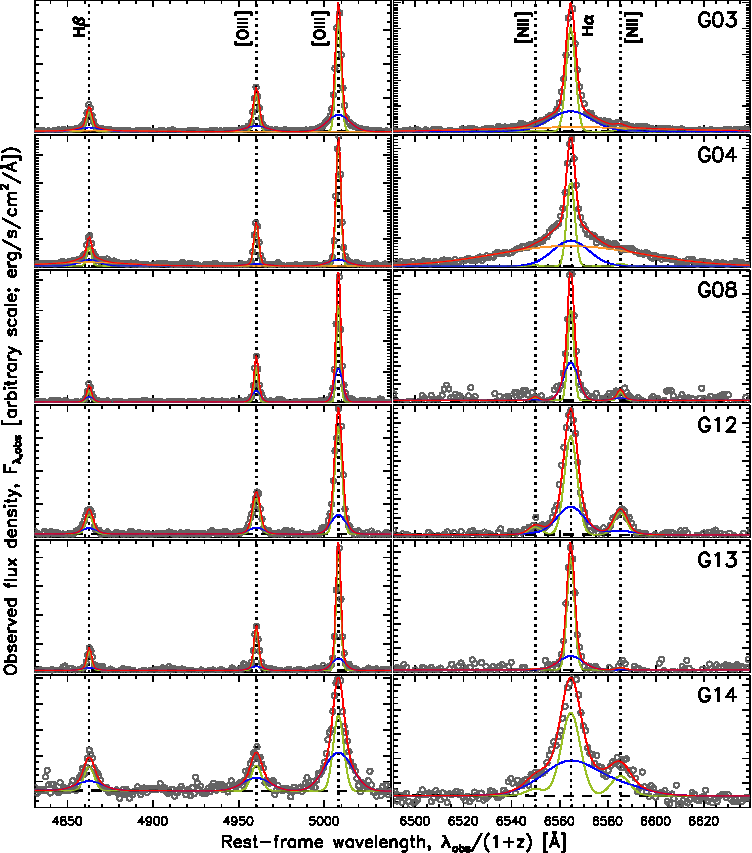
JWST/NIRSpec follow-up of CEERS extreme emission-line galaxies finds broad-line AGN contamination, but for spectroscopically extreme sources the narrow Hα component dominates. The authors therefore attribute the most extreme nebular emission primarily to young star formation, not AGN.

2026-02-25 · 2602.22386v1 · Research note

Little Red Dots as Obscured Little Blue Dots: A Super-Eddington Unification Model

Piero Madau, Roberto Maiolino

This modeling study argues that Little Red Dots are high-inclination, dust-reddened counterparts of super-Eddington Little Blue Dots. Anisotropic continua and modest BLR/dust covering factors can reproduce several LRD ensemble observables, but the proposed orientation unification remains model-dependent.

Figure 4 from You can't see me: super-Eddington growth hindering X-ray detection in high-z broad-line AGNs

2026-02-25 · 2602.22305v1 · Research note

You can't see me: super-Eddington growth hindering X-ray detection in high-z broad-line AGNs

Alessandro Trinca, Alessandro Lupi, Francesco Haardt, et al.

Joint modelling of broad lines and Chandra non-detections for 14 JWST high-redshift broad-line AGNs favors low-mass, highly super-Eddington black holes with over-cooled coronæ over massive, weakly accreting alternatives, but the inference remains model-dependent and bimodal.

2026-02-23 · 2602.20247v1 · Research note

Little Red Dots: One Photometric Tag Concealing Diverse Spectroscopic Flavors of Massive Star Formation and Black Hole Activity

Pablo G. Pérez-González, Guillermo Barro, Stefano Carniani, et al.

A 249-object JWST spectroscopic compilation argues that photometrically selected Little Red Dots are spectroscopically heterogeneous composites of accreting black holes and young stars, but its mass, duty-cycle, and Wolf–Rayet interpretations remain model-dependent.

Figure 2 from Undermassive Hosts of $z = 4-6 $ AGN from JWST/NIRCam Image Decomposition with CONGRESS, FRESCO, and JADES

2026-01-22 · 2601.15962v1 · Research note

Undermassive Hosts of $z = 4-6 $ AGN from JWST/NIRCam Image Decomposition with CONGRESS, FRESCO, and JADES

Zheng Ma, Eichi Egami, Yongda Zhu, et al.

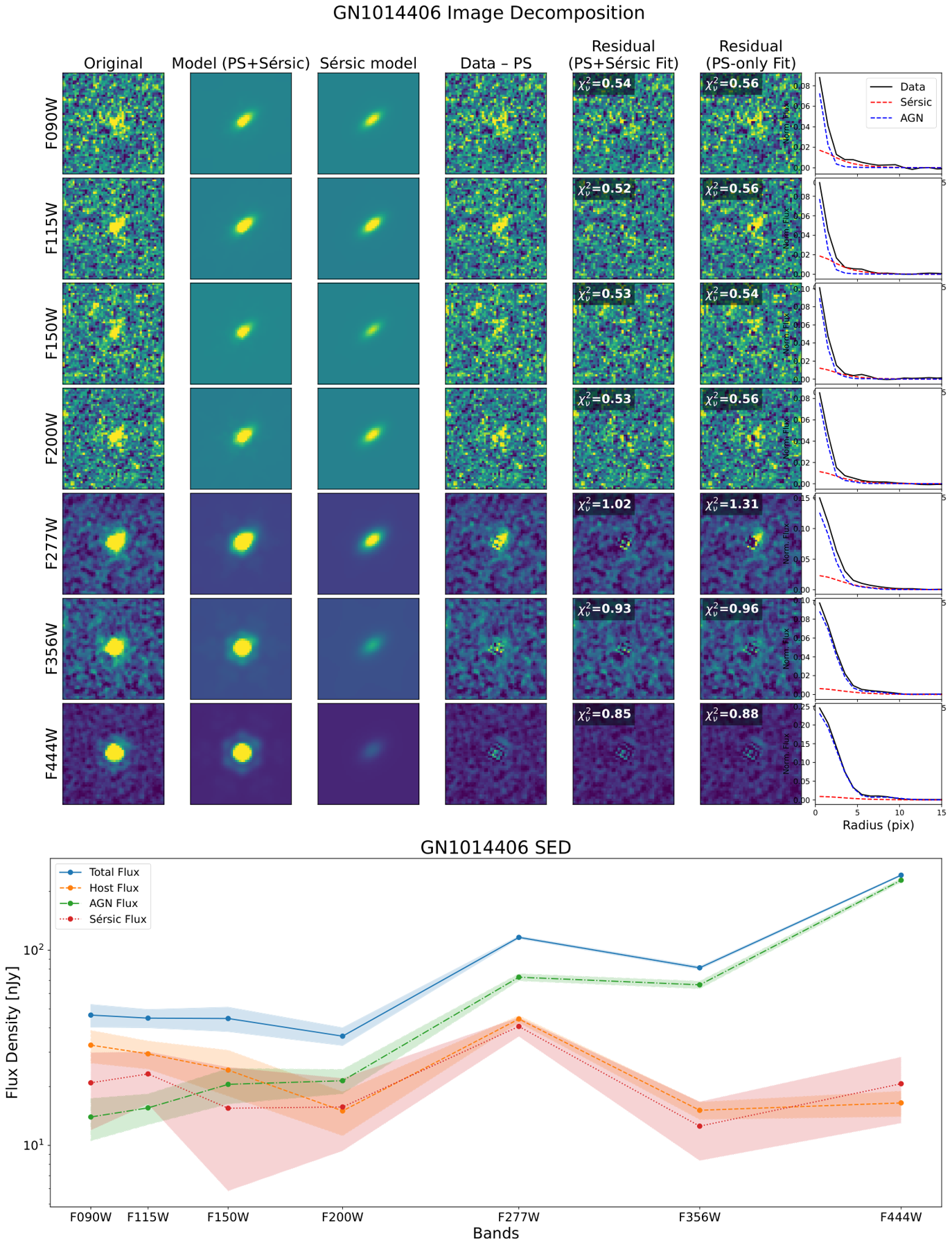
JWST/NIRCam decomposition detects extended host emission in 9 of 17 broad-Hα AGN at z≈4–6. Separating point-source light can reduce inferred host masses by 1–2 dex, yielding high BH-to-stellar mass ratios, although unresolved compact hosts remain a viable alternative.

2026-01-16 · 2601.11125v1 · Research note

Discovery of a gas-enshrouded broad-line AGN at z $\sim$ 7

Qianqiao Zhou, Xin Wang, Hang Zhou, et al.

JWST/HST observations of the lensed z≈6.87 galaxy A2744-z7DLA reveal damped Lyα absorption plus a statistically preferred broad Hα component, supporting a gas-enshrouded broad-line AGN interpretation while its UV–optical continuum remains predominantly stellar.

2025-12-16 · 2512.14844v1

Doubling NIRSpec/IFS capability to calibrate the single epoch black hole mass relation at high redshift

Eleonora Parlanti, Bartolomeo Trefoloni, Stefano Carniani, et al.

Presents a NIRSpec/IFU reduction that exploits the red signal on NRS2 for medium‑resolution gratings, effectively doubling the usable wavelength coverage and recovering Hα beyond the nominal range; the authors also note the exposure‑time trade‑off when using adjacent dispersers. Applied to five z≈2 quasars with reverberation‑mapped MBH, the extended cubes enable joint Hβ–Hα measurements at R≈1000. Hβ‑based single‑epoch masses best match RM, while Hα recipes show ≈0.5 dex larger scatter; for the least‑massive, high‑λEdd object (MBH,RM≈10^7.5 M⊙, λEdd=0.8) all SE estimators overpredict by ~1 dex, suggesting a bias at high accretion. The work delivers the first high‑z SE calibrations from Hβ and Hα for the newfound early‑BH population, with uncertainties still limited by sample size.
2025-12-14 · 2512.12509v1 · Research note

THRILS -- The High-(Redshift+Ionization) Line Search: Program Description & Redshift Catalog

Taylor A. Hutchison, Rebecca L. Larson, Pablo Arrabal Haro, et al.

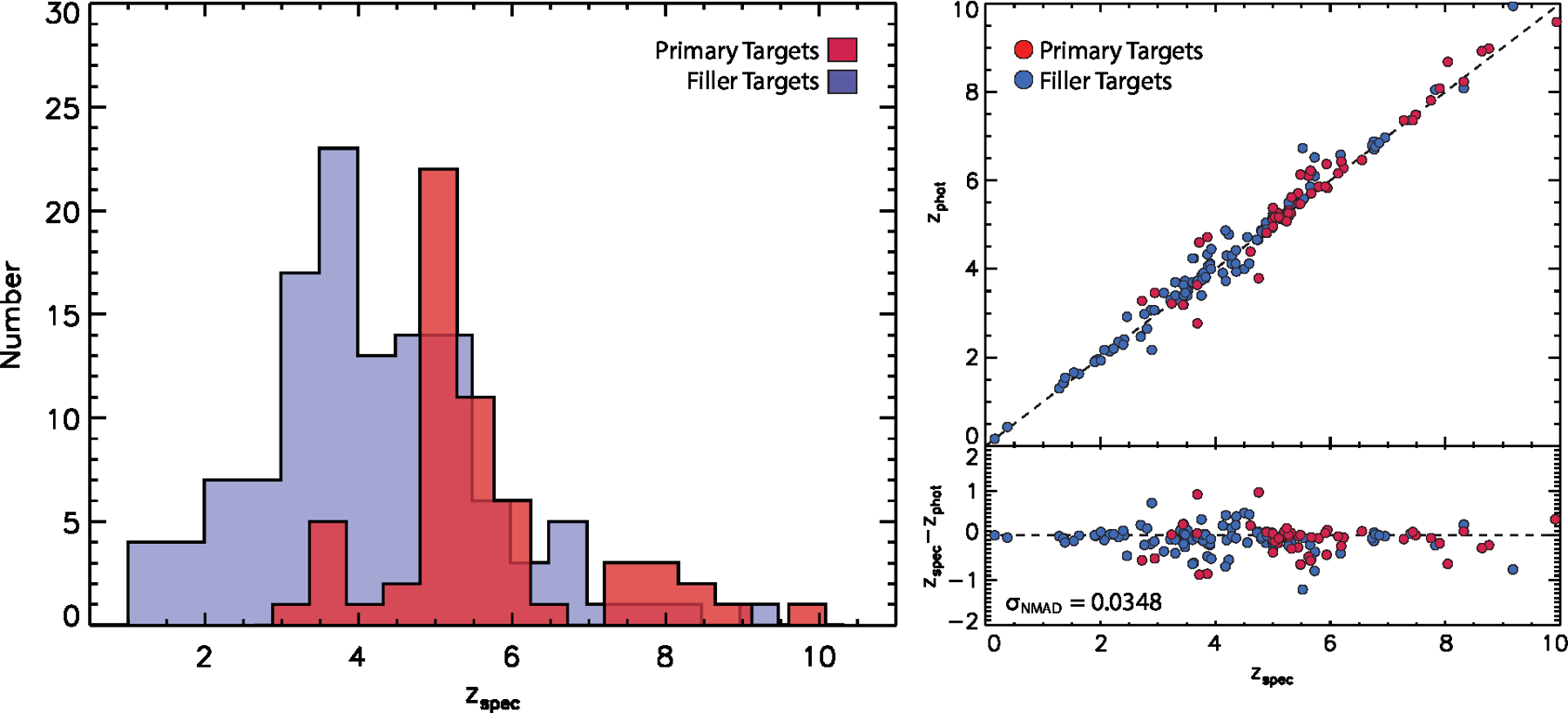
THRILS delivers deep JWST/NIRSpec G395M spectroscopy in two pointings, yielding 89 measured redshifts and empirical magnitude thresholds. Its >8-hour integrations expose faint lines inaccessible to shallower EGS spectroscopy, enabling targeted follow-up rather than population-level physical conclusions.

Figure 1 from A Comprehensive JWST/NIRSpec Census of Broad-Line Active Galactic Nuclei: Faint, Tiny, but Highly Accreting Sources in the Remote Universe

2025-12-02 · 2512.03281v1 · Research note

A Comprehensive JWST/NIRSpec Census of Broad-Line Active Galactic Nuclei: Faint, Tiny, but Highly Accreting Sources in the Remote Universe

Caroline Baccus, Xinfeng Xu

A JWST/NIRSpec search of roughly 80,000 spectra identifies 252 broad-line AGN to z=7.2, extending census statistics to fainter, lower-mass systems. The authors find high-redshift objects commonly at inferred Eddington ratios of 0.1–1, subject to heterogeneous depth and line-detection limits.

2025-12-01 · 2512.02093v1 · Research note

COSMOS-3D: Dense Circumnuclear Gas across Black Hole Growth Phases at z ~ 3

Zi-Jian Li, Siwei Zou, Jianwei Lyu, et al.

Two z~3 X-ray AGNs with He I λ10830 absorption indicate dense, broad-line-region-scale circumnuclear gas, but their contrasting obscuration, accretion rates, and outflow signatures provide only a two-object, model-dependent case for an evolutionary sequence.

Figure 2 from OzDES Reverberation Mapping of Active Galactic Nuclei: Final Data Release, Black-Hole Mass Results, & Scaling Relations

2025-12-01 · 2512.01261v1 · Research note

OzDES Reverberation Mapping of Active Galactic Nuclei: Final Data Release, Black-Hole Mass Results, & Scaling Relations

H. McDougall, T. M. Davis, Z. Yu, et al.

Final OzDES analysis uses multi-year optical monitoring to calibrate high-redshift BLR radius–luminosity relations from Hβ, Mg II, and C IV reverberation lags, yielding 62 RM black-hole masses and single-epoch estimates for 246 additional AGN.

2025-11-19 · 2511.15359v1 · Research note

Changing-look Active Galactic Nuclei from the Dark Energy Spectroscopic Instrument. V. Dramatic Variability in High-Ionization Broad Emission Lines

Zhi-Qiang Chen, Jun-Jie Jin, Wei-Jian Guo, et al.

A DESI–SDSS comparison identifies 97 z>0.9 changing-look quasars with high-ionization broad-line transitions. Their lower Eddington ratios, line–luminosity co-variability, and ∼3-year rest-frame transition times are consistent with—though do not prove—accretion-state changes.

2025-11-12 · 2511.09304v1 · Research note

Variability of optical spectral index to support a central sub-parsec binary black hole system in quasar SDSS J001224-102226.51

Zhang XueGuang

Using two SDSS epochs of the z=0.228 quasar SDSS J0012-1022, the authors argue that an anomalous luminosity–optical-slope change is consistent with phase-dependent obscuration of two accreting black holes. It supports, but does not establish, a sub-parsec binary interpretation.

Figure 1 from Probing the Physical Origin of the Balmer Decrement in the Broad-line Region of Nearby Active Galactic Nuclei via Spectral Variability

2025-11-11 · 2511.07714v1 · Research note

Probing the Physical Origin of the Balmer Decrement in the Broad-line Region of Nearby Active Galactic Nuclei via Spectral Variability

Suyeon Son, Minjin Kim, Luis C. Ho, et al.

Multi-epoch SDSS spectroscopy of 1,116 nearby type-1 AGNs finds broad-line Hα/Hβ decreases as individual AGNs brighten. The authors argue continuum-driven BLR radiative-transfer and excitation changes, rather than variable intrinsic dust reddening, predominantly drive this variability.

2025-11-04 · 2511.02902v1 · Research note

A close look at the black hole masses and hot dusty toruses of the first quasars with MIRI-MRS

Sarah E. I. Bosman, Javier Álvarez-Márquez, Frederick B. Davies, et al.

JWST/MIRI-MRS spectroscopy of four luminous type-1 quasars at z=7.08–7.64 yields mutually consistent broad-line black-hole masses of (4–15)×10^8 M⊙ and directly detects hot-torus emission, without resolving the early-SMBH growth tension.

2025-10-12 · 2510.10772v1 · Research note

Black Holes in the Shadow: The Missing High-Ionization Lines in the Earliest JWST AGNs

Greta Zucchi, Xihan Ji, Piero Madau, et al.

Stacked JADES Type 1 AGN spectra at z>5 show strong Balmer emission but weak or absent high-ionization lines. Cloudy comparisons disfavour much of the tested sub-Eddington parameter space, motivating—but not uniquely establishing—soft, filtered, or anisotropic ionizing continua.

Figure 3 from The $M_{\rm BH}-M_{*}$ Relationship at $3<z<7$: Big Black Holes in Little Red Dots

2025-10-08 · 2510.07376v1 · Research note

The $M_{\rm BH}-M_{*}$ Relationship at $3<z<7$: Big Black Holes in Little Red Dots

Brenda L. Jones, Dale D. Kocevski, Fabio Pacucci, et al.

For 70 JWST broad-line AGN at 3<z<7, the authors infer black holes overmassive relative to local broad-line AGN, with the offset and BH-to-stellar-mass ratio increasing toward high redshift; LRD-rich sample composition contributes substantially.

2025-09-24 · 2509.20597v1 · Research note

The X-ray Emission of NGC 5005: An Unobscured Low-Luminosity AGN with a Weakly Accreting Broad-Line Region

Anna Trindade Falcão, R. Middei, G. Fabbiano, et al.

A 255 ks Chandra study resolves NGC 5005’s soft, extended gas from a faint hard nucleus. The authors infer a lightly absorbed, intrinsically weak AGN whose reported broad Hα line persists at an exceptionally low inferred Eddington ratio.

2025-09-24 · 2509.20452v1

A GLIMPSE of Intermediate Mass Black holes in the epoch of reionization: Witnessing the Descendants of Direct Collapse?

Qinyue Fei, Seiji Fujimoto, Rohan P. Naidu, et al.

Ultra-deep JWST/NIRSpec G395M spectroscopy behind Abell S1063 enables a systematic search for faint broad-line nuclei, fitting narrow components with an [O III] λ5007 template and validating the method with mocks. The authors identify ten broad-line AGN at 4.5<z<7.0 (eight secure, two tentative) with broad Hα–based virial masses down to ~10^5.5 Msun; composite galaxy+AGN SEDs yield host masses implying M_BH/M_* ≲ 0.1% and placements consistent with the local M_BH–M_* relation. From these they build a BH mass function that agrees with prior results above ~10^6.5 Msun but shows an excess at ~10^5.5 Msun relative to a Schechter extrapolation. They interpret the low-mass excess as evidence for descendants of direct-collapse seeds in the reionization era.

2025-09-11 · 2509.09607v1

Discovery of Multiply Ionized Iron Emission Powered by an Active Galactic Nucleus in a z~7 Little Red Dot

Erini Lambrides, Rebecca Larson, Taylor Hutchison, et al.

THRILS spectroscopy of the z~7 Little Red Dot THRILS_46403 (CEERS-10444/RUBIES_49140) reveals bona fide AGN tracers: multiple Fe lines including a 4.5σ [Fe VII] and several [Fe II], plus an auroral [N II] detection at 3.1σ. Three Balmer lines show broad emission with superposed narrow absorption whose small widths and depths imply a partially covering absorber at or beyond the broad-line region. Electron-temperature diagnostics indicate O++ is markedly hotter than N+ across densities, pointing to a powerful, hard central ionizing source. Together these features establish multiply ionized iron emission from an accreting SMBH within the first 800 Myr and suggest direct sight-lines from the disk to gas at or beyond the BLR.

2025-09-03 · 2509.03576v1

How similar are narrow-line Seyfert 1 galaxies and high-z type 1 AGN?

M. Berton, E. Järvelä, A. Tortosa, et al.

Review draws a line between local narrow-line Seyfert 1s and the newly uncovered z>4 type 1 AGN/LRDs: both host low-mass (∼10^6–10^7 M⊙) black holes accreting near or above Eddington and often show features like steep, variable X-rays and, in a subset, relativistic jets. The authors argue jets can help shed angular momentum in super-Eddington flows, making NLS1s practical analogs for early SMBH growth. Radio examples underscore the wide range from host-dominated star-formation morphologies to blazar-like, large-scale jets. Key caveat: some systematic differences remain, plausibly tied to distinct environments and evolutionary paths at high redshift.

2025-09-02 · 2509.02027v1

The ALPINE-CRISTAL-JWST Survey: Revealing Less Massive Black Holes in High-Redshift Galaxies

Wenke Ren, John D. Silverman, Andreas L. Faisst, et al.

ALPINE-CRISTAL-JWST uses NIRSpec IFU aperture spectra at photometric peaks in 18 z=4.4–5.7 main-sequence galaxies and finds 7 broad-line AGN candidates via Hα, including one robust source (FWHM ≈ 2800 km/s) and six with 600–1600 km/s, two in a merger. Narrow-line diagnostics place these systems within the star-forming locus, so broad-line detection is the only reliable discriminator; the implied broad-line AGN fraction is 5.9–33% and is aided by targeting high-mass hosts. Virial estimates give MBH ≈ 10^6–10^{7.5} M⊙ with Lbol/LEdd ≈ 0.1–1, and candidates lie at or below the local MBH–M* relation, counter to prior JWST reports of overmassive BHs. The work highlights mass-dependent selection effects and points to a substantial, previously missed population of faint, undermassive broad-line AGN at early times.

2025-08-02 · 2508.01372v1

A Nitrogen-rich AGN Powering a Large Ionizing Bubble at z=8.63

Takahiro Morishita, Massimo Stiavelli, Charlotte A. Mason, et al.

New NIRSpec/MSA G140H/F070LP data reveal broad Lyα in CANUCS-LRD-z8.6 (z=8.63) centered near systemic (FWHM 1540±260 km/s), implying transmission through a large reionized region. Simple Strömgren modeling of the line shape yields an ionized-bubble radius Rb=1.5^{+0.3}_{-0.2} pMpc and a Lyα escape fraction fesc=11±3%. The intrinsic width is even broader (≈2200±280 km/s), consistent with a BLR in a low-luminosity AGN, while high N IV]/C IV and N IV]/O III] ratios from PRISM indicate nitrogen enrichment. A mild local overdensity (δ≈1.8) suggests neighboring galaxies may help sustain the bubble, linking this LRD to the emerging class of nitrogen-rich systems like GN-z11 and GHZ2/GLASSz12.

2025-07-28 · 2507.20684v1

A deep dive down the broad-line region: permitted OI, CaII and FeII emission in an AGN Little Red Dot at z=5.3

Roberta Tripodi, Maruša Bradač, Francesco D'Eugenio, et al.

JWST/NIRCam imaging and NIRSpec prism spectroscopy of the Bullet‑cluster LRD Bz5.3 (zspec=5.2907) reveal broad Balmer emission plus strong low‑ionization Fe II, O I, and Ca II triplet lines, confirming a bona fide BLR around an accreting SMBH. The work reports the first high‑z detection of the O I λ1304 bump (O I+Si II), alongside prominent O I λ8446 and Ca II λλ8498,8542,8662. A markedly low O I λ1304/λ8446 photon ratio (0.1–0.3) implies internal dust with AV≈0.4–1.0 and points to Lyβ fluorescence as the dominant excitation, consistent with high EW O I λ8446 and weak O I λ7774. Photoionization modeling of O I and Ca II favors multiple BLR gas phases with distinct densities/ionization states, supporting a stratified BLR at early times.