654 indexed papers · 430 research notes

Research archive

Reset

2026-08-24 · 2608.20781v1 · Research note

Pandora cluster Lensing, AGN, and Transient Exploration (PLATE) from JWST Multi-Epoch Imaging. I. Discovery of a type II supernova candidate in a spiral galaxy at $z=0.7$

Yuxuan Pang, Xin Wang, Ping Chen, et al.

JWST multi-epoch imaging identifies PLATE-23a at z=0.688 as a strongly favored Type IIP supernova candidate, with cooling early-time SEDs and late evolution resembling local Type IIP events, while sparse late photometry limits physical inferences.

2026-08-20 · 2608.18691v1

The Total and Polarized Radio Emission from the Innermost Jets of a High-Redshift Quasar and a Candidate at Parsec-Scale Resolution

Bence Husvéth, Krisztina É. Gabányi, Tao An, et al.

Husvéth et al. present 22-GHz EVN total-intensity and polarimetric VLBI imaging of the secure z=4.31 quasar J1510+5702 and the redshift-uncertain compact source J1606+3124, sampling rest-frame frequencies above 118 GHz if both published high-redshift values apply. J1510+5702 contains a very compact, polarized core with Tb = (1.08 ± 0.15) × 10^12 K and about 3.5% fractional polarization, implying an equipartition Doppler factor of roughly 22 and directly probing its strongly beamed inner jet. J1606+3124 shows only low-level polarization and, conditional on z=4.56, a lower Tb of (7.4 ± 0.8) × 10^10 K that permits mild boosting but leaves a young compact-source interpretation viable; the key caveat is that its published spectroscopic redshift is uncertain, with a photometric estimate near z=0.9. Together, the measurements demonstrate that 22-GHz cm-VLBI can recover rest-frame millimeter polarization from bright z>4 jet systems.

2026-08-20 · 2608.18212v1 · Research note

Quasar Impostors: Two Extremely UV-Bright ($M_{\rm UV}\approx-23.5$) Reionisation-Epoch Galaxies Powered by Very Massive Stars

Daming Yang, Joseph F. Hennawi, Sarah E. I. Bosman, et al.

JWST and ALMA reclassify two z=6.63–6.80, MUV≈−23.5 SHELLQs “quasars” as extreme star-forming galaxies. Their UV wind and broad He II features are better matched by VMS-inclusive population models, although inferred IMF cutoffs remain strongly model dependent.

Figure 3 from Ripples in the OCEANS: Broad Line Variability of Little Red Dots

2026-08-14 · 2608.12487v1 · Research note

Ripples in the OCEANS: Broad Line Variability of Little Red Dots

Madisyn Brooks, Kelcey Davis, Jonathan R. Trump, et al.

Across six z=4.95–6.68 little red dots, multi-epoch JWST spectroscopy yields only marginal broad-Hα variability in two objects and no significant continuum changes. The results offer tentative AGN support, but calibration-driven uncertainties and four non-detections preclude a definitive population-level conclusion.

Figure 3 from ATLAS. III. Dust Around Little Red Dots: Hydrogen Line Ratios beyond Dust-free Non-Case B Models

2026-08-12 · 2608.10832v1 · Research note

ATLAS. III. Dust Around Little Red Dots: Hydrogen Line Ratios beyond Dust-free Non-Case B Models

Tomokazu Kiyota, Masami Ouchi, Hiroto Yanagisawa, et al.

In 20 LRDs, extreme broad Balmer decrements require both dense, optically thick non-Case-B line formation and—when Hα/Hβ exceeds the model ceiling—additional broad-line-region-associated dust, rather than galaxy-wide extinction alone.

2026-08-12 · 2608.10280v1

Tabular foundation models for the estimation of probabilistic quasar photometric redshifts in S-PLUS

Raquel R. Valença, Lilianne Nakazono, Rafael Izbicki, et al.

This paper tests whether frozen tabular foundation models can deliver full probabilistic quasar photo-z posteriors for the 12-band S-PLUS DR6 survey, where colour-redshift degeneracies and spectroscopic-to-photometric covariate shift make single-value estimates inadequate. Across training sets spanning 500 to 121,626 quasars and comparisons with eight specialised baselines, TabPFN 2.5 is best or statistically tied for best on nearly every density and point-estimation metric, with especially strong gains for small training samples, bright or faint sources, and high-redshift quasars. Its posteriors remain close to nominally calibrated after importance-weighted evaluation intended to emulate the photometric target catalogue, making it a strong default for catalogue-scale quasar redshift inference; the practical limitation is the accelerator-memory cost of inference on large support and target sets. SHAP results further identify WISE W1/W2 as the most informative individual inputs, with UV and optical bands providing useful refinements.

2026-08-12 · 2608.10070v1 · Research note

A cosmic collision in the making: JWST/NIRISS reveals a merging and maturing protocluster core at z~3 around a red quasar

C. Bertemes, D. Wylezalek, G. Noirot, et al.

JWST/NIRISS spectroscopy identifies an exceptionally dense z≈3 protocluster around quasar J1652, with 18 robust members, two quiescent galaxies, and position–velocity substructure consistent with—though not proving—a merger of two haloes.

Figure 1 from GATOS: Distinct Feedback Modes in AGN Central Regions Revealed by Spatially Resolved JWST Spectroscopy

2026-08-11 · 2608.08369v1 · Research note

GATOS: Distinct Feedback Modes in AGN Central Regions Revealed by Spatially Resolved JWST Spectroscopy

Lulu Zhang, Chris Packham, Erin K. S. Hicks, et al.

Spatially resolved JWST/MIRI spectroscopy of five nearby AGN links contrasting PAH-ratio trends to AGN irradiation and shock-processing diagnostics. The authors interpret their coexistence as a route to nuclear PAH suppression and to divergent PAH star-formation calibrations.

2026-08-07 · 2608.05283v1

Emission line formation in scattering dominated media: implications for LRDs

Elisha Modelevsky, Omri Nitzan, Re'em Sari, et al.

Modelevsky et al. develop an analytic radiative-transfer framework for Balmer lines produced intrinsically inside static, optically thick, scattering-dominated envelopes, a geometry directly relevant if LRD central engines are hidden by dense gas. Unlike externally broadened, backlit or reflected lines, which generically acquire exponential wings, an extended intrinsic photosphere produces a broken power-law profile, transitioning from v^{-α} to v^{-(α+1)} with 0<α<1; this form fits the Hα profiles of JADES-GN-73488 and JADES-GN-68797. The result offers a line-shape diagnostic for distinguishing intrinsic from extrinsic Thomson broadening in LRDs, although the LTE calculation cannot reproduce the observed high Hα-to-continuum contrast and ultimately requires non-LTE modeling.

2026-08-07 · 2608.05267v1 · Research note

Where did all the Little Red Dots go? The abundance of LRD analogues among objects with broad lines at $z < 0.35$

Lasse Seyberlich, Sarah E. I. Bosman

In an SDSS broad-line sample at z<0.35, the authors identify nine SED-selected local LRD analogues and infer an abundance of 0.08%, supporting rarity at late times but with important spectral-coverage and contamination caveats.

2026-08-06 · 2608.04078v1

The most extreme high-z radio quasars in the eRASS:1 X-ray survey

L. Ighina, L. Palmieri, L. N. Martínez-Ramírez, et al.

Ighina et al. construct an eRASS:1-selected sample of extreme radio quasars by cross-matching eROSITA X-ray sources with RACS radio detections and DELVE optical/NIR dropout candidates, then spectroscopically following up 46 of 68 candidates. They confirm 39 quasars at z>3.5, including 14 new z>4 radio quasars, increasing the population above the same flux limits and area by about 65%. Their X-ray-to-optical and radio-loudness diagnostics identify a predominantly blazar-like subset, whose cumulative z>4 counts agree reasonably well with a fractional IC/CMB X-ray-enhancement model. The resulting uniformly selected sample provides a stronger basis for testing early jetted-SMBH growth and relativistic-jet evolution, although the redshift distribution remains affected by incomplete spectroscopy and blazar-classification choices.

Figure 3 from NEXUS: Spectral Variability of Little Red Dots and Blue Active Galactic Nuclei at $2 \lesssim z \lesssim 6$

2026-08-04 · 2608.01647v1 · Research note

NEXUS: Spectral Variability of Little Red Dots and Blue Active Galactic Nuclei at $2 \lesssim z \lesssim 6$

Zachary Stone, Yue Shen, Ming-Yang Zhuang, et al.

Multi-epoch JWST/NIRSpec monitoring finds that 17 little red dots have large Balmer decrements but weak month-scale continuum and Hα variability. The authors interpret the variability contrast with ordinary AGNs as evidence for differing broad-line emission and/or ionizing-driver properties.

Figure 2 from Misaligned or chaotic? A strong break of axial symmetry in the local LRD J1025 revealed with VLT/FORS2 spectropolarimetry

2026-08-03 · 2607.28715v1 · Research note

Misaligned or chaotic? A strong break of axial symmetry in the local LRD J1025 revealed with VLT/FORS2 spectropolarimetry

Francesco D'Eugenio, Gabriele Pezzulli, Roberto Maiolino, et al.

VLT/FORS2 spectropolarimetry of the z≈0.1 LRD J1025 finds an intrinsically polarised, nearly grey continuum and a weaker, differently angled broad Hα component. The 48±4° angle offset robustly requires broken axial symmetry, but does not identify its physical cause.

Figure 9 from An Exploratory Analysis of New Large Gaia-informed Quasar Samples in SDSS-V

2026-07-31 · 2607.27329v1 · Research note

An Exploratory Analysis of New Large Gaia-informed Quasar Samples in SDSS-V

Shir Aviram, Benny Trakhtenbrot, Tom Dwelly, et al.

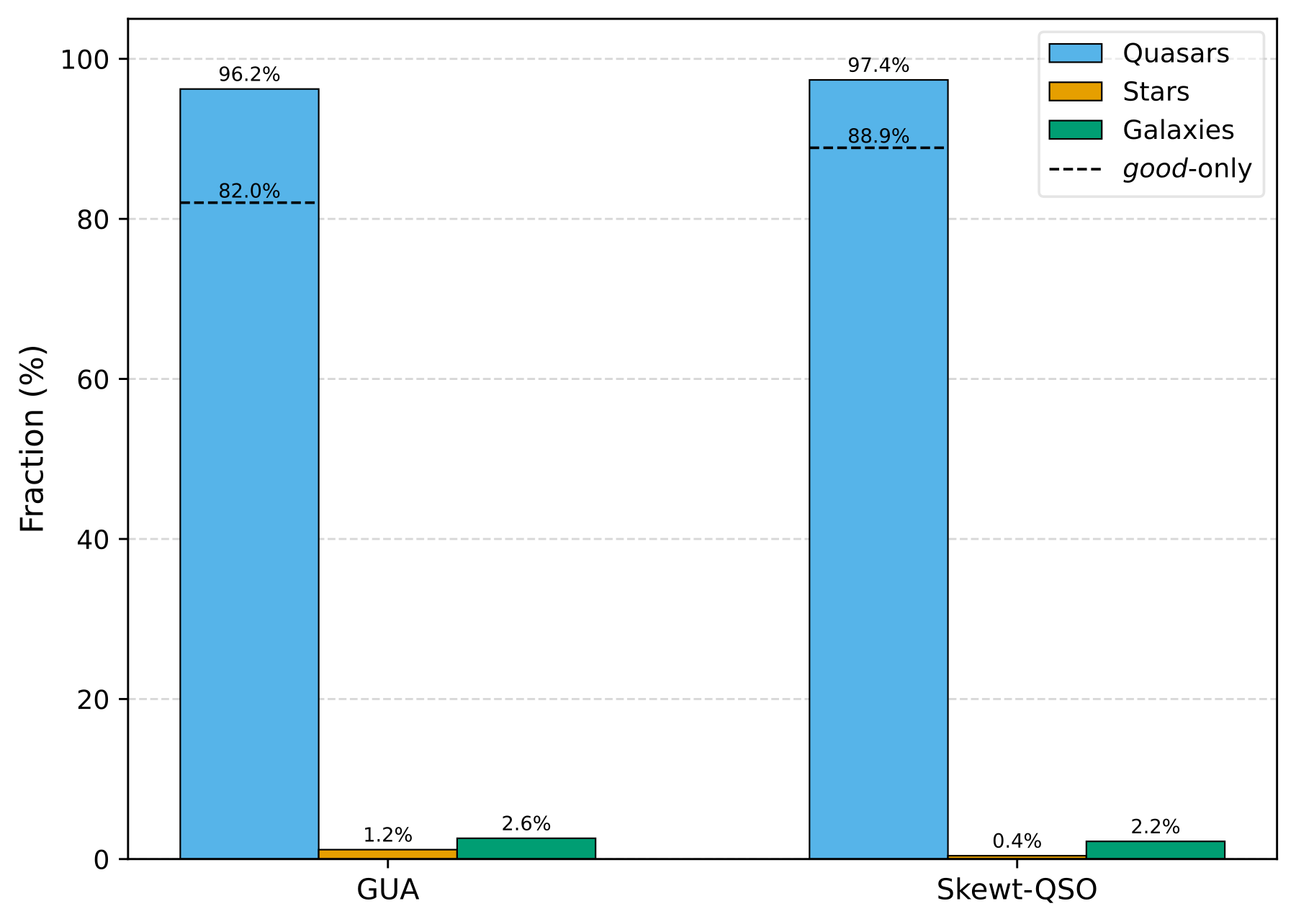
SDSS-V’s Gaia/WISE-informed GUA and Skewt_QSO targeting yields a large, mostly southern extension of spectroscopic quasars with broad physical-property coverage; after controlling redshift–luminosity selection differences, its black-hole and Eddington-ratio distributions agree with SDSS DR16Q.

Figure 2 from ATLAS. II. Extremely High Incidence of Balmer Line Absorption with Predominant Blueshifts in LRDs: Statistical Insights through Comparison with Type 1 AGNs

2026-07-30 · 2607.26269v1 · Research note

ATLAS. II. Extremely High Incidence of Balmer Line Absorption with Predominant Blueshifts in LRDs: Statistical Insights through Comparison with Type 1 AGNs

Hiroto Yanagisawa, Masami Ouchi, Tomokazu Kiyota, et al.

Among 40 JWST-selected LRDs, 14 show Hα absorption, far exceeding SDSS type-1 AGNs; the compiled absorbers are mostly blueshifted and kinematically narrower, consistent with line-of-sight outflows but not uniquely establishing their fate.

2026-07-30 · 2607.26255v1 · Research note

Tracing the Cosmic web across Cosmic time through SKA observations of radio galaxies

Pratik Dabhade, Gianluca Castignani, Mousumi Mahato, et al.

This review argues that SKA radio morphology, spectra and polarimetry, tied to redshift-resolved environmental maps, can turn radio galaxies into statistical cosmic-web probes; its quantitative examples are forecasts and pathfinder benchmarks rather than new SKA measurements.

Figure 2 from How to raise a supermassive black hole: interpreting early JWST AGN with the AESOPICA simulations

2026-07-30 · 2607.26177v1 · Research note

How to raise a supermassive black hole: interpreting early JWST AGN with the AESOPICA simulations

Sophie Koudmani, Jan Scholtz, Anthony J. Taylor, et al.

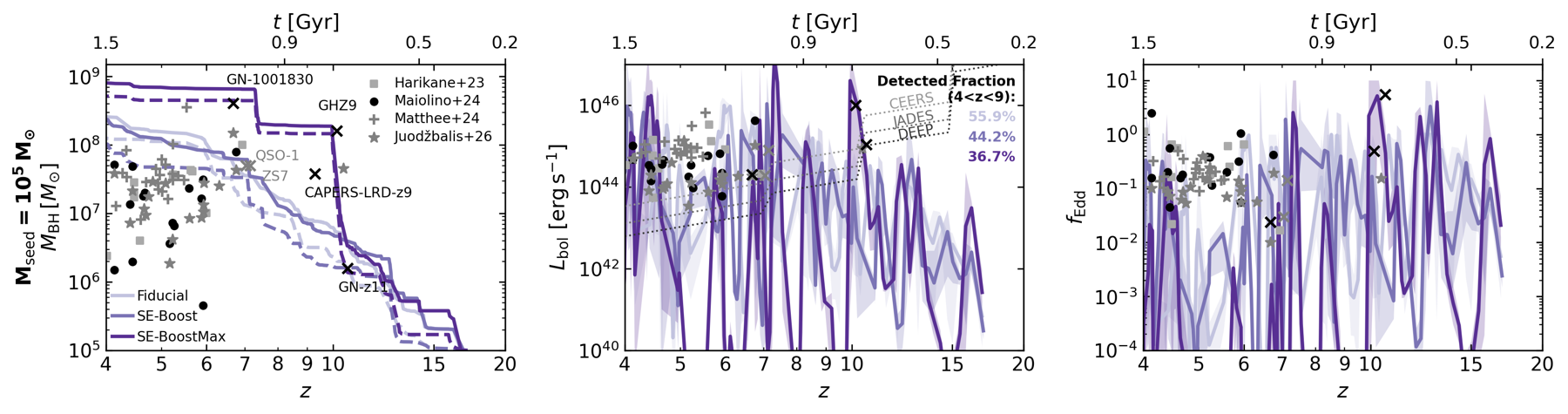
AESOPICA forward-models JWST broad-line selection in 12 cosmological simulations, finding that selection can yield apparently overmassive AGN from several seed scenarios; very light seeds nevertheless require unusually efficient, intermittently super-Eddington growth in the explored models.

2026-07-29 · 2607.25696v1 · Research note

Tracing Obscured AGN Contribution and Number Fraction Across 0 < z < 6 with JWST

Angel Rodriguez Barbosa, Tomotsugu Goto, Daryl Joe D. Santos, et al.

Using GOODS-S JWST SMILES+JADES photometry and CIGALE fits, the authors report that obscured-AGN incidence and infrared contribution rise toward high redshift, but are consistent with no systematic dependence on total infrared luminosity within their uncertainties.

Figure 1 from Vigorous turbulence driven by quasar-mode feedback in a cluster core

2026-07-29 · 2607.24911v1 · Research note

Vigorous turbulence driven by quasar-mode feedback in a cluster core

Satoshi Yamada, Shutaro Ueda, Hirofumi Noda, et al.

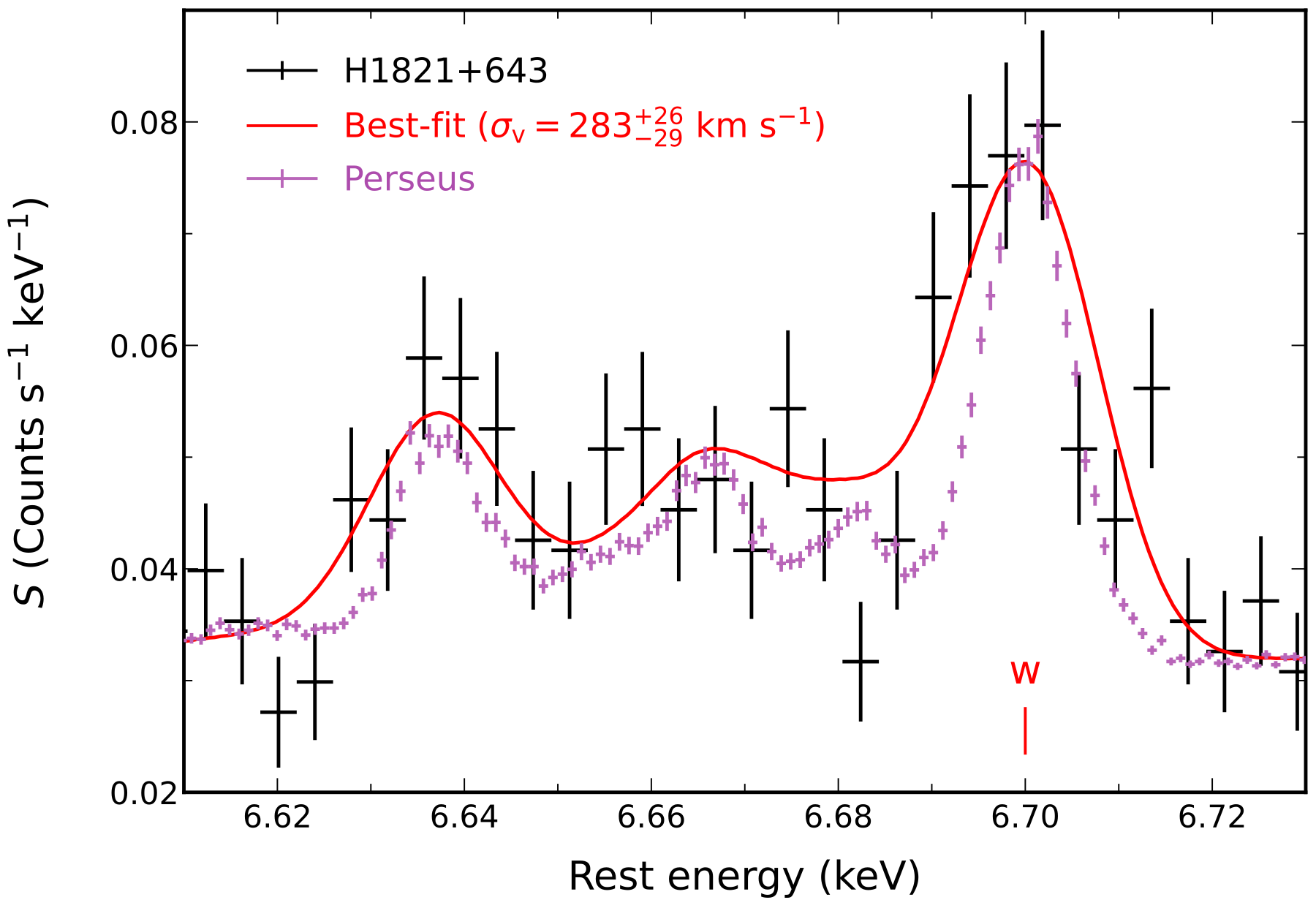
XRISM/Resolve spectroscopy of the z=0.297 quasar cluster H1821+643 measures unusually broad ICM Fe XXV lines, implying substantial non-thermal motions on 20–100 kpc scales. The authors interpret these motions as quasar-feedback coupling, but resonance scattering and sloshing remain relevant alternatives.

Figure 3 from Unsupervised selection and characterisation of Little Red Dots in JWST surveys with manifold learning

2026-07-28 · 2607.22835v1 · Research note

Unsupervised selection and characterisation of Little Red Dots in JWST surveys with manifold learning

Michele Ginolfi, Filippo Mannucci, Alessandro Marconi, et al.

UMAP applied to 242,327 JWST sources localises spectroscopic LRDs into two colour-linked regions and selects roughly 100 candidates. Against the available spectroscopic subset, the main region attains ~0.78 purity and ~0.82 completeness, but preprocessing disfavors the reddest high-z objects.

2026-07-27 · 2607.21869v1 · Research note

Stacked Reverberation Mapping of High Redshift Quasars in DESI. I. Feasibility Analysis

Rahma Alfarsy, R. E. A. Canning, Eva-Maria Mueller, et al.

DESI-like sparse spectroscopy plus ZTF-like photometry can, in simulations, recover stacked C IV reverberation lags and the input radius–luminosity relation within 1σ. Recovery depends especially on multi-hundred-day spectral baselines; this is feasibility evidence, not a measurement from DESI quasars.

Figure 2 from Outflows in super-Eddington quasars drive clumpy circumgalactic medium and extended H$α$ nebulae at $z \gtrsim 6$

2026-07-27 · 2607.21719v1 · Research note

Outflows in super-Eddington quasars drive clumpy circumgalactic medium and extended H$α$ nebulae at $z \gtrsim 6$

Lucas Tortora, Tiago Costa, Debora Sijacki, et al.

In one extreme z~6 halo, simulations predict that earlier seeding plus mildly super-Eddington growth drives cold, fast, neutral CGM clumps and extended Hα after feedback clears nuclear sightlines; this is a model prediction, not a population measurement.

2026-07-24 · 2607.20617v1 · Research note

A dust-free hierarchically nested supermassive-star model for James Webb Space Telescope Little Red Dots

Pau Amaro Seoane

This letter proposes that a dust-poor subset of Little Red Dots are hierarchically nested supermassive stars: magnetic envelope inflation and exposed stellar light reproduce a V-shaped continuum, while a dense inner core supplies broad Balmer emission and hides X-rays.

Figure 3 from An (in)complete NIRSpec census of Balmer absorption in Type 1 AGN -- radiation-driven outflows in little red dots, quasars and variable stars

2026-07-22 · 2607.19057v1 · Research note

An (in)complete NIRSpec census of Balmer absorption in Type 1 AGN -- radiation-driven outflows in little red dots, quasars and variable stars

Ignas Juodžbalis, Xihan Ji, Francesco D'Eugenio, et al.

Completeness-corrected JWST/NIRSpec fits indicate strong Hα absorption is common in little red dots (LRDs) but not detected in little blue dots, favoring blueshifted, likely outflowing gas while leaving rest-frame absorption substantially incomplete.

Figure 1 from Two Peas in a Pod: The First Confirmed Dual Active Galactic Nucleus within a Green Pea Galaxy System

2026-07-21 · 2607.17729v1 · Research note

Two Peas in a Pod: The First Confirmed Dual Active Galactic Nucleus within a Green Pea Galaxy System

Konstantinos Kouroumpatzakis, Peter G. Boorman, Jiří Svoboda, et al.

Chandra and Keck/DEIMOS observations identify two obscured, broad-line AGN in the interacting Green Pea system J1622+3521, separated by 8.4 kpc. The authors therefore report a confirmed dual AGN in a compact low-mass Green Pea environment.

Figure 2 from Optically Thick Outflow Driven by Supercritical Accretion May Explain Little Red Dots

2026-07-21 · 2607.17448v1 · Research note

Optically Thick Outflow Driven by Supercritical Accretion May Explain Little Red Dots

Jun-Rong Liu, Hua Feng, Luis C. Ho

The authors argue that supercritical accretion can launch an optically thick LRD outflow whose red photosphere, line broadening, and Balmer-break properties are broadly compatible with observations, while its Balmer decrements remain underpredicted.

Figure 2 from Spatial decomposition of Little Red Dots with JWST/NIRSpec IFU into broad-line red cores and narrow-line blue host galaxies

2026-07-13 · 2607.09647v1 · Research note

Spatial decomposition of Little Red Dots with JWST/NIRSpec IFU into broad-line red cores and narrow-line blue host galaxies

Yuzo Ishikawa, Anna-Christina Eilers, Rohan P. Naidu, et al.

Spatially resolved NIRSpec spectroscopy of five z≈5 broad-Hα Little Red Dots supports a two-component morphology: compact red continuum/broad-line cores and generally extended blue continuum/narrow-line regions, while imperfect separation and small-sample limitations preclude a unique physical origin.

Figure 2 from First detection of ultra-fast outflows in a quiescent galaxy

2026-07-09 · 2607.06844v1 · Research note

First detection of ultra-fast outflows in a quiescent galaxy

Yerong Xu, Malgorzata Siudek, Victor Rodríguez Morales, et al.

Using X-ray spectra of the single nearby, long-quenched galaxy KUG 1208+386, the authors report a ≈0.07c nuclear ultra-fast outflow. Its ≥3σ trial-corrected line evidence makes feedback in a quiescent host plausible, but not yet a demonstrated maintenance mechanism.

2026-07-08 · 2607.05523v1 · Research note

BlackTHUNDER Reveals a Massive Filament around a Compact AGN at $z\simeq5.23$

Giulia Tozzi, Hannah Übler, Eleonora Parlanti, et al.

JWST IFU spectroscopy and NIRCam imaging resolve GN-77652 at z=5.229 beside a ≈12-kpc, four-source filament. Its modest internal velocity gradient is modelled as rotation, while the filament’s coherent kinematics and a possible nearby second AGN indicate an assembling, complex environment.

2026-07-07 · 2607.04942v1 · Research note

MICONIC: The spatial relationship between star formation and the AGN in Centaurus A revealed by JWST/MIRI

O. C. Jones, M. L. Jones, D. Dicken, et al.

JWST/MIRI resolves dusty point sources across Centaurus A’s warped disc: 928 red infrared-excess objects are consistent with embedded young stellar objects and follow the disc rather than the radio jet, favoring merger-accreted gas as the immediate star-formation reservoir.

Figure 2 from The MIRI Early Obscured-AGN Wide Survey (MEOW): A Population of Hidden AGN at $z \gtrsim 5$ Revealed by JWST/MIRI Imaging

2026-07-07 · 2607.02666v1 · Research note

The MIRI Early Obscured-AGN Wide Survey (MEOW): A Population of Hidden AGN at $z \gtrsim 5$ Revealed by JWST/MIRI Imaging

Gene C. K. Leung, Anna-Christina Eilers, Ryan Endsley, et al.

MEOW uses JWST/MIRI hot-dust selection over GOODS to identify 16 z≳5 AGN candidates, mostly not previously selected as broad-line AGN. Its luminosity-function comparison suggests an obscured population comparable in abundance to broad-line AGN near log Lbol≈45, but faint-end constraints remain limited.

2026-07-02 · 2607.00093v1 · Research note

Search for Quasar Pairs with ${\it Gaia}$ Astrometric Data. III. Discovery of 9 dual and projected quasars

Qihang Chen, Zizhao He, Zhuojun Deng, et al.

Long-slit follow-up of 11 Gaia-selected quasar-pair candidates yields six systems classified as dual quasars and three projected quasar pairs; however, lensing remains viable for three of the six nominal duals, requiring sharper imaging or time-domain tests.

2026-07-02 · 2607.00084v1 · Research note

Little Red Dots at z~2 in EIGER reveal a gentle decline with respect to their peak number density at z~5

Shrriya Kapoor, Jorryt Matthee, Alberto Torralba, et al.

EIGER slitless spectroscopy identifies five z=1.93–3.18 little red dots among 19 near-infrared broad-line emitters. Their inferred z≈2 density is ≈7×10⁻⁶ cMpc⁻³, supporting a decline from z≈5, but less sharply than prior photometric work suggested.

Figure 3 from AGN Feedback: The impact of galactic-scale radio jets on the interstellar medium in starbursting obscured AGN

2026-07-01 · 2606.31673v1 · Research note

AGN Feedback: The impact of galactic-scale radio jets on the interstellar medium in starbursting obscured AGN

M. Polletta, C. J. Lonsdale, P. Pallavi, et al.

This is a proposed ELT/VESPER integral-field program, not a feedback detection: it will map eleven z=1.5–2.5 obscured, starbursting radio AGN to test whether spatially resolved jet–ISM associations coincide with shocks, outflows, and altered star formation.

Figure 1 from The metallicities of little red dot host galaxies: LRDs are metal poor, but not pristine

2026-07-01 · 2606.31515v1 · Research note

The metallicities of little red dot host galaxies: LRDs are metal poor, but not pristine

G. P. Nikopoulos, D. Watson, C. L. Pollock, et al.

Medium/high-resolution JWST/NIRSpec spectroscopy of 24 LRDs finds host narrow-line gas is typically metal poor (about 0.08 solar) rather than pristine. The result disfavors pristine-collapse requirements for most objects, while two LRDs approach extremely low abundances.

2026-07-01 · 2606.31312v1

Dissecting the Obscured Core of GN20: an Active Galactic Nucleus Outshone by Young Stars

M. Hamed, L. Colina, P. G. Pérez-González, et al.

This paper uses spatially resolved CIGALE SED fitting to separate the ∼1 kpc nuclear core of GN20 from the full 9.9 kpc galaxy, combining JWST NIRCam, MIRI, NIRSpec PRISM pseudo-continuum, HST, and millimeter data. The central result is that the galaxy-wide SED is overwhelmingly star-formation powered, with only a marginal integrated AGN fraction of 0.09 ± 0.02, while the nucleus requires a much stronger AGN contribution of 0.34 ± 0.05 to explain a rest-frame 2.5–3.6 μm mid-infrared excess from torus-heated dust. That means the AGN contributes about one-third of the nuclear infrared luminosity but only about 9% of the total L_IR, naturally explaining why integrated diagnostics and earlier Spitzer limits made the source look starburst-dominated. The broader significance is that GN20 looks like a buried-black-hole case where only JWST-resolution, nuclear-scale decomposition can uncover ongoing early SMBH growth inside an extreme z = 4.055 dusty starburst.

2026-07-01 · 2606.30757v1 · Research note

Unveil the nature of JWST-AGN and Little Red Dots with SKAO continuum surveys

Giovanni Mazzolari, Dharam V. Lal, Isabella Prandoni, et al.

This forecasting study argues that multi-frequency SKAO continuum observations could separate intrinsically weak, Compton-thick, and ionized-cocoon interpretations of radio-faint JWST AGN and LRDs, but it presents sensitivity-based predictions rather than new radio detections.

Figure 1 from Hunting Wandering 3<z<8 Black Holes: via Spatial Offsets in Ionization Ratio and Continuum Emission

2026-07-01 · 2606.30715v1 · Research note

Hunting Wandering 3<z<8 Black Holes: via Spatial Offsets in Ionization Ratio and Continuum Emission

Urvi Thakurdesai, Anthony J. Taylor, Steven L. Finkelstein, et al.

JWST/NIRSpec slit spectroscopy finds offset peaks in [O III]/Hβ relative to continuum light in 12 CEERS galaxies at 3<z<8. These are candidate off-nuclear ionizing regions, not direct detections of wandering black holes.

Figure 1 from Little Red Dots as Intermediate Mass, Super-Eddington Engines: Insights from Type IIn Supernovae and The 1837-1856 Great Eruption of $η$ Carinae

2026-07-01 · 2606.30711v1 · Research note

Little Red Dots as Intermediate Mass, Super-Eddington Engines: Insights from Type IIn Supernovae and The 1837-1856 Great Eruption of $η$ Carinae

Rohan P. Naidu, Jorryt Matthee, Anna de Graaff, et al.

The authors propose that Little Red Dots are dense-wind, super-Eddington engines analogous to Type IIn supernova interaction phases, rather than virial broad-line AGN. Their escape-velocity interpretation gives a typical-engine upper limit below 10^5 solar masses.

Figure 3 from No evolution in the number density of little red dots from cosmic dawn to cosmic noon

2026-06-30 · 2606.30253v1 · Research note

No evolution in the number density of little red dots from cosmic dawn to cosmic noon

Federica Loiacono, Roberto Gilli, Marco Mignoli, et al.

In one EIGER/J1030 field, five X-ray-undetected broad-line candidates imply an LRD density at z≈2.4 consistent with no decline from z≈7 above Lbol=3×10^44 erg s−1, but the large counting uncertainty and small sample preclude a precise evolutionary constraint.

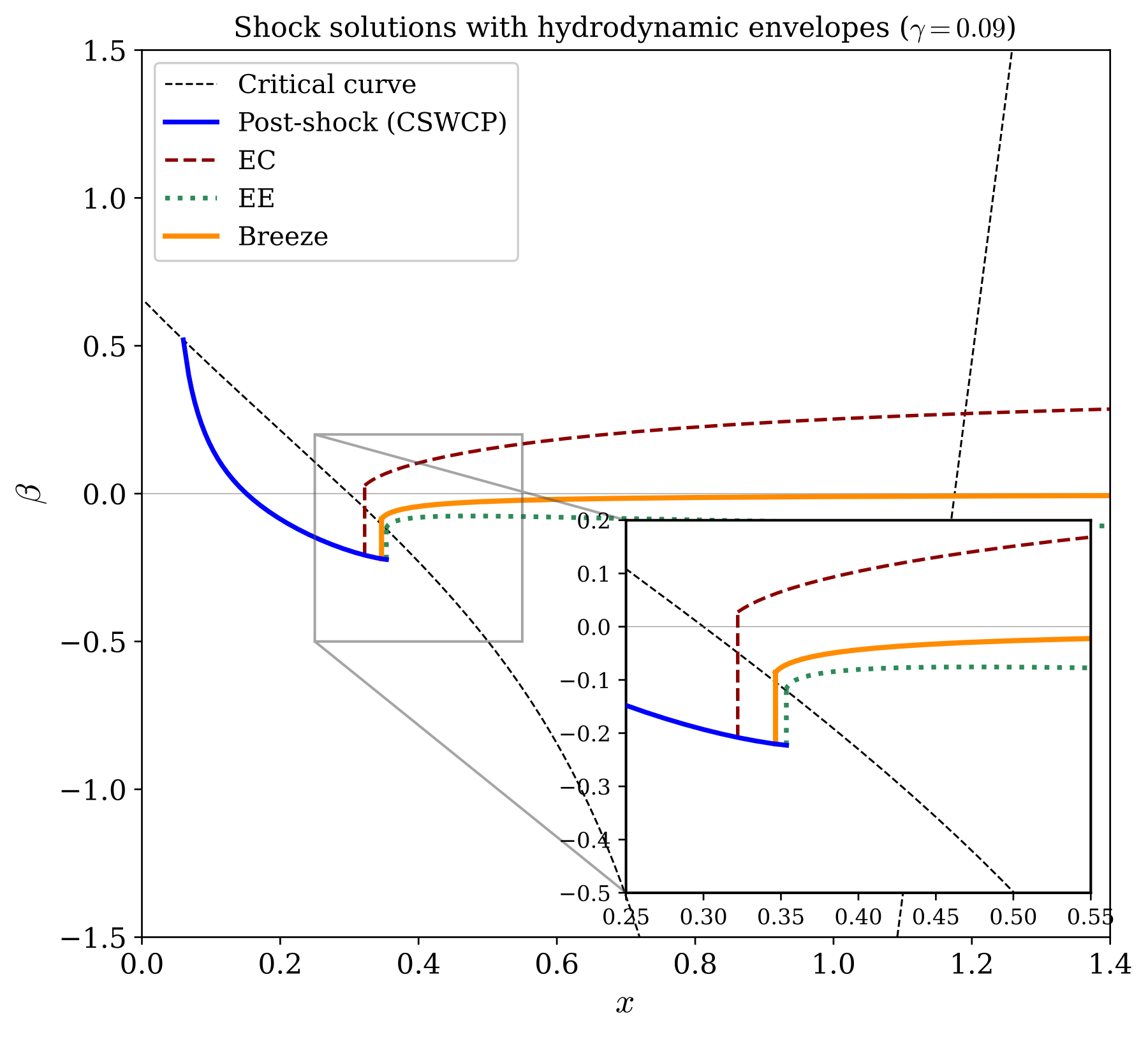
Figure 2 from General Relativistic Shock Wave Solutions with Black Hole Formation: The Singular Isothermal Sphere Case

2026-06-30 · 2606.29607v1 · Research note

General Relativistic Shock Wave Solutions with Black Hole Formation: The Singular Isothermal Sphere Case

Chien-Ting J. Chen, Michael J. Cai, Fabio Pacucci

This analytic study derives relativistic, self-similar shocks during singular-isothermal-sphere collapse to a black hole. In this idealized isothermal model, shocks connect collapsing interiors to several envelope states, reduce central supply relative to smooth collapse, and can release appreciable binding energy.

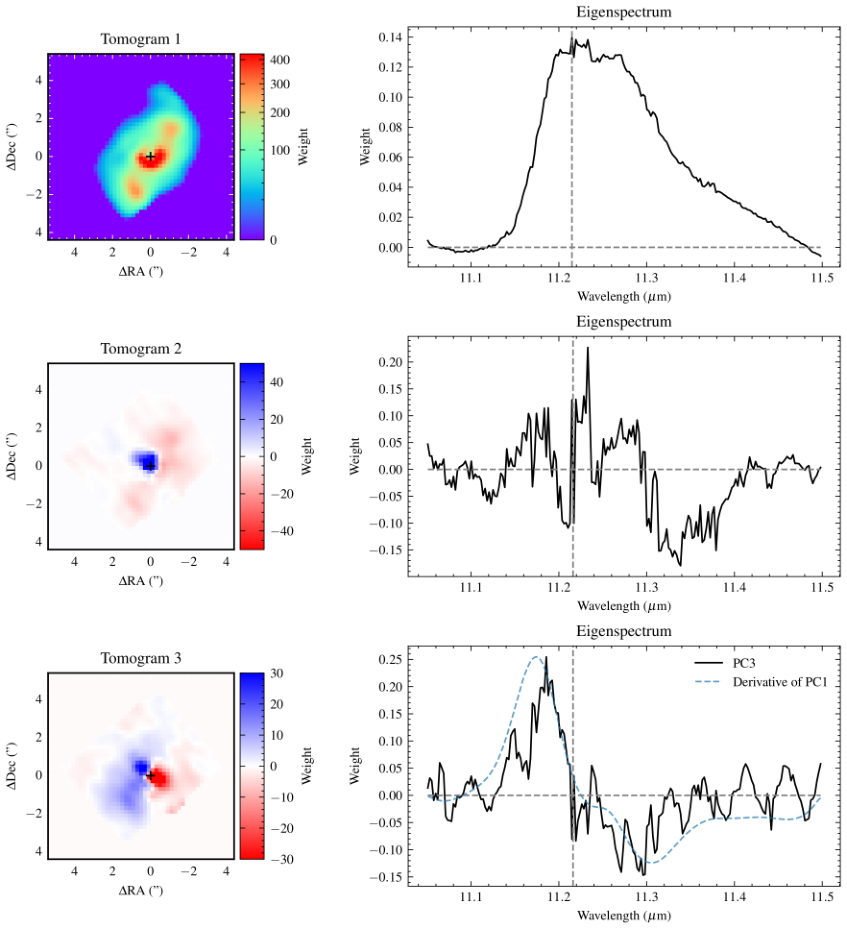
Figure 2 from Kinematic detection of dusty outflows from active galactic nuclei: Polycyclic aromatic hydrocarbon kinematics of type 2 quasars with JWST/MIRI spectroscopy

2026-06-29 · 2606.28311v1 · Research note

Kinematic detection of dusty outflows from active galactic nuclei: Polycyclic aromatic hydrocarbon kinematics of type 2 quasars with JWST/MIRI spectroscopy

Fergus R. Donnan, Cristina Ramos Almeida, Omaira González Martín, et al.

JWST/MIRI PCA tomography recovers 11.3-μm PAH velocity maps in three of five z~0.1 type-2 quasars; all three show dust-traced outflow kinematics, with molecular-gas residuals consistent with outflow after disk subtraction.

Figure 3 from Memoirs of the curvaton: non-perturbative non-Gaussianity and supermassive primordial black holes

2026-06-29 · 2606.28296v1 · Research note

Memoirs of the curvaton: non-perturbative non-Gaussianity and supermassive primordial black holes

S. Allegrini, A. J. Iovino, G. Perna, et al.

This theoretical study builds non-perturbative curvaton mappings for several potentials and argues that positive non-Gaussianity can yield supermassive primordial-black-hole seeds compatible with μ-distortion limits, offering a proposed—not observationally tested—route to JWST Little Red Dots.

Figure 9 from OzSSy1: The Australian Southern Seyfert-1 Spectroscopic Atlas and Catalogue at z < 0.1

2026-06-29 · 2606.27675v1 · Research note

OzSSy1: The Australian Southern Seyfert-1 Spectroscopic Atlas and Catalogue at z < 0.1

Neelesh Amrutha, Christian Wolf, Christopher A. Onken, et al.

OzSSy1 releases uniform WiFeS spectroscopy, decompositions, and line measurements for 887 southern broad-line AGNs at z<0.1, providing a local reference sample while retaining incompleteness from host dilution at the lowest redshifts.

Figure 6 from SEEDZ: Rapid Galaxy Assembly as a Pathway to Supermassive Stars, Dense Stellar Environments and Massive Black Hole Seeds

2026-06-29 · 2606.27427v1 · Research note

SEEDZ: Rapid Galaxy Assembly as a Pathway to Supermassive Stars, Dense Stellar Environments and Massive Black Hole Seeds

Lewis R. Prole, John A. Regan, Daxal Mehta, et al.

In SEEDZ high-resolution cosmological simulations, rapidly assembling halos preferentially meet a prescribed central-inflow criterion for heavy seeds. The authors infer that low-metallicity, sustained-accretion SMS candidates are rare, making any Little Red Dot connection conditional on model assumptions.

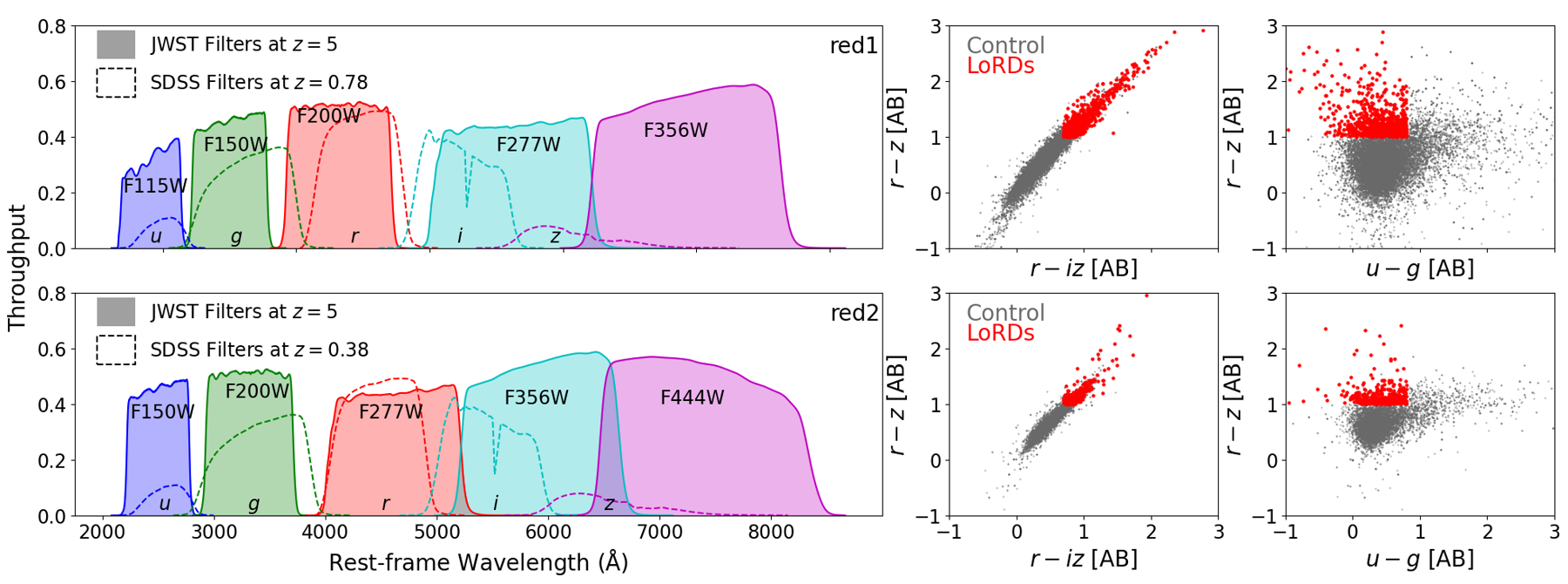
Figure 1 from A Population of Little Red Dot-like Quasars in SDSS

2026-06-25 · 2606.26098v1 · Research note

A Population of Little Red Dot-like Quasars in SDSS

Quinn O. Casey, Ryan C. Hickox, Nikko J. Cleri, et al.

SDSS color selection identifies ~1,300 low-redshift “LoRD” quasars whose V-shaped subset resembles LRD spectral energy distributions, but host contamination, unresolved morphology, and weak high-z X-ray limits prevent establishing them as a uniformly faithful analog population.

Figure 3 from Two years of shock interaction tracing three phases of evolution: the explosion of a Type IIn supernova, SN 2019vxm

2026-06-25 · 2606.25896v1 · Research note

Two years of shock interaction tracing three phases of evolution: the explosion of a Type IIn supernova, SN 2019vxm

Gitika Rameshan, Rishabh Singh Teja, D. K. Sahu, et al.

Across >2 years of photometry and spectroscopy, SN 2019vxm is interpreted as an interaction-powered Type IIn whose UV-to-optical-to-IR evolution and increasingly blueshifted Balmer asymmetry are consistent with a late dust contribution, though its origin remains unresolved.