654 indexed papers · 430 research notes

Research archive

Reset
Figure 8 from X-rays Mark the Spot: The Effects of Reduced Metallicity on X-ray AGN Obscuration at High Redshift

2026-06-25 · 2606.25018v1 · Research note

X-rays Mark the Spot: The Effects of Reduced Metallicity on X-ray AGN Obscuration at High Redshift

Yash A. Gursahani, Christopher S. Reynolds

Monte Carlo torus calculations predict that metal-poor, Compton-thick AGN can transmit more X-ray flux than solar-metallicity counterparts, potentially aiding z≳10 detection. The result is model-based: geometry, viewing angle, abundance pattern, and cold-gas assumptions remain consequential.

Figure 2 from Constraints on the Gas Geometry Surrounding Little Red Dots through Narrow-Line Diagnostics

2026-06-24 · 2606.23778v1 · Research note

Constraints on the Gas Geometry Surrounding Little Red Dots through Narrow-Line Diagnostics

Visal Sok, Erica J. Nelson, Mitchell C. Begelman, et al.

Narrow-line ratios in roughly 20 high-S/N JWST/NIRSpec LRD spectra challenge a uniformly opaque, unity-covering gas envelope: at least 40% require extreme ionization conditions, while weak He II indicates an ionizing spectrum softer than standard AGN.

Figure 4 from Little Red Dots on FIRE: Exploring the formation and observational signatures of ultra-compact early galaxies

2026-06-23 · 2606.23683v1 · Research note

Little Red Dots on FIRE: Exploring the formation and observational signatures of ultra-compact early galaxies

Niranjan Chandra Roy, Daniel Anglés-Alcázar, Rachel K. Cochrane, et al.

FIRE simulations show that transient, inflow-built ultra-compact stellar cores can match several LRD observables without AGN, but fail for the reddest optical continua and most extreme lines, favoring heterogeneous hybrid stellar+AGN interpretations.

2026-06-22 · 2606.21614v1 · Research note

Little Red and Blue Dots: AGN-excited narrow lines, Lyman-$α$ emission, and resemblance to standard quasars

Sophia Geris, Roberto Maiolino, Xihan Ji, et al.

In 36 GOODS LRDs/LBDs at z=2.26–7.89, the authors find AGN-like narrow-line excitation, extreme X-ray weakness, and LRD Lyα excess with a broad component resembling Hα. They argue against completely enclosing cocoon geometries, while retaining obscured-LBD interpretations.

2026-06-22 · 2606.20800v1 · Research note

No hidden monsters: Probing recently-quenched galaxies for obscured AGN with JWST-PRIMER MIRI and NIRCam

Guillaume Hewitt, Omar Almaini, David Maltby, et al.

In 65 PRIMER-UDS post-starbursts at z=1–2, massive systems mostly lack mid-IR excess: template tests place population-level obscured accretion below 1% Eddington. Low-mass PSBs instead show 18-μm excess plausibly associated with residual star formation.

2026-06-18 · 2606.18342v1 · Research note

Compact Core, Extended Reach: A Bipolar kpc-Scale Elongation in a Little Red Dot at $z \approx 5.5$

Zhiyuan Ji, Yang Sun, Mauro Giavalisco, et al.

For the single z=5.482 Little Red Dot LRD-204851, aligned UV, optical-line, and Lyα structures indicate a narrow bipolar channel extending several kpc. Lyα transfer fitting favors slow expansion, but cannot distinguish an outflow from a quasi-static ionization cone.

2026-06-17 · 2606.18155v1 · Research note

X-ray eclipse tomography: Resolving the extent of X-ray-emitting region(s) in the Seyfert galaxy ESO362-G18

Laura Rueda-Nieto, Beatriz Agís-González, Giovanni Miniutti

Swift eclipse monitoring of ESO 362-G18 uses time-resolved absorption changes to constrain an X-ray source within ~35 Rg. The authors infer a structured cloud and a soft-excess region ~50% larger than, yet overlapping, the hot corona.

2026-06-17 · 2606.17271v1 · Research note

Black Hole Stars Across the Universe: Identifying Central Engine Dominated Little Red Dots at $z\sim1.5-9.5$

Andrea Weibel, Rohan P. Naidu, Pascal A. Oesch, et al.

A BH*-template SED selection yields 241 compact, rest-optical central-engine-dominated candidates over z~1.7–9.3, extending beyond conventional V-shaped LRD criteria; inferred luminosities and Eddington-based masses remain model-dependent.

2026-06-17 · 2606.17144v1 · Research note

Decoupled Kinematics and Excitation in the Compton-thick AGN NGC 6552: Spatially Resolved KOOLS-IFU Observations

Kyuseok Oh, Yoshihiro Ueda, Kanta Fujiwara, et al.

KOOLS-IFU maps of NGC 6552 find broad [O III] emission declining with radius but no significant full-sample association between local kinematics and [O III]/Hβ excitation, favoring spatial dynamical structure over a detected excitation–kinematics coupling.

2026-06-16 · 2606.16343v1 · Research note

Optical Variability as a Probe of Hidden Nuclear Activity in Type 2 AGNs

Maša Lakićević

In 412 Stripe 82 Type 2 AGNs, optical RMS variability anticorrelates with several narrow-line luminosities, equivalent widths, and widths. The authors interpret this as variability retaining information about obscured accretion, although controls and photometric-noise limits temper causal inference.

Figure 5 from Probing Direct Contributions of Galaxies and AGN to Cosmic Reionization in a Quasar Field J0226+0302 with JWST NIRCam and NIRSpec

2026-06-16 · 2606.14959v1 · Research note

Probing Direct Contributions of Galaxies and AGN to Cosmic Reionization in a Quasar Field J0226+0302 with JWST NIRCam and NIRSpec

Xiangyu Jin, Jinyi Yang, Feige Wang, et al.

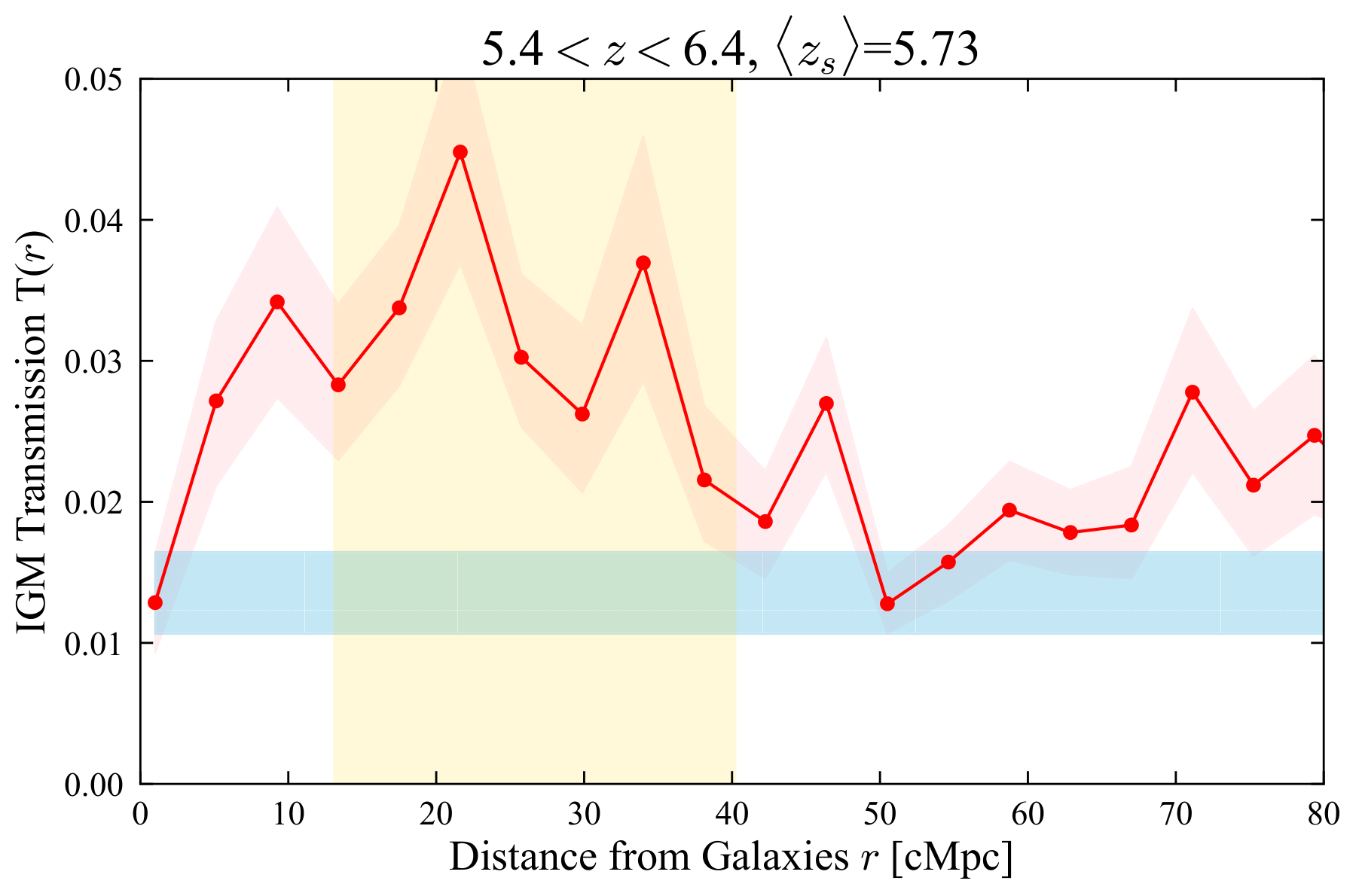
In the J0226+0302 quasar sightline, 73 line-emitting galaxies trace a tentative, 10–40 cMpc enhancement in IGM transmission, while four broad-line AGN show a possible smaller-scale enhancement. The results favor local ionizing-background variations but remain statistically and model limited.

2026-06-15 · 2606.13819v1 · Research note

GA-NIFS: The interplay between feedback and star formation at 3 < z < 9 probed by JWST/NIRSpec IFU

L. Ulivi, M. Perna, S. Arribas, et al.

Across six JWST/NIRSpec IFU targets at z=3–9, resolved stellar-population histories associate strong AGN-driven ionized outflows with recent nuclear quenching in the most massive systems, while starburst-driven outflows accompany continued growth in lower-mass galaxies.

Figure 1 from Between Degeneracy and Evolution: UV-to-optical Insights into the BH$^*$ Model in Little Red Dots

2026-06-11 · 2606.12355v1 · Research note

Between Degeneracy and Evolution: UV-to-optical Insights into the BH$^*$ Model in Little Red Dots

Rosa M. Mérida, Marcin Sawicki, Chris J. Willott, et al.

UV-to-optical continuum fits to 66 JWST LRDs find BH* configurations in only about 6% of 52 robust broad-prior fits; suppressing AGN light raises this to about 40%, exposing severe model degeneracy rather than establishing BH* prevalence.

2026-06-11 · 2606.12076v1 · Research note

X-ray luminosity function of Compton-thick AGN in the early Universe (z > 3). Robustness and biases of the CTK population

Angel Ruiz, Ektoras Pouliasis, Ioannis Georgantopoulos

Using X-ray spectra and infrared-informed absorption priors, the authors infer that Compton-thick AGN comprise 17% of AGN at z=3–6. The revision sharply reduces candidate classifications, but supports no significant redshift evolution in this fraction.

Figure 1 from JADES: the mass-metallicity relation at $z=1-10$. New calibrations, extremely metal-poor galaxies, and chemical diversity

2026-06-11 · 2606.11345v1 · Research note

JADES: the mass-metallicity relation at $z=1-10$. New calibrations, extremely metal-poor galaxies, and chemical diversity

Yuki Isobe, Mirko Curti, Roberto Maiolino, et al.

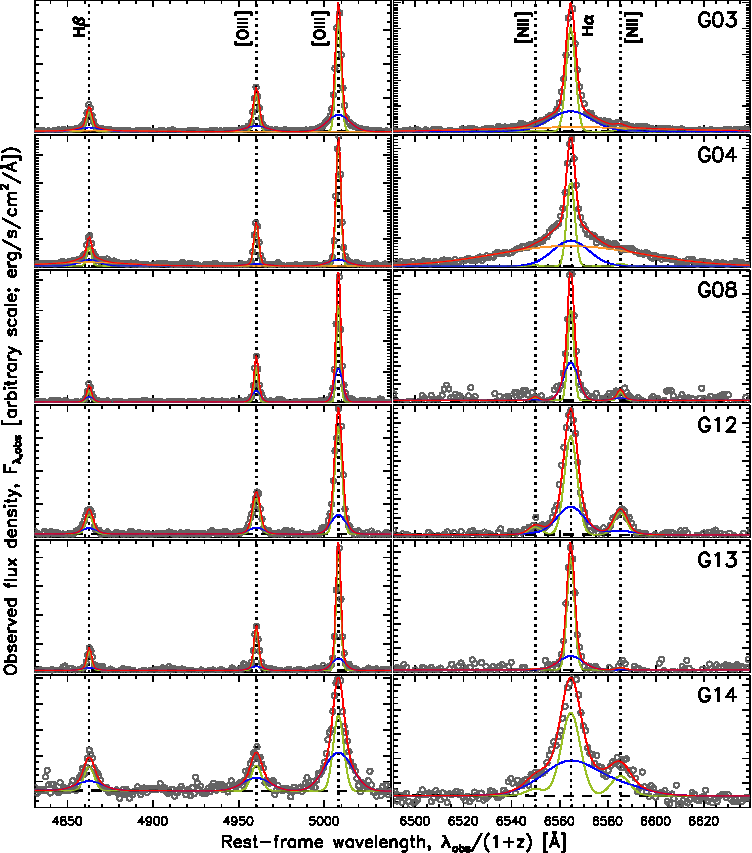
Stacked JWST/NIRSpec spectra of roughly 2,500 z=1–10 galaxies yield Te-anchored strong-line metallicity calibrations and MZRs. The authors find declining metallicity with redshift, 50 EMPG candidates, and two broad-Hα Little Red Dots in this metal-poor sample.

2026-06-10 · 2606.10455v1 · Research note

The Extreme Quasar Main Sequence of Super-Eddington DESI-DR1 NLSy1 Galaxies

Alberto Domínguez</name> <arxiv:affiliation>UCM</arxiv:affiliation> </author> <author> <name>Suvendu Rakshit, Vaidehi S. Paliya, D. J. Saikia, et al.

In 18,749 DESI-DR1 NLSy1s, stronger Fe II and lower single-epoch virial masses than SDSS-DR17 correspond to a larger inferred super-Eddington fraction. Two mass calibrations preserve the population difference, but virial-mass systematics remain consequential.

Figure 2 from Aether-SHELLQs: JWST integral-field spectroscopy of candidate obscured quasars at z ~ 6

2026-06-10 · 2606.10160v1 · Research note

Aether-SHELLQs: JWST integral-field spectroscopy of candidate obscured quasars at z ~ 6

Yoshiki Matsuoka, Roberto Decarli, Emanuele Paolo Farina, et al.

JWST/NIRSpec IFU spectroscopy of six z~6 SHELLQs narrow-Lyα candidates finds secure broad Balmer components in two, while extended, largely non-rotating ionized gas characterizes several non-broad-line systems. Broad-line incidence rises sharply with Lyα luminosity.

Figure 5 from Through the Veil: Ly$α$ Illuminates the Host Galaxies of Little Red Dots

2026-06-10 · 2606.09970v1 · Research note

Through the Veil: Ly$α$ Illuminates the Host Galaxies of Little Red Dots

Zhiyuan Ji, Yang Sun, Mauro Giavalisco, et al.

In 110 z≥4 little red dots, 32 Lyα detections and resolved imaging of 13 higher-redshift systems indicate that escaping Lyα more plausibly traces extended host-scale gas than the compact red/Balmer-line component, although continuum-subtraction and depth limit morphology.

Figure 2 from A Scaling Relation of LRDs between Broad H$α$ and Bolometric Luminosities: Enhanced Broad H$α$ Emission Relative to Low-$z$ Type 1 AGN

2026-06-09 · 2606.09726v1 · Research note

A Scaling Relation of LRDs between Broad H$α$ and Bolometric Luminosities: Enhanced Broad H$α$ Emission Relative to Low-$z$ Type 1 AGN

Hiroto Yanagisawa, Masami Ouchi, Tomokazu Kiyota, et al.

Across 37 z=3–7 LRDs, broad Hα scales tightly with modified-blackbody bolometric luminosity yet is ∼40 times stronger than in low-z Type 1 AGN at fixed Lbol. The authors attribute this to unusually high-covering, high-column broad-line gas.

Figure 6 from NEXUS: Abundance, Environments, and Spectral Diversity of Little Red Dots from the NIRSpec MSA Sample

2026-06-09 · 2606.09721v1 · Research note

NEXUS: Abundance, Environments, and Spectral Diversity of Little Red Dots from the NIRSpec MSA Sample

Zhiwei Pan, Ming-Yang Zhuang, Yue Shen, et al.

NEXUS combines JWST imaging and PRISM spectroscopy to census LRDs at z=2.3–7.5. Its 36 confirmed objects are predominantly broad-line sources, while selection calibration, abundance, clustering, and continuum diversity remain limited by contamination, resolution, and sample size.

2026-06-09 · 2606.09413v1 · Research note

Towards a consistent framework of determining active galactic nucleus contribution fraction and host galaxy properties

Mi Chen, Lingyu Wang, Berta Margalef-Bentabol, et al.

Across 21,428 COSMOS-Web galaxies, two SED codes and deep-learning imaging agree well when AGN light is negligible but diverge sharply for AGN-significant systems. Imaging-constrained refits can materially shift host properties despite acceptable photometric fits.

2026-06-08 · 2606.06585v1 · Research note

A Population of Red Galaxies with Very Strong Emission Lines at $z > 5$ Revealed by the NIRCam Medium Bands: ''Classic'' LRDs, Dusty Star-Forming Galaxies, and a Missing Population of LRDs

Sunna Withers, Adam Muzzin, Swara Ravindranath, et al.

Medium-band NIRCam colors identify 26 red, strong-line galaxies at z=5.01–8.60. Nine unresolved objects evade common Little Red Dot cuts; the authors favor a missed LRD population, but dusty star formation and AGN remain viable alternatives.

Figure 2 from The quasi-star model for Little Red Dots: potential and challenges

2026-06-08 · 2606.06575v1 · Research note

The quasi-star model for Little Red Dots: potential and challenges

Fabrizio Gentile, Mauro Giavalisco, Emanuele Daddi, et al.

Cloudy fits show that a host-plus-quasi-star model can reproduce several LRD continuum and hydrogen-line properties, but helium lines, hot dust, and model degeneracy prevent it from uniquely establishing quasi-stars as the explanation.

Figure 5 from The Multi-phase Biconical Outflow in the local IR-Luminous Merger IRASF01364-1042

2026-06-05 · 2606.06005v1 · Research note

The Multi-phase Biconical Outflow in the local IR-Luminous Merger IRASF01364-1042

Y. Song</name> <arxiv:affiliation>European Southern Observatory, Chile</arxiv:affiliation> <arxiv:affiliation>Joint ALMA Observatory, Chile</arxiv:affiliation> <arxiv:affiliation>Max-Planck-Institut für Radioastronomie, Germany</arxiv:affiliation> </author> <author> <name>V. U</name> <arxiv:affiliation>IPAC, California Institute of Technology, USA</arxiv:affiliation> <arxiv:affiliation>University of California, Irvine, USA</arxiv:affiliation> </author> <author> <name>J. Kader</name> <arxiv:affiliation>University of California, Irvine, USA</arxiv:affiliation> </author> <author> <name>M. Bianchin</name> <arxiv:affiliation>University of California, Irvine, USA</arxiv:affiliation> <arxiv:affiliation>Instituto de Astrof\' isica de Canarias, Spain</arxiv:affiliation> <arxiv:affiliation>Universidad de La Laguna, Spain</arxiv:affiliation> </author> <author> <name>J. Agostino</name> <arxiv:affiliation>Ritter Astrophysical Research Center and Department of Physics and Astronomy, University of Toledo, USA</arxiv:affiliation> </author> <author> <name>L. Barcos-Muñoz</name> <arxiv:affiliation>National Radio Astronomy Observatory, Charlottesville, USA</arxiv:affiliation> <arxiv:affiliation>Department of Astronomy, University of Virginia, Charlottesville, USA</arxiv:affiliation> </author> <author> <name>N. Torres-Albà</name> <arxiv:affiliation>Department of Astronomy, University of Virginia, Charlottesville, USA</arxiv:affiliation> </author> <author> <name>A. Medling</name> <arxiv:affiliation>Ritter Astrophysical Research Center and Department of Physics and Astronomy, University of Toledo, USA</arxiv:affiliation> </author> <author> <name>C. Ricci</name> <arxiv:affiliation>Department of Astronomy, University of Geneva, Switzerland</arxiv:affiliation> <arxiv:affiliation>Instituto de Estudios Astrofísicos, Facultad de Ingeniería y Ciencias, Universidad Diego Portales, Chile</arxiv:affiliation> </author> <author> <name>L. Armus</name> <arxiv:affiliation>IPAC, California Institute of Technology, USA</arxiv:affiliation> </author> <author> <name>T. Lai</name> <arxiv:affiliation>IPAC, California Institute of Technology, USA</arxiv:affiliation> </author> <author> <name>L. Ghodsi</name> <arxiv:affiliation>Hiroshima Astrophysical Science Center, Hiroshima University, Japan</arxiv:affiliation> </author> <author> <name>A. Evans</name> <arxiv:affiliation>National Radio Astronomy Observatory, Charlottesville, USA</arxiv:affiliation> <arxiv:affiliation>Department of Astronomy, University of Virginia, Charlottesville, USA</arxiv:affiliation> </author> <author> <name>H. Inami</name> <arxiv:affiliation>Occidental College, Physics Department, USA</arxiv:affiliation> </author> <author> <name>S. Stierwalt</name> <arxiv:affiliation>Leiden Observatory, Leiden University, The Netherlands</arxiv:affiliation> </author> <author> <name>T. Bohn</name> <arxiv:affiliation>Occidental College, Physics Department, USA</arxiv:affiliation> </author> <author> <name>K. L. Emig</name> <arxiv:affiliation>National Radio Astronomy Observatory, Charlottesville, USA</arxiv:affiliation> </author> <author> <name>V. Buiten</name> <arxiv:affiliation>Instituto de Alta Investigación, Universidad de Tarapacá, Chile</arxiv:affiliation> </author> <author> <name>G. Donnelly</name> <arxiv:affiliation>Ritter Astrophysical Research Center and Department of Physics and Astronomy, University of Toledo, USA</arxiv:affiliation> </author> <author> <name>E. Treister</name> <arxiv:affiliation>European Space Agency, c/o STScI, USA</arxiv:affiliation> </author> <author> <name>A. Jimenez-Gallardo</name> <arxiv:affiliation>European Southern Observatory, Chile</arxiv:affiliation> </author> <author> <name>T. Böker</name> <arxiv:affiliation>Centre for Astrophysics Research, University of Hertfordshire, UK</arxiv:affiliation> </author> <author> <name>D. Kakkad</name> <arxiv:affiliation>Steward Observatory, University of Arizona, USA</arxiv:affiliation> </author> <author> <name>S. Linden</name> <arxiv:affiliation>School of Sciences, European University Cyprus, Cyprus</arxiv:affiliation> </author> <author> <name>P. van der Werf</name> <arxiv:affiliation>Instituto de Alta Investigación, Universidad de Tarapacá, Chile</arxiv:affiliation> </author> <author> <name>V. Charmandaris</name> <arxiv:affiliation>Institute of Astrophysics, Foundation for Research and Technology-Hellas</arxiv:affiliation> <arxiv:affiliation>Department of Physics, University of Crete, Greece</arxiv:affiliation> <arxiv:affiliation>Department of Astronomy, University of Florida, USA</arxiv:affiliation> </author> <author> <name>R. Remigio</name> <arxiv:affiliation>University of California, Irvine, USA</arxiv:affiliation> </author> <author> <name>L. Lenkic</name> <arxiv:affiliation>IPAC, California Institute of Technology, USA</arxiv:affiliation> </author> <author> <name>C. Finlez</name> <arxiv:affiliation>European Southern Observatory, Chile</arxiv:affiliation> <arxiv:affiliation>Joint ALMA Observatory, Chile</arxiv:affiliation> </author> <author> <name>M. Sanchez-García</name> <arxiv:affiliation>Department of Physics, University of Crete, Greece</arxiv:affiliation> <arxiv:affiliation>Department of Astronomy, University of Florida, USA</arxiv:affiliation> </author> <author> <name>C. Lofaro</name> <arxiv:affiliation>Department of Physics, University of Crete, Greece</arxiv:affiliation> <arxiv:affiliation>Department of Astronomy, University of Florida, USA</arxiv:affiliation> </author> <author> <name>A. Saravia</name> <arxiv:affiliation>National Radio Astronomy Observatory, Charlottesville, USA</arxiv:affiliation> <arxiv:affiliation>Department of Astronomy, University of Virginia, Charlottesville, USA</arxiv:affiliation> </author> <author> <name>I. Yoon</name> <arxiv:affiliation>National Radio Astronomy Observatory, Charlottesville, USA</arxiv:affiliation> </author> <author> <name>G. C. Privon</name> <arxiv:affiliation>National Radio Astronomy Observatory, Charlottesville, USA</arxiv:affiliation> <arxiv:affiliation>Department of Astronomy, University of Virginia, Charlottesville, USA</arxiv:affiliation> <arxiv:affiliation>Research School of Astronomy and Astrophysics, Australian National University, Australia</arxiv:affiliation> </author> <author> <name>T. Gao</name> <arxiv:affiliation>ARC Centre of Excellence for All Sky Astrophysics in 3 Dimensions</arxiv:affiliation> <arxiv:affiliation>W. M. Keck Observatory, USA</arxiv:affiliation> </author> <author> <name>H. Aziz</name> <arxiv:affiliation>University of California, Irvine, USA</arxiv:affiliation> </author> <author> <name>R. McGurk</name> <arxiv:affiliation>Institute for Astronomy, University of Hawaii, USA</arxiv:affiliation> </author> <author> <name>T. Díaz-Santos</name> <arxiv:affiliation>Department of Physics, University of Crete, Greece</arxiv:affiliation> <arxiv:affiliation>Department of Astronomy, University of Florida, USA</arxiv:affiliation> </author> <author> <name>D. Kunneriath</name> <arxiv:affiliation>National Radio Astronomy Observatory, Charlottesville, USA</arxiv:affiliation> </author> <author> <name>David B. Sanders

Spatially resolved JWST, ALMA and KCWI data support a multiphase, minor-axis biconical outflow in the dusty local merger IRAS F01364-1042. The authors infer faster ionized than molecular gas and argue a nuclear starburst can energetically drive it despite an obscured AGN.

2026-06-05 · 2606.05281v1 · Research note

Little red dots as a cosmological probe: constraining $H_0$ with quasi-periodic pulsations

Zijian Zhang, Kohei Inayoshi, Masamune Oguri, et al.

Using one lensed, decades-variable little red dot, the authors turn an idealized pulsation period–luminosity–temperature relation into a preliminary, period-limited H0 estimate. Ten-year monitoring could improve statistical precision, but calibration of the relation remains the decisive uncertainty.

2026-06-04 · 2606.04712v1 · Research note

The Extreme Rarity and Physical Properties of Low-redshift AGNs with Balmer Absorption

Jinyi Shangguan, Chang-Hao Chen, Luis C. Ho, et al.

Among 14,584 SDSS type-1 AGNs at z<0.35, seven robust Balmer absorbers imply a ∼0.05% incidence. Joint, resolution-aware Balmer fitting finds narrow, generally saturated absorbers; a rare high-Eddington, weak-Fe II subset may be preferentially affected.

Figure 3 from ABCD: The Nuclear Structure of the Little Red Dots Revealted through Absorption, Break, Continuum, and Decrement

2026-06-04 · 2606.04711v1 · Research note

ABCD: The Nuclear Structure of the Little Red Dots Revealted through Absorption, Break, Continuum, and Decrement

Chang-Hao Chen, Jinyi Shangguan, Luis C. Ho, et al.

JWST/NIRSpec spectroscopy of 14 LRDs separates Balmer emission and absorption, favoring dense broad-line gas over dust as the main origin of elevated broad Balmer decrements. A clumpy, viewing-angle-dependent nuclear geometry is proposed, but velocity-profile fits succeed in only three of five high-S/N sources.

2026-06-03 · 2606.03667v1 · Research note

Constraining AGN accretion physics with black hole mass-luminosity scaling relations

F. Fiore, M. Gaspari, S. Puccetti, et al.

Across a large SDSS–eROSITA quasar sample, bolometric luminosity scales nearly linearly with virial black-hole mass while hard X-rays rise more slowly. The authors argue this disfavors classical Bondi feeding and favors CCA, but redshift covariances and JWST line-based systematics limit interpretation.

2026-06-03 · 2606.03522v1 · Research note

The UV Side of Little Red Dots: Red, Compact, and Iron-Enhanced Rest-UV Emission with a Strong Downturn around Ly$α$

Makoto Ando, Yuichi Harikane, Harley Katz, et al.

Across roughly 100 JWST-selected LRDs, rest-UV emission is redder and about four times more compact than matched star-forming galaxies. Stacked spectral trends and high Fe II/Mg II favor a substantial compact central component, although its physical origin remains model-dependent.

Figure 3 from Little Red Dot progenitors from Compact Starbursts: A Natural Path to Early AGN Formation

2026-06-03 · 2606.03375v1 · Research note

Little Red Dot progenitors from Compact Starbursts: A Natural Path to Early AGN Formation

Matías Liempi, Muhammad A. Latif, Dominik R. G. Schleicher

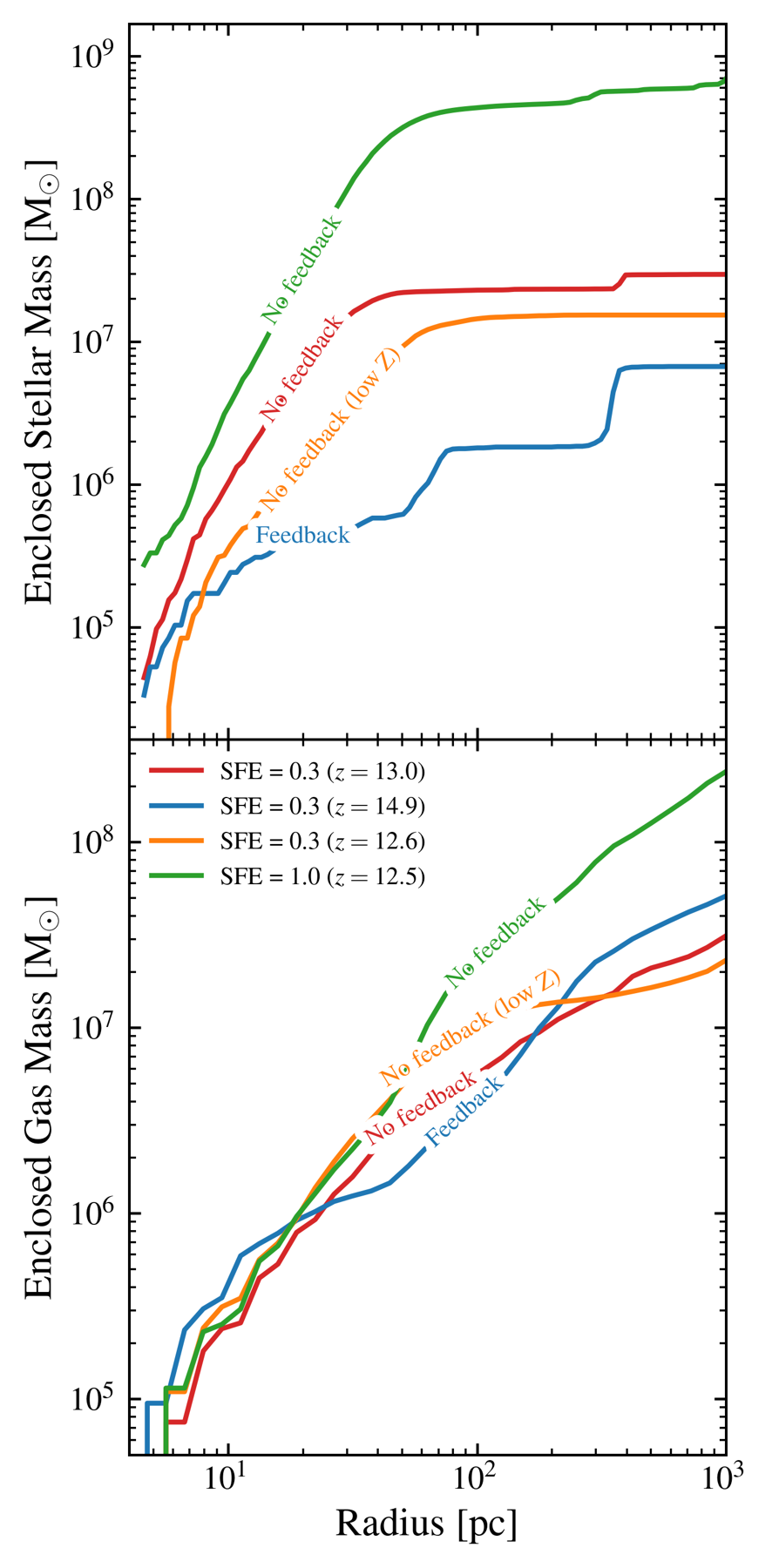
Cosmological simulations of compact z≈12.5–14.9 starbursts find centrally concentrated stellar and gas reservoirs. The authors argue that rapid inflow and transport could, under an assumed 10% retained efficiency, assemble conditions for a ∼10^6 M⊙ black hole and an AGN phase.

2026-06-02 · 2606.01870v1 · Research note

Mass and Spin Growth of Very Massive Stars in Star Clusters Potentially Associated with Little Red Dots

Ataru Tanikawa, Masaru Shibata, Kunihito Ioka

Four N-body cluster models produce collision-grown very massive stars of 10^3–10^4 M⊙; a collision-maintained bloated phase can substantially increase growth, but its duration and the resulting masses/spins remain sensitive to idealized collision and stellar-evolution assumptions.

Figure 3 from OCEANS of Absorption: High-resolution NIRSpec Spectroscopy Reveals Diverse Balmer-line Absorption in Little Red Dots

2026-06-02 · 2606.00258v1 · Research note

OCEANS of Absorption: High-resolution NIRSpec Spectroscopy Reveals Diverse Balmer-line Absorption in Little Red Dots

Kelcey Davis, Madisyn Brooks, Raymond C. Simons, et al.

High-resolution JWST/NIRSpec spectra of 10 compact, color-selected LRDs at 3<z<7 recover Balmer absorption in four. The authors argue resolution exposes frequent, diverse excited-hydrogen absorption, but the small, selected sample limits population-level inferences.

2026-06-02 · 2606.00205v1 · Research note

Ultraviolet diversity of Little Red Dots as a probe for direct-collapse black hole ages

Elia Cenci, Melanie Habouzit, Dale D. Kocevski

In MELIORA simulations at z>8.5, the host-to-DCBH UV–optical balance declines over roughly 30 Myr after direct collapse, offering a model-dependent relative age indicator: UV-faint/red LRDs are younger, whereas UV-bright systems have more developed stellar hosts.

2026-06-01 · 2605.31077v1 · Research note

Super-Eddington accretion of black holes in early nuclear bursts gives birth to Little Red Dots

Yangyao Chen, Houjun Mo

A cosmological black-hole/galaxy model interprets z≈5 Little Red Dots as luminous, short super-Eddington nuclear-burst phases of previously seeded black holes. It reproduces the reported number-density shape, but the proposed triggering, seeding mix, and descendants remain model-dependent.

2026-06-01 · 2605.30424v1

High-ionization coronal lines trace quasar-like activity in recently quenched galaxies at high redshift

F. Valentino, K. Ito, M. Farcy, et al.

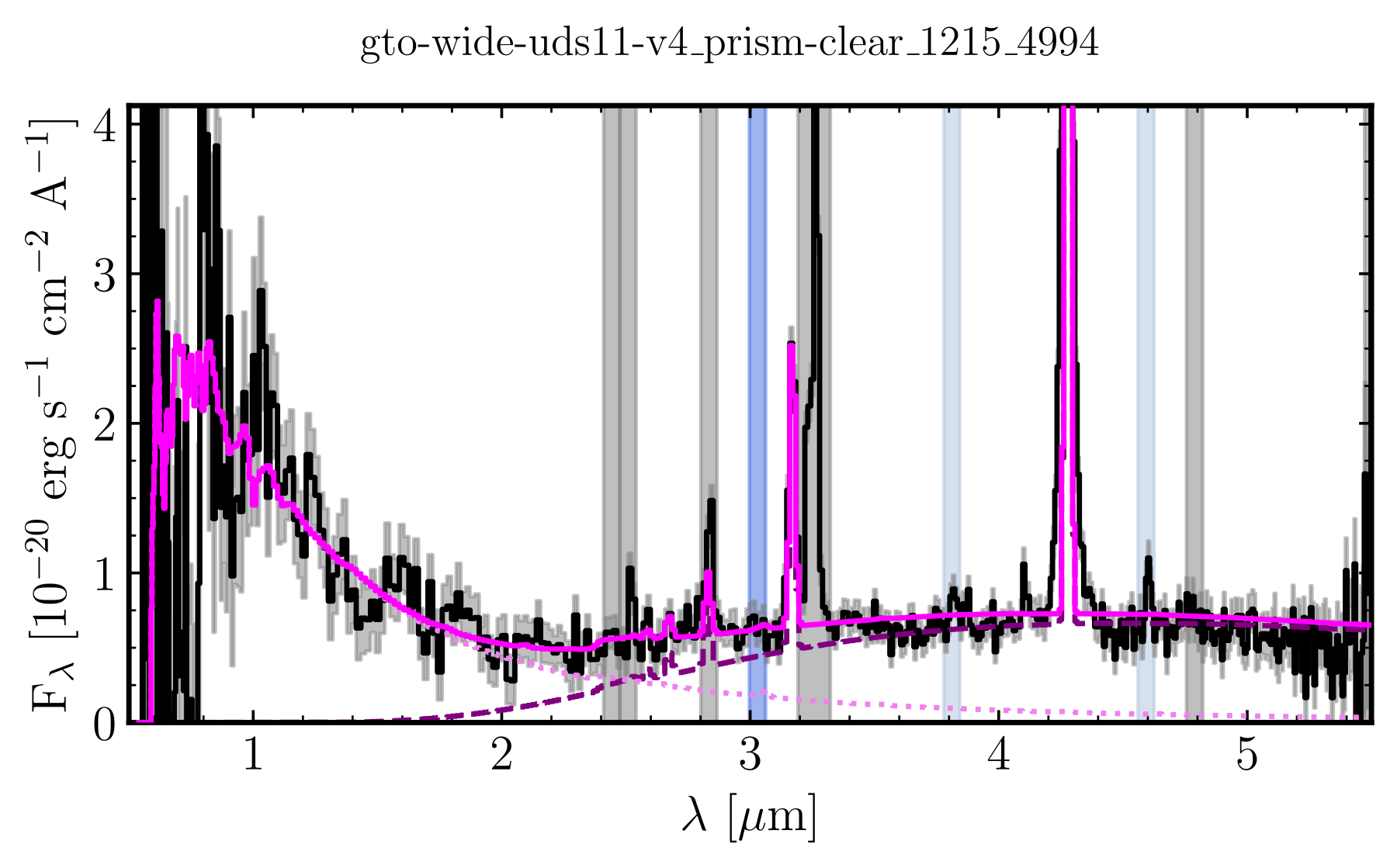
This paper searches JWST/NIRSpec archival spectra of 87 massive quenched galaxies at z≈1.5-4.5 and finds [NeV] λ3427 in six, arguing that this coronal line cleanly isolates luminous SMBH accretion in systems where residual star formation is not a viable explanation. Four of the six [NeV] hosts also show broad Hα with FWHM ≳ 4000 km s^-1, implying MBH ≈ 10^8.5-10^9.5 Msun, while the [NeV] luminosities indicate quasar-like power outputs of roughly 10^45-10^46 erg s^-1 and Eddington ratios of about 10-50%. The strongest [NeV] emitters sit in the youngest post-starburst galaxies with Dn4000 ≲ 1.3, whereas older quenched systems lack comparable activity, pointing to intense radiatively efficient black-hole growth that can continue for several hundred Myr after the main quenching event. That timing matters because it links early quenching to delayed but still powerful SMBH growth, and provides a concrete empirical target for models that aim to produce the first massive passive galaxies.

Figure 4 from A Rapid Evolution in the Observed Mbh/M* Relation at z > 3 Revealed via Spectro-photometric SED-Modeling

2026-06-01 · 2605.30414v1 · Research note

A Rapid Evolution in the Observed Mbh/M* Relation at z > 3 Revealed via Spectro-photometric SED-Modeling

Ansh R. Gupta, Anthony Taylor, Emma Curtis-Lake, et al.

Using AGN-aware fits to JWST spectra, the authors report that non-LRD broad-line AGN shift from elevated observed M_BH/M* above z≈4.5 to the local relation by z≈3.5; LRD host-mass inferences remain substantially less secure.

Figure 2 from Transient Signatures of Star-Envelope Collisions in Little Red Dots

2026-05-29 · 2605.29895v1 · Research note

Transient Signatures of Star-Envelope Collisions in Little Red Dots

Tomoya Suzuguchi, Kohei Inayoshi

This modeling study predicts optical/UV transients when cluster stars strike proposed gaseous LRD envelopes. Red-supergiant impacts on envelopes near the SMBH mass are favored; rates could reach 0.3 yr⁻¹ per compact LRD, but detectability depends critically on low-redshift LRD abundance.

2026-05-28 · 2605.27903v1

Double Dots: Compact Pairs Mark Little Red Dots and High-Redshift Broad-line AGNs

A. J. Barger, L. L. Cowie

Using JWST imaging of the lensed A2744 field, this paper defines a sample of 31 sub-0.25 arcsecond compact pairs, or “Double Dots,” and shows their separations are strongly skewed to small values, consistent with most being physical systems rather than chance alignments. The main empirical result is that close pairs are extremely common among known broad-line high-redshift sources in the field: at least 16 of 24 published little red dots and both previously identified high-redshift BLAGNs are double systems, with a median observed separation of 0.15 arcseconds. The authors then show that unresolved companions can materially reshape the observed SED, including washing out the canonical LRD v-shape, and that 2D spectroscopy can place the broad-line emission on either the redder or bluer member of the pair. That makes compact pairing itself a powerful marker of broad-line activity at high redshift and points to merger-driven accretion as a plausible underlying trigger.

2026-05-26 · 2605.24112v1 · Research note

The Lumina Project: The Demographics of Active Galactic Nuclei from Quasars to Little Red Dots at $z\geq 3$

Xuejian Shen, Oliver Zier, Aaron Smith, et al.

Lumina couples a large radiation-hydrodynamic volume to an empirical SMBH-to-observable prescription, and its authors report simultaneous consistency with high-redshift quasar and LRD luminosity functions and LRD clustering. The agreement depends on assumed LRD demographics and spectral properties.

2026-05-20 · 2605.21589v1 · Research note

A Magnetized Black Hole Envelope Model for Little Red Dots

Shinsuke Takasao, Kohei Inayoshi

This theoretical magnetized black-hole-envelope model links cool LRD continua, broad-line shapes, and weak X-rays to super-Eddington spherical inflow onto a rotating envelope, but its quantitative success remains conditional on assumed envelope structure, opacity, magnetism, and line-scattering physics.

2026-05-20 · 2605.21574v1 · Research note

(LRDs)$^2$: The Low-ReDshift Little Red Dots Survey. II. DESI DR1 Sample

Xiaojing Lin, Xiaohui Fan, Zheng Cai, et al.

A DESI DR1 selection identifies 27 candidate low-redshift LRDs at z=0.2–0.9; near-IR spectra of 18 show broad, highly decremented Balmer lines and unusual continua, supporting—but not independently proving—continuity with high-redshift LRD phenomenology.

Figure 1 from Population synthesis of active galactic nuclei based on the radiation-regulated unification model

2026-05-17 · 2605.17547v1 · Research note

Population synthesis of active galactic nuclei based on the radiation-regulated unification model

D. Gerolymatou, S. Paltani, C. Ricci, et al.

Using simulation-based inference on a synthetic local AGN population, the authors find an intrinsic Compton-thick fraction of 40±3%. Their radiation-regulated geometry broadly reproduces several X-ray observables, but depends materially on fixed, simplified broad-line-region and torus assumptions.

2026-05-14 · 2605.15263v1 · Research note

On the quenching of LRD X-ray emission by both Compton-thick gas and high accretion rates

Albert Sneppen, Darach Watson, James H. Matthews, et al.

Sirocco cocoon models suggest that current LRD X-ray non-detections require both moderately enriched, Compton-thick gas and intrinsically X-ray-weak/soft AGN emission. The inference is conditional on assumed intrinsic SEDs, metallicities, columns, and redshift-dependent observing bandpasses.

2026-05-14 · 2605.14922v1 · Research note

DREAMS. JWST Spectroscopy of a $z=8.3$ Galaxy with an ALMA Dust Continuum Detection: Early Dust, Very High $T_{\rm dust}$, and a Multi-wavelength [OIII] Ratio Discrepancy

Kana Takechi, Masami Ouchi, Kimihiko Nakajima, et al.

For the single z=8.312 galaxy MACS0416-Y1, deep JWST/NIRSpec plus archival IFU/ALMA data support a broad-line AGN interpretation, low metallicity and dust mass ratios, and a spatially non-coincident origin for optical and far-infrared [OIII].

Figure 2 from A new sample of Little Red Dots at $z<0.45$ in DESI DR1: Broad Balmer lines, low ionization spectrum and no variability

2026-05-14 · 2605.14233v1 · Research note

A new sample of Little Red Dots at $z<0.45$ in DESI DR1: Broad Balmer lines, low ionization spectrum and no variability

Kevin Park, Alberto Torralba, Jorryt Matthee, et al.

A DESI DR1 line-selected search identifies eight compact z=0.20–0.44 LRD candidates with broad, steep-decrement Balmer emission, low-excitation spectra, and generally weak multi-year variability, extending detailed LRD tests to the nearby Universe.

Figure 2 from Non-LTE atmosphere models of very luminous sources and their applicability to Little Red Dots, quasi-stars, and similar objects

2026-05-12 · 2605.12141v1 · Research note

Non-LTE atmosphere models of very luminous sources and their applicability to Little Red Dots, quasi-stars, and similar objects

Fabrice Martins, Daniel Schaerer, Rui Marques-Chaves

Non-LTE, optically thick wind-atmosphere models at ∼10^10 L☉ can reproduce several LRD continuum and line properties after A_V≈1.9–2.7 attenuation, but cannot generally produce both strong emission lines and a genuine Balmer break.

2026-05-11 · 2605.11077v1 · Research note

The Impact of Cosmic Variance and Satellites on JWST Clustering Measurements at Redshift around 6

Jiamu Huang, Elia Pizzati, Joseph F. Hennawi, et al.

For ASPIRE-like JWST clustering at z≈6, mock-based covariances—not Poisson pair-count errors—are needed for calibrated halo-mass inference: Poisson intervals are systematically too narrow because they omit cosmic variance and correlated radial bins.

Figure 1 from JWST observations and a model for the extremely luminous obscured quasar W2246-0526 at z=4.6

2026-05-09 · 2605.09078v1 · Research note

JWST observations and a model for the extremely luminous obscured quasar W2246-0526 at z=4.6

Charalambia Varnava, Andreas Efstathiou, Tanio Díaz-Santos, et al.

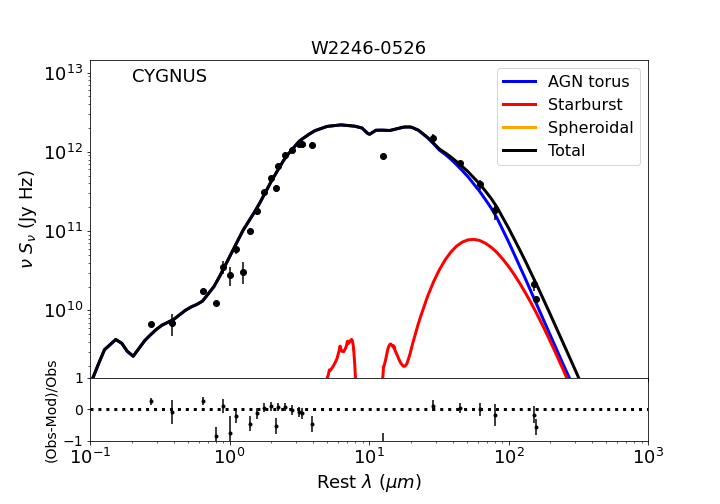
JWST/MIRI-MRS-informed SED fits to the single z=4.601 Hot DOG W2246-0526 favor an added hot-dust component interpreted as polar dust. This changes inferred AGN luminosity, but its geometry and physical association with an outflow remain model-dependent.

Figure 4 from Testing the BH$^*$ Model: a UV-to-Optical Spectral Fitting of The Cliff

2026-05-08 · 2605.07976v1 · Research note

Testing the BH$^*$ Model: a UV-to-Optical Spectral Fitting of The Cliff

Rosa M. Mérida, Marcin Sawicki, Gaia Gaspar, et al.

UV-to-optical fitting of one z=3.55 little red dot, The Cliff, admits a BH* envelope plus low-mass, dusty, metal-poor host. The result depends materially on Balmer-absorption and dust prescriptions, while AGN UV leakage remains unconstrained.

Figure 6 from A Changing-Look Seyfert Discovered by eROSITA Reveals a Two-Component Broad-Line Region

2026-05-08 · 2605.07965v1 · Research note

A Changing-Look Seyfert Discovered by eROSITA Reveals a Two-Component Broad-Line Region

Alex Markowitz, Mirko Krumpe, David Homan, et al.

eROSITA-triggered monitoring of HE 1237-2252/J1240−2309 links a changing-look transition to intrinsic accretion-rate recovery and an evolving two-component Balmer-line profile. A diskline-like component strengthens with UV flux, while the proposed corona/illumination mechanism remains interpretive.

2026-05-06 · 2605.05301v1 · Research note

An X-ray and optical spectral study of the changing-look narrow-line Seyfert 1 2MASX J0413-0050

A. Vietri, A. Tortosa, D. Ilić, et al.

Across four optical and three X-ray epochs, J0413-0050 changed from broad Balmer emission in 2004 to an Hβ-free 2021 state and back to broad plus narrow Hβ in 2023. The authors favor changing accretion over obscuration, but X-ray column density is unconstrained.

2026-05-06 · 2605.05074v1 · Research note

Little red dots as obscured little blue dots: relative abundances, luminosities, and black-hole masses

Piero Madau, Roberto Maiolino

A forward model treating little red dots as dust-intercepted, inclined counterparts of compact broad-line AGN matches the currently measured UV luminosity function, but dust covering fraction and cloud extinction remain substantially degenerate.