654 indexed papers · 430 research notes

Research archive

Reset

2026-11-06 · 2611.07020v1 · Research note

The obscured nucleus of NGC3256 S. I. Anisotropic AGN near-IR radiation field traced by CO v=1-0 with JWST/NIRSpec

Miguel Pereira-Santaella, Eduardo González-Alfonso, Ismael García-Bernete, et al.

JWST/NIRSpec CO v=1–0 emission across NGC 3256 S’s outflow base implies that the obscured AGN’s 4.7-μm radiation is anisotropic and likely collimated, though the inferred geometry depends on radiative-transfer assumptions.

Figure 1 from Ly$α$ in Compact Broad-Line Emitters, Including Little Red Dots, Is More Closely Linked to the Host Galaxy than to the Broad-Line Nucleus

2026-11-04 · 2611.03801v1 · Research note

Ly$α$ in Compact Broad-Line Emitters, Including Little Red Dots, Is More Closely Linked to the Host Galaxy than to the Broad-Line Nucleus

Yongda Zhu, Zheng Ma, Xiaojing Lin, et al.

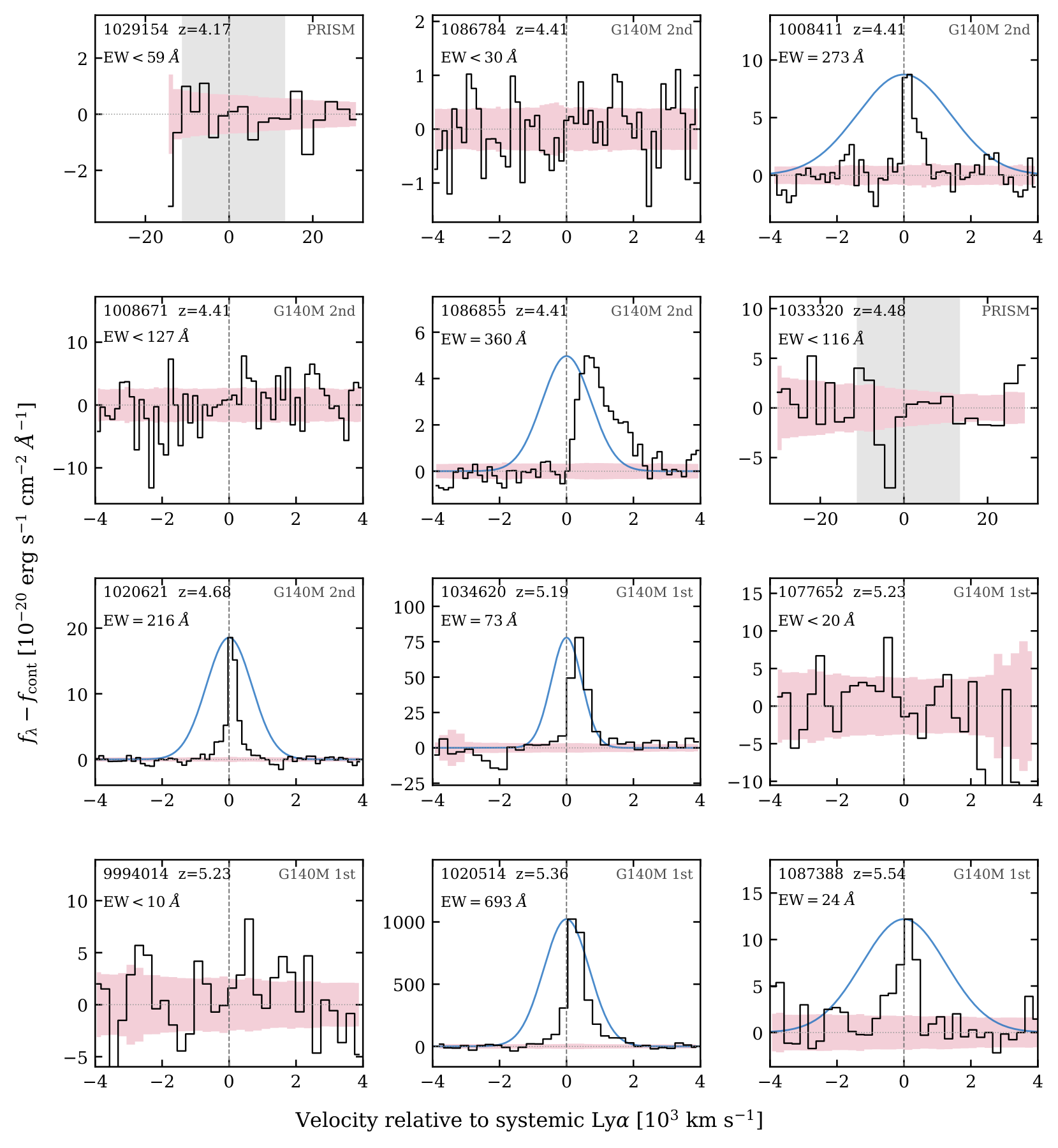
In 12 z=4.17–5.54 compact broad-line emitters, Lyα is detected in six and is systematically narrower than broad Hα. Host-SED predictions correlate more closely with observed Lyα than nuclear Hα/UV, although excess Lyα permits nuclear emission.

2026-10-15 · 2610.19320v1 · Research note

Large-scale Environmental Dependence of AGN Activity Revealed by JWST Pa$α$ Emitters

Danyang Jiang, Linhua Jiang, Shuqi Fu, et al.

Using JWST Paα spectroscopy, the authors find that radio-bright AGNs at z=1.1–1.5 occupy denser ∼1.5 pMpc environments than matched controls; density also correlates with accretion indicators, while environmental Paα luminosity functions are elevated and flatter at the faint end.

2026-10-07 · 2610.08731v1 · Research note

Halo Mass Function Constraints on Early Galaxy and AGN Populations in the JWST Era

Elan Yogeswaren, Robert Schaefer

This framework treats JWST massive galaxies, AGN, and UV luminosity functions as host-halo supply tests. It finds that rare-halo abundance predictions depend strongly on high-redshift HMF calibration and assumed baryonic or black-hole mappings, precluding simple source-by-source consistency claims.

Figure 1 from Breaking the Blend: A multi-tracer kinematic decomposition method for IFS data applied to disentangling the AGN outflow and circumnuclear ring in NGC 5728 with JWST

2026-09-25 · 2609.30232v1 · Research note

Breaking the Blend: A multi-tracer kinematic decomposition method for IFS data applied to disentangling the AGN outflow and circumnuclear ring in NGC 5728 with JWST

Oscar Veenema, Niranjan Thatte, Dimitra Rigopoulou, et al.

Using JWST mid-infrared IFS of NGC 5728, the authors decompose blended circumnuclear line emission into a star-forming ring and AGN bicone. Stacking twelve tracers yields spatial flux fractions that are stable across tested weighting choices.

Figure 4 from Search for High-Ionization Nebular Emission (SHINE). I. A Systematically Selected [Ne V] Sample at z > 3 with JWST/NIRSpec PRISM

2026-09-24 · 2609.27130v1 · Research note

Search for High-Ionization Nebular Emission (SHINE). I. A Systematically Selected [Ne V] Sample at z > 3 with JWST/NIRSpec PRISM

Shobita Satyapal, Sara Doan, Daniel Schaerer, et al.

SHINE identifies 25 luminous [Ne V] emitters at z=3.06–9.44 from >9,000 JWST/NIRSpec PRISM galaxies. Their hard-ionization lines favor accretion, but heterogeneous selection and incomplete diagnostic overlap preclude an intrinsic AGN-incidence measurement.

2026-09-22 · 2609.22428v1 · Research note

Star Formation and Nebular Attenuation from Pa$α$, Br$α$, and Br$β$ in Massive Dust-obscured Galaxies at Cosmic Noon using JWST

Virginia Vanicek, Jed McKinney, Alexandra Pope, et al.

JWST MIRI/Spitzer hydrogen-line measurements in 27 dusty z~1–2 infrared galaxies yield directly inferred nebular attenuation declining from ~3 mag near 2 μm to ~1 mag near 4 μm, yet IR-based SFRs remain ~2.5 times higher.

2026-09-03 · 2609.01711v1 · Research note

JWST Reveals a Candidate Supermassive Black Hole Binary at z=4.3 in the Brightest Sub-millimeter Galaxy in COSMOS-Web

Jed McKinney, Ansh Gupta, Julian B. Munoz, et al.

JWST spectra of the single dusty galaxy AzTEC-1 at z=4.3419 reveal a broad Hα component blueshifted by 1245 km s⁻¹. The authors favor a candidate sub-pc SMBH binary or recoiling SMBH over an ionized outflow, but confirmation requires resolved follow-up.

Figure 3 from Skyfire: A Spectroscopic Census of Little Red Dots and Broad-Line AGN in the CEERS Field

2026-09-02 · 2609.00112v1 · Research note

Skyfire: A Spectroscopic Census of Little Red Dots and Broad-Line AGN in the CEERS Field

Dale D. Kocevski, Anthony J. Taylor, Masafusa Onoue, et al.

Skyfire’s CEERS NIRSpec census finds broad Balmer emission across redder LRDs and somewhat bluer candidates, motivating an expanded continuum-slope selection. The color trend is suggestive of continuity with blue broad-line sources, but uneven targeting prevents a definitive population-unification claim.

2026-09-01 · 2608.28745v1 · Research note

Super-Eddington Little Blue Dots May Reionize Helium Too Early

Christopher Cain, Brent Smith, Gibson B. Bowling, et al.

A reionization-budget calculation argues that, if faint z=3–7 Little Blue Dots are common and leak ionizing radiation efficiently, most cannot be highly super-Eddington: their hard EUV spectra would complete He II reionization earlier than allowed.

Figure 1 from GATOS: Distinct Feedback Modes in AGN Central Regions Revealed by Spatially Resolved JWST Spectroscopy

2026-08-11 · 2608.08369v1 · Research note

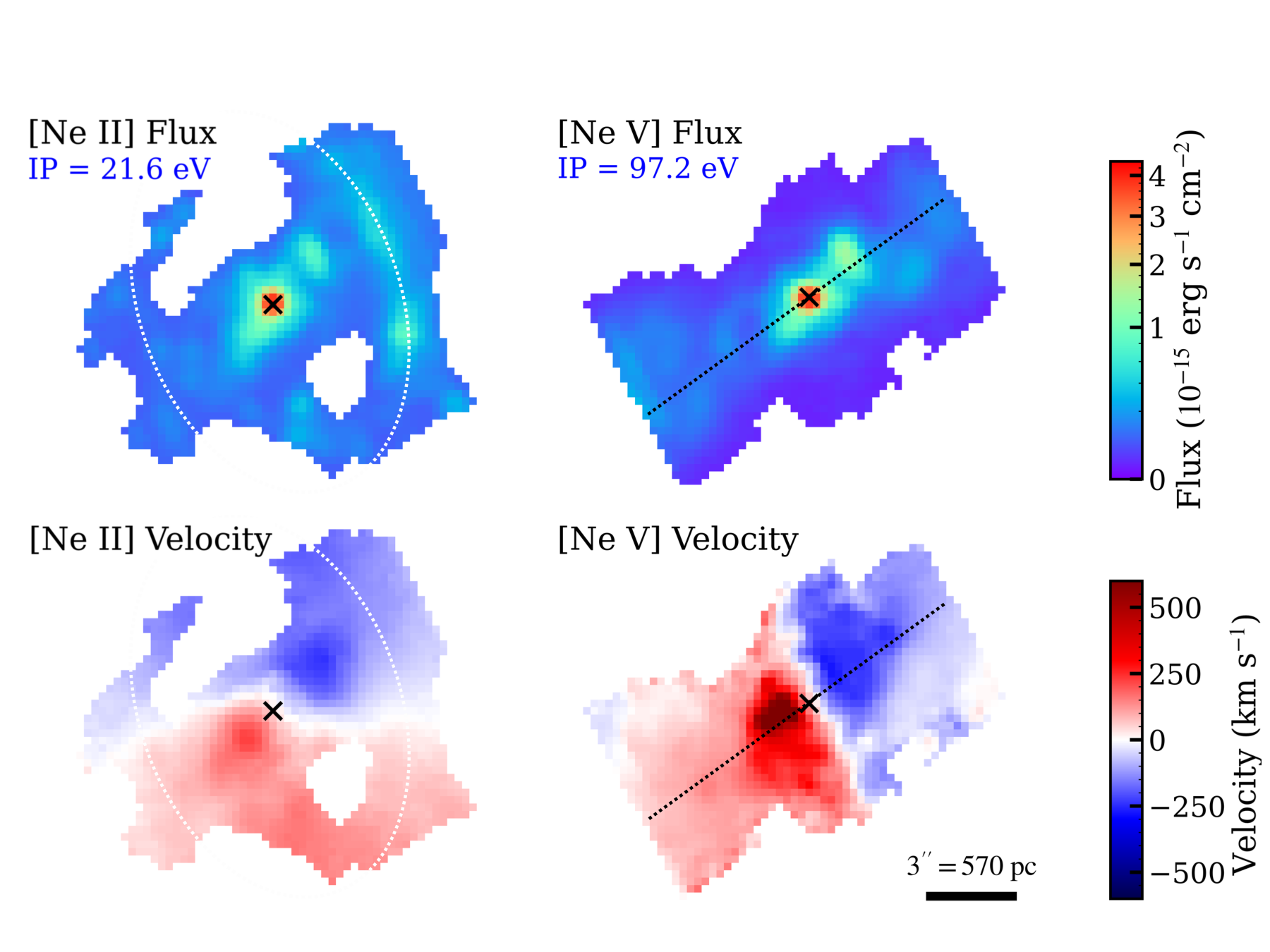
GATOS: Distinct Feedback Modes in AGN Central Regions Revealed by Spatially Resolved JWST Spectroscopy

Lulu Zhang, Chris Packham, Erin K. S. Hicks, et al.

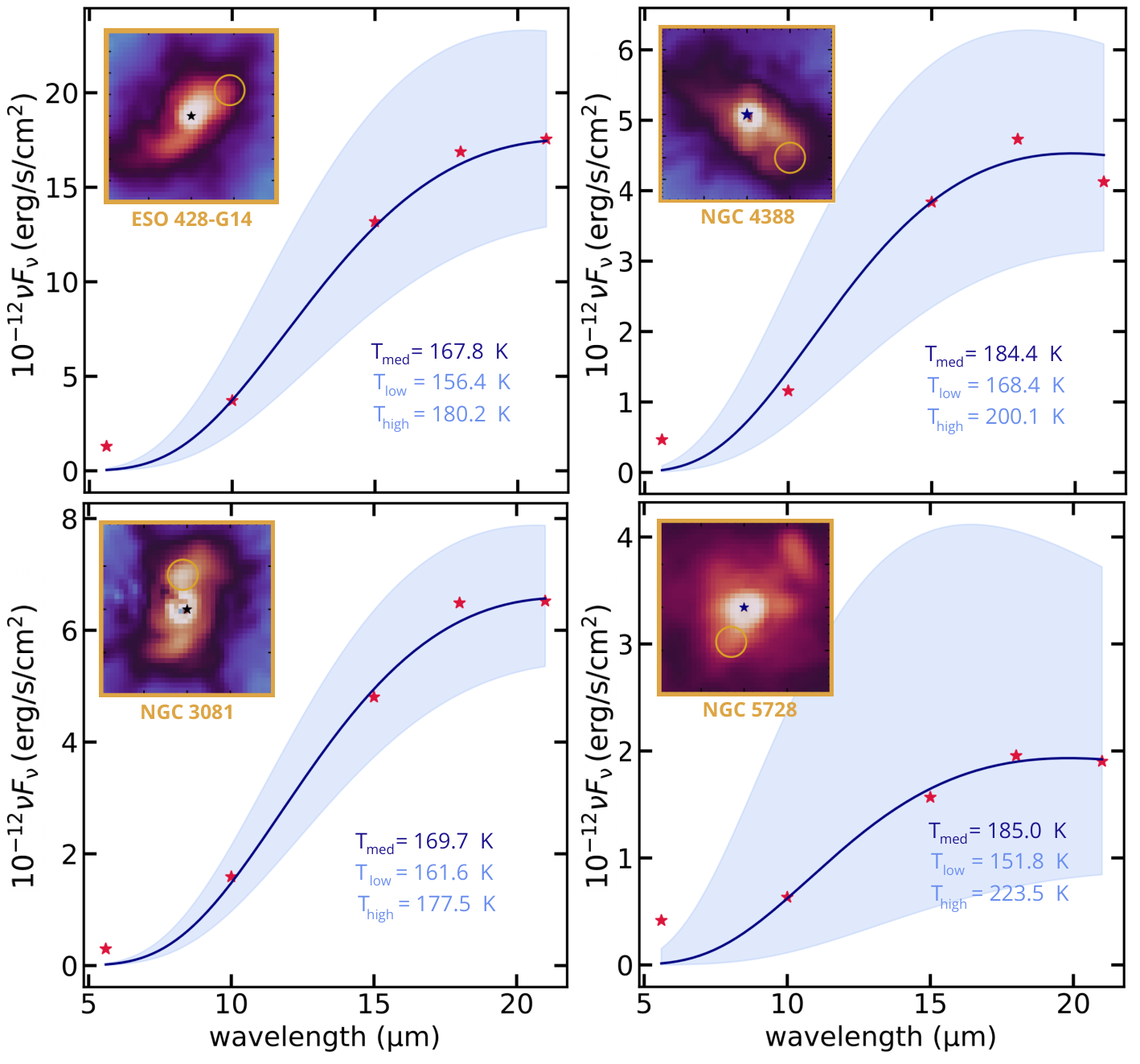
Spatially resolved JWST/MIRI spectroscopy of five nearby AGN links contrasting PAH-ratio trends to AGN irradiation and shock-processing diagnostics. The authors interpret their coexistence as a route to nuclear PAH suppression and to divergent PAH star-formation calibrations.

Figure 2 from How to raise a supermassive black hole: interpreting early JWST AGN with the AESOPICA simulations

2026-07-30 · 2607.26177v1 · Research note

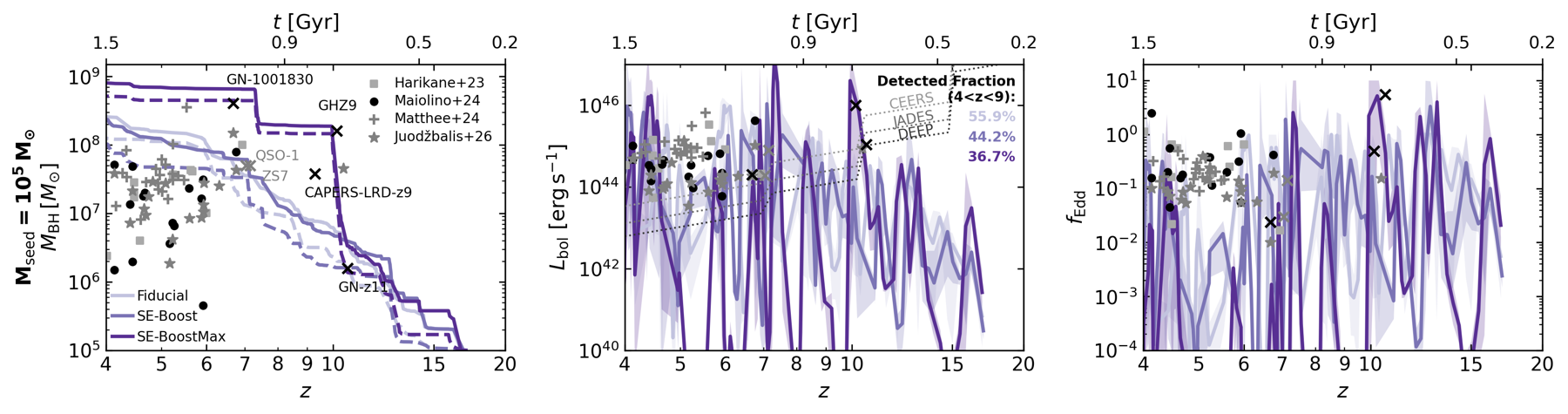
How to raise a supermassive black hole: interpreting early JWST AGN with the AESOPICA simulations

Sophie Koudmani, Jan Scholtz, Anthony J. Taylor, et al.

AESOPICA forward-models JWST broad-line selection in 12 cosmological simulations, finding that selection can yield apparently overmassive AGN from several seed scenarios; very light seeds nevertheless require unusually efficient, intermittently super-Eddington growth in the explored models.

2026-07-29 · 2607.25696v1 · Research note

Tracing Obscured AGN Contribution and Number Fraction Across 0 < z < 6 with JWST

Angel Rodriguez Barbosa, Tomotsugu Goto, Daryl Joe D. Santos, et al.

Using GOODS-S JWST SMILES+JADES photometry and CIGALE fits, the authors report that obscured-AGN incidence and infrared contribution rise toward high redshift, but are consistent with no systematic dependence on total infrared luminosity within their uncertainties.

2026-07-08 · 2607.05523v1 · Research note

BlackTHUNDER Reveals a Massive Filament around a Compact AGN at $z\simeq5.23$

Giulia Tozzi, Hannah Übler, Eleonora Parlanti, et al.

JWST IFU spectroscopy and NIRCam imaging resolve GN-77652 at z=5.229 beside a ≈12-kpc, four-source filament. Its modest internal velocity gradient is modelled as rotation, while the filament’s coherent kinematics and a possible nearby second AGN indicate an assembling, complex environment.

2026-07-07 · 2607.04942v1 · Research note

MICONIC: The spatial relationship between star formation and the AGN in Centaurus A revealed by JWST/MIRI

O. C. Jones, M. L. Jones, D. Dicken, et al.

JWST/MIRI resolves dusty point sources across Centaurus A’s warped disc: 928 red infrared-excess objects are consistent with embedded young stellar objects and follow the disc rather than the radio jet, favoring merger-accreted gas as the immediate star-formation reservoir.

Figure 2 from The MIRI Early Obscured-AGN Wide Survey (MEOW): A Population of Hidden AGN at $z \gtrsim 5$ Revealed by JWST/MIRI Imaging

2026-07-07 · 2607.02666v1 · Research note

The MIRI Early Obscured-AGN Wide Survey (MEOW): A Population of Hidden AGN at $z \gtrsim 5$ Revealed by JWST/MIRI Imaging

Gene C. K. Leung, Anna-Christina Eilers, Ryan Endsley, et al.

MEOW uses JWST/MIRI hot-dust selection over GOODS to identify 16 z≳5 AGN candidates, mostly not previously selected as broad-line AGN. Its luminosity-function comparison suggests an obscured population comparable in abundance to broad-line AGN near log Lbol≈45, but faint-end constraints remain limited.

2026-07-01 · 2606.31312v1

Dissecting the Obscured Core of GN20: an Active Galactic Nucleus Outshone by Young Stars

M. Hamed, L. Colina, P. G. Pérez-González, et al.

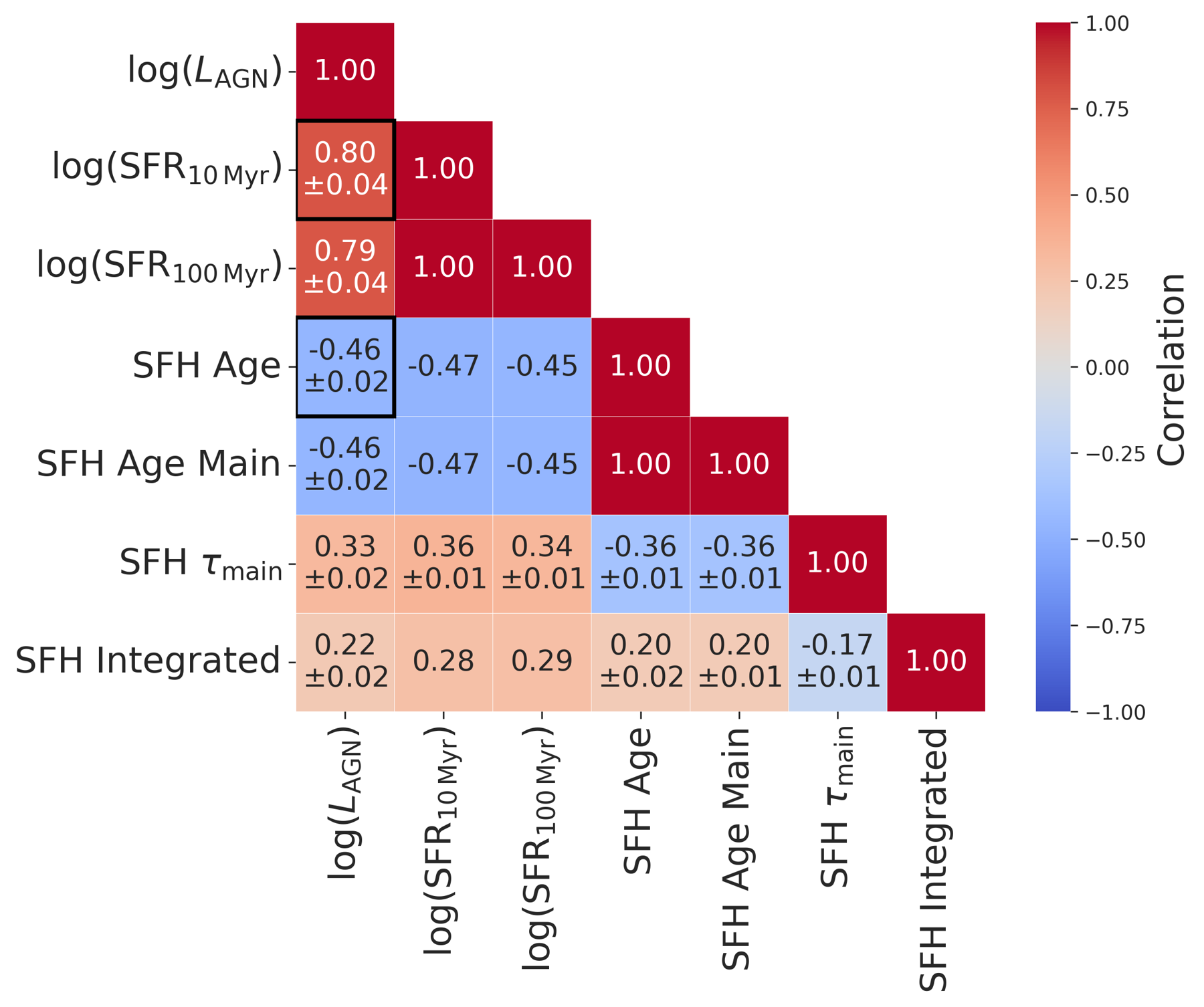
This paper uses spatially resolved CIGALE SED fitting to separate the ∼1 kpc nuclear core of GN20 from the full 9.9 kpc galaxy, combining JWST NIRCam, MIRI, NIRSpec PRISM pseudo-continuum, HST, and millimeter data. The central result is that the galaxy-wide SED is overwhelmingly star-formation powered, with only a marginal integrated AGN fraction of 0.09 ± 0.02, while the nucleus requires a much stronger AGN contribution of 0.34 ± 0.05 to explain a rest-frame 2.5–3.6 μm mid-infrared excess from torus-heated dust. That means the AGN contributes about one-third of the nuclear infrared luminosity but only about 9% of the total L_IR, naturally explaining why integrated diagnostics and earlier Spitzer limits made the source look starburst-dominated. The broader significance is that GN20 looks like a buried-black-hole case where only JWST-resolution, nuclear-scale decomposition can uncover ongoing early SMBH growth inside an extreme z = 4.055 dusty starburst.

2026-07-01 · 2606.30757v1 · Research note

Unveil the nature of JWST-AGN and Little Red Dots with SKAO continuum surveys

Giovanni Mazzolari, Dharam V. Lal, Isabella Prandoni, et al.

This forecasting study argues that multi-frequency SKAO continuum observations could separate intrinsically weak, Compton-thick, and ionized-cocoon interpretations of radio-faint JWST AGN and LRDs, but it presents sensitivity-based predictions rather than new radio detections.

Figure 1 from Hunting Wandering 3<z<8 Black Holes: via Spatial Offsets in Ionization Ratio and Continuum Emission

2026-07-01 · 2606.30715v1 · Research note

Hunting Wandering 3<z<8 Black Holes: via Spatial Offsets in Ionization Ratio and Continuum Emission

Urvi Thakurdesai, Anthony J. Taylor, Steven L. Finkelstein, et al.

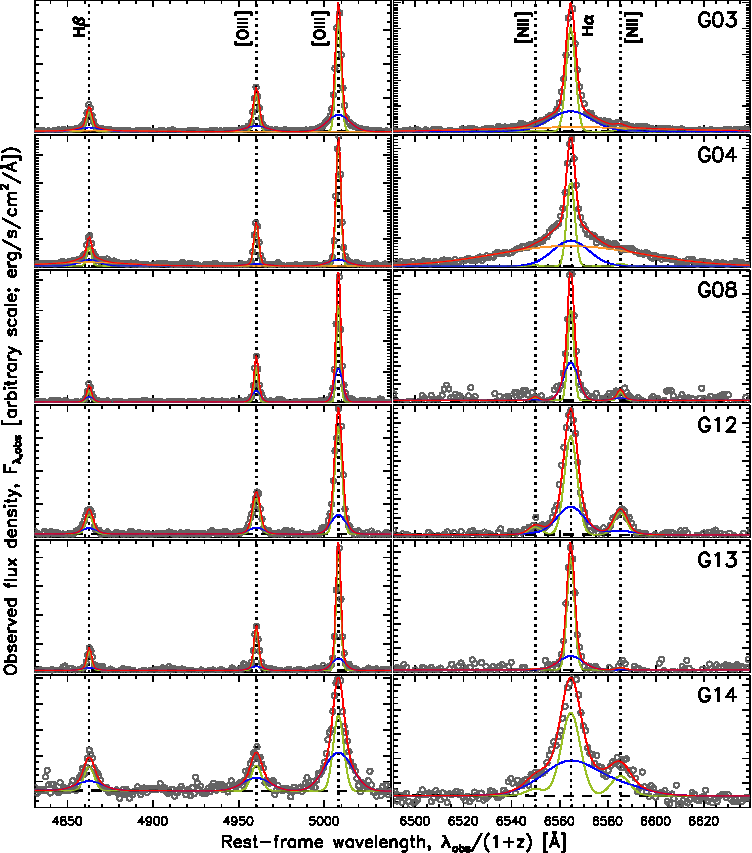
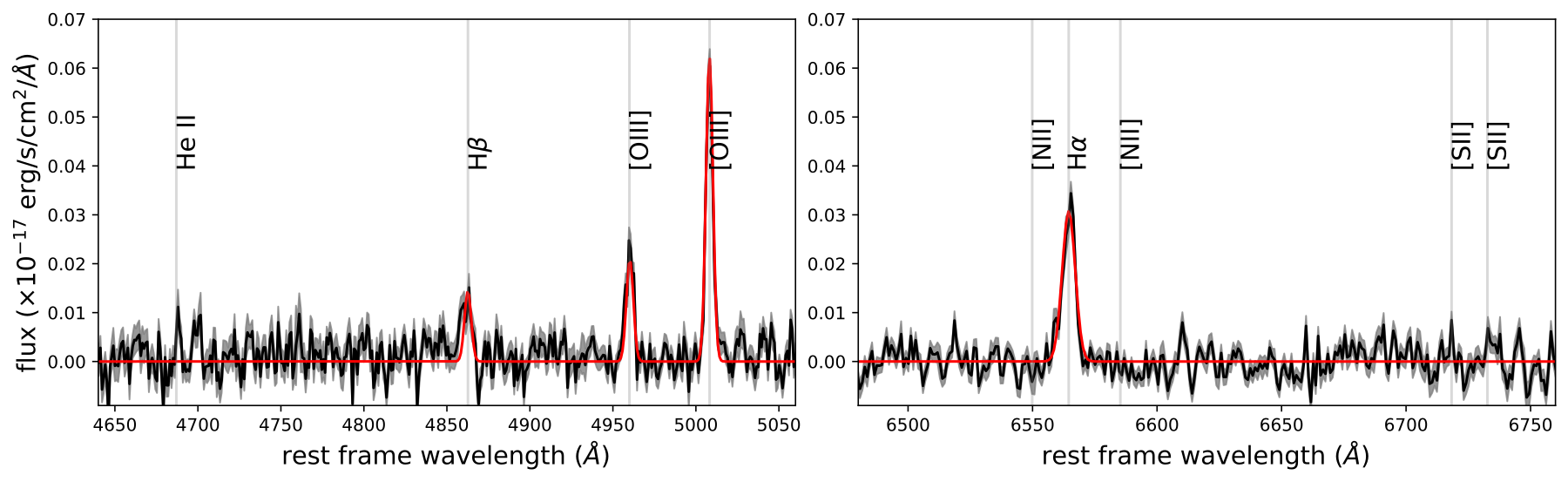
JWST/NIRSpec slit spectroscopy finds offset peaks in [O III]/Hβ relative to continuum light in 12 CEERS galaxies at 3<z<8. These are candidate off-nuclear ionizing regions, not direct detections of wandering black holes.

Figure 2 from Kinematic detection of dusty outflows from active galactic nuclei: Polycyclic aromatic hydrocarbon kinematics of type 2 quasars with JWST/MIRI spectroscopy

2026-06-29 · 2606.28311v1 · Research note

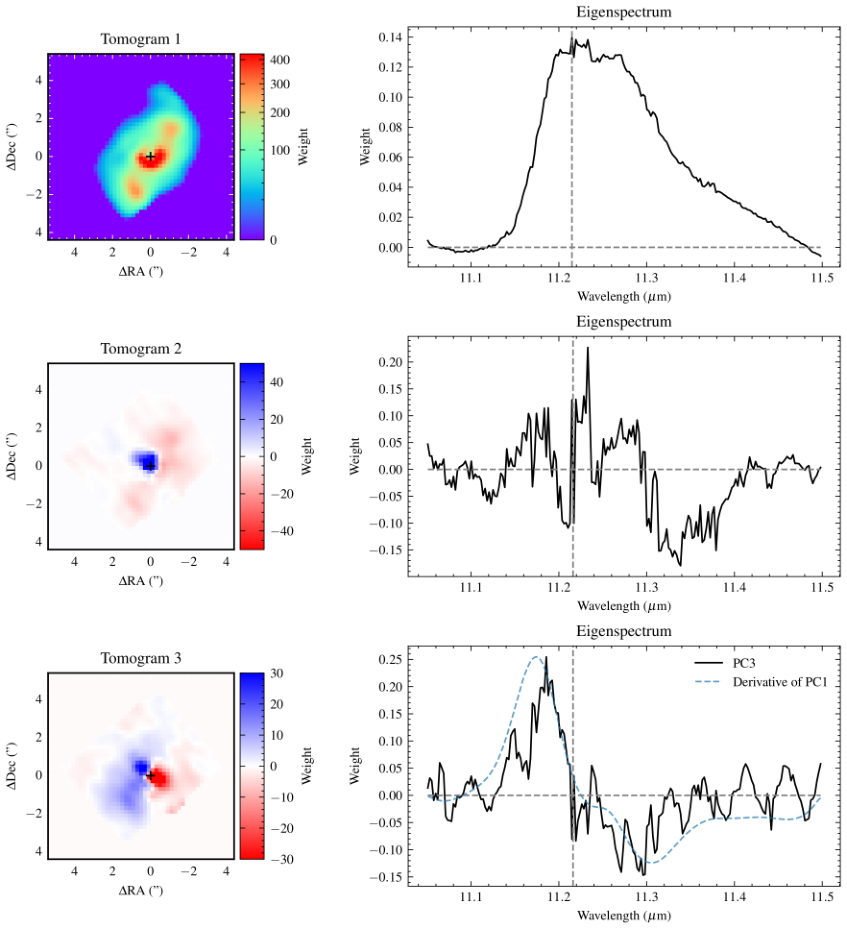
Kinematic detection of dusty outflows from active galactic nuclei: Polycyclic aromatic hydrocarbon kinematics of type 2 quasars with JWST/MIRI spectroscopy

Fergus R. Donnan, Cristina Ramos Almeida, Omaira González Martín, et al.

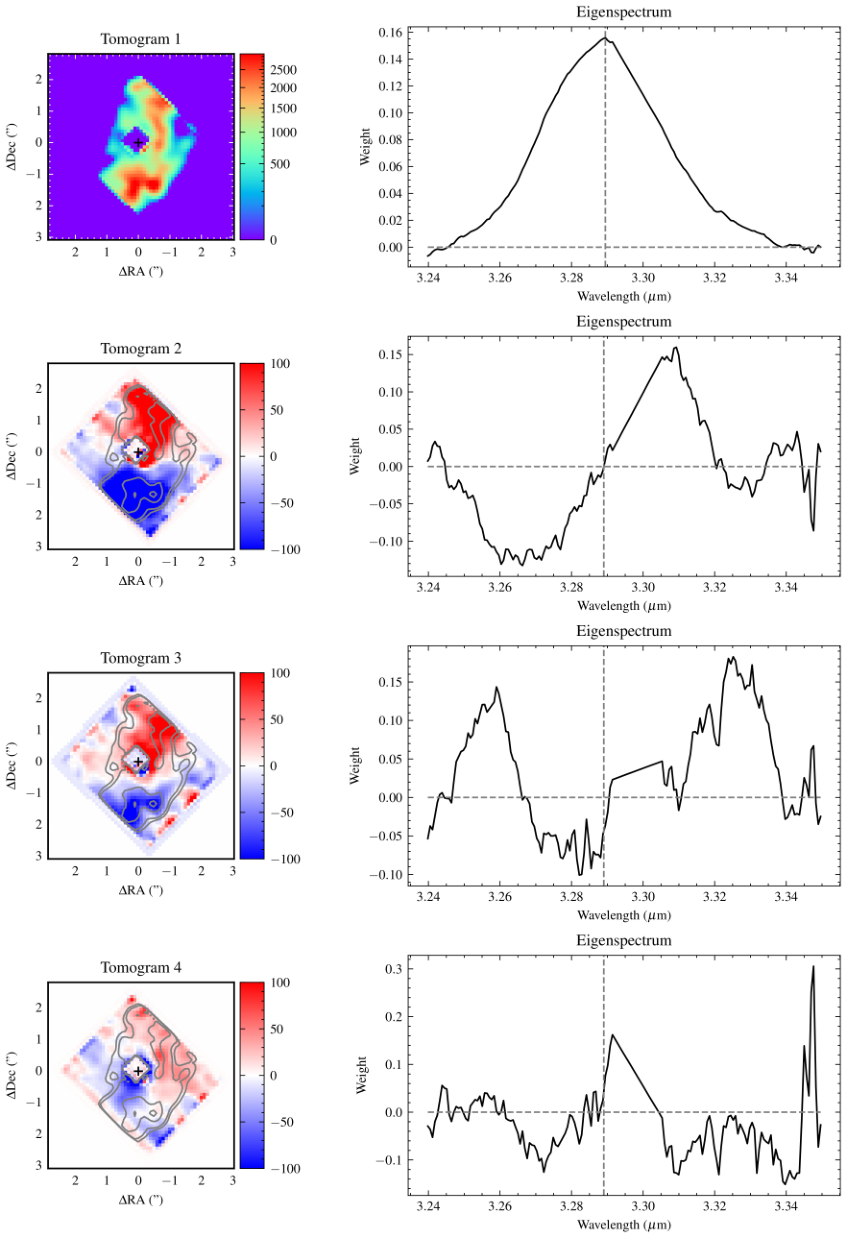
JWST/MIRI PCA tomography recovers 11.3-μm PAH velocity maps in three of five z~0.1 type-2 quasars; all three show dust-traced outflow kinematics, with molecular-gas residuals consistent with outflow after disk subtraction.

2026-06-22 · 2606.20800v1 · Research note

No hidden monsters: Probing recently-quenched galaxies for obscured AGN with JWST-PRIMER MIRI and NIRCam

Guillaume Hewitt, Omar Almaini, David Maltby, et al.

In 65 PRIMER-UDS post-starbursts at z=1–2, massive systems mostly lack mid-IR excess: template tests place population-level obscured accretion below 1% Eddington. Low-mass PSBs instead show 18-μm excess plausibly associated with residual star formation.

Figure 5 from Probing Direct Contributions of Galaxies and AGN to Cosmic Reionization in a Quasar Field J0226+0302 with JWST NIRCam and NIRSpec

2026-06-16 · 2606.14959v1 · Research note

Probing Direct Contributions of Galaxies and AGN to Cosmic Reionization in a Quasar Field J0226+0302 with JWST NIRCam and NIRSpec

Xiangyu Jin, Jinyi Yang, Feige Wang, et al.

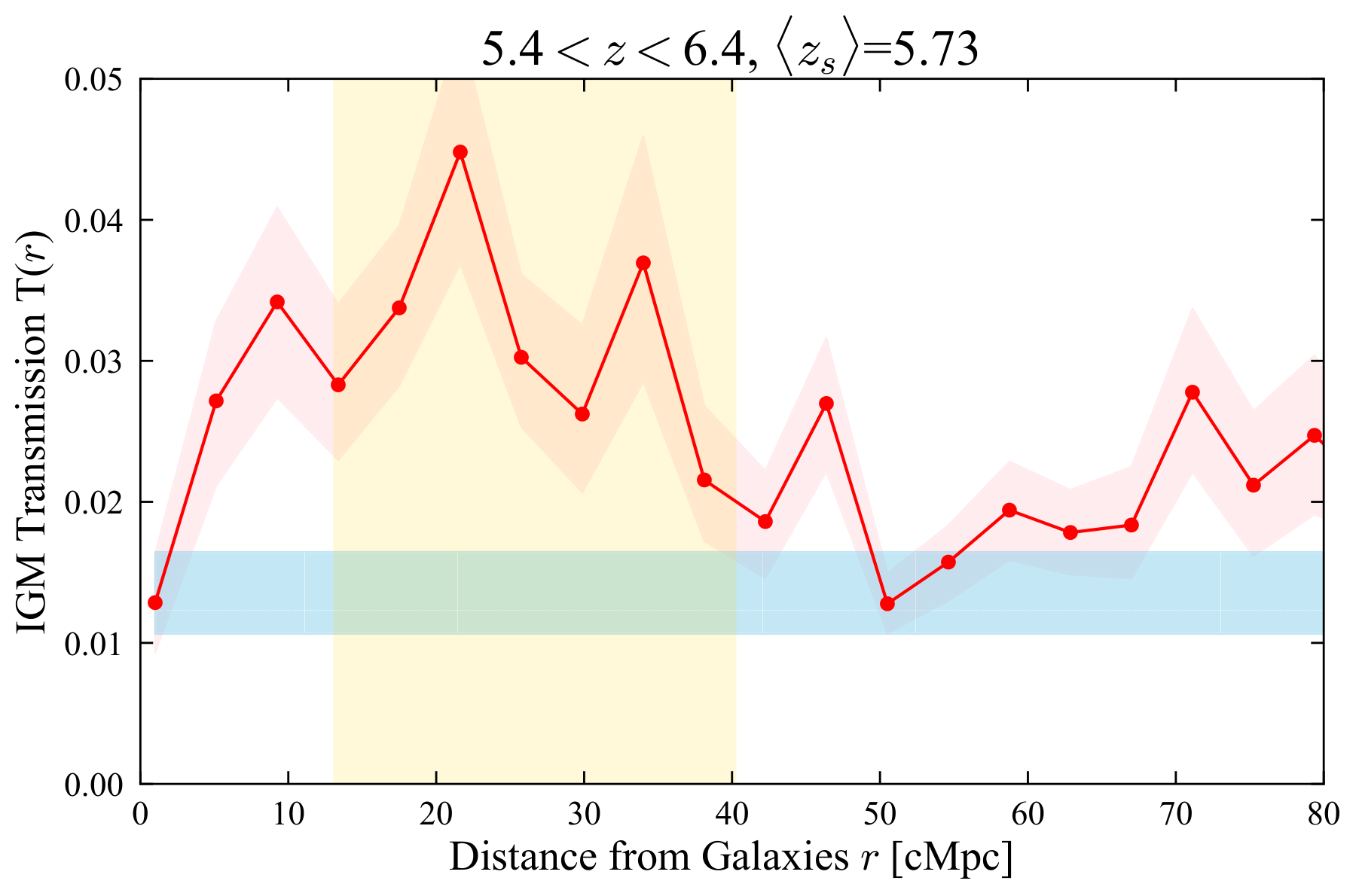
In the J0226+0302 quasar sightline, 73 line-emitting galaxies trace a tentative, 10–40 cMpc enhancement in IGM transmission, while four broad-line AGN show a possible smaller-scale enhancement. The results favor local ionizing-background variations but remain statistically and model limited.

2026-06-15 · 2606.13819v1 · Research note

GA-NIFS: The interplay between feedback and star formation at 3 < z < 9 probed by JWST/NIRSpec IFU

L. Ulivi, M. Perna, S. Arribas, et al.

Across six JWST/NIRSpec IFU targets at z=3–9, resolved stellar-population histories associate strong AGN-driven ionized outflows with recent nuclear quenching in the most massive systems, while starburst-driven outflows accompany continued growth in lower-mass galaxies.

Figure 2 from Aether-SHELLQs: JWST integral-field spectroscopy of candidate obscured quasars at z ~ 6

2026-06-10 · 2606.10160v1 · Research note

Aether-SHELLQs: JWST integral-field spectroscopy of candidate obscured quasars at z ~ 6

Yoshiki Matsuoka, Roberto Decarli, Emanuele Paolo Farina, et al.

JWST/NIRSpec IFU spectroscopy of six z~6 SHELLQs narrow-Lyα candidates finds secure broad Balmer components in two, while extended, largely non-rotating ionized gas characterizes several non-broad-line systems. Broad-line incidence rises sharply with Lyα luminosity.

2026-06-09 · 2606.09413v1 · Research note

Towards a consistent framework of determining active galactic nucleus contribution fraction and host galaxy properties

Mi Chen, Lingyu Wang, Berta Margalef-Bentabol, et al.

Across 21,428 COSMOS-Web galaxies, two SED codes and deep-learning imaging agree well when AGN light is negligible but diverge sharply for AGN-significant systems. Imaging-constrained refits can materially shift host properties despite acceptable photometric fits.

Figure 5 from The Multi-phase Biconical Outflow in the local IR-Luminous Merger IRASF01364-1042

2026-06-05 · 2606.06005v1 · Research note

The Multi-phase Biconical Outflow in the local IR-Luminous Merger IRASF01364-1042

Y. Song</name> <arxiv:affiliation>European Southern Observatory, Chile</arxiv:affiliation> <arxiv:affiliation>Joint ALMA Observatory, Chile</arxiv:affiliation> <arxiv:affiliation>Max-Planck-Institut für Radioastronomie, Germany</arxiv:affiliation> </author> <author> <name>V. U</name> <arxiv:affiliation>IPAC, California Institute of Technology, USA</arxiv:affiliation> <arxiv:affiliation>University of California, Irvine, USA</arxiv:affiliation> </author> <author> <name>J. Kader</name> <arxiv:affiliation>University of California, Irvine, USA</arxiv:affiliation> </author> <author> <name>M. Bianchin</name> <arxiv:affiliation>University of California, Irvine, USA</arxiv:affiliation> <arxiv:affiliation>Instituto de Astrof\' isica de Canarias, Spain</arxiv:affiliation> <arxiv:affiliation>Universidad de La Laguna, Spain</arxiv:affiliation> </author> <author> <name>J. Agostino</name> <arxiv:affiliation>Ritter Astrophysical Research Center and Department of Physics and Astronomy, University of Toledo, USA</arxiv:affiliation> </author> <author> <name>L. Barcos-Muñoz</name> <arxiv:affiliation>National Radio Astronomy Observatory, Charlottesville, USA</arxiv:affiliation> <arxiv:affiliation>Department of Astronomy, University of Virginia, Charlottesville, USA</arxiv:affiliation> </author> <author> <name>N. Torres-Albà</name> <arxiv:affiliation>Department of Astronomy, University of Virginia, Charlottesville, USA</arxiv:affiliation> </author> <author> <name>A. Medling</name> <arxiv:affiliation>Ritter Astrophysical Research Center and Department of Physics and Astronomy, University of Toledo, USA</arxiv:affiliation> </author> <author> <name>C. Ricci</name> <arxiv:affiliation>Department of Astronomy, University of Geneva, Switzerland</arxiv:affiliation> <arxiv:affiliation>Instituto de Estudios Astrofísicos, Facultad de Ingeniería y Ciencias, Universidad Diego Portales, Chile</arxiv:affiliation> </author> <author> <name>L. Armus</name> <arxiv:affiliation>IPAC, California Institute of Technology, USA</arxiv:affiliation> </author> <author> <name>T. Lai</name> <arxiv:affiliation>IPAC, California Institute of Technology, USA</arxiv:affiliation> </author> <author> <name>L. Ghodsi</name> <arxiv:affiliation>Hiroshima Astrophysical Science Center, Hiroshima University, Japan</arxiv:affiliation> </author> <author> <name>A. Evans</name> <arxiv:affiliation>National Radio Astronomy Observatory, Charlottesville, USA</arxiv:affiliation> <arxiv:affiliation>Department of Astronomy, University of Virginia, Charlottesville, USA</arxiv:affiliation> </author> <author> <name>H. Inami</name> <arxiv:affiliation>Occidental College, Physics Department, USA</arxiv:affiliation> </author> <author> <name>S. Stierwalt</name> <arxiv:affiliation>Leiden Observatory, Leiden University, The Netherlands</arxiv:affiliation> </author> <author> <name>T. Bohn</name> <arxiv:affiliation>Occidental College, Physics Department, USA</arxiv:affiliation> </author> <author> <name>K. L. Emig</name> <arxiv:affiliation>National Radio Astronomy Observatory, Charlottesville, USA</arxiv:affiliation> </author> <author> <name>V. Buiten</name> <arxiv:affiliation>Instituto de Alta Investigación, Universidad de Tarapacá, Chile</arxiv:affiliation> </author> <author> <name>G. Donnelly</name> <arxiv:affiliation>Ritter Astrophysical Research Center and Department of Physics and Astronomy, University of Toledo, USA</arxiv:affiliation> </author> <author> <name>E. Treister</name> <arxiv:affiliation>European Space Agency, c/o STScI, USA</arxiv:affiliation> </author> <author> <name>A. Jimenez-Gallardo</name> <arxiv:affiliation>European Southern Observatory, Chile</arxiv:affiliation> </author> <author> <name>T. Böker</name> <arxiv:affiliation>Centre for Astrophysics Research, University of Hertfordshire, UK</arxiv:affiliation> </author> <author> <name>D. Kakkad</name> <arxiv:affiliation>Steward Observatory, University of Arizona, USA</arxiv:affiliation> </author> <author> <name>S. Linden</name> <arxiv:affiliation>School of Sciences, European University Cyprus, Cyprus</arxiv:affiliation> </author> <author> <name>P. van der Werf</name> <arxiv:affiliation>Instituto de Alta Investigación, Universidad de Tarapacá, Chile</arxiv:affiliation> </author> <author> <name>V. Charmandaris</name> <arxiv:affiliation>Institute of Astrophysics, Foundation for Research and Technology-Hellas</arxiv:affiliation> <arxiv:affiliation>Department of Physics, University of Crete, Greece</arxiv:affiliation> <arxiv:affiliation>Department of Astronomy, University of Florida, USA</arxiv:affiliation> </author> <author> <name>R. Remigio</name> <arxiv:affiliation>University of California, Irvine, USA</arxiv:affiliation> </author> <author> <name>L. Lenkic</name> <arxiv:affiliation>IPAC, California Institute of Technology, USA</arxiv:affiliation> </author> <author> <name>C. Finlez</name> <arxiv:affiliation>European Southern Observatory, Chile</arxiv:affiliation> <arxiv:affiliation>Joint ALMA Observatory, Chile</arxiv:affiliation> </author> <author> <name>M. Sanchez-García</name> <arxiv:affiliation>Department of Physics, University of Crete, Greece</arxiv:affiliation> <arxiv:affiliation>Department of Astronomy, University of Florida, USA</arxiv:affiliation> </author> <author> <name>C. Lofaro</name> <arxiv:affiliation>Department of Physics, University of Crete, Greece</arxiv:affiliation> <arxiv:affiliation>Department of Astronomy, University of Florida, USA</arxiv:affiliation> </author> <author> <name>A. Saravia</name> <arxiv:affiliation>National Radio Astronomy Observatory, Charlottesville, USA</arxiv:affiliation> <arxiv:affiliation>Department of Astronomy, University of Virginia, Charlottesville, USA</arxiv:affiliation> </author> <author> <name>I. Yoon</name> <arxiv:affiliation>National Radio Astronomy Observatory, Charlottesville, USA</arxiv:affiliation> </author> <author> <name>G. C. Privon</name> <arxiv:affiliation>National Radio Astronomy Observatory, Charlottesville, USA</arxiv:affiliation> <arxiv:affiliation>Department of Astronomy, University of Virginia, Charlottesville, USA</arxiv:affiliation> <arxiv:affiliation>Research School of Astronomy and Astrophysics, Australian National University, Australia</arxiv:affiliation> </author> <author> <name>T. Gao</name> <arxiv:affiliation>ARC Centre of Excellence for All Sky Astrophysics in 3 Dimensions</arxiv:affiliation> <arxiv:affiliation>W. M. Keck Observatory, USA</arxiv:affiliation> </author> <author> <name>H. Aziz</name> <arxiv:affiliation>University of California, Irvine, USA</arxiv:affiliation> </author> <author> <name>R. McGurk</name> <arxiv:affiliation>Institute for Astronomy, University of Hawaii, USA</arxiv:affiliation> </author> <author> <name>T. Díaz-Santos</name> <arxiv:affiliation>Department of Physics, University of Crete, Greece</arxiv:affiliation> <arxiv:affiliation>Department of Astronomy, University of Florida, USA</arxiv:affiliation> </author> <author> <name>D. Kunneriath</name> <arxiv:affiliation>National Radio Astronomy Observatory, Charlottesville, USA</arxiv:affiliation> </author> <author> <name>David B. Sanders

Spatially resolved JWST, ALMA and KCWI data support a multiphase, minor-axis biconical outflow in the dusty local merger IRAS F01364-1042. The authors infer faster ionized than molecular gas and argue a nuclear starburst can energetically drive it despite an obscured AGN.
2026-06-03 · 2606.03667v1 · Research note

Constraining AGN accretion physics with black hole mass-luminosity scaling relations

F. Fiore, M. Gaspari, S. Puccetti, et al.

Across a large SDSS–eROSITA quasar sample, bolometric luminosity scales nearly linearly with virial black-hole mass while hard X-rays rise more slowly. The authors argue this disfavors classical Bondi feeding and favors CCA, but redshift covariances and JWST line-based systematics limit interpretation.

2026-06-01 · 2605.30424v1

High-ionization coronal lines trace quasar-like activity in recently quenched galaxies at high redshift

F. Valentino, K. Ito, M. Farcy, et al.

This paper searches JWST/NIRSpec archival spectra of 87 massive quenched galaxies at z≈1.5-4.5 and finds [NeV] λ3427 in six, arguing that this coronal line cleanly isolates luminous SMBH accretion in systems where residual star formation is not a viable explanation. Four of the six [NeV] hosts also show broad Hα with FWHM ≳ 4000 km s^-1, implying MBH ≈ 10^8.5-10^9.5 Msun, while the [NeV] luminosities indicate quasar-like power outputs of roughly 10^45-10^46 erg s^-1 and Eddington ratios of about 10-50%. The strongest [NeV] emitters sit in the youngest post-starburst galaxies with Dn4000 ≲ 1.3, whereas older quenched systems lack comparable activity, pointing to intense radiatively efficient black-hole growth that can continue for several hundred Myr after the main quenching event. That timing matters because it links early quenching to delayed but still powerful SMBH growth, and provides a concrete empirical target for models that aim to produce the first massive passive galaxies.

Figure 4 from A Rapid Evolution in the Observed Mbh/M* Relation at z > 3 Revealed via Spectro-photometric SED-Modeling

2026-06-01 · 2605.30414v1 · Research note

A Rapid Evolution in the Observed Mbh/M* Relation at z > 3 Revealed via Spectro-photometric SED-Modeling

Ansh R. Gupta, Anthony Taylor, Emma Curtis-Lake, et al.

Using AGN-aware fits to JWST spectra, the authors report that non-LRD broad-line AGN shift from elevated observed M_BH/M* above z≈4.5 to the local relation by z≈3.5; LRD host-mass inferences remain substantially less secure.

2026-05-14 · 2605.14922v1 · Research note

DREAMS. JWST Spectroscopy of a $z=8.3$ Galaxy with an ALMA Dust Continuum Detection: Early Dust, Very High $T_{\rm dust}$, and a Multi-wavelength [OIII] Ratio Discrepancy

Kana Takechi, Masami Ouchi, Kimihiko Nakajima, et al.

For the single z=8.312 galaxy MACS0416-Y1, deep JWST/NIRSpec plus archival IFU/ALMA data support a broad-line AGN interpretation, low metallicity and dust mass ratios, and a spatially non-coincident origin for optical and far-infrared [OIII].

Figure 4 from Resolving the Multiphase Outflow, Shock Signatures, and PAHs in the AGN-Starburst Composite ULIRG F10565+2448 with JWST MIRI/MRS

2026-05-04 · 2605.03016v1 · Research note

Resolving the Multiphase Outflow, Shock Signatures, and PAHs in the AGN-Starburst Composite ULIRG F10565+2448 with JWST MIRI/MRS

Kylie Yui Dan, Jerome Seebeck, Sylvain Veilleux, et al.

JWST/MIRI-MRS resolves a warm-H₂ outflow in the composite ULIRG F10565+2448: it is hotter than the disk but apparently sub-escape-speed, while a faster unresolved ionized component and localized shock candidates support multiphase feedback.

2026-05-04 · 2605.02663v1 · Research note

Jet-driven shocks and turbulence in radio-loud Active Galactic Nuclei observed with JWST MIRI/MRS

Rogemar A. Riffel, Gabriel L. Souza-Oliveira, Luis Colina, et al.

JWST/MIRI-MRS mapping of seven nearby radio-loud AGN links elevated warm-H2 excitation and broadened multiphase gas to radio-jet environments, including transverse regions. The authors interpret the correlations as predominantly jet-driven shocks, while recognizing source-dependent exceptions.

Figure 3 from PEARLS: Two Distinct Populations of AGN Hosts Moving Between Star Formation and Quiescence

2026-05-01 · 2605.00822v1 · Research note

PEARLS: Two Distinct Populations of AGN Hosts Moving Between Star Formation and Quiescence

Gibson B. Bowling, Rafael Ortiz, S. P. Willner, et al.

After image decomposition and host-only SED fitting, 36 NIRCam-selected NEP-TDF AGN candidates separate into a likely AGN “branch” and an ambiguous, largely early-type “bridge” near quenching; the reported SFR–AGN-fraction trend is weakly explanatory.

2026-05-01 · 2605.00763v1 · Research note

Life After the Quasar: Overmassive Black Holes and Remnant Ionised Bubbles in and Around Two z~6.6 Galaxies

Romain A. Meyer, Pascal A. Oesch, Callum Witten, et al.

JWST/NIRSpec spectra of two z~6.6 ultra-luminous Lyα emitters reveal broad Balmer-line black-hole masses near 2×10^8 M⊙ and double-peaked Lyα, which the authors interpret as brief post-quasar phases inside relic ionised bubbles.

Figure 5 from Decoupling the AGN outflow and star-forming disk kinematics in the nuclear region of NGC 7582 with JWST NIRSpec and MIRI/MRS

2026-04-27 · 2604.24892v1 · Research note

Decoupling the AGN outflow and star-forming disk kinematics in the nuclear region of NGC 7582 with JWST NIRSpec and MIRI/MRS

Oscar Veenema, Niranjan Thatte, Dimitra Rigopoulou, et al.

JWST IFU spectroscopy of NGC 7582 separates rotating circumnuclear-disk gas from an AGN bicone by ionisation potential and line-profile decomposition, finding distinct kinematic axes and broader outflow lines; mixed-ionisation tracers require two components.

Figure 1 from GLIMPSED: Direct evidence for a fast AGN-driven outflow from a z=6.64 Little Red Dot host galaxy

2026-04-09 · 2604.08687v1 · Research note

GLIMPSED: Direct evidence for a fast AGN-driven outflow from a z=6.64 Little Red Dot host galaxy

Damien Korber, Rui Marques-Chaves, Daniel Schaerer, et al.

Medium-resolution JWST/NIRSpec data spatially separate an LRD-like AGN and its host at z=6.64, revealing exceptionally broad ionised gas consistent with AGN driving but a low inferred mass-loading factor and therefore limited immediate star-formation impact.

Figure 3 from Constraints on the host galaxy and AGN properties of three z > 6 JWST AGN from NOEMA observations

2026-03-31 · 2603.29652v1 · Research note

Constraints on the host galaxy and AGN properties of three z > 6 JWST AGN from NOEMA observations

Giovanni Mazzolari, Hannah Übler, Rodrigo Herrera Camus, et al.

Deep NOEMA observations of three z>6 JWST AGN—two Little Red Dots and one blue Type-I source—yield no significant [C II] or dust-continuum detection, tightening host-galaxy and SED constraints while leaving the physical origin of their [C II] deficit unresolved.

2026-03-23 · 2603.22393v1 · Research note

MEOW: The increase in the obscured AGN fraction in mid-infrared from 0 < z < 6 with JWST MIRI

Teodora-Elena Bulichi, Gene C. K. Leung, Anna-Christina Eilers, et al.

Using JWST/MIRI-selected sources, MEOW infers that obscured AGN become increasingly dominant with redshift: its SED-based luminosity functions imply a 98–99% obscured fraction at z=4.5–6 for luminous AGN, relative to UV type-1 quasars.

2026-03-18 · 2603.17967v1 · Research note

JWST Reveals Two Overmassive Black Hole Candidates in Dwarf Galaxies at z $\approx$ 0.7: Pushing Black Hole Searches into the Dwarf-Galaxy Regime

E. Iani, P. Rinaldi, A. Torralba, et al.

Two z≈0.7 compact dwarfs combine blue, burst-dominated UV–optical emission with a MIRI hot-dust excess. SED-inferred AGN luminosities imply candidate black holes disproportionately massive for ≈10^7 M⊙ hosts, but masses depend strongly on the assumed Eddington ratio.

Figure 1 from GATOS N: The first direct kinematic evidence of dusty outflows from AGN via PAH kinematics of local Seyfert galaxies with JWST

2026-03-12 · 2603.12200v1 · Research note

GATOS N: The first direct kinematic evidence of dusty outflows from AGN via PAH kinematics of local Seyfert galaxies with JWST

Fergus R. Donnan, Ismael García-Bernete, Dimitra Rigopoulou, et al.

JWST IFU observations of 10 local Seyferts use PCA tomography of broad PAH bands to map dust-phase kinematics. The authors report neutral, larger PAHs sharing molecular and ionised-outflow signatures in NGC 5728 and NGC 7582, while 3.3 μm PAHs trace disks.

Figure 5 from The X-ray weakness of Little Red Dots and JWST-selected AGN: comparison with local AGN in different accretion regimes

2026-03-10 · 2603.10162v1 · Research note

The X-ray weakness of Little Red Dots and JWST-selected AGN: comparison with local AGN in different accretion regimes

A. Tortosa, C. Ricci, P. Du, et al.

High-redshift LRDs and JWST-selected broad-line AGN are X-ray weak relative to broad Hα, plausibly resembling highly accreting local systems; however, predominantly upper-limit-based X-ray constraints leave intrinsic coronal suppression and obscuration unresolved.

2026-03-04 · 2603.04358v1 · Research note

A Selection Aware View of Black Hole-Galaxy Coevolution at High Redshift

Francesco Ziparo, Stefano Carniani, Simona Gallerani, et al.

Forward-modeling broad-Hα selection in a JADES broad-line AGN sample at z≳4 yields an M_BH–M★ relation consistent in mean with local relations but with 0.63 dex intrinsic scatter, implying diverse early black-hole growth histories.

Figure 4 from You can't see me: super-Eddington growth hindering X-ray detection in high-z broad-line AGNs

2026-02-25 · 2602.22305v1 · Research note

You can't see me: super-Eddington growth hindering X-ray detection in high-z broad-line AGNs

Alessandro Trinca, Alessandro Lupi, Francesco Haardt, et al.

Joint modelling of broad lines and Chandra non-detections for 14 JWST high-redshift broad-line AGNs favors low-mass, highly super-Eddington black holes with over-cooled coronæ over massive, weakly accreting alternatives, but the inference remains model-dependent and bimodal.

2026-01-30 · 2601.23250v1 · Research note

Too many or too massive? Investigating the high-$z$ demography of active SMBHs from JWST

Daniel Roberts, Francesco Shankar, Vieri Cammelli, et al.

A data-driven demographic consistency test finds that the abundant faint JWST AGN at z≈5.5 can be explained by moderately elevated black-hole–stellar-mass scaling relations and ∼50% duty cycles, without requiring the most extreme inferred black-hole masses.

2026-01-23 · 2601.16977v1 · Research note

ReveaLLAGN 1: JWST Emission-Line Spectra Reveal Low-Luminosity AGN with UV-Deficient SEDs and Warm Molecular Gas

Kameron Goold, Anil Seth, Mallory Molina, et al.

JWST NIRSpec/MIRI nuclear spectra of eight LLAGN plus Cen A associate decreasing [Ne V]-to-X-ray output below log(Lbol/LEdd)≈−3.5 with a UV-deficient ionizing SED, while finding warmer rotational H2 and predominantly nuclear silicate emission.

Figure 2 from Undermassive Hosts of $z = 4-6 $ AGN from JWST/NIRCam Image Decomposition with CONGRESS, FRESCO, and JADES

2026-01-22 · 2601.15962v1 · Research note

Undermassive Hosts of $z = 4-6 $ AGN from JWST/NIRCam Image Decomposition with CONGRESS, FRESCO, and JADES

Zheng Ma, Eichi Egami, Yongda Zhu, et al.

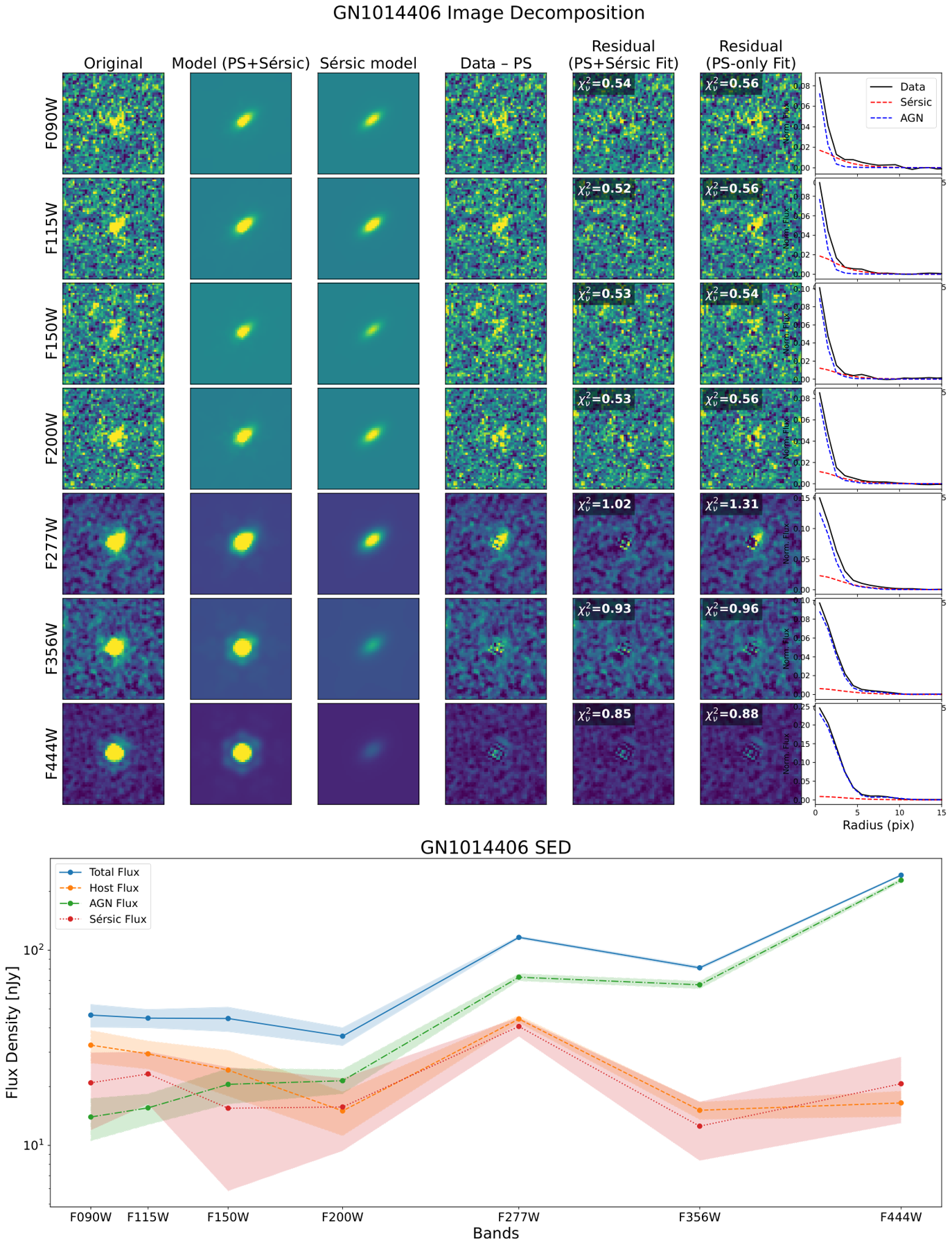
JWST/NIRCam decomposition detects extended host emission in 9 of 17 broad-Hα AGN at z≈4–6. Separating point-source light can reduce inferred host masses by 1–2 dex, yielding high BH-to-stellar mass ratios, although unresolved compact hosts remain a viable alternative.

2026-01-16 · 2601.11466v1 · Research note

Pseudo Little Red Dot: an Active Black Hole Embedded in a Dense and Dusty, Metal-Poor Starburst Galaxy at z=5.96

Karina I. Caputi, Ryan A. Cooper, Pierluigi Rinaldi, et al.

JWST spectroscopy identifies a lensed z=5.96 “pseudo-LRD” whose red optical colour is Hα-line driven, yet whose broad Hα supports a ∼3×10^6 M⊙ black hole embedded in a dusty, dense, very metal-poor starburst.

2026-01-16 · 2601.11125v1 · Research note

Discovery of a gas-enshrouded broad-line AGN at z $\sim$ 7

Qianqiao Zhou, Xin Wang, Hang Zhou, et al.

JWST/HST observations of the lensed z≈6.87 galaxy A2744-z7DLA reveal damped Lyα absorption plus a statistically preferred broad Hα component, supporting a gas-enshrouded broad-line AGN interpretation while its UV–optical continuum remains predominantly stellar.

2026-01-12 · 2601.07990v1 · Research note

Evidence of Feedback Effects in Low-luminosity Active Galactic Nuclei Revealed by JWST Spectroscopy

Lulu Zhang, Chris Packham, Erin K. S. Hicks, et al.

JWST 3–28 μm nuclear spectroscopy of four low-luminosity AGN associates weak high-ionization emission, shock-like line ratios, altered PAH populations, and non-thermal H₂ excitation with feedback, while leaving the proposed jet connection indirect.

Figure 4 from GATOS XI : Excess dust heating in the Narrow Line Regions of nearby AGN revealed with JWST/MIRI

2026-01-06 · 2601.02865v1 · Research note

GATOS XI : Excess dust heating in the Narrow Line Regions of nearby AGN revealed with JWST/MIRI

Houda Haidar, David J. Rosario, Ismael García-Bernete, et al.

JWST/MIRI imaging of eight nearby Seyferts finds resolved 100–200 pc NLR dust in four. Its warm, steep mid-IR SEDs exceed simple AGN-heating predictions; the authors therefore favor local shock heating, while treating shocks as an interpretation rather than a direct calorimetric detection.

Figure 9 from Probing AGN Feedback in Dwarf Galaxies with Spatially Resolved NIR Coronal Lines from JWST

2025-12-04 · 2512.05041v1 · Research note

Probing AGN Feedback in Dwarf Galaxies with Spatially Resolved NIR Coronal Lines from JWST

Archana Aravindan, Thomas Bohn, Gabriela Canalizo, et al.

JWST/NIRSpec IFU maps of four dwarf AGN with [O III] outflows find extended, predominantly AGN-photoionized near-IR coronal emission and compact broad components. The results link coronal-line visibility to outflows, but small-sample correlations do not establish causation.

2025-12-01 · 2512.02093v1 · Research note

COSMOS-3D: Dense Circumnuclear Gas across Black Hole Growth Phases at z ~ 3

Zi-Jian Li, Siwei Zou, Jianwei Lyu, et al.

Two z~3 X-ray AGNs with He I λ10830 absorption indicate dense, broad-line-region-scale circumnuclear gas, but their contrasting obscuration, accretion rates, and outflow signatures provide only a two-object, model-dependent case for an evolutionary sequence.