654 indexed papers · 430 research notes

Research archive

Reset
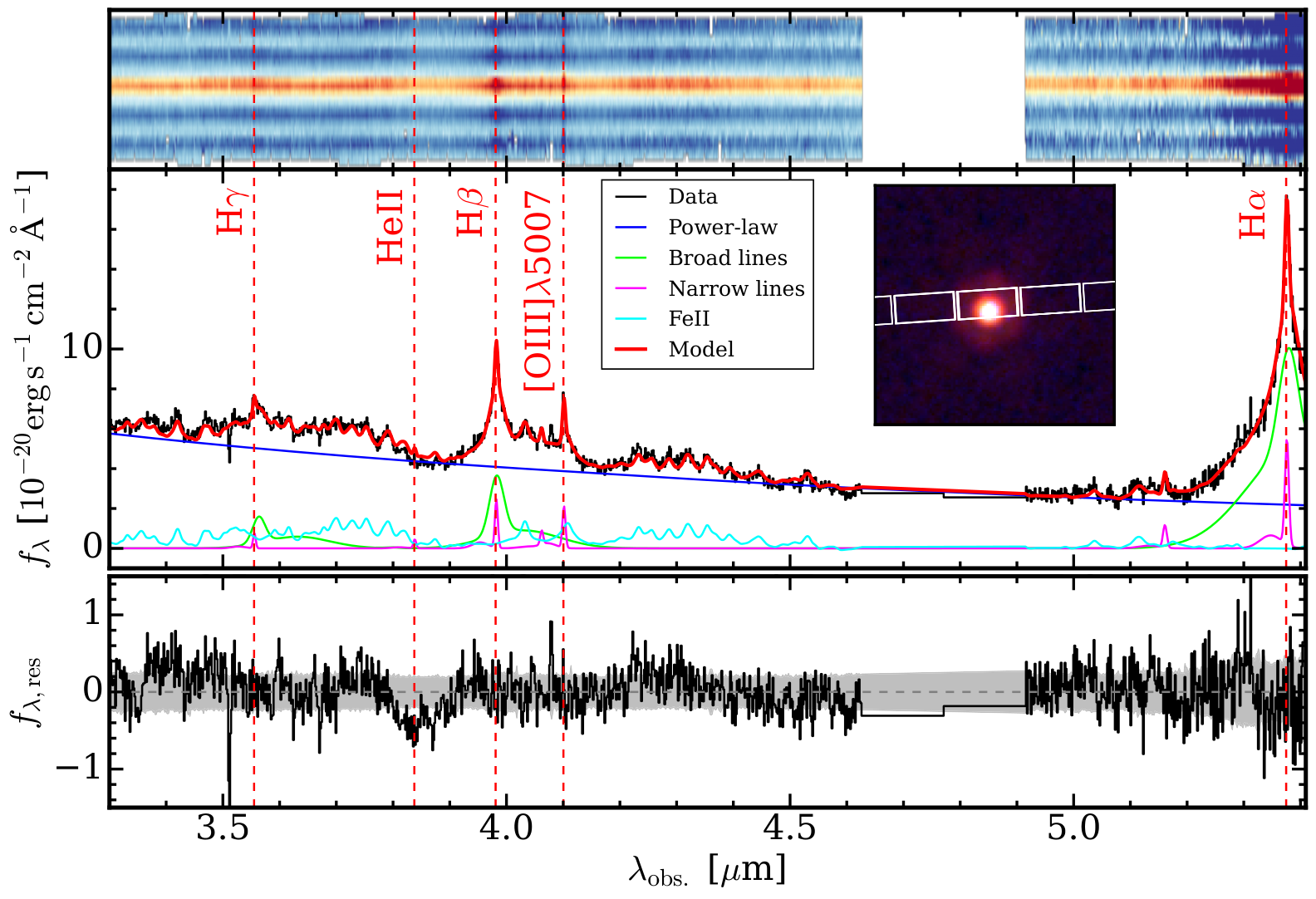
Figure 1 from A Black Hole Star at Cosmic Noon: Extreme Balmer break, photospheric continuum, and broad absorption by thick winds in a Little Red Dot at z=1.7

2026-03-30 · 2603.28335v1 · Research note

A Black Hole Star at Cosmic Noon: Extreme Balmer break, photospheric continuum, and broad absorption by thick winds in a Little Red Dot at z=1.7

Alberto Torralba, Jorryt Matthee, Andrea Weibel, et al.

PAN-BH*-1 is a single z=1.731 Little Red Dot at cosmic noon with an extreme Balmer break, compact red continuum, and broad Hα absorption. Its data are consistent with—but do not establish—a thick, rotating photospheric disk wind.

2026-03-18 · 2603.17667v1 · Research note

The Engine and its Flows: Little Red Dot spectra are shaped by the column densities of their gas envelopes

Jorryt Matthee, Alberto Torralba, Gabriele Pezzulli, et al.

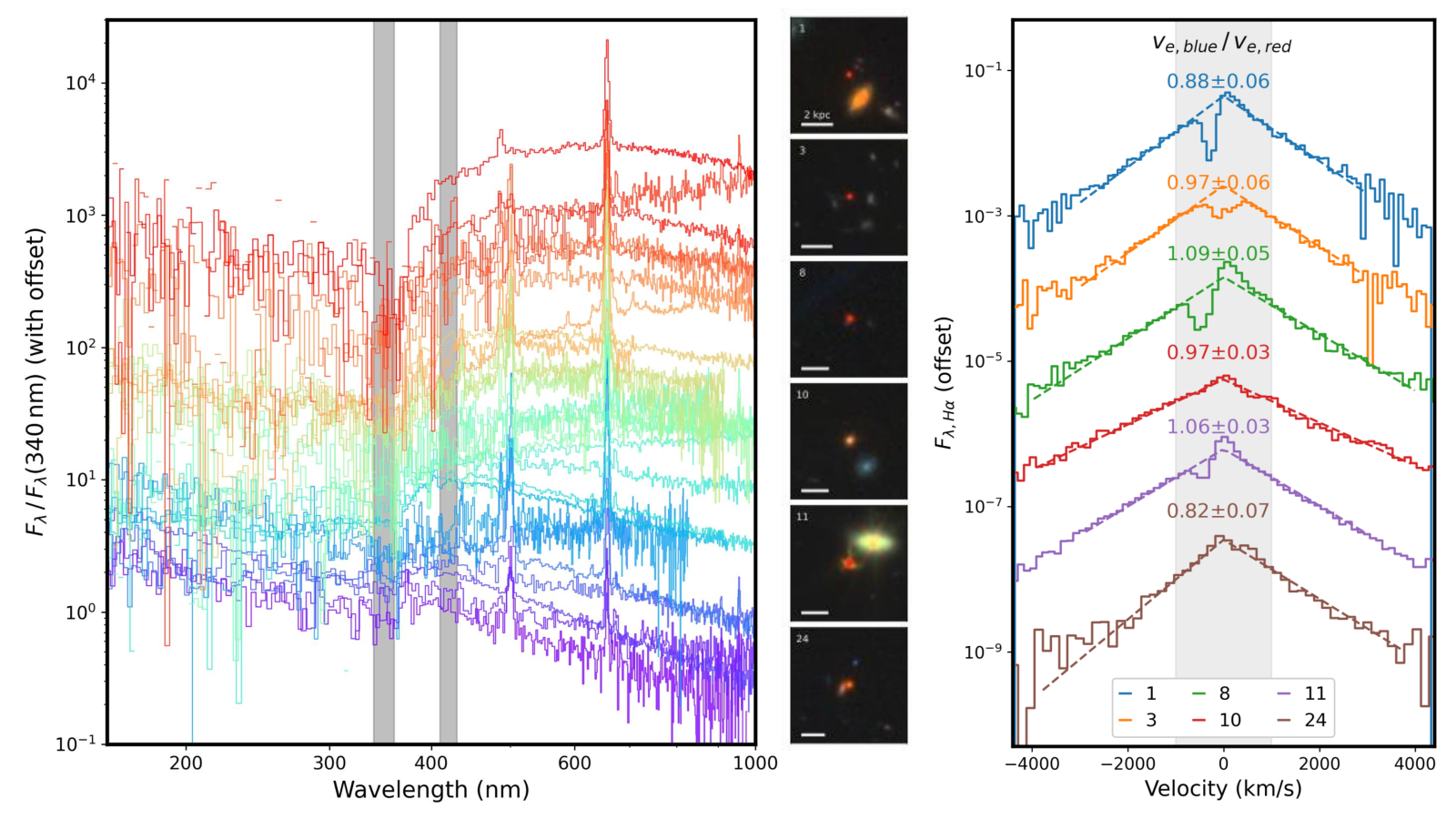
In 18 z≈3–7 broad-Hα emitters, Balmer cores progress from narrow emission to P-Cygni-like and absorption-dominated profiles as UV–optical colour reddens. The authors interpret this as changing envelope column density and optical depth, not purely dynamical line broadening.

2026-03-02 · 2603.01668v1 · Research note

A Unified Explanation for JWST Little Red Dots and High-Redshift Low-Mass Disk-like Galaxies: Prolate Galaxies Viewed End-on vs Side-on

Yingjie Peng

Peng proposes that many JWST little red dots are ordinary low-mass prolate galaxies viewed close to their long axes: projection and maximal columns could jointly produce compact red continua and broadened Balmer profiles, while side-on counterparts appear elongated.

Figure 2 from Extreme Emission Line Galaxies in CEERS Are Powered by Star Formation, not AGN

2026-02-26 · 2602.23310v1 · Research note

Extreme Emission Line Galaxies in CEERS Are Powered by Star Formation, not AGN

Kelcey Davis, Madisyn Brooks, Jonathan R. Trump, et al.

JWST/NIRSpec follow-up of CEERS extreme emission-line galaxies finds broad-line AGN contamination, but for spectroscopically extreme sources the narrow Hα component dominates. The authors therefore attribute the most extreme nebular emission primarily to young star formation, not AGN.

2026-02-25 · 2602.22386v1 · Research note

Little Red Dots as Obscured Little Blue Dots: A Super-Eddington Unification Model

Piero Madau, Roberto Maiolino

This modeling study argues that Little Red Dots are high-inclination, dust-reddened counterparts of super-Eddington Little Blue Dots. Anisotropic continua and modest BLR/dust covering factors can reproduce several LRD ensemble observables, but the proposed orientation unification remains model-dependent.

2026-02-23 · 2602.20247v1 · Research note

Little Red Dots: One Photometric Tag Concealing Diverse Spectroscopic Flavors of Massive Star Formation and Black Hole Activity

Pablo G. Pérez-González, Guillermo Barro, Stefano Carniani, et al.

A 249-object JWST spectroscopic compilation argues that photometrically selected Little Red Dots are spectroscopically heterogeneous composites of accreting black holes and young stars, but its mass, duty-cycle, and Wolf–Rayet interpretations remain model-dependent.

2026-02-13 · 2602.12548v1 · Research note

The Structure and Evolution of LRDs: Insights from JWST NIRSpec Medium and High Resolution Spectroscopy at $z\sim4$

Yuxuan Pang, Xin Wang, Cheng Cheng, et al.

Medium/high-resolution JWST/NIRSpec spectra of 11 z~4 little red dots separate broad and narrow Balmer emission, linking broad Hα to the optical continuum while [O III] tracks UV light. The authors infer rapidly accreting 10^6–10^8 M⊙ black holes and propose a clumpy envelope.

Figure 1 from Direct pathway to the Early Supermassive Black Holes: A Red Super-Eddington Quasar in a Massive Starburst Host at $z=7.2$

2026-02-12 · 2602.12325v1 · Research note

Direct pathway to the Early Supermassive Black Holes: A Red Super-Eddington Quasar in a Massive Starburst Host at $z=7.2$

Qinyue Fei, Seiji Fujimoto, Gabriel Brammer, et al.

GNz7q at z=7.1899 combines a 10^7.55-M⊙, apparently super-Eddington black hole with a massive, rapidly star-forming host. The authors argue that its near-local BH-to-stellar mass ratio makes it a plausible progenitor channel for luminous z≈6 quasars.

2026-01-29 · 2601.22214v1 · Research note

The Little Blue and Red Dots Rosetta Stones: Non-Gaussian broad lines, hot dust, and X-ray weakness

M. Brazzini, F. D'Eugenio, R. Maiolino, et al.

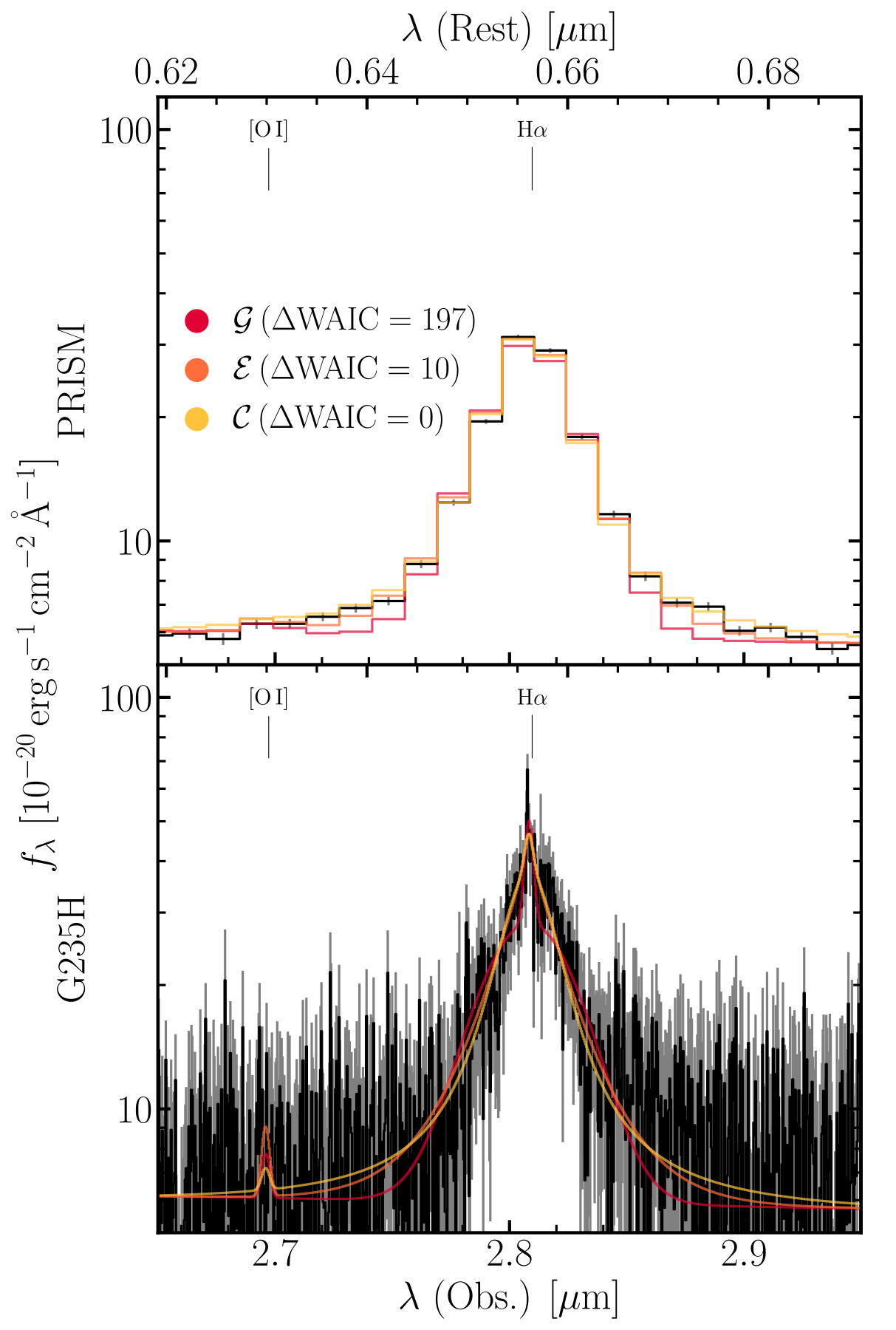
A two-object JWST comparison finds that a prototypical Little Red Dot and Little Blue Dot share broad, non-Gaussian Balmer emission, weak hot dust, and X-ray weakness, but differ sharply in helium emission and Balmer absorption.

2026-01-28 · 2601.20929v1 · Research note

Little Red Dot $-$ Host Galaxy $=$ Black Hole Star: A Gas-Enshrouded Heart at the Center of Every Little Red Dot

Wendy Q. Sun, Rohan P. Naidu, Jorryt Matthee, et al.

Using empirical [O III]-matched host subtraction for 98 JWST/NIRSpec LRDs, the authors infer a red, dense-envelope central component that dominates rest-optical light. The conclusion depends critically on assigning all [O III] to the host and on stack-based decomposition.

Figure 1 from Inside the cocoon: a comprehensive explanation of the spectra of Little Red Dots

2026-01-26 · 2601.18864v1 · Research note

Inside the cocoon: a comprehensive explanation of the spectra of Little Red Dots

A. Sneppen, D. Watson, J. H. Matthews, et al.

Self-consistent radiative-transfer modelling of z>3 LRD-like JWST spectra supports accreting ∼10^6 M⊙ black holes embedded in low-dust, dense ionized cocoons. The authors infer mixed inflow/outflow geometry and reproduce continuum breaks, absorption, and electron-scattering line wings.

2026-01-16 · 2601.11466v1 · Research note

Pseudo Little Red Dot: an Active Black Hole Embedded in a Dense and Dusty, Metal-Poor Starburst Galaxy at z=5.96

Karina I. Caputi, Ryan A. Cooper, Pierluigi Rinaldi, et al.

JWST spectroscopy identifies a lensed z=5.96 “pseudo-LRD” whose red optical colour is Hα-line driven, yet whose broad Hα supports a ∼3×10^6 M⊙ black hole embedded in a dusty, dense, very metal-poor starburst.

2026-01-16 · 2601.11125v1 · Research note

Discovery of a gas-enshrouded broad-line AGN at z $\sim$ 7

Qianqiao Zhou, Xin Wang, Hang Zhou, et al.

JWST/HST observations of the lensed z≈6.87 galaxy A2744-z7DLA reveal damped Lyα absorption plus a statistically preferred broad Hα component, supporting a gas-enshrouded broad-line AGN interpretation while its UV–optical continuum remains predominantly stellar.

2026-01-15 · 2601.10573v1 · Research note

Origins of the UV continuum and Balmer emission lines in Little Red Dots: observational validation of dense gas envelope models enshrouding the AGN

Yoshihisa Asada, Kohei Inayoshi, Qinyue Fei, et al.

Across 28 z=5–7.2 LRDs, UV-to-Hα behavior resembles young starbursts rather than unobscured AGN, while nine blue broad-line controls resemble Type 1 AGN. The authors therefore favor opaque black-hole envelopes, but the correlations do not uniquely establish the ionizing mechanism.

2026-01-13 · 2601.08212v1 · Research note

Diverse Origins of Broad H$α$ Lines in Heavily Obscured AGNs Revealed by Multi-epoch Spectroscopy

Shoichiro Mizukoshi, Takeo Minezaki, Subaru Ubukata, et al.

Five-epoch spectroscopy of three AGNs with A_V>50 mag finds broad-Hα behavior is not uniform: Mrk 268 varies at 4.3σ, consistent with direct BLR emission, whereas MCG -3-34-64 and UGC 5101 favor outflow and/or scattering contributions.

2026-01-08 · 2601.04955v1 · Research note

Rapid emergence of overmassive black holes in the early Universe

Sunmyon Chon, Shingo Hirano, Tomoaki Ishiyama, et al.

A cosmological radiation-hydrodynamic zoom simulation produces two unusually massive heavy seeds in an overdense, strongly irradiated environment; their growth and transient obscuring disks offer a proposed route to overmassive high-redshift black holes and an LRD-like phase.

Figure 1 from Little Red Dots: The Assembly of Early Supermassive Black Holes in the JWST Era

2025-12-31 · 2601.00089v1 · Research note

Little Red Dots: The Assembly of Early Supermassive Black Holes in the JWST Era

David D Vaida, Ryan Jeffrey Farber

This mini-review argues that little red dots are probably heterogeneous: broad Balmer lines and compact, V-shaped SEDs support accretion in some, whereas pervasive multiwavelength non-detections and viable stellar fits prevent a population-wide AGN identification.

2025-12-31 · 2601.00044v1 · Research note

Born in the Dark: The Catastrophic Collapse of Fuzzy Dark Matter Solitons as the Origin of Little Red Dots

Tak-Pong Woo

The authors propose that LRDs are transient, Compton-thick inflows within fuzzy-dark-matter soliton cores. Their size-and-column arguments favor boson masses of a few ×10^-22 eV, but the mechanism remains an analytic, idealized-merger scenario requiring radiation-hydrodynamic tests.

Figure 1 from From "The Cliff" to "Virgil": Mapping the Spectral Diversity of Little Red Dots with JWST/NIRSpec

2025-12-17 · 2512.15853v1 · Research note

From "The Cliff" to "Virgil": Mapping the Spectral Diversity of Little Red Dots with JWST/NIRSpec

Guillermo Barro, Pablo G. Perez-Gonzalez, Dale Kocevski, et al.

JWST/NIRSpec spectroscopy of 118 little red dots reveals a continuum–line sequence: red, curved Balmer-break SEDs give way to bluer, power-law-like systems. A galaxy plus enshrouded-black-hole model can reproduce the trend, but its physical decomposition remains non-unique.

2025-12-14 · 2512.12509v1 · Research note

THRILS -- The High-(Redshift+Ionization) Line Search: Program Description & Redshift Catalog

Taylor A. Hutchison, Rebecca L. Larson, Pablo Arrabal Haro, et al.

THRILS delivers deep JWST/NIRSpec G395M spectroscopy in two pointings, yielding 89 measured redshifts and empirical magnitude thresholds. Its >8-hour integrations expose faint lines inaccessible to shallower EGS spectroscopy, enabling targeted follow-up rather than population-level physical conclusions.

Figure 1 from A Critical Evaluation of the Physical Nature of the Little Red Dots

2025-12-02 · 2512.03130v1 · Research note

A Critical Evaluation of the Physical Nature of the Little Red Dots

Kohei Inayoshi, Luis C. Ho

This review argues that LRD broad Balmer lines, red optical continua, Balmer absorption/breaks, and weak infrared/X-ray behavior favor embedded accreting black holes over a purely stellar origin, while leaving the gas geometry and evolutionary interpretation unresolved.

2025-11-26 · 2511.21820v1 · Research note

Little Red Dots host Black Hole Stars: A unified family of gas-reddened AGN revealed by JWST/NIRSpec spectroscopy

Anna de Graaff, Raphael E. Hviding, Rohan P. Naidu, et al.

A 116-object JWST LRD sample shows narrowly peaked, thermal-like optical continua and coordinated line–continuum trends. The authors interpret these correlations as evidence for AGN embedded in dense gas envelopes, while assigning [O III] largely to faint star-forming hosts.

Figure 2 from Too Quiet for Comfort: Local Little Red Dots Lack Variability over Decades

2025-11-20 · 2511.16082v1 · Research note

Too Quiet for Comfort: Local Little Red Dots Lack Variability over Decades

Colin J. Burke, Zachary Stone, Yue Shen, et al.

Three nearby proposed Little Red Dot analogs show <3–4% optical-continuum variability over rest-frame five years; two also have broad-Hα changes below a few percent over roughly 15 years, challenging ordinary variable, photoionized broad-line interpretations.

Figure 2 from A Fleeting GLIMPSE of N/O Enrichment at Cosmic Dawn: Evidence for Wolf Rayet N Stars in a z = 6.1 Galaxy

2025-11-17 · 2511.13591v1 · Research note

A Fleeting GLIMPSE of N/O Enrichment at Cosmic Dawn: Evidence for Wolf Rayet N Stars in a z = 6.1 Galaxy

Danielle A. Berg, Rohan P. Naidu, John Chisholm, et al.

Deep JWST/NIRSpec spectroscopy of the compact, lensed z=6.1025 galaxy RXCJ2248-ID3 finds high N/O, low metallicity, and WN-like Wolf–Rayet signatures. The authors interpret these jointly as short-lived, WN-dominated nitrogen enrichment after a recent burst.

Figure 1 from Probing the Physical Origin of the Balmer Decrement in the Broad-line Region of Nearby Active Galactic Nuclei via Spectral Variability

2025-11-11 · 2511.07714v1 · Research note

Probing the Physical Origin of the Balmer Decrement in the Broad-line Region of Nearby Active Galactic Nuclei via Spectral Variability

Suyeon Son, Minjin Kim, Luis C. Ho, et al.

Multi-epoch SDSS spectroscopy of 1,116 nearby type-1 AGNs finds broad-line Hα/Hβ decreases as individual AGNs brighten. The authors argue continuum-driven BLR radiative-transfer and excitation changes, rather than variable intrinsic dust reddening, predominantly drive this variability.

2025-11-10 · 2511.07515v1 · Research note

The Deepest GLIMPSE of a Dense Gas Cocoon Enshrouding a Little Red Dot

Vasily Kokorev, John Chisholm, Rohan P. Naidu, et al.

Deep JWST spectroscopy of the lensed z=3.501 LRD GLIMPSE-17775 finds broad exponential line wings, Balmer absorption/break, and fluorescence-rich Fe II/O I emission consistent with a dense, partially ionized AGN cocoon; the super-Eddington inference remains model-dependent.

Figure 2 from A JWST/NIRSpec Integral Field Unit Survey of Luminous Quasars at z ~ 5-6 (Q-IFU): Rest-frame Optical Nuclear Properties and Extended Nebulae

2025-11-08 · 2511.06085v1 · Research note

A JWST/NIRSpec Integral Field Unit Survey of Luminous Quasars at z ~ 5-6 (Q-IFU): Rest-frame Optical Nuclear Properties and Extended Nebulae

Weizhe Liu, Xiaohui Fan, Huan Li, et al.

JWST/NIRSpec IFU observations of 27 luminous z≈5–6 quasars find ≈10^9 M⊙ actively accreting black holes and extended [O III] in six systems; nuclear optical properties broadly resemble lower-redshift quasars, while shallow data limit environmental inferences.

2025-10-12 · 2510.10772v1 · Research note

Black Holes in the Shadow: The Missing High-Ionization Lines in the Earliest JWST AGNs

Greta Zucchi, Xihan Ji, Piero Madau, et al.

Stacked JADES Type 1 AGN spectra at z>5 show strong Balmer emission but weak or absent high-ionization lines. Cloudy comparisons disfavour much of the tested sub-Eddington parameter space, motivating—but not uniquely establishing—soft, filtered, or anisotropic ionizing continua.

Figure 2 from Evidence of violation of Case B recombination in Little Red Dots

2025-10-07 · 2510.06362v1 · Research note

Evidence of violation of Case B recombination in Little Red Dots

G. P. Nikopoulos, D. Watson, A. Sneppen, et al.

JWST/NIRSpec Balmer decompositions in seven Little Red Dots generally support Case B recombination plus strong broad-line extinction, but RUBIES EGS-49140 is inconsistent at >5σ, plausibly indicating optically thick, very dense gas rather than an ordinary dust law.

Figure 7 from The warm outer layer of a Little Red Dot as the source of [Fe II] and collisional Balmer lines with scattering wings

2025-09-30 · 2510.00103v1 · Research note

The warm outer layer of a Little Red Dot as the source of [Fe II] and collisional Balmer lines with scattering wings

Alberto Torralba, Jorryt Matthee, Gabriele Pezzulli, et al.

Deep JWST spectra of the single z=5.535 LRD GN-9771 reveal optical [Fe II] and unusual Balmer profiles consistent with a dense, ∼7000 K radiative-transfer layer; if scattering dominates the wings, standard virial black-hole masses may be biased high.

Figure 4 from Irony at z=6.68: a bright AGN with forbidden Fe emission and multi-component Balmer absorption

2025-09-30 · 2510.00101v1 · Research note

Irony at z=6.68: a bright AGN with forbidden Fe emission and multi-component Balmer absorption

Francesco D'Eugenio, Erica Nelson, Xihan Ji, et al.

Deep JWST/NIRSpec spectroscopy of the z=6.68 Little Red Dot Irony supports an AGN viewed through dense, stratified, multi-component gas: Balmer absorption covers both continuum and broad-line emission, while black-hole inferences remain profile-dependent.

2025-09-11 · 2509.09607v1

Discovery of Multiply Ionized Iron Emission Powered by an Active Galactic Nucleus in a z~7 Little Red Dot

Erini Lambrides, Rebecca Larson, Taylor Hutchison, et al.

THRILS spectroscopy of the z~7 Little Red Dot THRILS_46403 (CEERS-10444/RUBIES_49140) reveals bona fide AGN tracers: multiple Fe lines including a 4.5σ [Fe VII] and several [Fe II], plus an auroral [N II] detection at 3.1σ. Three Balmer lines show broad emission with superposed narrow absorption whose small widths and depths imply a partially covering absorber at or beyond the broad-line region. Electron-temperature diagnostics indicate O++ is markedly hotter than N+ across densities, pointing to a powerful, hard central ionizing source. Together these features establish multiply ionized iron emission from an accreting SMBH within the first 800 Myr and suggest direct sight-lines from the disk to gas at or beyond the BLR.

2025-09-09 · 2509.07611v1

Balmer Absorption in Iron Low-Ionization Broad Absorption Line Quasars

Karen M. Leighly, Sarah C. Gallagher, Hyunseop Choi, et al.

Analyzes Balmer absorption in 14 FeLoBAL quasars (8 new), measuring velocities, widths, and apparent optical depths, and correcting for partial covering to infer true H(n=2) columns. Finds only a weak Eddington ratio–outflow speed trend because most objects are low‑speed “loitering” outflows; dN/dv peaks at low velocities and anticorrelates with luminosity and Eddington ratio. Reports a correlation between Balmer-line width and the optical–IR slope αoi, tying absorber kinematics to SED/accretion state. Notes parallels with Little Red Dots—V‑shaped continua, steep reddening with a scattered blue component, weak hot dust, and X‑ray weakness—hinting at shared conditions that elevate the n=2 population.

2025-09-05 · 2509.05423v1

Another view into JWST-discovered X-ray weak AGNs via radiative dusty feedback

W. Ishibashi, A. C. Fabian, R. Maiolino, et al.

The authors revisit the X-ray weakness of JWST-selected AGN by mapping dusty gas dynamics onto the N_H–λ plane using the effective Eddington limit for dust. Varying metallicity, grain size, and composition shifts the critical boundary: low-Z, dust-poor gas resists radiation pressure, enabling long-lived nuclear absorption and heavy X-ray obscuration consistent with early JWST-AGN and LRDs. The blowout vs. stalling analysis shows that higher metallicity is needed to expel larger columns, whereas substantial columns stall at low Z, making metallicity a key regulator of obscuration. The framework also naturally links Balmer absorption features and weak radio emission to the same radiative dusty feedback physics.

2025-08-27 · 2508.20177v1

MEGA: Spectrophotometric SED Fitting of Little Red Dots Detected in JWST MIRI

Kaila Ronayne, Casey Papovich, Allison Kirkpatrick, et al.

MEGA fits JWST/NIRCam+NIRSpec+MIRI SEDs for eight spectroscopically confirmed Little Red Dots at z=5.1–8.7 using CIGALE and Prospector across star-forming, AGN-dominated, and composite scenarios. By BIC, six of eight prefer AGN-dominated solutions, consistent with red F150W–F444W > 1 but flat F444W–F770W and −1.0 < F1000W–F1500W < 1.1 colors that imply weak hot dust. Two Balmer-break LRDs with broad Hα are matched by hot, dense-gas (log T=5–5.7; log n=9–11) plus an added 800–1400 K thermal component, with total Lbol/L_sun < 10^12 and consistency with far-IR/radio limits. However, no single template reproduces all observables—the dense-gas fits miss the rest-UV and narrow [O III]—arguing for non-standard gas conditions and mixed AGN–star-formation.

2025-08-27 · 2508.19618v1

The BlueDOG at Cosmic Noon: A Possible Analog to Little Red Dots?

Seongjae Kim, Woong-Seob Jeong, Minjin Kim, et al.

Spectro-photometry of the hyperluminous BlueDOG ADFS-KMTDOG-102 (z=2.604) in ADF-S shows an extremely massive, heavily obscured system (log M*=12.3) with SED shape akin to JWST little red dots. Gemini-S GMOS+FLAMINGOS-2 spectra indicate AGN-dominated UV line ratios, a double-peaked, ~2″-extended Lyα, and an extinction-corrected broad Hα giving an enormous black hole (log MBH=10.2). The source thus links DOG-like hyperluminous systems to LRD-like SEDs at cosmic noon, suggesting rapid black-hole growth in a mature stellar host. The blue-excess UV continuum remains unresolved—consistent with either recent star formation or AGN-scattered light, with the Lyα escape fraction sitting near LAE relations.

2025-08-12 · 2508.08768v1

Impact of Resonance, Raman, and Thomson Scattering on Hydrogen Line Formation in Little Red Dots

Seok-Jun Chang, Max Gronke, Jorryt Matthee, et al.

The authors run 3D Monte Carlo radiative transfer to test how resonance, Raman, and Thomson scattering sculpt Balmer lines in Little Red Dots. Resonance scattering in an n=2–populated H I medium drives strong departures from Case B and distinct Hα vs Hβ shapes, but Hβ is funneled into Paα, preventing broad Hβ wings. Raman scattering of higher Lyman-series emission can explain Hα/Hβ wing-width ratios ≳1.28, whereas Ramanization of a UV continuum is disfavored by the near-constant FWHM across transitions. Thomson scattering with Te≈10^4 K and electron column ≈10^24 cm−2 reproduces the ≳1000 km s−1 wings and implies virial BH masses can be overestimated by ≳10 if widths are taken at face value.

2025-08-04 · 2508.02792v1

Luminous Mid-IR Selected Obscured Quasars at Cosmic Noon in SDSS Stripe82 II: Spectroscopic Diversity and Broad H$α$ Emissions

Ben Wang, Yuzo Ishikawa, Joseph F. Hennawi, et al.

Survey of 24 WISE W4–bright, optically faint/red SDSS Stripe 82 candidates confirms 23 luminous Type‑2 quasars at z = 0.88–3.49 using Gemini/GNIRS plus Keck/LRIS and KCWI spectra. About one‑third (8/23) unexpectedly show broad Hα (FWHM > 2000 km/s) while sharing SEDs with JWST “little red dots,” marking them as lower‑z analogues of heavily obscured broad‑line AGN. The sample also exhibits relatively weak [O III] λ5007 given their high bolometric luminosities, and the authors construct a new Type‑2 QSO composite spectrum. Results demonstrate that simple mid‑IR plus extreme r−W4 color selection efficiently recovers a spectroscopically diverse obscured quasar population at cosmic noon, informing SMBH growth demographics that connect to the LRD population.

2025-07-31 · 2507.23774v1

Lord of LRDs: Insights into a "Little Red Dot" with a low-ionization spectrum at z = 0.1

Xihan Ji, Francesco D'Eugenio, Ignas Juodžbalis, et al.

A nearby LRD analog is uncovered: the broad-line AGN SDSS J102530.29+140207.3 at z=0.1 shows the hallmark V-shaped SED, broad Balmer emission (FWHM 1000–2000 km/s), and deep Balmer absorption. New GTC optical spectra reveal a G–K-giant-like continuum with a clear CH G-band and unusually deep low-ionization absorption, plus a series of [Fe II] emission lines; similar [Fe II] features are identified in a JWST-selected LRD at z=2.26. Multi-epoch data show small but significant Hα variability, and NuSTAR confirms extreme X-ray weakness consistent with Compton-thick obscuration (NH>10^24 cm^-2). Together these point to a dense, complex nuclear environment that reproduces LRD hallmarks locally and informs early black-hole growth, though the strength of the ionic/atomic/molecular absorptions remains challenging for standard stellar/AGN models.

2025-07-29 · 2507.22014v1

Little Red Dots as self-gravitating discs accreting on supermassive stars: Spectral appearance and formation pathway of the progenitors to direct collapse black holes

Lorenz Zwick, Christopher Tiede, Lucio Mayer

Models little red dots as supermassive stars fed by massive self‑gravitating discs assembled in gas‑rich major mergers, reproducing the V‑shaped SED as two blackbodies and attributing Balmer broadening to disc rotation—without invoking extra AGN, stellar, or dust components. MCMC fits to two representative LRDs (J0647‑1045 and COS‑756434) yield sub‑Eddington disc accretion and SMS masses of a few ×10^6 Msun with physically motivated parameters. The framework predicts a luminosity cut‑off of order few ×10^44 erg/s and ties the observed redshift distribution of LRDs to merger rates, matching current trends. Acknowledged caveat: reproducing the absolute abundance of LRDs remains challenging, though the fits are robust to observed diversity.

2025-07-28 · 2507.20684v1

A deep dive down the broad-line region: permitted OI, CaII and FeII emission in an AGN Little Red Dot at z=5.3

Roberta Tripodi, Maruša Bradač, Francesco D'Eugenio, et al.

JWST/NIRCam imaging and NIRSpec prism spectroscopy of the Bullet‑cluster LRD Bz5.3 (zspec=5.2907) reveal broad Balmer emission plus strong low‑ionization Fe II, O I, and Ca II triplet lines, confirming a bona fide BLR around an accreting SMBH. The work reports the first high‑z detection of the O I λ1304 bump (O I+Si II), alongside prominent O I λ8446 and Ca II λλ8498,8542,8662. A markedly low O I λ1304/λ8446 photon ratio (0.1–0.3) implies internal dust with AV≈0.4–1.0 and points to Lyβ fluorescence as the dominant excitation, consistent with high EW O I λ8446 and weak O I λ7774. Photoionization modeling of O I and Ca II favors multiple BLR gas phases with distinct densities/ionization states, supporting a stratified BLR at early times.

2025-07-16 · 2507.12618v1

Supermassive Stars Match the Spectral Signatures of JWST's Little Red Dots

Devesh Nandal, Abraham Loeb

First-principles synthetic spectra for non-rotating, metal-free supermassive stars (up to 10^6 M⊙) are used to test whether LRDs are direct photospheres of SMSs. The model’s luminosity at 4050 Å (Lλ ≈ 1.7×10^44 erg s^-1 μm^-1) and NLTE physics reproduce hallmark LRD traits—a V-shaped Balmer break and strong Hβ emission with other Balmer lines in absorption—with wind/macroturbulent broadening matching observed profiles. Quantitative fits to sources at z=7.76 and z=3.55 include an Hβ width match for MoM‑BH*-1 to within 4%, offering a self-consistent alternative to multi-component obscured AGN. A luminosity-dependent visibility window of ~10^4 yr for the brightest systems and 10^5–10^6 yr for objects 1–2 dex fainter implies LRDs may capture brief, pre-collapse stages of SMBH progenitors.

2025-07-14 · 2507.10659v1

The Discovery of Little Red Dots in the Local Universe: Signatures of Cool Gas Envelopes

Xiaojing Lin, Xiaohui Fan, Zheng Cai, et al.

Reports three SDSS-selected local little red dots at z=0.1–0.2 with LBT/MODS and Magellan/FIRE follow-up, showing the same hallmarks as high‑z LRDs: compact morphologies, V‑shaped UV–optical SEDs with declining NIR continua, broad H/He lines, full Balmer+Paschen series, and minimal variability. All display blue‑shifted He I absorption; two show Hα and Na D absorption, and two have abundant narrow [Fe II]; J1025+1402 (The Egg) further exhibits extreme Na D, K I, and Ca II triplet absorption consistent with a cool (~5000 K), metal‑enriched envelope. Line diagnostics point to AGN‑powered, metal‑poor narrow lines with little dust, very high‑density inner regions for the broad lines (or unusual dust), and [Fe II] from dense gas between them; two targets are X‑ray non‑detections and WISE photometry implies only weak dust (T ~10^2–10^3 K). The authors propose a largely thermalized cool‑gas envelope plus an extended, high‑density outflow to unify these features, positioning local LRDs as resolvable analogs of early BH growth.

2025-07-12 · 2507.09085v1

Little Red Dots As Late-stage Quasi-stars

Mitchell C. Begelman, Jason Dexter

Begelman and Dexter propose that JWST “Little Red Dots” are late-stage quasi-stars: black holes embedded in massive envelopes accreting at super‑Eddington rates once the BH exceeds ~10% of the total mass. In this regime the models predict mass‑insensitive global properties, yielding reddish continua with a pronounced Balmer break and Balmer lines broadened primarily by electron scattering rather than Doppler motions. The enormous electron columns naturally quench X‑rays, while BHs grow roughly linearly in time; late-stage objects with MBH ≳10^6 Msun should dominate the quasi-star population. Given lifetimes of only tens of Myr yet high observed LRD number densities, the authors argue most SMBHs likely pass through this quasi‑star/LRD phase.

2025-07-11 · 2507.08929v1

Ruling out dominant electron scattering in Little Red Dots' Rosetta Stone using multiple hydrogen lines

Matilde Brazzini, Francesco D'Eugenio, Roberto Maiolino, et al.

Targets the LRD “Rosetta Stone” GN-28074 (z=2.26) and tests whether broad Balmer/Paβ wings are dominated by wavelength-independent electron scattering. Using JWST/NIRSpec MSA medium-resolution data (∼1.7 hr), the authors compare Hα, Hβ, and Paβ profiles in velocity space and find mismatched wing shapes, contrary to the electron-scattering prediction of identical profiles. Joint fits with Gaussian BLR components plus exponential scattering wings cannot simultaneously match all three lines with physically plausible parameters. Result: dominant electron scattering around the BLR is ruled out for GN-28074, arguing against a universal systematic BH-mass overestimation in LRDs.

2025-07-09 · 2507.07190v1

The Balmer Break and Optical Continuum of Little Red Dots from Super-Eddington Accretion

Hanpu Liu, Yan-Fei Jiang, Eliot Quataert, et al.

Semi-analytic atmospheres plus radiative-transfer show that super-Eddington flows can reproduce LRDs’ red rest-optical continua and Balmer breaks without dust or an external absorbing shell. A cool, low-density photosphere (ρ < 10^{-9} g cm^{-3}) creates a strong opacity jump at the Balmer limit, yielding a break even at T_eff ≈ 5000 K. Thin disks match the color only with a fine-tuned inner truncation giving T_eff ~ 5000 K, whereas a geometrically thick, quasi-spherical flow naturally produces T_eff ≈ 4000–6000 K largely insensitive to Ṁ (Hayashi-line-like). The resulting continua agree with current LRD spectra and motivate predictions for future super-Eddington simulations.

2025-07-02 · 2507.01355v1

The birth of young radio jets in changing-look AGN: a population study

Sufia Birmingham, Charlotte Ward, Kristina Nyland, et al.

A population study of 474 spectroscopically confirmed changing-look AGN tracks their radio behavior with ASKAP VAST and VLASS to test whether optical state changes spawn newborn radio jets. Across 20 VAST-detected CLAGN, the authors see no Mrk 590– or 1ES 1927+654–like radio fading within ~10 years of the changing-look epoch, and for six low‑z, high‑mass objects they rule out a Mrk 590–like flare. Population-wide, CLAGN show higher VAST/VLASS detection and 1 GHz variability rates but lower radio‑loud fractions than a control AGN sample, and VLA SEDs plus Magellan spectra do not support a link to VLASS sources that transitioned from radio‑quiet to radio‑loud. The results imply enhanced accretion episodes often stir compact radio activity but rarely mirror the decadal jet turn‑on channel seen in RL-transition systems, constraining when and how young radio jets are born.

2025-06-17 · 2506.14870v1

JADES and BlackTHUNDER: rest-frame Balmer-line absorption and the local environment in a Little Red Dot at z = 5

Francesco D'Eugenio, Ignas Juodžbalis, Xihan Ji, et al.

Reports a broad-line Little Red Dot at z=5.077 (JADES-GS+033223.41-275404.5/159717) with NIRSpec MSA+IFU, revealing multi-component Hα including two broad Gaussians. A virial black hole mass of log(MBH/M⊙)=7.65 and a narrow [O III] λ5007-based dynamical mass of log(Mdyn/M⊙)=9.1 imply a BH overmassive relative to its host. The source sits in a 7-kpc pool of ionized gas with three neighbors (a satellite, a possible satellite/gas cloud, and a tentatively detected spatially detached outflow). A deep rest-frame Hα absorber (deeper than the continuum; v=-13 km s−1, σ=120 km s−1) appears in G395H but not G395M, with tentative EW variability over two rest-frame months (2.6σ), underscoring resolution- and time-dependent incidence of absorbers in LRDs.

2025-06-05 · 2506.05459v1

RUBIES: A Spectroscopic Census of Little Red Dots; All V-Shaped Point Sources Have Broad Lines

Raphael E. Hviding, Anna de Graaff, Tim B. Miller, et al.

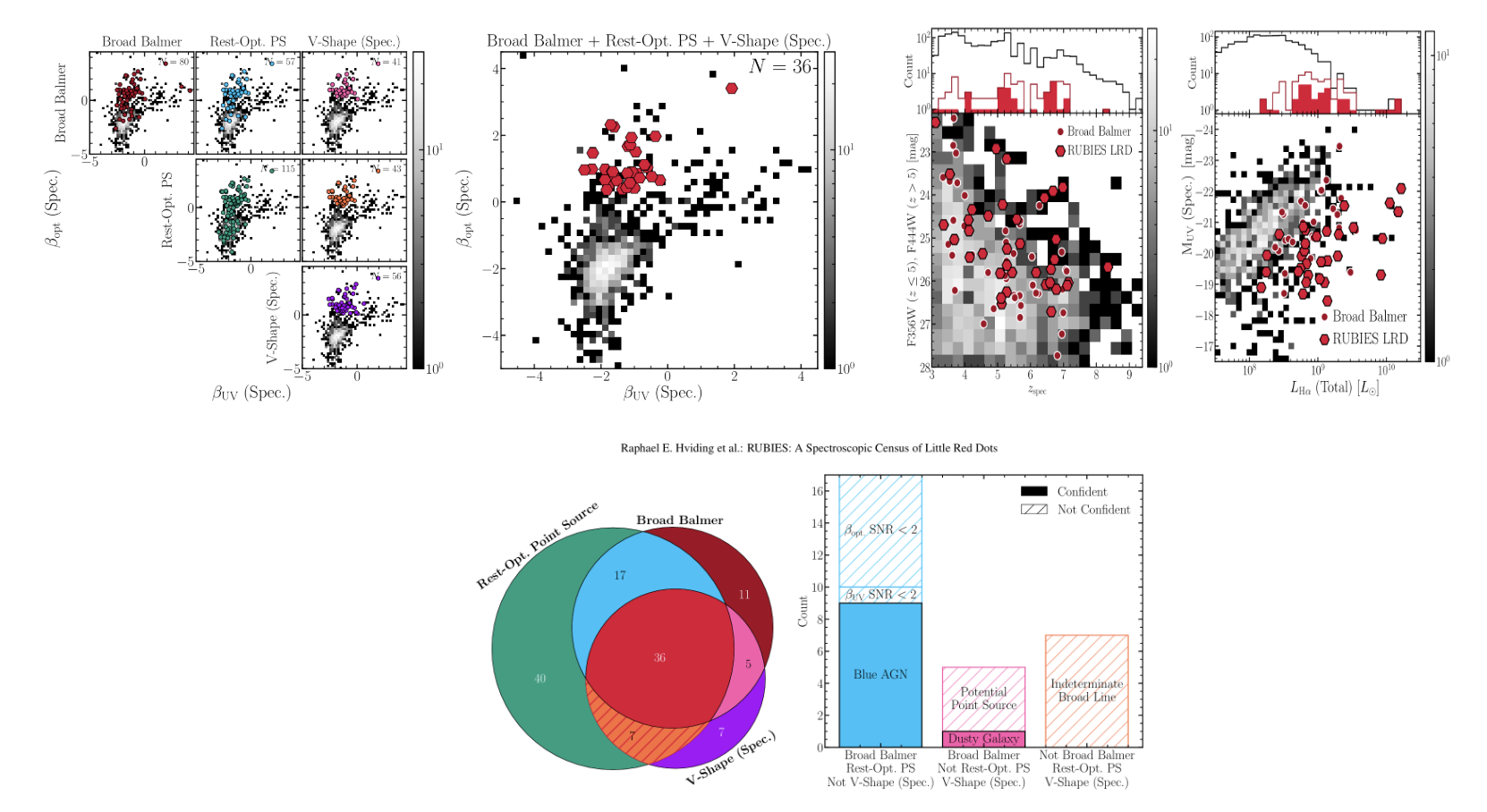
RUBIES delivers uniform NIRSpec PRISM+G395M spectroscopy for ~1500 z>3.1 sources, identifying 80 broad-Balmer emitters, including 28 (35%) at z>6. A coherent subpopulation of 36 shows v-shaped UV–to–optical continua with dominant rest‑optical point sources; these are defined as spectroscopic LRDs, the largest such sample to date. The key result is that every v‑shaped point source exhibits broad Balmer lines, tying continuum shape, compact morphology, and AGN kinematics together. Photometric LRD searches recover only 50–62% of these to F444W<26.5, implying current color cuts miss many due to faint rest‑UV, comparatively bluer rest‑optical colors, or uncertain photo‑z.

2025-05-28 · 2505.22567v1

A black hole in a near-pristine galaxy 700 million years after the Big Bang

Roberto Maiolino, Hannah Uebler, Francesco D'Eugenio, et al.

JWST/NIRSpec-IFS dissects the triply imaged Little Red Dot Abell2744-QSO1 at z=7.04, isolating the narrow Hβ to map line ratios. [OIII]5007 is exceptionally weak—[OIII]/Hβn ≈ 0.6 within r<150 pc and <0.32 at 150–300 pc—implying Z ≈ 8×10^-3 Z⊙ centrally and Z<6×10^-3 Z⊙ in the extended gas, while broad Balmer lines/variability yield MBH ≈1.5×10^7 M⊙ in a host with Mdyn ≈10^7.1–10^8 M⊙. This places a massive black hole in an almost pristine, very low-mass galaxy only ~700 Myr post-Big Bang. The chemistry and mass budget strain heavy-seed or super‑Eddington growth paths, motivating alternatives such as primordial black-hole seeds that remain to be fully tested.

2025-05-26 · 2505.20393v1

NEXUS: A Spectroscopic Census of Broad-line AGNs and Little Red Dots at $3\lesssim z\lesssim 6$

Ming-Yang Zhuang, Junyao Li, Yue Shen, et al.

Using NIRCam/WFSS F322W2+F444W in the central 100 arcmin² of NEXUS, the team secures a spectroscopic census of 23 BLAGNs at 3≲z≲6, 15 of which satisfy Little Red Dot criteria. The sample spans L(Hα)≈10^{42.2}–10^{43.7} erg s⁻¹, M_BH≈10^{6.3}–10^{8.4} M_⊙, and λ_Edd≈0.1–1 (median 0.4); about half of the LRDs show strong Balmer absorption indicating dense gas near the emission region. Most LRDs reveal extended (hundreds of parsec) rest-UV/optical host emission that significantly or dominantly contributes to the UV, explaining the characteristic UV upturn, and the LRD number density is ≈10⁻⁵ cMpc⁻³ with a mild decline toward lower z. Small-scale (≲1 cMpc) cross-correlations give a BLAGN bias of ~3.3 and halo masses of a few×10¹¹ h⁻¹ M_⊙, while LRD clustering appears overly strong for their space density, hinting at excess small-scale clustering; the single-epoch M_BH and λ_Edd carry large systematics.

2025-05-14 · 2505.09542v1

A weak Ly$α$ halo for an extremely bright Little Red Dot: Indications of enshrouded SMBH growth

Alberto Torralba, Jorryt Matthee, Gabriele Pezzulli, et al.

Deep VLT/MUSE mapping around the ultra-luminous LRD A2744-45924 (z=4.464, μ=1.8; L_Hα≈10^44 erg s^-1) reveals a modest, spatially offset Lyα halo with exponential scale length ≈5.7 pkpc and a narrow line (FWHM 270±15 km s^-1) whose flux is only 7% of Hα. Compact N IV] λ1486 coincides with the point-like Hα seen by JWST, while the far-UV continuum centroid shifts with the Lyα offset. The authors argue Hα traces the AGN whereas Lyα is powered by star formation; four neighboring Lyα halos (Δz<0.02, Δr<100 pkpc) show no luminosity excess indicative of AGN illumination. Altogether this points to a dense, near-unity covering-factor cocoon that shrouds the SMBH, suppressing UV/ionizing escape and signaling enshrouded early black-hole growth.

2025-05-13 · 2505.08885v1

XMM-Newton Conclusively Identifies an Active Galactic Nucleus in a Green Pea Galaxy

Peter G. Boorman, Jiří Svoboda, Daniel Stern, et al.

Deep XMM-Newton monitoring of the Green Pea SDSS J082247.66+224144.0 (z=0.216) tests for an elusive low-luminosity AGN long hinted by its Γ≈2, L2–10 keV≈10^42 erg s^-1 spectrum. Across 6.2 years (rest-frame), the hard 2–10 keV luminosity remains stable while the soft 0.5–2 keV flux drops by ~60%, yielding a markedly harder second epoch. Swapped-epoch spectral posterior checks and SDSS line decomposition (requiring a broad Hα despite BPT star-forming narrow lines) point to transient, low-column obscuration as the only viable explanation. This work delivers the first conclusive X-ray AGN identification in a Green Pea, strengthening the case that faint AGN could have contributed to reionisation and clarifying local analogs of JWST Little Red Dots.

2025-05-09 · 2505.06359v1

JWST/NIRSpec Observations of High Ionization Emission Lines in Galaxies at High Redshift

Mengtao Tang, Daniel P. Stark, Adèle Plat, et al.

Deep NIRSpec R=2700 spectroscopy of 53 new z>4 galaxies, plus a census of 851 archival spectra, is used to track high-ionization UV lines. The team reports narrow NV λ1240 in two systems—CEERS‑7902 (z=6.98; an LRD with broad Hβ) and CEERS‑1025 (z=8.72; narrow-line)—while CIV and He II are absent, yielding extreme NV/CIV and NV/He II. The inferred incidence of narrow high-ionization UV lines is 12.5(+23.7/−10.4)% in LRDs and 2.2(+1.7/−1.0)% in UV-selected galaxies at z>4, implying hard radiation fields in a small subset and that dense H I may not fully cover some LRD nuclei. The line ratios and non-detections argue for extending searches down to the NV doublet, though statistics remain limited by the number of deep rest-UV spectra.